






"Sub-Saharan Africa" region includes following countries:
 Cabo Verde
 Benin
Benin Gambia
 Ghana
Ghana Guinea
 Côte d'Ivoire
 Liberia
 Mali
Mali Mauritania
 Niger
Niger Nigeria
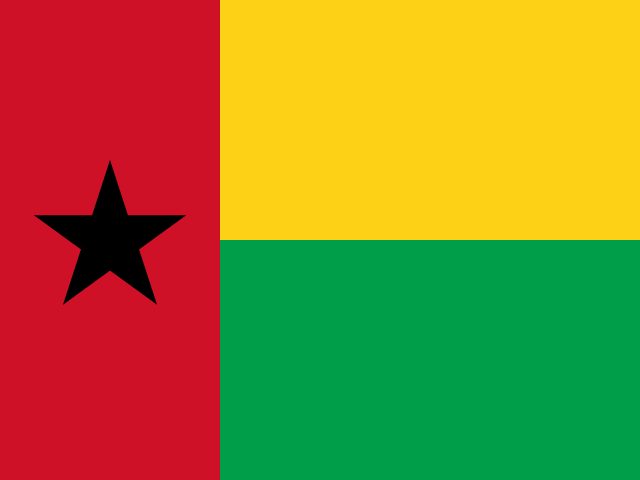 Guinea-Bissau
 Saint Helena, Ascension and Tristan da Cunha
 Senegal
 Sierra Leone
 Togo
Togo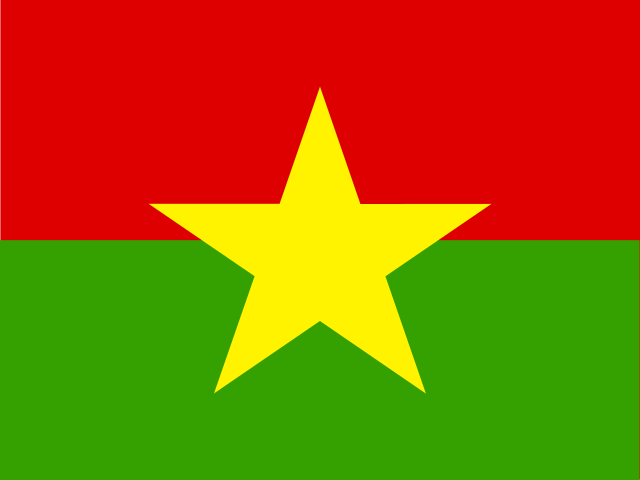 Burkina Faso
 British Indian Ocean Territory
 Burundi
 Comoros
 Mayotte
 Ethiopia
 Eritrea
 French Southern Territories
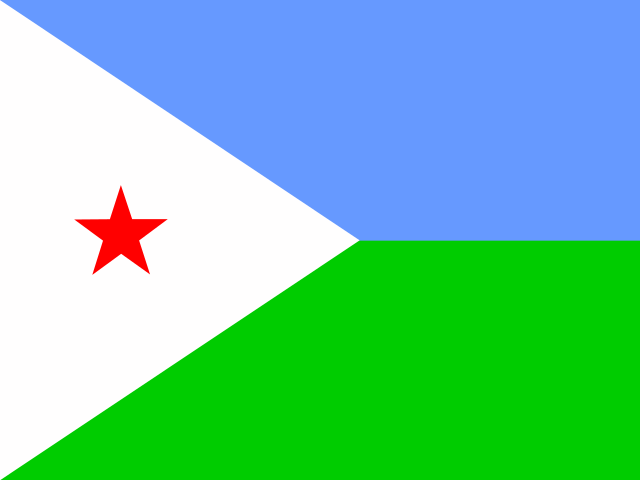 Djibouti
 Kenya
Kenya Madagascar
 Malawi
 Mauritius
 Mozambique
 Reunion
 Rwanda
 Seychelles
 Somalia
 Zimbabwe
 South Sudan
 Uganda
 Tanzania
 Zambia
 Angola
 Cameroon
 Central African Republic
 Chad
Chad Congo
Congo Democratic Republic of the Congo
 Equatorial Guinea
 Gabon
Gabon Sao Tome and Principe
 Botswana
 Lesotho
 Namibia
 South Africa
 Eswatini
Earlier Report Observations
The dried shelled legumes market in Sub-Saharan Africa experienced fluctuating production volumes from 2018 to 2020, influenced by evolving agricultural practices. In 2019, persistent constraints from soil degradation and limited access to imported inputs contributed to a production decline to 39.7 thousand tons. The market recovered in 2020, reaching 43.1 thousand tons, supported by stronger initiatives for valuing legumes in informal seed systems and increased emphasis on research and development investments to enhance local production sustainability.
From 2021, the market's value demonstrated consistent growth, reaching $32.2 million by 2023, while physical volumes showed stabilization. This divergence was driven by a focused shift towards local processing to add value, evidenced by the development of fruit and vegetable supply chains and new commercial opportunities for diversified processed products. Policy measures supporting agricultural SMEs in production and marketing, along with the structuring of value chains, further propelled the market. Investments in port and logistics infrastructure, particularly in Senegal, facilitated exports and adaptation to international requirements, contributing to higher market value even as export volumes rose.
Factors in 2024 continue to emphasize infrastructure and value addition, with projects like the dry port construction in Senegal aimed at easing external trade and logistics. Growing demand for higher-value locally processed dried products, coupled with reinforced skills in West African agri-industry and the promotion of agroecological market gardening with specific labels, underpin the ongoing trajectory towards a more value-oriented and export-friendly market structure.
Table of content
- 1. Disclaimer
- 2. Terms of use of the report
- 3. Product codes in the statistical classifications used in the report
-
4. Key Market Indicators and Trends
-
4.1. Key Market Indicators
-
4.1.1. In kind
- 4.1.1.1. Production, 2018-2023
- 4.1.1.2. Imports, 2018-2024
- 4.1.1.3. Exports, 2018-2024
- 4.1.1.4. Market size, 2018-2023
-
4.1.2. In value
- 4.1.2.1. Production, 2018-2023
- 4.1.2.2. Imports, 2018-2024
- 4.1.2.3. Exports, 2018-2024
- 4.1.2.4. Market size, 2018-2023
-
4.1.1. In kind
- 4.2. Market Trends and Factors
-
4.1. Key Market Indicators
-
5. Production
-
5.1. Production in Sub-Saharan Africa
- 5.1.1. Annual dynamics of production in Sub-Saharan Africa in kind, 2018-2023, K t
-
5.2. Global production by Country, 2018-2023
- 5.2.1. Annual dynamics of production by macroregions in kind, 2018-2023, K t
- 5.2.2. Dynamics of production structure by macroregions in kind, 2018-2023
- 5.2.3. Annual dynamics of production by country in kind, 2018-2023, K t
- 5.2.4. Structure of production by countries in kind, 2018-2023
- 5.2.5. Dynamics of peoduction structure by countries in kind, 2018-2023
-
5.1. Production in Sub-Saharan Africa
-
6. Imports
-
6.1. Imports (Direct Data*)
- 6.1.1. Imports - Total information
-
6.1.2. Imports in kind, K t
- 6.1.2.1. Annual dynamics of product's imports to Cabo Verde in kind, 2018-2024, K t
- 6.1.2.2. Dynamics of product's imports in kind to Cabo Verde by countries, 2018-2024, K t
- 6.1.2.3. Structure of product's imports in kind by countries, 2018-2024
-
6.1.3. Imports in value, M $ US
- 6.1.3.1. Annual dynamics of product's imports to Cabo Verde in value, 2018-2024, M $ US
- 6.1.3.2. Dynamics of product's imports in value to Cabo Verde by countries, 2018-2024, M $ US
- 6.1.3.3. Structure of product's imports in value by countries, 2018-2024
-
6.1.4. Average price of product's imports, $ US/t
- 6.1.4.1. Annual dynamics of average price of product's imports to Cabo Verde, 2018-2024, $ US/t
- 6.1.4.2. Dynamics of average price of product's imports to Cabo Verde by countries, 2018-2024, $ US/t
-
6.2. Imports (Mirror Data)
- 6.2.1. Imports - Total information
-
6.2.2. Imports in kind, K t
- 6.2.2.1. Annual dynamics of product's imports to Cabo Verde in kind, 2018-2024, K t
- 6.2.2.2. Dynamics of product's imports in kind to Cabo Verde by countries, 2018-2024, K t
- 6.2.2.3. Structure of product's imports in kind by countries, 2018-2024
-
6.2.3. Imports in value, M $ US
- 6.2.3.1. Annual dynamics of product's imports to Cabo Verde in value, 2018-2024, M $ US
- 6.2.3.2. Dynamics of product's imports in value to Cabo Verde by countries, 2018-2024, M $ US
- 6.2.3.3. Structure of product's imports in value by countries, 2018-2024
-
6.2.4. Average price of product's imports, $ US/t
- 6.2.4.1. Annual dynamics of average price of product's imports to Cabo Verde, 2018-2024, $ US/t
- 6.2.4.2. Dynamics of average price of product's imports to Cabo Verde by countries, 2018-2024, $ US/t
-
6.1. Imports (Direct Data*)
-
7. Exports
-
7.1. Exports (Direct Data*)
- 7.1.1. Exports - Total information
-
7.1.2. Exports in kind, K t
- 7.1.2.1. Annual dynamics of product's exports from Cabo Verde in kind, 2018-2024, K t
- 7.1.2.2. Dynamics of product's exports in kind from Cabo Verde by countries, 2018-2024, K t
- 7.1.2.3. Structure of product's exports in kind by countries, 2018-2024
-
7.1.3. Exports in value, M $ US
- 7.1.3.1. Annual dynamics of product's exports from Cabo Verde in value, 2018-2024, M $ US
- 7.1.3.2. Dynamics of product's exports in value from Cabo Verde by countries, 2018-2024, M $ US
- 7.1.3.3. Structure of product's exports in value by countries, 2018-2024
-
7.1.4. Average price of product's exports, $ US/t
- 7.1.4.1. Annual dynamics of average price of product's exports from Cabo Verde, 2018-2024, $ US/t
- 7.1.4.2. Dynamics of average price of product's exports from Cabo Verde by countries, 2018-2024, $ US/t
-
7.2. Exports (Mirror Data)
- 7.2.1. Exports - Total information
-
7.2.2. Exports in kind, K t
- 7.2.2.1. Annual dynamics of product's exports from Cabo Verde in kind, 2018-2024, K t
- 7.2.2.2. Dynamics of product's exports in kind from Cabo Verde by countries, 2018-2024, K t
- 7.2.2.3. Structure of product's exports in kind by countries, 2018-2024
-
7.2.3. Exports in value, M $ US
- 7.2.3.1. Annual dynamics of product's exports from Cabo Verde in value, 2018-2024, M $ US
- 7.2.3.2. Dynamics of product's exports in value from Cabo Verde by countries, 2018-2024, M $ US
- 7.2.3.3. Structure of product's exports in value by countries, 2018-2024
-
7.2.4. Average price of product's exports, $ US/t
- 7.2.4.1. Annual dynamics of average price of product's exports from Cabo Verde, 2018-2024, $ US/t
- 7.2.4.2. Dynamics of average price of product's exports from Cabo Verde by countries, 2018-2024, $ US/t
-
7.1. Exports (Direct Data*)
-
8. Trade balance
-
8.1. Trade balance (Direct Data)
- 8.1.1. In kind, K t
- 8.1.2. In value, M $ US
-
8.2. Trade balance (Mirror Data)
- 8.2.1. In kind, K t
- 8.2.2. In value, M $ US
-
8.1. Trade balance (Direct Data)
-
9. Top buying and selling countries, 2018-2024
-
9.1. Direct Data
- 9.1.1. Import in Value by Countries-buyers
- 9.1.2. Export in Value by Countries-suppliers
-
9.2. Mirror Data
- 9.2.1. Import in Value by Countries-buyers
- 9.2.2. Export in Value by Countries-suppliers
-
9.1. Direct Data
Production dried shelled legumes in Sub-Saharan Africa
In kind, 2017-2020, K t
Top producers of dried shelled legumes, 2017-2020
World map of production of dried shelled legumes, 2017-2020
In 2020, Sub-Saharan Africa produced 43,125 thousand tonnes of dried shelled legumes, marking an 8.5% increase compared to 2019. Over the 2017-2020 period, production grew by 9.2%, with a compound annual growth rate of 3.0%. The most significant decline occurred in 2019, when production fell by 1.6%.
Annual dynamics of production in Sub-Saharan Africa in kind, 2017-2020, K t
| Parameter | 2018 | 2019 | 2020 | CAGR | |
|---|---|---|---|---|---|
| 1 | Change from last year | 2.2% | (1.6%) | 8.5% | 3.0% |
In value, 2017-2020, M $ US
Following two years of decline, dried shelled legumes production in Sub-Saharan Africa rebounded. In 2020, the output was valued at $27,297 million, representing a strong 10.8% increase from 2019. However, over the 2017-2020 period, production value decreased by 12.5%, with a compound annual decline rate of 4.4%. The lowest value was recorded in 2019 at $24,631 million, which also saw the largest decline of 13.8%.
Annual dynamics of production in Sub-Saharan Africa in value, 2017-2020, M $ US
| Parameter | 2018 | 2019 | 2020 | CAGR | |
|---|---|---|---|---|---|
| 1 | Change from last year | (8.4%) | (13.8%) | 10.8% | (4.4%) |
Exports dried shelled legumes from Sub-Saharan Africa
Exports in kind, K t
Dried shelled legumes exports from Sub-Saharan Africa increased for the second consecutive year. In 2020, the region exported 1,089 thousand tonnes, which is 15.4% higher than in 2019. Between 2017 and 2020, exports surged by 52.8%, equivalent to an annualized growth rate of 15.2%. The lowest volume was recorded in 2018 at 663 thousand tonnes, which also experienced the largest decline of 7.0%. In contrast, 2019 saw the most significant increase of 42.2%.
Annual dynamics of product's exports from Sub-Saharan Africa in kind, 2017-2020, K t
| Parameter | 2018 | 2019 | 2020 | CAGR | |
|---|---|---|---|---|---|
| 1 | Change from last year | (7.0%) | 42.2% | 15.4% | 15.2% |
From 2017 to 2020, India (32.9% of exports in volume), the United Arab Emirates (5.5%), and Vietnam (5.0%) were among the largest buyers of dried shelled legumes from Sub-Saharan Africa. Together, they accounted for just 43.3% of total exports, indicating a broadly diversified partner base.
Structure of product's exports in kind by countries, 2017-2020
World map of product's exports from Sub-Saharan Africa in kind, 2017-2020
Exports in value, M $ US
Sub-Saharan Africa's dried shelled legumes exports increased for the second year in a row. In 2020, exports reached $689.0 million, showing a 17.9% advance compared to the previous year. Over the 2017-2020 period, exports grew by 22.4%, with an annualized rate of 7.0%. The lowest value was recorded in 2018 at $469.4 million, which also saw the largest decline of 16.6%. In 2019, exports posted the highest increase of 24.5%.
Annual dynamics of product's exports from Sub-Saharan Africa in value, 2017-2020, M $ US
| Parameter | 2018 | 2019 | 2020 | CAGR | |
|---|---|---|---|---|---|
| 1 | Change from last year | (16.6%) | 24.5% | 17.9% | 7.0% |
During 2017-2020, exports of dried shelled legumes from Sub-Saharan Africa in value terms were distributed across numerous markets. India (30.3% of exports in value), the United Arab Emirates (7.2%), and Pakistan (5.6%) together accounted for only 43.1% of total flows.
Structure of product's exports in value by countries, 2017-2020
World map of product's exports from Sub-Saharan Africa in value, 2017-2020
Imports dried shelled legumes to Sub-Saharan Africa
Imports in kind, K t
Market performance showed noticeable fluctuations during the period. Imports reached their lowest point in 2019 at 340 thousand tonnes and peaked in 2020 at 626 thousand tonnes, reflecting a 1.8-fold gap. In 2020, Sub-Saharan Africa imported 626 thousand tonnes of dried shelled legumes, an 84.2% rise compared to 2019. The largest decline occurred in 2018, with a drop of 30.0%.
Annual dynamics of product's imports to Sub-Saharan Africa in kind, 2017-2020, K t
| Parameter | 2018 | 2019 | 2020 | CAGR | |
|---|---|---|---|---|---|
| 1 | Change from last year | (30.0%) | (6.0%) | 84.2% | 6.6% |
From 2017 to 2020, the country structure of imports in volume remained highly diversified. The United States (13.3% of imports in volume), Canada (10.9%), and Ukraine (6.4%) together accounted for only 30.7% of total flows, while a long tail of smaller markets made up the remaining 69.3%.
Structure of product's imports in kind by countries, 2017-2020
World map of product's imports to Sub-Saharan Africa in kind, 2017-2020
Imports in value, M $ US
After two years of decrease, dried shelled legumes imports to Sub-Saharan Africa increased. In 2020, imports amounted to $423.6 million, corresponding to a steep 50.6% rise compared to 2019. However, over the 2017-2020 period, imports decreased by 3.5%, with an annualized decline rate of 1.2%. The lowest value was recorded in 2019 at $281.2 million, while the largest decline of 22.2% occurred in 2018.
Annual dynamics of product's imports to Sub-Saharan Africa in value, 2017-2020, M $ US
| Parameter | 2018 | 2019 | 2020 | CAGR | |
|---|---|---|---|---|---|
| 1 | Change from last year | (22.2%) | (17.7%) | 50.6% | (1.2%) |
In 2017-2020, the partner portfolio for imports in value terms of dried shelled legumes to Sub-Saharan Africa was quite broad. The United States (18.3% of imports in value), Canada (17.0%), and the United Arab Emirates (7.5%) together represented only 42.8% of total flows.
Structure of product's imports in value by countries, 2017-2020
World map of product's imports to Sub-Saharan Africa in value, 2017-2020
Related Reports

Dried shelled legumes market in Central Asia
2026-03-27
Dried shelled legumes market in Slovenia
2026-03-27
Dried shelled legumes market in Dominica
2026-03-27

Taro market in Sub-Saharan Africa
2026-03-27

Garlic market in Sub-Saharan Africa
2026-03-27


Why Choose Us?
Only Verified Data
No Hidden Costs or Separate Fees
Smarter Subscription Pricing
Contact Our Team
Submit your inquiry using the form below — our team will get back to you within 24 hours.