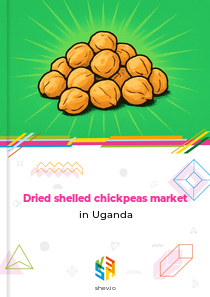







Earlier Report Observations
The volume of Uganda's dried shelled chickpeas market showed remarkable stability between 2018 and 2023, fluctuating within a narrow band of 5 589 to 5 712 t. This plateau in production and consumption can be traced to persistent structural challenges within the local value chain. Despite the earlier introduction of improved chickpea varieties aimed at boosting household incomes, the market's expansion was constrained by limited domestic processing capacity and a lack of developed alternative sales channels, which led many farmers to abandon cultivation.
By 2024, the market context was shaped more by external global factors. Export restrictions in key supplying countries like Turkey affected international supply and pricing, while growing worldwide consumer demand for plant-based proteins presented new export opportunities. Domestically, agricultural policy continued to focus on broader value chain development and climate-smart farming, though the fundamental bottlenecks in processing and market access for chickpeas remained unresolved.
Table of content
- 1. Disclaimer
- 2. Terms of use of the report
- 3. Product codes in the statistical classifications used in the report
-
4. Key Market Indicators and Trends
-
4.1. Key Market Indicators
-
4.1.1. In kind
- 4.1.1.1. Production, 2018-2023
- 4.1.1.2. Imports, 2018-2024
- 4.1.1.3. Exports, 2018-2024
- 4.1.1.4. Market size, 2018-2023
-
4.1.1. In kind
- 4.2. Market Trends and Factors
-
4.1. Key Market Indicators
-
5. Production
-
5.1. Production in Uganda
- 5.1.1. Annual dynamics of production in Uganda in kind, 2018-2023, t
- 5.1.2. Annual dynamics of production in Uganda in value, 2018-2023, $ US
-
5.2. Global production by Country, 2018-2023
- 5.2.1. Annual dynamics of production by macroregions in kind, 2018-2023, t
- 5.2.2. Dynamics of production structure by macroregions in kind, 2018-2023
- 5.2.3. Annual dynamics of production by country in kind, 2018-2023, t
- 5.2.4. Structure of production by countries in kind, 2018-2023
- 5.2.5. Dynamics of peoduction structure by countries in kind, 2018-2023
-
5.1. Production in Uganda
-
6. Imports
-
6.1. Imports (Direct Data)
- 6.1.1. Imports - Total information
-
6.1.2. Imports in kind, kg
- 6.1.2.1. Annual dynamics of product's imports to Uganda in kind, 2018-2024, kg
- 6.1.2.2. Dynamics of product's imports in kind to Uganda by countries, 2018-2024, kg
- 6.1.2.3. Structure of product's imports in kind by countries, 2018-2024
-
6.1.3. Imports in value, $ US
- 6.1.3.1. Annual dynamics of product's imports to Uganda in value, 2018-2024, $ US
- 6.1.3.2. Dynamics of product's imports in value to Uganda by countries, 2018-2024, $ US
- 6.1.3.3. Structure of product's imports in value by countries, 2018-2024
-
6.1.4. Average price of product's imports, $ US/t
- 6.1.4.1. Annual dynamics of average price of product's imports to Uganda, 2018-2024, $ US/t
- 6.1.4.2. Dynamics of average price of product's imports to Uganda by countries, 2018-2024, $ US/t
-
6.2. Imports (Mirror Data)
- 6.2.1. Imports - Total information
-
6.2.2. Imports in kind, kg
- 6.2.2.1. Annual dynamics of product's imports to Uganda in kind, 2018-2024, kg
- 6.2.2.2. Dynamics of product's imports in kind to Uganda by countries, 2018-2024, kg
- 6.2.2.3. Structure of product's imports in kind by countries, 2018-2024
-
6.2.3. Imports in value, $ US
- 6.2.3.1. Annual dynamics of product's imports to Uganda in value, 2018-2024, $ US
- 6.2.3.2. Dynamics of product's imports in value to Uganda by countries, 2018-2024, $ US
- 6.2.3.3. Structure of product's imports in value by countries, 2018-2024
-
6.2.4. Average price of product's imports, $ US/t
- 6.2.4.1. Annual dynamics of average price of product's imports to Uganda, 2018-2024, $ US/t
- 6.2.4.2. Dynamics of average price of product's imports to Uganda by countries, 2018-2024, $ US/t
-
6.1. Imports (Direct Data)
-
7. Exports
-
7.1. Exports (Direct Data)
- 7.1.1. Exports - Total information
-
7.1.2. Exports in kind, kg
- 7.1.2.1. Annual dynamics of product's exports from Uganda in kind, 2018-2024, kg
- 7.1.2.2. Dynamics of product's exports in kind from Uganda by countries, 2018-2024, kg
- 7.1.2.3. Structure of product's exports in kind by countries, 2018-2024
-
7.1.3. Exports in value, $ US
- 7.1.3.1. Annual dynamics of product's exports from Uganda in value, 2018-2024, $ US
- 7.1.3.2. Dynamics of product's exports in value from Uganda by countries, 2018-2024, $ US
- 7.1.3.3. Structure of product's exports in value by countries, 2018-2024
-
7.1.4. Average price of product's exports, $ US/t
- 7.1.4.1. Annual dynamics of average price of product's exports from Uganda, 2018-2024, $ US/t
- 7.1.4.2. Dynamics of average price of product's exports from Uganda by countries, 2018-2024, $ US/t
-
7.2. Exports (Mirror Data)
- 7.2.1. Exports - Total information
-
7.2.2. Exports in kind, kg
- 7.2.2.1. Annual dynamics of product's exports from Uganda in kind, 2018-2024, kg
- 7.2.2.2. Dynamics of product's exports in kind from Uganda by countries, 2018-2024, kg
- 7.2.2.3. Structure of product's exports in kind by countries, 2018-2024
-
7.2.3. Exports in value, $ US
- 7.2.3.1. Annual dynamics of product's exports from Uganda in value, 2018-2024, $ US
- 7.2.3.2. Dynamics of product's exports in value from Uganda by countries, 2018-2024, $ US
- 7.2.3.3. Structure of product's exports in value by countries, 2018-2024
-
7.2.4. Average price of product's exports, $ US/t
- 7.2.4.1. Annual dynamics of average price of product's exports from Uganda, 2018-2024, $ US/t
- 7.2.4.2. Dynamics of average price of product's exports from Uganda by countries, 2018-2024, $ US/t
-
7.1. Exports (Direct Data)
-
8. Trade balance
-
8.1. Trade balance (Direct Data)
- 8.1.1. In kind, kg
- 8.1.2. In value, $ US
-
8.2. Trade balance (Mirror Data)
- 8.2.1. In kind, kg
- 8.2.2. In value, $ US
-
8.1. Trade balance (Direct Data)
-
9. Top buying and selling countries, 2018-2024
-
9.1. Direct Data
- 9.1.1. Import in Value by Countries-buyers
- 9.1.2. Export in Value by Countries-suppliers
-
9.2. Mirror Data
- 9.2.1. Import in Value by Countries-buyers
- 9.2.2. Export in Value by Countries-suppliers
-
9.1. Direct Data
Production dried shelled chickpeas in Uganda
In kind, 2017-2020, t
From 2017 to 2020, Uganda ranked 28th globally in dried shelled chickpeas production.
Top producers of dried shelled chickpeas, 2017-2020
World map of production of dried shelled chickpeas, 2017-2020
Uganda's dried shelled chickpeas production declined after two years of growth. In 2020, the country produced 5 554 tonnes, marking a slight year-over-year decrease of 2.4%. Over the 2017-2020 period, production increased by 2.5%, with a compound annual growth rate of 0.8%. The highest production was recorded in 2019 at 5 688 tonnes, while the largest annual increase occurred in 2018 at 2.5%.
Annual dynamics of production in Uganda in kind, 2017-2020, t
| Parameter | 2018 | 2019 | 2020 | CAGR | |
|---|---|---|---|---|---|
| 1 | Change from last year | 2.5% | 2.4% | (2.4%) | 0.8% |
Exports dried shelled chickpeas from Uganda
Exports in kind, kg
The market exhibited volatility during the observed period. Export volumes reached their lowest point in 2020 and peaked in 2019, with a 58-fold difference between these years. In 2020, Uganda exported 134 kg of dried shelled chickpeas, representing a 98.3% decrease from the previous year. The maximum export volume was recorded in 2019 at 7 827 kg, with the largest annual increase also occurring in 2019 at 421.8%.
Annual dynamics of product's exports from Uganda in kind, 2017-2020, kg
| Parameter | 2018 | 2019 | 2020 | CAGR | |
|---|---|---|---|---|---|
| 1 | Change from last year | (14.3%) | 421.8% | (98.3%) | (57.5%) |
From 2017 to 2020, Kenya, South Sudan, and Canada formed the core of Uganda's dried shelled chickpeas exports, accounting for 100.0% of total flows. Kenya led with 44.6% of exports in kind, followed by South Sudan at 30.2% and Canada at 25.2%.
Structure of product's exports in kind by countries, 2017-2020
World map of product's exports from Uganda in kind, 2017-2020
Exports in value, $ US
Market behavior was volatile during these years. Exports dropped to their lowest point in 2020 after peaking in 2019, with a 23-fold difference between these years. In 2020, Uganda exported dried shelled chickpeas worth 129 US dollars, a 95.7% decrease compared to 2019. The maximum value was recorded in 2019 at 2 995 US dollars, with the largest annual increase also in 2019 at 323.8%.
Annual dynamics of product's exports from Uganda in value, 2017-2020, $ US
| Parameter | 2018 | 2019 | 2020 | CAGR | |
|---|---|---|---|---|---|
| 1 | Change from last year | 45.9% | 323.8% | (95.7%) | (35.7%) |
Over the 2017-2020 period, Kenya, South Sudan, and Canada were the main destinations for Uganda's dried shelled chickpeas exports in value terms, together accounting for 100.0% of total exports. Kenya held 46.2% of the export value, South Sudan 30.6%, and Canada 23.2%.
Structure of product's exports in value by countries, 2017-2020
World map of product's exports from Uganda in value, 2017-2020
Imports dried shelled chickpeas to Uganda
Imports in kind, kg
Uganda imported 35 952 kg of dried shelled chickpeas in 2020, a 10.6% increase from the previous year. Between 2017 and 2020, imports grew by 12.4%, equivalent to an annualized rate of 4.0%. The maximum import volume was recorded in 2018 at 36 614 kg. The largest annual decline occurred in 2019 at 11.2%, while the largest increase was in 2018 at 14.5%.
Annual dynamics of product's imports to Uganda in kind, 2017-2020, kg
| Parameter | 2018 | 2019 | 2020 | CAGR | |
|---|---|---|---|---|---|
| 1 | Change from last year | 14.5% | (11.2%) | 10.6% | 4.0% |
From 2017 to 2020, Uganda's imports in kind were highly concentrated, with the United Arab Emirates and India together accounting for 84.2% of total flows. Other partners made up the remaining share.
Structure of product's imports in kind by countries, 2017-2020
World map of product's imports to Uganda in kind, 2017-2020
Imports in value, $ US
The market showed volatility during these years. Import values reached their lowest point in 2017 and peaked in 2020, with a 2-fold difference between these years. In 2020, Uganda's imports of dried shelled chickpeas totaled 29 915 US dollars, a sharp 45.0% increase compared to 2019. The largest annual decline was recorded in 2019 at 28.3%, while the largest increase occurred in 2018 at 88.6%.
Annual dynamics of product's imports to Uganda in value, 2017-2020, $ US
| Parameter | 2018 | 2019 | 2020 | CAGR | |
|---|---|---|---|---|---|
| 1 | Change from last year | 88.6% | (28.3%) | 45.0% | 25.1% |
Throughout 2017-2020, the United Arab Emirates and India dominated Uganda's dried shelled chickpeas imports in value terms, jointly accounting for 84.3% of total flows. Other countries held significantly smaller shares.
Structure of product's imports in value by countries, 2017-2020
World map of product's imports to Uganda in value, 2017-2020
Related Reports
Dried shelled chickpeas market in ASEAN
2026-03-27
Dried shelled chickpeas market in India
2026-03-27
Dried shelled chickpeas market in Iran
2026-03-27
Sweet potatoe market in Uganda
2026-03-27

Alliaceous vegetables market in Uganda
2026-03-27

2026-03-27

Dried shelled cow peas market in Uganda
2026-03-27
In-depth market research on this product
Global Chickpea Market 2021–2031: Size, Share, Trends and Forecast
Global market report: size, trends and forecast to 2031 · 192 pages
Why Choose Us?
Only Verified Data
No Hidden Costs or Separate Fees
Smarter Subscription Pricing
Contact Our Team
Submit your inquiry using the form below — our team will get back to you within 24 hours.