






"Middle Africa" region includes following countries:
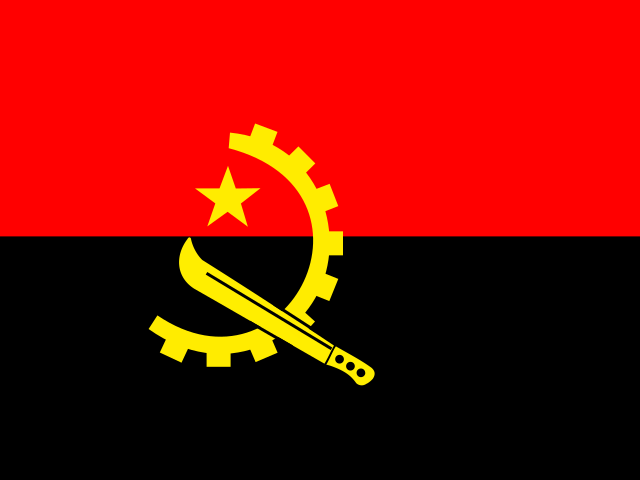 Angola
 Cameroon
 Central African Republic
 Chad
Chad Congo
Congo Democratic Republic of the Congo
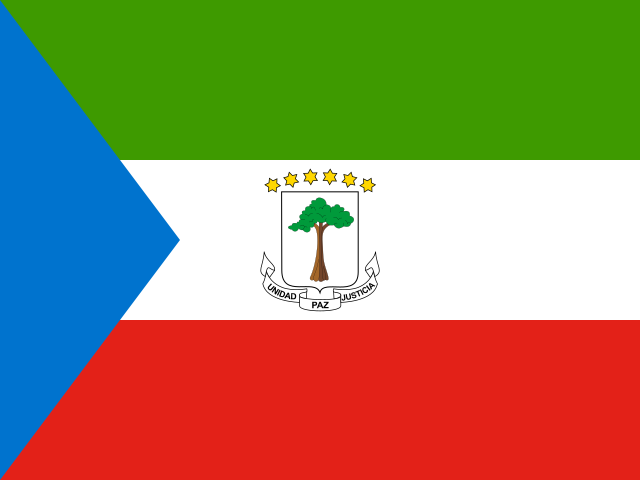 Equatorial Guinea
 Gabon
Gabon Sao Tome and Principe
Earlier Report Observations
Production of cotton seeds in Middle Africa increased from 423 thousand tonnes in 2018 to 457 thousand tonnes in 2019. This growth was primarily driven by the development of new edible cotton seed varieties without gossypol, which opened a potential new market segment for human and animal consumption, boosting demand for cotton seeds.
After a period of stabilization in 2020 at 456 thousand tonnes, output fell sharply to 385 thousand tonnes in 2021, bringing the market size down to 342 thousand tonnes. The market began to recover in 2022, with production at 382 thousand tonnes and market volume reaching 376 thousand tonnes.
The recovery continued in 2023 as production rose to 412 thousand tonnes and the market size expanded to 398 thousand tonnes. This upward trend was supported by the European Union's strengthened organic production and labeling rules, which entered into force in 2022, creating incentives for producers targeting the EU export market, alongside a broader global rebound in cotton production and demand.
Table of content
- 1. Disclaimer
- 2. Terms of use of the report
- 3. Product codes in the statistical classifications used in the report
-
4. Key Market Indicators and Trends
-
4.1. Key Market Indicators
-
4.1.1. In kind
- 4.1.1.1. Production, 2018-2023
- 4.1.1.2. Imports, 2018-2024
- 4.1.1.3. Exports, 2018-2024
- 4.1.1.4. Market size, 2018-2023
-
4.1.1. In kind
- 4.2. Market Trends and Factors
-
4.1. Key Market Indicators
-
5. Production
-
5.1. Production in Middle Africa
- 5.1.1. Annual dynamics of production in Middle Africa in kind, 2018-2023, K t
-
5.2. Global production by Country, 2018-2023
- 5.2.1. Annual dynamics of production by macroregions in kind, 2018-2023, K t
- 5.2.2. Dynamics of production structure by macroregions in kind, 2018-2023
- 5.2.3. Annual dynamics of production by country in kind, 2018-2023, K t
- 5.2.4. Structure of production by countries in kind, 2018-2023
- 5.2.5. Dynamics of peoduction structure by countries in kind, 2018-2023
-
5.1. Production in Middle Africa
-
6. Exports
-
6.1. Exports (Direct Data*)
- 6.1.1. Exports - Total information
-
6.1.2. Exports in kind, t
- 6.1.2.1. Annual dynamics of product's exports from Angola in kind, 2018-2024, t
- 6.1.2.2. Dynamics of product's exports in kind from Angola by countries, 2018-2024, t
- 6.1.2.3. Structure of product's exports in kind by countries, 2018-2024
-
6.1.3. Exports in value, K $ US
- 6.1.3.1. Annual dynamics of product's exports from Angola in value, 2018-2024, K $ US
- 6.1.3.2. Dynamics of product's exports in value from Angola by countries, 2018-2024, K $ US
- 6.1.3.3. Structure of product's exports in value by countries, 2018-2024
-
6.1.4. Average price of product's exports, $ US/kg
- 6.1.4.1. Annual dynamics of average price of product's exports from Angola, 2018-2024, $ US/kg
- 6.1.4.2. Dynamics of average price of product's exports from Angola by countries, 2018-2024, $ US/kg
-
6.2. Exports (Mirror Data)
- 6.2.1. Exports - Total information
-
6.2.2. Exports in kind, t
- 6.2.2.1. Annual dynamics of product's exports from Angola in kind, 2018-2024, t
- 6.2.2.2. Dynamics of product's exports in kind from Angola by countries, 2018-2024, t
- 6.2.2.3. Structure of product's exports in kind by countries, 2018-2024
-
6.2.3. Exports in value, K $ US
- 6.2.3.1. Annual dynamics of product's exports from Angola in value, 2018-2024, K $ US
- 6.2.3.2. Dynamics of product's exports in value from Angola by countries, 2018-2024, K $ US
- 6.2.3.3. Structure of product's exports in value by countries, 2018-2024
-
6.2.4. Average price of product's exports, $ US/kg
- 6.2.4.1. Annual dynamics of average price of product's exports from Angola, 2018-2024, $ US/kg
- 6.2.4.2. Dynamics of average price of product's exports from Angola by countries, 2018-2024, $ US/kg
-
6.1. Exports (Direct Data*)
-
7. Imports
-
7.1. Imports (Direct Data*)
- 7.1.1. Imports - Total information
-
7.1.2. Imports in kind, t
- 7.1.2.1. Annual dynamics of product's imports to Angola in kind, 2018-2024, t
- 7.1.2.2. Dynamics of product's imports in kind to Angola by countries, 2018-2024, t
- 7.1.2.3. Structure of product's imports in kind by countries, 2018-2024
-
7.1.3. Imports in value, K $ US
- 7.1.3.1. Annual dynamics of product's imports to Angola in value, 2018-2024, K $ US
- 7.1.3.2. Dynamics of product's imports in value to Angola by countries, 2018-2024, K $ US
- 7.1.3.3. Structure of product's imports in value by countries, 2018-2024
-
7.1.4. Average price of product's imports, $ US/kg
- 7.1.4.1. Annual dynamics of average price of product's imports to Angola, 2018-2024, $ US/kg
- 7.1.4.2. Dynamics of average price of product's imports to Angola by countries, 2018-2024, $ US/kg
-
7.2. Imports (Mirror Data)
- 7.2.1. Imports - Total information
-
7.2.2. Imports in kind, t
- 7.2.2.1. Annual dynamics of product's imports to Angola in kind, 2018-2024, t
- 7.2.2.2. Dynamics of product's imports in kind to Angola by countries, 2018-2024, t
- 7.2.2.3. Structure of product's imports in kind by countries, 2018-2024
-
7.2.3. Imports in value, K $ US
- 7.2.3.1. Annual dynamics of product's imports to Angola in value, 2018-2024, K $ US
- 7.2.3.2. Dynamics of product's imports in value to Angola by countries, 2018-2024, K $ US
- 7.2.3.3. Structure of product's imports in value by countries, 2018-2024
-
7.2.4. Average price of product's imports, $ US/kg
- 7.2.4.1. Annual dynamics of average price of product's imports to Angola, 2018-2024, $ US/kg
- 7.2.4.2. Dynamics of average price of product's imports to Angola by countries, 2018-2024, $ US/kg
-
7.1. Imports (Direct Data*)
-
8. Trade balance
-
8.1. Trade balance (Direct Data)
- 8.1.1. In kind, t
- 8.1.2. In value, K $ US
-
8.2. Trade balance (Mirror Data)
- 8.2.1. In kind, t
- 8.2.2. In value, K $ US
-
8.1. Trade balance (Direct Data)
-
9. Top buying and selling countries, 2018-2024
-
9.1. Direct Data
- 9.1.1. Import in Value by Countries-buyers
- 9.1.2. Export in Value by Countries-suppliers
-
9.2. Mirror Data
- 9.2.1. Import in Value by Countries-buyers
- 9.2.2. Export in Value by Countries-suppliers
-
9.1. Direct Data
Production cotton seeds in Middle Africa
In kind, 2017-2020, K t
Top producers of cotton seeds, 2017-2020
World map of production of cotton seeds, 2017-2020
After two years of growth, cotton seed production in Middle Africa declined. In 2020, production remained virtually unchanged at 455.5 thousand tonnes compared to 2019. Over the period from 2017 to 2020, production increased by 46%, with a compound annual growth rate of 13.5%. The highest production level was recorded in 2019 at 457.2 thousand tonnes. The largest annual increase occurred in 2018, when production grew by 35.7%.
Annual dynamics of production in Middle Africa in kind, 2017-2020, K t
| Parameter | 2018 | 2019 | 2020 | CAGR | |
|---|---|---|---|---|---|
| 1 | Change from last year | 35.7% | 8.0% | (0.4%) | 13.5% |
Exports cotton seeds from Middle Africa
Exports in kind, t
The market showed an unstable trend throughout the period. Exports reached their lowest point in 2018 at 4 993 tonnes, then peaked in 2020 at 29 606 tonnes, representing a 5.9-fold difference between these years. The 2020 export volume was 61.1% higher than in 2019. The largest decline occurred in 2018, when exports fell by 49.9%, while the largest increase was recorded in 2019 with growth of 268.1%.
Annual dynamics of product's exports from Middle Africa in kind, 2017-2020, t
| Parameter | 2018 | 2019 | 2020 | CAGR | |
|---|---|---|---|---|---|
| 1 | Change from last year | (49.9%) | 268.1% | 61.1% | 43.7% |
From 2017 to 2020, Nigeria played the leading role in cotton seed exports from Middle Africa, accounting for 87.7% of total export volumes. The remaining share was distributed among other trading partners.
Structure of product's exports in kind by countries, 2017-2020
World map of product's exports from Middle Africa in kind, 2017-2020
Exports in value, K $ US
The market exhibited an unstable trend throughout the period. Export values reached their lowest point in 2018 at 338 thousand US dollars, then peaked in 2020 at 3 057 thousand US dollars, representing a 9-fold difference between these years. The 2020 export value increased by 11.9% compared to 2019. The largest decline occurred in 2018, when export values fell by 51.4%, while the largest increase was recorded in 2019 with growth of 707.3%.
Annual dynamics of product's exports from Middle Africa in value, 2017-2020, K $ US
| Parameter | 2018 | 2019 | 2020 | CAGR | |
|---|---|---|---|---|---|
| 1 | Change from last year | (51.4%) | 707.3% | 11.9% | 63.7% |
From 2017 to 2020, Nigeria was the primary destination for cotton seed exports in value terms, accounting for 80.7% of total export flows. Other markets collectively formed a long tail of smaller trading partners.
Structure of product's exports in value by countries, 2017-2020
World map of product's exports from Middle Africa in value, 2017-2020
Imports cotton seeds to Middle Africa
Imports in kind, t
There were noticeable fluctuations in import volumes during the period. Imports reached their lowest point in 2018 at 0.3 tonnes, then peaked in 2019 at 52 tonnes, representing a 179-fold difference between these years. In 2020, Middle Africa imported 6 tonnes of cotton seeds, which was 88.1% lower than in 2019. The largest decline occurred in 2018, when imports fell by 99.0%, while the largest increase was recorded in 2019 with growth of 17,762.2%.
Annual dynamics of product's imports to Middle Africa in kind, 2017-2020, t
| Parameter | 2018 | 2019 | 2020 | CAGR | |
|---|---|---|---|---|---|
| 1 | Change from last year | (99.0%) | 17 762.2% | (88.1%) | (40.8%) |
Throughout 2017 to 2020, Spain, China, and India were the main sources of cotton seed imports to Middle Africa. Spain accounted for 38.4% of imports, China for 3.5%, and India for 1.3%. Together, these three countries represented 43.2% of total import volumes.
Structure of product's imports in kind by countries, 2017-2020
World map of product's imports to Middle Africa in kind, 2017-2020
Imports in value, K $ US
There were noticeable fluctuations in import values during the period. Import values reached their lowest point in 2018 at 2 thousand US dollars, then peaked in 2017, representing a 149-fold difference between these years. In 2020, Middle Africa imported cotton seeds worth 9 thousand US dollars, which was 54.0% lower than in 2019. The largest decline occurred in 2018, when import values fell by 99.3%, while the largest increase was recorded in 2019 with growth of 899.0%.
Annual dynamics of product's imports to Middle Africa in value, 2017-2020, K $ US
| Parameter | 2018 | 2019 | 2020 | CAGR | |
|---|---|---|---|---|---|
| 1 | Change from last year | (99.3%) | 899.0% | (54.0%) | (68.6%) |
From 2017 to 2020, Spain effectively dominated cotton seed imports to Middle Africa in value terms, accounting for 90.2% of total import flows.
Structure of product's imports in value by countries, 2017-2020
World map of product's imports to Middle Africa in value, 2017-2020
Related Reports

Cotton seeds market in Guatemala
2026-03-28
2026-03-28
2026-03-28
2026-03-28

2026-03-28


Sunflower seeds market in Middle Africa
2026-03-28

Why Choose Us?
Only Verified Data
No Hidden Costs or Separate Fees
Smarter Subscription Pricing
Contact Our Team
Submit your inquiry using the form below — our team will get back to you within 24 hours.