






"Africa" region includes following countries:
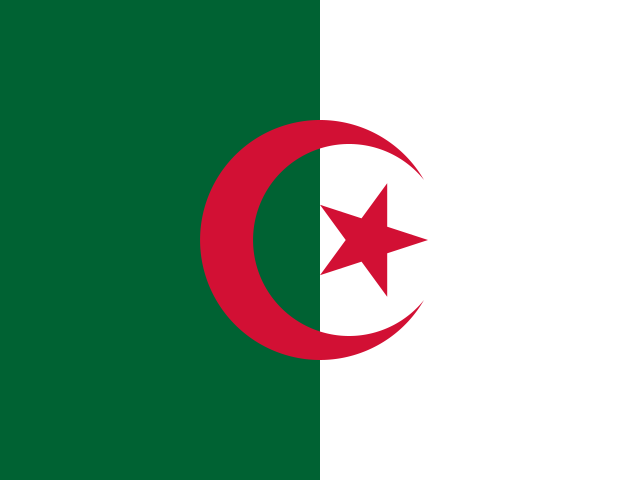 Algeria
 Libya
Libya Morocco
 Sudan
Sudan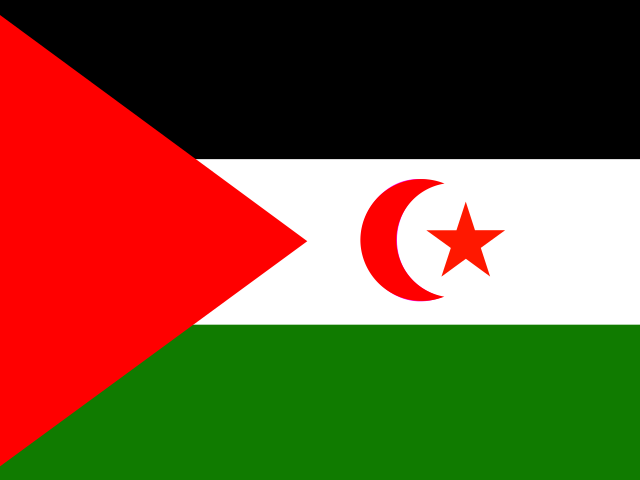 Western Sahara
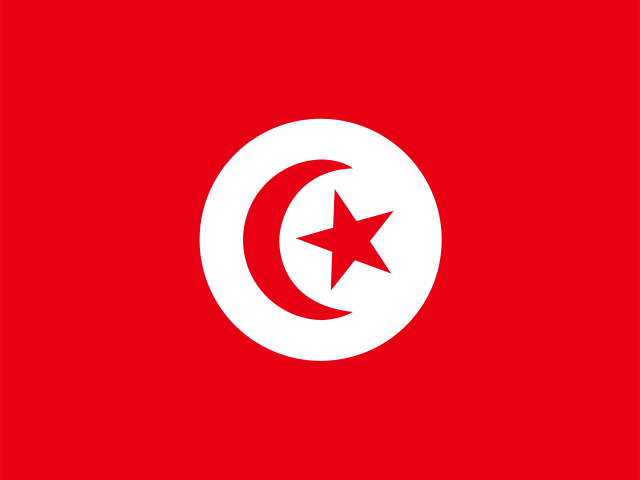 Tunisia
 Egypt
Egypt Cabo Verde
 Benin
Benin Gambia
 Ghana
Ghana Guinea
 Côte d'Ivoire
 Liberia
 Mali
Mali Mauritania
 Niger
Niger Nigeria
 Guinea-Bissau
 Saint Helena, Ascension and Tristan da Cunha
 Senegal
 Sierra Leone
 Togo
Togo Burkina Faso
 British Indian Ocean Territory
 Burundi
 Comoros
 Mayotte
 Ethiopia
 Eritrea
 French Southern Territories
 Djibouti
 Kenya
Kenya Madagascar
 Malawi
 Mauritius
 Mozambique
 Reunion
 Rwanda
 Seychelles
 Somalia
 Zimbabwe
 South Sudan
 Uganda
 Tanzania
 Zambia
 Angola
 Cameroon
 Central African Republic
 Chad
Chad Congo
Congo Democratic Republic of the Congo
 Equatorial Guinea
 Gabon
Gabon Sao Tome and Principe
 Botswana
 Lesotho
 Namibia
 South Africa
 Eswatini
Earlier Report Observations
The market volume for corn oil and fractions in Africa declined from 329 thousand tons in 2018 to 258 thousand tons in 2023. This contraction was driven by large-scale investments across the region to boost local palm oil production, such as Nigeria's push to reduce import dependency. The increased domestic supply of edible oils reduced the need for corn oil imports, which fell sharply over the period.
Entry of multinational agri-food companies and the launch of new palm oil processing facilities, like the Olam plant in Gabon and refineries in Senegal, intensified competition. Government programs, including Gabon's GRAINE initiative, further supported local palm oil cultivation and processing, shifting consumer and industrial demand toward palm-based alternatives.
Global palm oil price spikes, notably in 2020, affected affordability and access to edible oils in markets like Senegal. However, the structural expansion of palm oil capacity continued to pressure the corn oil market, even as corn oil imports showed a tentative recovery in 2024.
Table of content
- 1. Disclaimer
- 2. Terms of use of the report
- 3. Product codes in the statistical classifications used in the report
-
4. Key Market Indicators and Trends
-
4.1. Key Market Indicators
-
4.1.1. In kind
- 4.1.1.1. Production, 2018-2023
- 4.1.1.2. Imports, 2018-2024
- 4.1.1.3. Exports, 2018-2024
- 4.1.1.4. Market size, 2018-2023
-
4.1.1. In kind
- 4.2. Market Trends and Factors
-
4.1. Key Market Indicators
-
5. Production
-
5.1. Production in Africa
- 5.1.1. Annual dynamics of production in Africa in kind, 2018-2023, K t
-
5.2. Global production by Country, 2018-2023
- 5.2.1. Annual dynamics of production by macroregions in kind, 2018-2023, K t
- 5.2.2. Dynamics of production structure by macroregions in kind, 2018-2023
- 5.2.3. Annual dynamics of production by country in kind, 2018-2023, K t
- 5.2.4. Structure of production by countries in kind, 2018-2023
- 5.2.5. Dynamics of peoduction structure by countries in kind, 2018-2023
-
5.1. Production in Africa
-
6. Imports
-
6.1. Imports (Direct Data*)
- 6.1.1. Imports - Total information
-
6.1.2. Imports in kind, K t
- 6.1.2.1. Annual dynamics of product's imports to Algeria in kind, 2018-2024, K t
- 6.1.2.2. Dynamics of product's imports in kind to Algeria by countries, 2018-2024, K t
- 6.1.2.3. Structure of product's imports in kind by countries, 2018-2024
-
6.1.3. Imports in value, M $ US
- 6.1.3.1. Annual dynamics of product's imports to Algeria in value, 2018-2024, M $ US
- 6.1.3.2. Dynamics of product's imports in value to Algeria by countries, 2018-2024, M $ US
- 6.1.3.3. Structure of product's imports in value by countries, 2018-2024
-
6.1.4. Average price of product's imports, $ US/t
- 6.1.4.1. Annual dynamics of average price of product's imports to Algeria, 2018-2024, $ US/t
- 6.1.4.2. Dynamics of average price of product's imports to Algeria by countries, 2018-2024, $ US/t
-
6.2. Imports (Mirror Data)
- 6.2.1. Imports - Total information
-
6.2.2. Imports in kind, K t
- 6.2.2.1. Annual dynamics of product's imports to Algeria in kind, 2018-2024, K t
- 6.2.2.2. Dynamics of product's imports in kind to Algeria by countries, 2018-2024, K t
- 6.2.2.3. Structure of product's imports in kind by countries, 2018-2024
-
6.2.3. Imports in value, M $ US
- 6.2.3.1. Annual dynamics of product's imports to Algeria in value, 2018-2024, M $ US
- 6.2.3.2. Dynamics of product's imports in value to Algeria by countries, 2018-2024, M $ US
- 6.2.3.3. Structure of product's imports in value by countries, 2018-2024
-
6.2.4. Average price of product's imports, $ US/t
- 6.2.4.1. Annual dynamics of average price of product's imports to Algeria, 2018-2024, $ US/t
- 6.2.4.2. Dynamics of average price of product's imports to Algeria by countries, 2018-2024, $ US/t
-
6.1. Imports (Direct Data*)
-
7. Exports
-
7.1. Exports (Direct Data*)
- 7.1.1. Exports - Total information
-
7.1.2. Exports in kind, K t
- 7.1.2.1. Annual dynamics of product's exports from Algeria in kind, 2018-2024, K t
- 7.1.2.2. Dynamics of product's exports in kind from Algeria by countries, 2018-2024, K t
- 7.1.2.3. Structure of product's exports in kind by countries, 2018-2024
-
7.1.3. Exports in value, M $ US
- 7.1.3.1. Annual dynamics of product's exports from Algeria in value, 2018-2024, M $ US
- 7.1.3.2. Dynamics of product's exports in value from Algeria by countries, 2018-2024, M $ US
- 7.1.3.3. Structure of product's exports in value by countries, 2018-2024
-
7.1.4. Average price of product's exports, $ US/t
- 7.1.4.1. Annual dynamics of average price of product's exports from Algeria, 2018-2024, $ US/t
- 7.1.4.2. Dynamics of average price of product's exports from Algeria by countries, 2018-2024, $ US/t
-
7.2. Exports (Mirror Data)
- 7.2.1. Exports - Total information
-
7.2.2. Exports in kind, K t
- 7.2.2.1. Annual dynamics of product's exports from Algeria in kind, 2018-2024, K t
- 7.2.2.2. Dynamics of product's exports in kind from Algeria by countries, 2018-2024, K t
- 7.2.2.3. Structure of product's exports in kind by countries, 2018-2024
-
7.2.3. Exports in value, M $ US
- 7.2.3.1. Annual dynamics of product's exports from Algeria in value, 2018-2024, M $ US
- 7.2.3.2. Dynamics of product's exports in value from Algeria by countries, 2018-2024, M $ US
- 7.2.3.3. Structure of product's exports in value by countries, 2018-2024
-
7.2.4. Average price of product's exports, $ US/t
- 7.2.4.1. Annual dynamics of average price of product's exports from Algeria, 2018-2024, $ US/t
- 7.2.4.2. Dynamics of average price of product's exports from Algeria by countries, 2018-2024, $ US/t
-
7.1. Exports (Direct Data*)
-
8. Trade balance
-
8.1. Trade balance (Direct Data)
- 8.1.1. In kind, K t
- 8.1.2. In value, M $ US
-
8.2. Trade balance (Mirror Data)
- 8.2.1. In kind, K t
- 8.2.2. In value, M $ US
-
8.1. Trade balance (Direct Data)
-
9. Top buying and selling countries, 2018-2024
-
9.1. Direct Data
- 9.1.1. Import in Value by Countries-buyers
- 9.1.2. Export in Value by Countries-suppliers
-
9.2. Mirror Data
- 9.2.1. Import in Value by Countries-buyers
- 9.2.2. Export in Value by Countries-suppliers
-
9.1. Direct Data
Production corn oil and fractions in Africa
In kind, 2017-2020, K t
Top producers of corn oil and fractions, 2017-2020
World map of production of corn oil and fractions, 2017-2020
Africa's corn oil and fractions production has increased for the third consecutive year. In 2020, the continent produced 174.3 thousand tons, marking a 3.3% rise compared to 2019. Looking at the period from 2017 to 2020, production grew by 8.3%, which translates to an annualized growth rate of 2.7%.
Annual dynamics of production in Africa in kind, 2017-2020, K t
| Parameter | 2018 | 2019 | 2020 | CAGR | |
|---|---|---|---|---|---|
| 1 | Change from last year | 1.0% | 3.8% | 3.3% | 2.7% |
Exports corn oil and fractions from Africa
Exports in kind, K t
The export market for corn oil and fractions from Africa showed an unstable trend over the observed period. Exports reached their lowest point in 2017, then peaked in 2018 at 19.0 thousand tons, creating a 2.2-fold gap between these years. In 2020, exports stood at 13.8 thousand tons, reflecting a modest decline of 9.2% from 2019. The largest increase occurred in 2018, with a surge of 117.6%, while the most significant drop was recorded in 2019 at 20.3%.
Annual dynamics of product's exports from Africa in kind, 2017-2020, K t
| Parameter | 2018 | 2019 | 2020 | CAGR | |
|---|---|---|---|---|---|
| 1 | Change from last year | 117.6% | (20.3%) | (9.2%) | 16.3% |
From 2017 to 2020, Africa's export portfolio for corn oil and fractions in kind was quite broad. Key partners included Jordan, accounting for 6.2% of exports, Israel at 2.1%, and the United Arab Emirates at 1.8%. Together, these three countries represented only 10.1% of total export flows, indicating a diverse distribution among many other nations.
Structure of product's exports in kind by countries, 2017-2020
World map of product's exports from Africa in kind, 2017-2020
Exports in value, M $ US
After a two-year decline, Africa's corn oil and fractions exports in value terms saw an increase. In 2020, exports amounted to 47.3 million US dollars, showing an uptick of 19.9% compared to 2019. However, over the full period from 2017 to 2020, exports decreased by 38.6%, with a compound annual growth rate of -15.0%. The lowest value was recorded in 2019 at 39.4 million US dollars, which also saw the largest decline of 35.9%.
Annual dynamics of product's exports from Africa in value, 2017-2020, M $ US
| Parameter | 2018 | 2019 | 2020 | CAGR | |
|---|---|---|---|---|---|
| 1 | Change from last year | (20.1%) | (35.9%) | 19.9% | (15.0%) |
Between 2017 and 2020, the buyer portfolio for Africa's corn oil and fractions exports in value terms was broad. Jordan contributed 5.3% of exports, Israel 1.9%, and Saudi Arabia 1.7%, together making up only 8.9% of total export value. Many other countries held smaller but still notable shares, highlighting the market's diversity.
Structure of product's exports in value by countries, 2017-2020
World map of product's exports from Africa in value, 2017-2020
Imports corn oil and fractions to Africa
Imports in kind, K t
Corn oil and fractions imports into Africa declined for the third consecutive year. In 2020, Africa imported 138.7 thousand tons, representing a solid drop of 19.0% compared to the previous year. Over the period from 2017 to 2020, imports decreased by 35.5%, with a compound annual growth rate of -13.6%.
Annual dynamics of product's imports to Africa in kind, 2017-2020, K t
| Parameter | 2018 | 2019 | 2020 | CAGR | |
|---|---|---|---|---|---|
| 1 | Change from last year | (13.7%) | (7.7%) | (19.0%) | (13.6%) |
From 2017 to 2020, the main sources for Africa's corn oil and fractions imports in kind were the United States, with a 35.2% share, Turkey at 14.0%, and Brazil at 10.6%. Together, these three countries formed a dominant cluster, accounting for 59.9% of total import flows.
Structure of product's imports in kind by countries, 2017-2020
World map of product's imports to Africa in kind, 2017-2020
Imports in value, M $ US
Imported corn oil and fractions volumes into Africa declined for the third consecutive year in value terms. In 2020, import value stood at 153.6 million US dollars, indicating a slight decline of 2.8% relative to the prior year. Over the 2017-2020 period, imports decreased by 39.7%, with a compound annual growth rate of -15.5%.
Annual dynamics of product's imports to Africa in value, 2017-2020, M $ US
| Parameter | 2018 | 2019 | 2020 | CAGR | |
|---|---|---|---|---|---|
| 1 | Change from last year | (17.8%) | (24.5%) | (2.8%) | (15.5%) |
Between 2017 and 2020, the United States remained the leading supplier of corn oil and fractions to Africa in value terms, accounting for 31.4% of imports. Turkey followed with 16.1%, and Spain with 9.3%. These three countries jointly formed 56.9% of total import value, continuing as the main suppliers to the region.
Structure of product's imports in value by countries, 2017-2020
World map of product's imports to Africa in value, 2017-2020
Related Reports

Corn oil and fractions market in Mozambique
2026-03-28




Sesame oil and fractions market in Africa
2026-03-28
Why Choose Us?
Only Verified Data
No Hidden Costs or Separate Fees
Smarter Subscription Pricing
Contact Our Team
Submit your inquiry using the form below — our team will get back to you within 24 hours.