






"Sub-Saharan Africa" region includes following countries:
 Cabo Verde
 Benin
Benin Gambia
 Ghana
Ghana Guinea
 Côte d'Ivoire
 Liberia
 Mali
Mali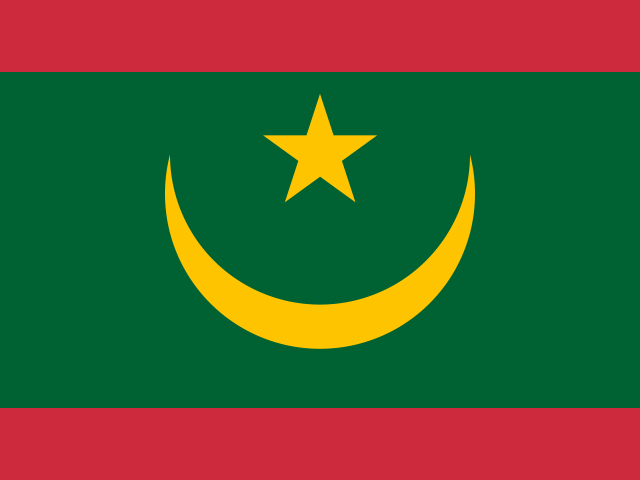 Mauritania
 Niger
Niger Nigeria
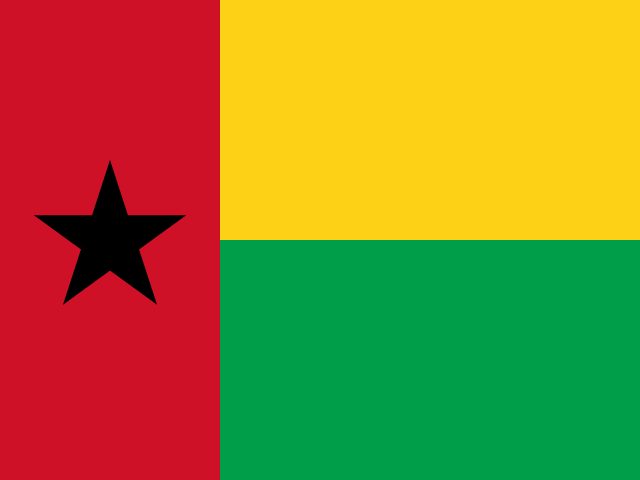 Guinea-Bissau
 Saint Helena, Ascension and Tristan da Cunha
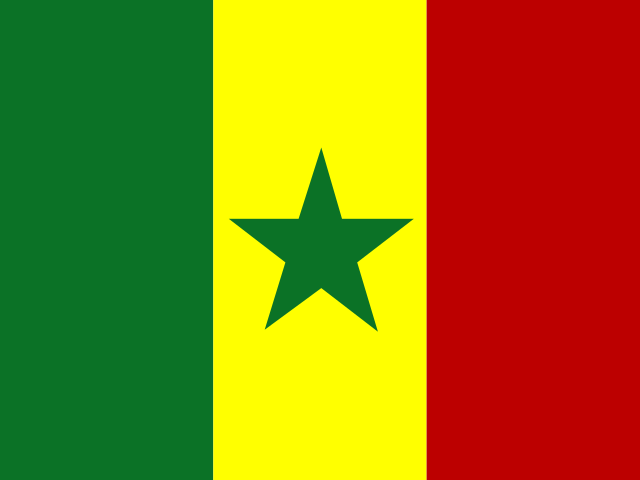 Senegal
 Sierra Leone
 Togo
Togo Burkina Faso
 British Indian Ocean Territory
 Burundi
 Comoros
 Mayotte
 Ethiopia
 Eritrea
 French Southern Territories
 Djibouti
 Kenya
Kenya Madagascar
 Malawi
 Mauritius
 Mozambique
 Reunion
 Rwanda
 Seychelles
 Somalia
 Zimbabwe
 South Sudan
 Uganda
 Tanzania
 Zambia
 Angola
 Cameroon
 Central African Republic
 Chad
Chad Congo
Congo Democratic Republic of the Congo
 Equatorial Guinea
 Gabon
Gabon Sao Tome and Principe
 Botswana
 Lesotho
 Namibia
 South Africa
 Eswatini
Earlier Report Observations
The coffee market volume in Sub-Saharan Africa fluctuated between 995 thousand tons and 1 218 thousand tons from 2018 to 2023. The initial decline in 2019 was followed by a recovery in 2020, supported by growing coffee consumption in South Africa and Ethiopia's role as the region's leading producer influencing neighboring markets.
Market volume stabilized around 1 089 thousand tons in 2021 as consumer preferences shifted toward premium, personalized, and sustainable coffee options. The subsequent rise to 1 218 thousand tons in 2022 coincided with high household coffee consumption in North African countries, which bolstered regional demand.
By 2023, the market volume contracted to 1 132 thousand tons, even as the African Continental Free Trade Area agreement reduced customs duties to facilitate market access. In 2024, a sharp price increase for instant coffee and the launch of new ready-to-drink beverage lines signaled evolving consumer behavior and product diversification within the sector.
Table of content
- 1. Disclaimer
- 2. Terms of use of the report
- 3. Product codes in the statistical classifications used in the report
-
4. Key Market Indicators and Trends
-
4.1. Key Market Indicators
-
4.1.1. In kind
- 4.1.1.1. Production, 2018-2023
- 4.1.1.2. Imports, 2018-2024
- 4.1.1.3. Exports, 2018-2024
- 4.1.1.4. Market size, 2018-2023
-
4.1.1. In kind
- 4.2. Market Trends and Factors
-
4.1. Key Market Indicators
-
5. Production
-
5.1. Production in Sub-Saharan Africa
- 5.1.1. Annual dynamics of production in Sub-Saharan Africa in kind, 2018-2023, K t
-
5.2. Global production by Country, 2018-2023
- 5.2.1. Annual dynamics of production by macroregions in kind, 2018-2023, K t
- 5.2.2. Dynamics of production structure by macroregions in kind, 2018-2023
- 5.2.3. Annual dynamics of production by country in kind, 2018-2023, K t
- 5.2.4. Structure of production by countries in kind, 2018-2023
- 5.2.5. Dynamics of peoduction structure by countries in kind, 2018-2023
-
5.1. Production in Sub-Saharan Africa
-
6. Imports
-
6.1. Imports (Direct Data*)
- 6.1.1. Imports - Total information
-
6.1.2. Imports in kind, K t
- 6.1.2.1. Annual dynamics of product's imports to Cabo Verde in kind, 2018-2024, K t
- 6.1.2.2. Dynamics of product's imports in kind to Cabo Verde by countries, 2018-2024, K t
- 6.1.2.3. Structure of product's imports in kind by countries, 2018-2024
-
6.1.3. Imports in value, M $ US
- 6.1.3.1. Annual dynamics of product's imports to Cabo Verde in value, 2018-2024, M $ US
- 6.1.3.2. Dynamics of product's imports in value to Cabo Verde by countries, 2018-2024, M $ US
- 6.1.3.3. Structure of product's imports in value by countries, 2018-2024
-
6.1.4. Average price of product's imports, $ US/t
- 6.1.4.1. Annual dynamics of average price of product's imports to Cabo Verde, 2018-2024, $ US/t
- 6.1.4.2. Dynamics of average price of product's imports to Cabo Verde by countries, 2018-2024, $ US/t
-
6.2. Imports (Mirror Data)
- 6.2.1. Imports - Total information
-
6.2.2. Imports in kind, K t
- 6.2.2.1. Annual dynamics of product's imports to Cabo Verde in kind, 2018-2024, K t
- 6.2.2.2. Dynamics of product's imports in kind to Cabo Verde by countries, 2018-2024, K t
- 6.2.2.3. Structure of product's imports in kind by countries, 2018-2024
-
6.2.3. Imports in value, M $ US
- 6.2.3.1. Annual dynamics of product's imports to Cabo Verde in value, 2018-2024, M $ US
- 6.2.3.2. Dynamics of product's imports in value to Cabo Verde by countries, 2018-2024, M $ US
- 6.2.3.3. Structure of product's imports in value by countries, 2018-2024
-
6.2.4. Average price of product's imports, $ US/t
- 6.2.4.1. Annual dynamics of average price of product's imports to Cabo Verde, 2018-2024, $ US/t
- 6.2.4.2. Dynamics of average price of product's imports to Cabo Verde by countries, 2018-2024, $ US/t
-
6.1. Imports (Direct Data*)
-
7. Exports
-
7.1. Exports (Direct Data*)
- 7.1.1. Exports - Total information
-
7.1.2. Exports in kind, K t
- 7.1.2.1. Annual dynamics of product's exports from Cabo Verde in kind, 2018-2024, K t
- 7.1.2.2. Dynamics of product's exports in kind from Cabo Verde by countries, 2018-2024, K t
- 7.1.2.3. Structure of product's exports in kind by countries, 2018-2024
-
7.1.3. Exports in value, M $ US
- 7.1.3.1. Annual dynamics of product's exports from Cabo Verde in value, 2018-2024, M $ US
- 7.1.3.2. Dynamics of product's exports in value from Cabo Verde by countries, 2018-2024, M $ US
- 7.1.3.3. Structure of product's exports in value by countries, 2018-2024
-
7.1.4. Average price of product's exports, $ US/t
- 7.1.4.1. Annual dynamics of average price of product's exports from Cabo Verde, 2018-2024, $ US/t
- 7.1.4.2. Dynamics of average price of product's exports from Cabo Verde by countries, 2018-2024, $ US/t
-
7.2. Exports (Mirror Data)
- 7.2.1. Exports - Total information
-
7.2.2. Exports in kind, K t
- 7.2.2.1. Annual dynamics of product's exports from Cabo Verde in kind, 2018-2024, K t
- 7.2.2.2. Dynamics of product's exports in kind from Cabo Verde by countries, 2018-2024, K t
- 7.2.2.3. Structure of product's exports in kind by countries, 2018-2024
-
7.2.3. Exports in value, M $ US
- 7.2.3.1. Annual dynamics of product's exports from Cabo Verde in value, 2018-2024, M $ US
- 7.2.3.2. Dynamics of product's exports in value from Cabo Verde by countries, 2018-2024, M $ US
- 7.2.3.3. Structure of product's exports in value by countries, 2018-2024
-
7.2.4. Average price of product's exports, $ US/t
- 7.2.4.1. Annual dynamics of average price of product's exports from Cabo Verde, 2018-2024, $ US/t
- 7.2.4.2. Dynamics of average price of product's exports from Cabo Verde by countries, 2018-2024, $ US/t
-
7.1. Exports (Direct Data*)
-
8. Trade balance
-
8.1. Trade balance (Direct Data)
- 8.1.1. In kind, K t
- 8.1.2. In value, M $ US
-
8.2. Trade balance (Mirror Data)
- 8.2.1. In kind, K t
- 8.2.2. In value, M $ US
-
8.1. Trade balance (Direct Data)
-
9. Top buying and selling countries, 2018-2024
-
9.1. Direct Data
- 9.1.1. Import in Value by Countries-buyers
- 9.1.2. Export in Value by Countries-suppliers
-
9.2. Mirror Data
- 9.2.1. Import in Value by Countries-buyers
- 9.2.2. Export in Value by Countries-suppliers
-
9.1. Direct Data
Production coffee, husks, skins and substitutes in Sub-Saharan Africa
In kind, 2017-2020, K t
Top producers of coffee, husks, skins and substitutes, 2017-2020
World map of production of coffee, husks, skins and substitutes, 2017-2020
Sub-Saharan Africa's production of coffee, husks, skins, and substitutes has grown for the third year in a row. In 2020, the region produced 1 883 K t, marking a 3.8% increase from 2019. Looking at the period from 2017 to 2020, production rose by 29.7%, with an average annual growth rate of 9.1%.
Annual dynamics of production in Sub-Saharan Africa in kind, 2017-2020, K t
| Parameter | 2018 | 2019 | 2020 | CAGR | |
|---|---|---|---|---|---|
| 1 | Change from last year | 14.4% | 9.2% | 3.8% | 9.1% |
In value, 2017-2020, M $ US
Sub-Saharan Africa's production value for coffee, husks, skins, and substitutes has increased for the second consecutive year. In 2020, the output was valued at 4 531 M $ US, up 8.7% from the previous year. Between 2017 and 2020, production value grew by 8.2%, translating to an annualized rate of 2.7%. The lowest value was in 2018 at 3 996 M $ US, which also saw the largest decline of 4.6%.
Annual dynamics of production in Sub-Saharan Africa in value, 2017-2020, M $ US
| Parameter | 2018 | 2019 | 2020 | CAGR | |
|---|---|---|---|---|---|
| 1 | Change from last year | (4.6%) | 4.3% | 8.7% | 2.7% |
Exports coffee, husks, skins and substitutes from Sub-Saharan Africa
Exports in kind, K t
In 2020, Sub-Saharan Africa's exports of coffee, husks, skins, and substitutes totaled 820.7 K t, a 4.1% decrease from 2019. Over the 2017-2020 period, exports increased by 18.5%, with a compound annual growth rate of 5.8%. The lowest export volume was in 2018 at 591.6 K t, with the largest decline of 14.6% that year. In contrast, 2019 saw the highest volume at 855.4 K t, with the largest increase of 44.6%.
Annual dynamics of product's exports from Sub-Saharan Africa in kind, 2017-2020, K t
| Parameter | 2018 | 2019 | 2020 | CAGR | |
|---|---|---|---|---|---|
| 1 | Change from last year | (14.6%) | 44.6% | (4.1%) | 5.8% |
From 2017 to 2020, the export structure for coffee, husks, skins, and substitutes in Sub-Saharan Africa was highly diversified. Germany accounted for 13.3% of exports, Italy for 11.3%, and Belgium for 8.5%, together making up just 33.0% of total flows. The remaining 67.0% was spread across a wide range of smaller markets.
Structure of product's exports in kind by countries, 2017-2020
World map of product's exports from Sub-Saharan Africa in kind, 2017-2020
Exports in value, M $ US
Sub-Saharan Africa's export value for coffee, husks, skins, and substitutes has risen for the second year in a row. In 2020, exports amounted to 1 975 M $ US, showing little change from 2019. The lowest value was recorded in 2018 at 1 424 M $ US, which also experienced the largest decline of 28.7%. The largest increase occurred in 2019, with a 38.1% rise.
Annual dynamics of product's exports from Sub-Saharan Africa in value, 2017-2020, M $ US
| Parameter | 2018 | 2019 | 2020 | CAGR | |
|---|---|---|---|---|---|
| 1 | Change from last year | (28.7%) | 38.1% | 0.5% | (0.4%) |
Between 2017 and 2020, the export value of coffee, husks, skins, and substitutes from Sub-Saharan Africa was distributed across many partner countries. Germany held 12.9% of exports, the United States 10.6%, and Belgium 8.9%, together accounting for only 32.4% of total flows.
Structure of product's exports in value by countries, 2017-2020
World map of product's exports from Sub-Saharan Africa in value, 2017-2020
Imports coffee, husks, skins and substitutes to Sub-Saharan Africa
Imports in kind, K t
Sub-Saharan Africa's import volume of coffee, husks, skins, and substitutes has increased for the second consecutive year. In 2020, imports reached 41.1 K t, a strong 13.4% gain from 2019. From 2017 to 2020, imports grew by 18.2%, equivalent to an annualized rate of 5.7%. The lowest volume was in 2018 at 33.0 K t, which saw the largest decline of 5.2%.
Annual dynamics of product's imports to Sub-Saharan Africa in kind, 2017-2020, K t
| Parameter | 2018 | 2019 | 2020 | CAGR | |
|---|---|---|---|---|---|
| 1 | Change from last year | (5.2%) | 9.9% | 13.4% | 5.7% |
The import structure for coffee, husks, skins, and substitutes in Sub-Saharan Africa from 2017 to 2020 was diverse. Brazil accounted for 13.3% of imports, Vietnam for 8.3%, and Indonesia for 3.6%, together making up just 25.2% of total flows. The remaining 74.8% was spread among numerous smaller markets.
Structure of product's imports in kind by countries, 2017-2020
World map of product's imports to Sub-Saharan Africa in kind, 2017-2020
Imports in value, M $ US
Sub-Saharan Africa's import value for coffee, husks, skins, and substitutes has declined for the third consecutive year. In 2020, imports totaled 145 M $ US, a slight decrease of 1.2% from 2019. Between 2017 and 2020, imports fell by 10.8%, with an annualized decline rate of 3.7%.
Annual dynamics of product's imports to Sub-Saharan Africa in value, 2017-2020, M $ US
| Parameter | 2018 | 2019 | 2020 | CAGR | |
|---|---|---|---|---|---|
| 1 | Change from last year | (0.4%) | (9.4%) | (1.2%) | (3.7%) |
Throughout 2017 to 2020, imports in value terms of coffee, husks, skins, and substitutes to Sub-Saharan Africa were not concentrated on a few key markets. Switzerland accounted for 13.2% of imports, Brazil for 10.8%, and Vietnam for 6.7%, together representing only 30.7% of total flows.
Structure of product's imports in value by countries, 2017-2020
World map of product's imports to Sub-Saharan Africa in value, 2017-2020
Related Reports


Pepper market in Sub-Saharan Africa
2026-03-28


Ginger market in Sub-Saharan Africa
2026-03-28

Why Choose Us?
Only Verified Data
No Hidden Costs or Separate Fees
Smarter Subscription Pricing
Contact Our Team
Submit your inquiry using the form below — our team will get back to you within 24 hours.