






Earlier Report Observations
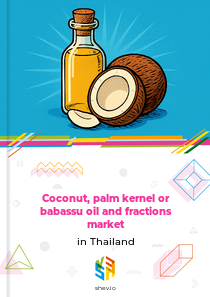
The market volume for coconut, palm kernel, and babassu oils in Thailand expanded significantly from 186 thousand tonnes in 2018 to 255 thousand tonnes by 2020, with most of the growth occurring in 2019. The market stabilized at this level in 2020. However, in 2021, the volume contracted sharply to 144 thousand tonnes, primarily due to a substantial increase in exports that year.
The market recovered strongly in 2022, reaching 221 thousand tonnes, and continued to grow to 239 thousand tonnes in 2023. The expansion in 2022 was supported by broader industry growth driven by rising demand from the food, oleochemical, and biodiesel sectors. Government policies promoting increased oil palm cultivation for biodiesel production to reduce diesel imports also contributed to supporting domestic production and market volume.
Looking ahead, the industry has been shaped by measures such as a ban on exports of crude palm oil to balance the domestic market and a policy shift to promote B5 biodiesel blending, reflecting ongoing adjustments to both local and global market dynamics.
Table of content
- 1. Disclaimer
- 2. Terms of use of the report
- 3. Product codes in the statistical classifications used in the report
-
4. Key Market Indicators and Trends
-
4.1. Key Market Indicators
-
4.1.1. In kind
- 4.1.1.1. Production, 2018-2023
- 4.1.1.2. Imports, 2018-2024
- 4.1.1.3. Exports, 2018-2024
- 4.1.1.4. Market size, 2018-2023
-
4.1.1. In kind
- 4.2. Market Trends and Factors
-
4.1. Key Market Indicators
-
5. Production
-
5.1. Production in Thailand
- 5.1.1. Annual dynamics of production in Thailand in kind, 2018-2023, K t
- 5.1.2. Annual dynamics of production in Thailand in value, 2018-2023, $ US
-
5.2. Global production by Country, 2018-2023
- 5.2.1. Annual dynamics of production by macroregions in kind, 2018-2023, K t
- 5.2.2. Dynamics of production structure by macroregions in kind, 2018-2023
- 5.2.3. Annual dynamics of production by country in kind, 2018-2023, K t
- 5.2.4. Structure of production by countries in kind, 2018-2023
- 5.2.5. Dynamics of peoduction structure by countries in kind, 2018-2023
-
5.1. Production in Thailand
-
6. Imports
-
6.1. Imports (Direct Data)
- 6.1.1. Imports - Total information
-
6.1.2. Imports in kind, K t
- 6.1.2.1. Annual dynamics of product's imports to Thailand in kind, 2018-2024, K t
- 6.1.2.2. Dynamics of product's imports in kind to Thailand by countries, 2018-2024, K t
- 6.1.2.3. Structure of product's imports in kind by countries, 2018-2024
-
6.1.3. Imports in value, M $ US
- 6.1.3.1. Annual dynamics of product's imports to Thailand in value, 2018-2024, M $ US
- 6.1.3.2. Dynamics of product's imports in value to Thailand by countries, 2018-2024, M $ US
- 6.1.3.3. Structure of product's imports in value by countries, 2018-2024
-
6.1.4. Average price of product's imports, $ US/t
- 6.1.4.1. Annual dynamics of average price of product's imports to Thailand, 2018-2024, $ US/t
- 6.1.4.2. Dynamics of average price of product's imports to Thailand by countries, 2018-2024, $ US/t
-
6.2. Imports (Mirror Data)
- 6.2.1. Imports - Total information
-
6.2.2. Imports in kind, K t
- 6.2.2.1. Annual dynamics of product's imports to Thailand in kind, 2018-2024, K t
- 6.2.2.2. Dynamics of product's imports in kind to Thailand by countries, 2018-2024, K t
- 6.2.2.3. Structure of product's imports in kind by countries, 2018-2024
-
6.2.3. Imports in value, M $ US
- 6.2.3.1. Annual dynamics of product's imports to Thailand in value, 2018-2024, M $ US
- 6.2.3.2. Dynamics of product's imports in value to Thailand by countries, 2018-2024, M $ US
- 6.2.3.3. Structure of product's imports in value by countries, 2018-2024
-
6.2.4. Average price of product's imports, $ US/t
- 6.2.4.1. Annual dynamics of average price of product's imports to Thailand, 2018-2024, $ US/t
- 6.2.4.2. Dynamics of average price of product's imports to Thailand by countries, 2018-2024, $ US/t
-
6.1. Imports (Direct Data)
-
7. Exports
-
7.1. Exports (Direct Data)
- 7.1.1. Exports - Total information
-
7.1.2. Exports in kind, K t
- 7.1.2.1. Annual dynamics of product's exports from Thailand in kind, 2018-2024, K t
- 7.1.2.2. Dynamics of product's exports in kind from Thailand by countries, 2018-2024, K t
- 7.1.2.3. Structure of product's exports in kind by countries, 2018-2024
-
7.1.3. Exports in value, M $ US
- 7.1.3.1. Annual dynamics of product's exports from Thailand in value, 2018-2024, M $ US
- 7.1.3.2. Dynamics of product's exports in value from Thailand by countries, 2018-2024, M $ US
- 7.1.3.3. Structure of product's exports in value by countries, 2018-2024
-
7.1.4. Average price of product's exports, $ US/t
- 7.1.4.1. Annual dynamics of average price of product's exports from Thailand, 2018-2024, $ US/t
- 7.1.4.2. Dynamics of average price of product's exports from Thailand by countries, 2018-2024, $ US/t
-
7.2. Exports (Mirror Data)
- 7.2.1. Exports - Total information
-
7.2.2. Exports in kind, K t
- 7.2.2.1. Annual dynamics of product's exports from Thailand in kind, 2018-2024, K t
- 7.2.2.2. Dynamics of product's exports in kind from Thailand by countries, 2018-2024, K t
- 7.2.2.3. Structure of product's exports in kind by countries, 2018-2024
-
7.2.3. Exports in value, M $ US
- 7.2.3.1. Annual dynamics of product's exports from Thailand in value, 2018-2024, M $ US
- 7.2.3.2. Dynamics of product's exports in value from Thailand by countries, 2018-2024, M $ US
- 7.2.3.3. Structure of product's exports in value by countries, 2018-2024
-
7.2.4. Average price of product's exports, $ US/t
- 7.2.4.1. Annual dynamics of average price of product's exports from Thailand, 2018-2024, $ US/t
- 7.2.4.2. Dynamics of average price of product's exports from Thailand by countries, 2018-2024, $ US/t
-
7.1. Exports (Direct Data)
-
8. Trade balance
-
8.1. Trade balance (Direct Data)
- 8.1.1. In kind, K t
- 8.1.2. In value, M $ US
-
8.2. Trade balance (Mirror Data)
- 8.2.1. In kind, K t
- 8.2.2. In value, M $ US
-
8.1. Trade balance (Direct Data)
-
9. Top buying and selling countries, 2018-2024
-
9.1. Direct Data
- 9.1.1. Import in Value by Countries-buyers
- 9.1.2. Export in Value by Countries-suppliers
-
9.2. Mirror Data
- 9.2.1. Import in Value by Countries-buyers
- 9.2.2. Export in Value by Countries-suppliers
-
9.1. Direct Data
Production coconut, palm kernel or babassu oil and fractions in Thailand
In kind, 2017-2020, K t
Thailand ranked 5th globally in the production of coconut, palm kernel, or babassu oil and fractions from 2017 to 2020.
Top producers of coconut, palm kernel or babassu oil and fractions, 2017-2020
World map of production of coconut, palm kernel or babassu oil and fractions, 2017-2020
Thailand's production of coconut, palm kernel, or babassu oil and fractions declined after two years of growth. In 2020, output reached 281.5 K t, marking a modest year-over-year decrease of 7.4%. Over the 2017-2020 period, production rose by 6.5%, averaging an annual growth rate of 2.1%. The peak was recorded in 2019 at 304.0 K t, with the largest increase occurring in 2018 at 7.4%.
Annual dynamics of production in Thailand in kind, 2017-2020, K t
| Parameter | 2018 | 2019 | 2020 | CAGR | |
|---|---|---|---|---|---|
| 1 | Change from last year | 7.4% | 7.2% | (7.4%) | 2.1% |
Exports coconut, palm kernel or babassu oil and fractions from Thailand
Exports in kind, K t
In 2020, Thailand exported 68.1 K t of coconut, palm kernel, or babassu oil and fractions, showing a slight increase of 5.7% from 2019. From 2017 to 2020, exports fell by 39%, with a compound annual growth rate of -15.2%. The lowest export volume was in 2019 at 64.5 K t, while the highest was in 2018 at 116.0 K t. The most significant drop occurred in 2019, with a decline of 44.4%.
Annual dynamics of product's exports from Thailand in kind, 2017-2020, K t
| Parameter | 2018 | 2019 | 2020 | CAGR | |
|---|---|---|---|---|---|
| 1 | Change from last year | 3.9% | (44.4%) | 5.7% | (15.2%) |
From 2017 to 2020, Malaysia was nearly the sole buyer of Thailand's coconut, palm kernel, or babassu oil and fractions, accounting for 100.0% of total exports in volume terms.
Structure of product's exports in kind by countries, 2017-2020
World map of product's exports from Thailand in kind, 2017-2020
Exports in value, M $ US
Thailand's exports of coconut, palm kernel, or babassu oil and fractions in value terms increased after a two-year decline. In 2020, exports totaled 54.0 M $ US, representing a sharp rise of 35.4% compared to the previous year. Over the 2017-2020 period, exports decreased by 61.9%, averaging an annual decline of 27.5%. The lowest value was recorded in 2019 at 39.9 M $ US, with the largest drop also in 2019 at 65.9%.
Annual dynamics of product's exports from Thailand in value, 2017-2020, M $ US
| Parameter | 2018 | 2019 | 2020 | CAGR | |
|---|---|---|---|---|---|
| 1 | Change from last year | (17.7%) | (65.9%) | 35.4% | (27.5%) |
Between 2017 and 2020, the export structure in value terms was heavily concentrated, with Malaysia dominating as the primary market, holding a 94.4% share of total flows.
Structure of product's exports in value by countries, 2017-2020
World map of product's exports from Thailand in value, 2017-2020
Imports coconut, palm kernel or babassu oil and fractions to Thailand
Imports in kind, K t
The import market exhibited volatility during the observed period. The lowest import volume was in 2019 at 15.2 K t, while the highest was in 2020 at 41.9 K t, resulting in a 2.8-fold difference. In 2020, Thailand imported approximately 41.9 K t of coconut, palm kernel, or babassu oil and fractions, reflecting a dramatic increase of 176.4% from the previous year. The largest decline occurred in 2018 at 25.1%.
Annual dynamics of product's imports to Thailand in kind, 2017-2020, K t
| Parameter | 2018 | 2019 | 2020 | CAGR | |
|---|---|---|---|---|---|
| 1 | Change from last year | (25.1%) | (15.2%) | 176.4% | 20.6% |
Throughout 2017-2020, Indonesia was the dominant source for Thailand's imports of coconut, palm kernel, or babassu oil and fractions in volume terms, consistently representing 100.0% of total flows.
Structure of product's imports in kind by countries, 2017-2020
World map of product's imports to Thailand in kind, 2017-2020
Imports in value, M $ US
The import market in value terms showed signs of volatility over the period. The minimum value was in 2019 at 10.7 M $ US, and the maximum was in 2020 at 38.5 M $ US, creating a 3.6-fold variation. In 2020, Thailand's imports totaled 38.5 M $ US, indicating a substantial gain of 258.3% from the year before. The largest decrease was recorded in 2018 at 48.1%.
Annual dynamics of product's imports to Thailand in value, 2017-2020, M $ US
| Parameter | 2018 | 2019 | 2020 | CAGR | |
|---|---|---|---|---|---|
| 1 | Change from last year | (48.1%) | (42.0%) | 258.3% | 2.6% |
From 2017 to 2020, Indonesia almost entirely shaped the geographical structure of Thailand's imports in value terms for coconut, palm kernel, or babassu oil and fractions, with a 100.0% share of total flows.
Structure of product's imports in value by countries, 2017-2020
World map of product's imports to Thailand in value, 2017-2020
Related Reports


Sesame oil and fractions market in Thailand
2026-03-28

Castor oil and fractions market in Thailand
2026-03-28


Why Choose Us?
Only Verified Data
No Hidden Costs or Separate Fees
Smarter Subscription Pricing
Contact Our Team
Submit your inquiry using the form below — our team will get back to you within 24 hours.