






"Middle Africa" region includes following countries:
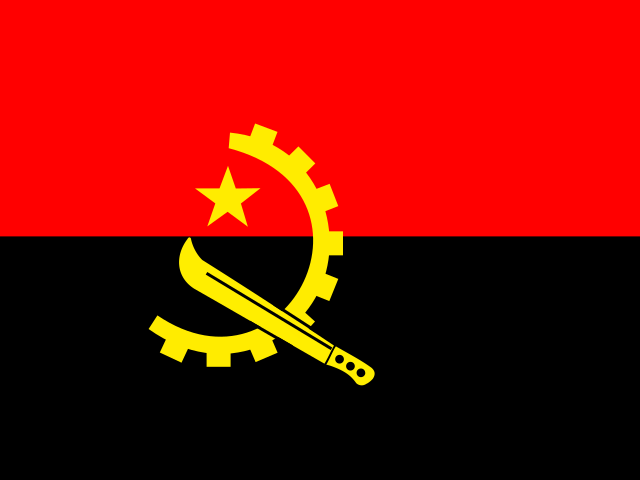 Angola
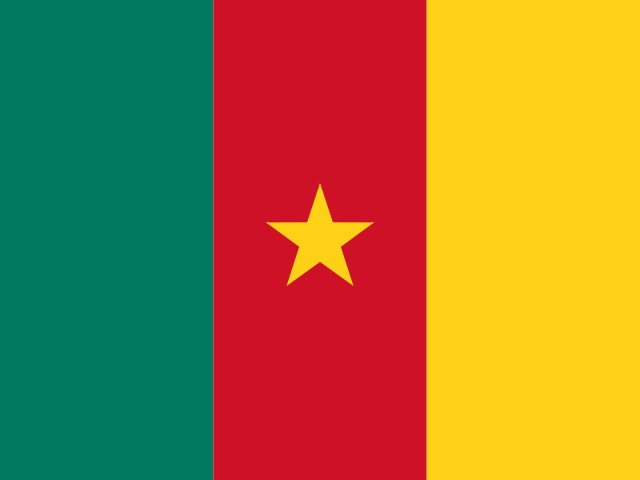 Cameroon
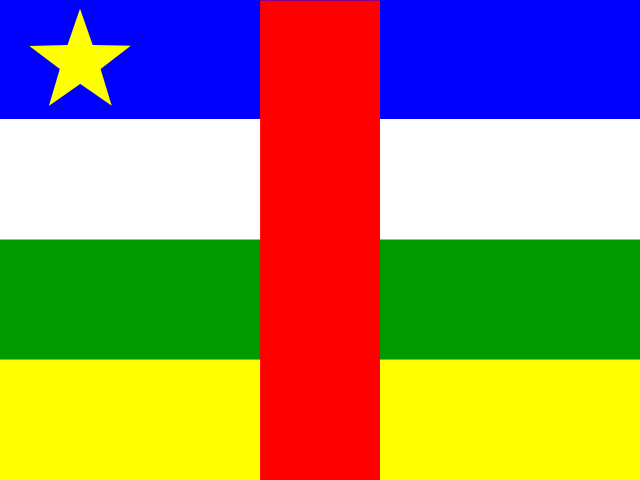 Central African Republic
 Chad
Chad Congo
Congo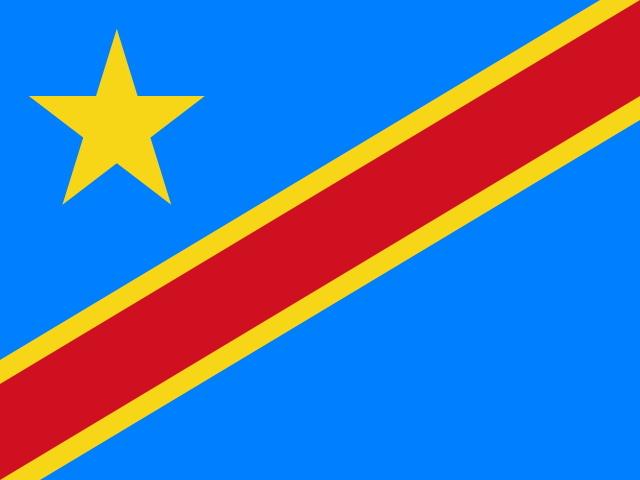 Democratic Republic of the Congo
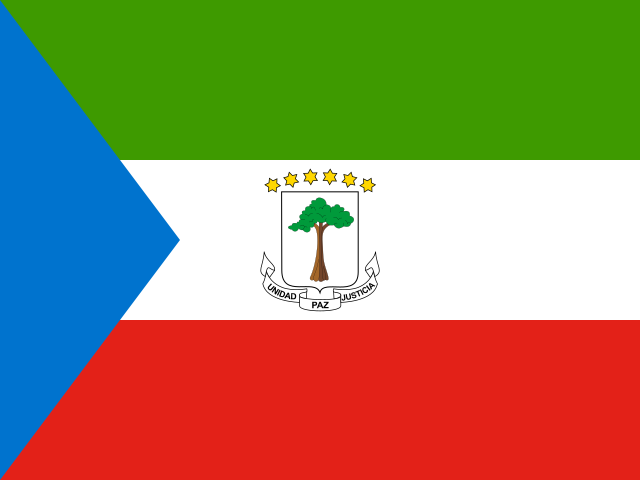 Equatorial Guinea
 Gabon
Gabon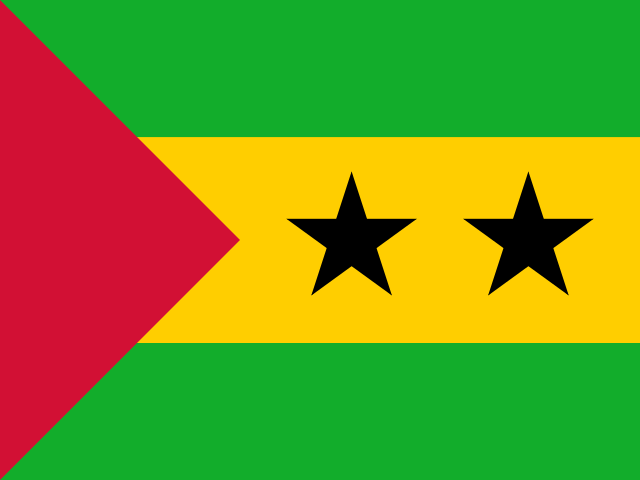 Sao Tome and Principe
Earlier Report Observations
The soybean oil market in Middle Africa showed significant volatility between 2018 and 2023. Market volume started at 162.5 thousand tons in 2018, then contracted to 112.6 thousand tons in 2019 and 98.5 thousand tons in 2020.
A rebound occurred from 2021 to 2022, with market size reaching 121.4 thousand tons and then 144.2 thousand tons, before falling again to 94.8 thousand tons in 2023. These movements were largely driven by swings in import volumes, which dropped from 150.4 thousand tons in 2018 to 81.1 thousand tons in 2020, then recovered to 127.5 thousand tons in 2022, while domestic production increased steadily from 12.1 thousand tons to 18.4 thousand tons over the period.
In 2024, import volume rose to 86.1 thousand tons, a change supported by lower global soybean oil prices following a record harvest in the United States, which enhanced affordability for import-dependent markets in the region.
Table of content
- 1. Disclaimer
- 2. Terms of use of the report
- 3. Product codes in the statistical classifications used in the report
-
4. Key Market Indicators and Trends
-
4.1. Key Market Indicators
-
4.1.1. In kind
- 4.1.1.1. Production, 2018-2023
- 4.1.1.2. Imports, 2018-2024
- 4.1.1.3. Exports, 2018-2024
- 4.1.1.4. Market size, 2018-2023
-
4.1.1. In kind
- 4.2. Market Trends and Factors
-
4.1. Key Market Indicators
-
5. Production
-
5.1. Production in Middle Africa
- 5.1.1. Annual dynamics of production in Middle Africa in kind, 2018-2023, t
-
5.2. Global production by Country, 2018-2023
- 5.2.1. Annual dynamics of production by macroregions in kind, 2018-2023, t
- 5.2.2. Dynamics of production structure by macroregions in kind, 2018-2023
- 5.2.3. Annual dynamics of production by country in kind, 2018-2023, t
- 5.2.4. Structure of production by countries in kind, 2018-2023
- 5.2.5. Dynamics of peoduction structure by countries in kind, 2018-2023
-
5.1. Production in Middle Africa
-
6. Imports
-
6.1. Imports (Direct Data*)
- 6.1.1. Imports - Total information
-
6.1.2. Imports in kind, K t
- 6.1.2.1. Annual dynamics of product's imports to Angola in kind, 2018-2024, K t
- 6.1.2.2. Dynamics of product's imports in kind to Angola by countries, 2018-2024, K t
- 6.1.2.3. Structure of product's imports in kind by countries, 2018-2024
-
6.1.3. Imports in value, M $ US
- 6.1.3.1. Annual dynamics of product's imports to Angola in value, 2018-2024, M $ US
- 6.1.3.2. Dynamics of product's imports in value to Angola by countries, 2018-2024, M $ US
- 6.1.3.3. Structure of product's imports in value by countries, 2018-2024
-
6.1.4. Average price of product's imports, $ US/t
- 6.1.4.1. Annual dynamics of average price of product's imports to Angola, 2018-2024, $ US/t
- 6.1.4.2. Dynamics of average price of product's imports to Angola by countries, 2018-2024, $ US/t
-
6.2. Imports (Mirror Data)
- 6.2.1. Imports - Total information
-
6.2.2. Imports in kind, K t
- 6.2.2.1. Annual dynamics of product's imports to Angola in kind, 2018-2024, K t
- 6.2.2.2. Dynamics of product's imports in kind to Angola by countries, 2018-2024, K t
- 6.2.2.3. Structure of product's imports in kind by countries, 2018-2024
-
6.2.3. Imports in value, M $ US
- 6.2.3.1. Annual dynamics of product's imports to Angola in value, 2018-2024, M $ US
- 6.2.3.2. Dynamics of product's imports in value to Angola by countries, 2018-2024, M $ US
- 6.2.3.3. Structure of product's imports in value by countries, 2018-2024
-
6.2.4. Average price of product's imports, $ US/t
- 6.2.4.1. Annual dynamics of average price of product's imports to Angola, 2018-2024, $ US/t
- 6.2.4.2. Dynamics of average price of product's imports to Angola by countries, 2018-2024, $ US/t
-
6.1. Imports (Direct Data*)
-
7. Exports
-
7.1. Exports (Direct Data*)
- 7.1.1. Exports - Total information
-
7.1.2. Exports in kind, K t
- 7.1.2.1. Annual dynamics of product's exports from Angola in kind, 2018-2024, K t
- 7.1.2.2. Dynamics of product's exports in kind from Angola by countries, 2018-2024, K t
- 7.1.2.3. Structure of product's exports in kind by countries, 2018-2024
-
7.1.3. Exports in value, M $ US
- 7.1.3.1. Annual dynamics of product's exports from Angola in value, 2018-2024, M $ US
- 7.1.3.2. Dynamics of product's exports in value from Angola by countries, 2018-2024, M $ US
- 7.1.3.3. Structure of product's exports in value by countries, 2018-2024
-
7.1.4. Average price of product's exports, $ US/t
- 7.1.4.1. Annual dynamics of average price of product's exports from Angola, 2018-2024, $ US/t
- 7.1.4.2. Dynamics of average price of product's exports from Angola by countries, 2018-2024, $ US/t
-
7.2. Exports (Mirror Data)
- 7.2.1. Exports - Total information
-
7.2.2. Exports in kind, K t
- 7.2.2.1. Annual dynamics of product's exports from Angola in kind, 2018-2024, K t
- 7.2.2.2. Dynamics of product's exports in kind from Angola by countries, 2018-2024, K t
- 7.2.2.3. Structure of product's exports in kind by countries, 2018-2024
-
7.2.3. Exports in value, M $ US
- 7.2.3.1. Annual dynamics of product's exports from Angola in value, 2018-2024, M $ US
- 7.2.3.2. Dynamics of product's exports in value from Angola by countries, 2018-2024, M $ US
- 7.2.3.3. Structure of product's exports in value by countries, 2018-2024
-
7.2.4. Average price of product's exports, $ US/t
- 7.2.4.1. Annual dynamics of average price of product's exports from Angola, 2018-2024, $ US/t
- 7.2.4.2. Dynamics of average price of product's exports from Angola by countries, 2018-2024, $ US/t
-
7.1. Exports (Direct Data*)
-
8. Trade balance
-
8.1. Trade balance (Direct Data)
- 8.1.1. In kind, K t
- 8.1.2. In value, M $ US
-
8.2. Trade balance (Mirror Data)
- 8.2.1. In kind, K t
- 8.2.2. In value, M $ US
-
8.1. Trade balance (Direct Data)
-
9. Top buying and selling countries, 2018-2024
-
9.1. Direct Data
- 9.1.1. Import in Value by Countries-buyers
- 9.1.2. Export in Value by Countries-suppliers
-
9.2. Mirror Data
- 9.2.1. Import in Value by Countries-buyers
- 9.2.2. Export in Value by Countries-suppliers
-
9.1. Direct Data
Production soybean oil and fractions in Middle Africa
In kind, 2017-2020, t
Top producers of soybean oil and fractions, 2017-2020
World map of production of soybean oil and fractions, 2017-2020
Soybean oil and fractions production in Middle Africa has increased for the third consecutive year. In 2020, production reached 17,480 tonnes, which is 41.5% higher than in 2019. Looking at the period from 2017 to 2020, production grew by 54.9%, translating to an average annual growth rate of 15.7%.
Annual dynamics of production in Middle Africa in kind, 2017-2020, t
| Parameter | 2018 | 2019 | 2020 | CAGR | |
|---|---|---|---|---|---|
| 1 | Change from last year | 7.1% | 2.2% | 41.5% | 15.7% |
Exports soybean oil and fractions from Middle Africa
Exports in kind, K t
The data shows irregular changes, indicating a volatile market environment. Export levels fluctuated significantly, with a 222-fold difference between the low in 2017 and the high in 2019. In 2020, Middle Africa exported 0.1 thousand tonnes of soybean oil and fractions, marking a sharp drop of 91.3% compared to 2019. The peak was recorded in 2019 at 0.7 thousand tonnes, with the largest increase that year reaching 9,961.9%.
Annual dynamics of product's exports from Middle Africa in kind, 2017-2020, K t
| Parameter | 2018 | 2019 | 2020 | CAGR | |
|---|---|---|---|---|---|
| 1 | Change from last year | 120.3% | 9 961.9% | (91.3%) | 168.3% |
Between 2017 and 2020, Zambia and Spain together accounted for 2.5% of total exports in kind, making them the primary markets for soybean oil and fractions from Middle Africa.
Structure of product's exports in kind by countries, 2017-2020
World map of product's exports from Middle Africa in kind, 2017-2020
Exports in value, M $ US
Volatility characterized the market behavior during these years. A 116-fold variation was observed between the minimum in 2017 and the maximum in 2019. In 2020, soybean oil and fractions exports from Middle Africa amounted to 0.1 million US dollars, reflecting a contraction of 93.2% compared to the previous year. The highest value was recorded in 2019 at 1.0 million US dollars, with the largest increase that year reaching 8,264.3%.
Annual dynamics of product's exports from Middle Africa in value, 2017-2020, M $ US
| Parameter | 2018 | 2019 | 2020 | CAGR | |
|---|---|---|---|---|---|
| 1 | Change from last year | 39.2% | 8 264.3% | (93.2%) | 99.2% |
Over the period 2017–2020, Spain (2.3% of exports in value terms), Zambia (1.8%), and Namibia (0.9%) led the ranking of buyers for soybean oil and fractions from Middle Africa. Their combined share reached 5.1% of total exports in value terms.
Structure of product's exports in value by countries, 2017-2020
World map of product's exports from Middle Africa in value, 2017-2020
Imports soybean oil and fractions to Middle Africa
Imports in kind, K t
Volatility characterized the market behavior during these years. Imports varied widely, with a 5-fold gap between the trough in 2017 and the peak in 2018. In 2020, soybean oil and fractions shipments to Middle Africa from abroad reached 81.1 thousand tonnes, which is 19.6% less than in 2019. The maximum value was recorded in 2018 at 150.4 thousand tonnes. The largest decline occurred in 2019 at 32.9%, while the largest increase was in 2018 at 400.6%.
Annual dynamics of product's imports to Middle Africa in kind, 2017-2020, K t
| Parameter | 2018 | 2019 | 2020 | CAGR | |
|---|---|---|---|---|---|
| 1 | Change from last year | 400.6% | (32.9%) | (19.6%) | 39.2% |
From 2017 to 2020, Portugal (43.5% of imports in kind), Indonesia (24.0%), and Malaysia (13.7%) formed the main group of sources for soybean oil and fractions imports to Middle Africa, with a combined share of 81.3% of total flows.
Structure of product's imports in kind by countries, 2017-2020
World map of product's imports to Middle Africa in kind, 2017-2020
Imports in value, M $ US
The market showed signs of volatility over the observed period. Import volumes varied 2.8 times from the low in 2017 to the high in 2018. In 2020, soybean oil and fractions deliveries to Middle Africa amounted to 95.1 million US dollars, representing a decline of 23.2% compared to 2019. The maximum value was recorded in 2018 at 127.1 million US dollars, with the largest increase that year reaching 177.7%.
Annual dynamics of product's imports to Middle Africa in value, 2017-2020, M $ US
| Parameter | 2018 | 2019 | 2020 | CAGR | |
|---|---|---|---|---|---|
| 1 | Change from last year | 177.7% | (2.5%) | (23.2%) | 27.6% |
In 2017–2020, Portugal (56.3% of imports in value terms), Malaysia (13.9%), and Indonesia (7.8%) formed the main cluster of markets for imports in value terms, with a combined share of 78.0% of total flows.
Structure of product's imports in value by countries, 2017-2020
World map of product's imports to Middle Africa in value, 2017-2020
Related Reports
Soybean oil and fractions market in Sweden
2026-03-28
Soybean oil and fractions market in Africa
2026-03-28



Why Choose Us?
Only Verified Data
No Hidden Costs or Separate Fees
Smarter Subscription Pricing
Contact Our Team
Submit your inquiry using the form below — our team will get back to you within 24 hours.