






"Northern Africa" region includes following countries:
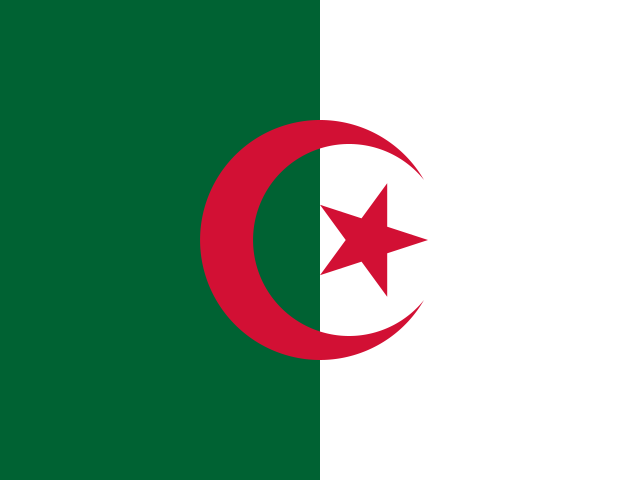 Algeria
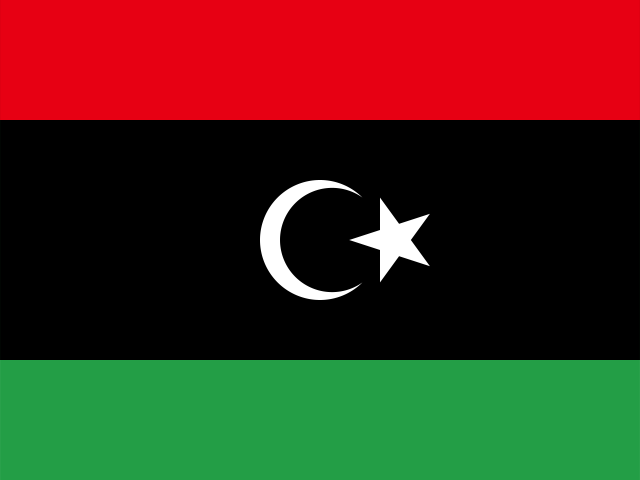 Libya
Libya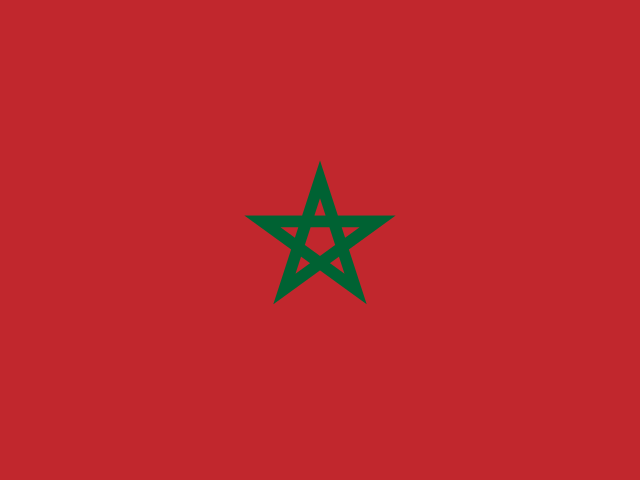 Morocco
 Sudan
Sudan Western Sahara
 Tunisia
 Egypt
EgyptEarlier Report Observations
The camel meat market in Northern Africa began a steady expansion from 2018, with production rising from 194,000 tons to over 203,000 tons by 2019. This initial growth was supported by a significant increase in the regional camel herd, notably in Morocco where the number of heads grew from 140,000 to 171,000 between 2008 and 2018. The wider adoption of modern preservation techniques like vacuum and modified atmosphere packaging improved product shelf life and marketability. Concurrently, consumer interest grew as camel meat was increasingly recognized as a lean, therapeutic alternative to traditional red meats.
Market dynamics shifted in 2020 as the COVID-19 pandemic disrupted supply chains, contributing to a period of stabilization in production volumes. However, underlying demand remained stable, particularly in arid regions where camel meat is a local staple. The subsequent surge in production to nearly 219,000 tons in 2021 was fueled by traders seeking new export markets in West African countries like Côte d'Ivoire and Nigeria, partly due to security risks in the Sahel. Climate change further reinforced the camel's value as a resilient source of meat adapted to dry conditions, supporting this growth phase.
Growth moderated after 2021, with production reaching 222,300 tons in 2023. The market was increasingly shaped by the dietary appeal of camel meat, prized for its leanness and high collagen content, which influenced consumer preferences across North Africa. Development in related sectors, such as camel milk production in Algeria, also sustained focus on the camelid sector, even as it faced infrastructure challenges like access to veterinary supplies and cold storage in remote areas.
Table of content
- 1. Disclaimer
- 2. Terms of use of the report
- 3. Product codes in the statistical classifications used in the report
-
4. Key Market Indicators and Trends
-
4.1. Key Market Indicators
-
4.1.1. In kind
- 4.1.1.1. Production, 2018-2023
- 4.1.1.2. Imports, 2019-2024
- 4.1.1.3. Exports, 2019-2024
- 4.1.1.4. Market size, 2019-2023
-
4.1.1. In kind
- 4.2. Market Trends and Factors
-
4.1. Key Market Indicators
-
5. Production
-
5.1. Production in Northern Africa
- 5.1.1. Annual dynamics of production in Northern Africa in kind, 2018-2023, K t
-
5.2. Global production by Country, 2018-2023
- 5.2.1. Annual dynamics of production by macroregions in kind, 2018-2023, K t
- 5.2.2. Dynamics of production structure by macroregions in kind, 2018-2023
- 5.2.3. Annual dynamics of production by country in kind, 2018-2023, K t
- 5.2.4. Structure of production by countries in kind, 2018-2023
- 5.2.5. Dynamics of peoduction structure by countries in kind, 2018-2023
-
5.1. Production in Northern Africa
-
6. Imports
-
6.1. Imports (Direct Data*)
- 6.1.1. Imports - Total information
-
6.1.2. Imports in kind, t
- 6.1.2.1. Annual dynamics of product's imports to Algeria in kind, 2019-2024, t
- 6.1.2.2. Dynamics of product's imports in kind to Algeria by countries, 2019-2024, t
- 6.1.2.3. Structure of product's imports in kind by countries, 2019-2024
-
6.1.3. Imports in value, K $ US
- 6.1.3.1. Annual dynamics of product's imports to Algeria in value, 2019-2024, K $ US
- 6.1.3.2. Dynamics of product's imports in value to Algeria by countries, 2019-2024, K $ US
- 6.1.3.3. Structure of product's imports in value by countries, 2019-2024
-
6.1.4. Average price of product's imports, $ US/t
- 6.1.4.1. Annual dynamics of average price of product's imports to Algeria, 2019-2024, $ US/t
- 6.1.4.2. Dynamics of average price of product's imports to Algeria by countries, 2019-2024, $ US/t
-
6.2. Imports (Mirror Data)
- 6.2.1. Imports - Total information
-
6.2.2. Imports in kind, t
- 6.2.2.1. Annual dynamics of product's imports to Algeria in kind, 2019-2024, t
- 6.2.2.2. Dynamics of product's imports in kind to Algeria by countries, 2019-2024, t
- 6.2.2.3. Structure of product's imports in kind by countries, 2019-2024
-
6.2.3. Imports in value, K $ US
- 6.2.3.1. Annual dynamics of product's imports to Algeria in value, 2019-2024, K $ US
- 6.2.3.2. Dynamics of product's imports in value to Algeria by countries, 2019-2024, K $ US
- 6.2.3.3. Structure of product's imports in value by countries, 2019-2024
-
6.2.4. Average price of product's imports, $ US/t
- 6.2.4.1. Annual dynamics of average price of product's imports to Algeria, 2019-2024, $ US/t
- 6.2.4.2. Dynamics of average price of product's imports to Algeria by countries, 2019-2024, $ US/t
-
6.1. Imports (Direct Data*)
-
7. Exports
-
7.1. Exports (Direct Data*)
- 7.1.1. Exports - Total information
-
7.1.2. Exports in kind, t
- 7.1.2.1. Annual dynamics of product's exports from Algeria in kind, 2019-2024, t
- 7.1.2.2. Dynamics of product's exports in kind from Algeria by countries, 2019-2024, t
- 7.1.2.3. Structure of product's exports in kind by countries, 2019-2024
-
7.1.3. Exports in value, K $ US
- 7.1.3.1. Annual dynamics of product's exports from Algeria in value, 2019-2024, K $ US
- 7.1.3.2. Dynamics of product's exports in value from Algeria by countries, 2019-2024, K $ US
- 7.1.3.3. Structure of product's exports in value by countries, 2019-2024
-
7.1.4. Average price of product's exports, $ US/t
- 7.1.4.1. Annual dynamics of average price of product's exports from Algeria, 2019-2024, $ US/t
- 7.1.4.2. Dynamics of average price of product's exports from Algeria by countries, 2019-2024, $ US/t
-
7.2. Exports (Mirror Data)
- 7.2.1. Exports - Total information
-
7.2.2. Exports in kind, t
- 7.2.2.1. Annual dynamics of product's exports from Algeria in kind, 2019-2024, t
- 7.2.2.2. Dynamics of product's exports in kind from Algeria by countries, 2019-2024, t
- 7.2.2.3. Structure of product's exports in kind by countries, 2019-2024
-
7.2.3. Exports in value, K $ US
- 7.2.3.1. Annual dynamics of product's exports from Algeria in value, 2019-2024, K $ US
- 7.2.3.2. Dynamics of product's exports in value from Algeria by countries, 2019-2024, K $ US
- 7.2.3.3. Structure of product's exports in value by countries, 2019-2024
-
7.2.4. Average price of product's exports, $ US/t
- 7.2.4.1. Annual dynamics of average price of product's exports from Algeria, 2019-2024, $ US/t
- 7.2.4.2. Dynamics of average price of product's exports from Algeria by countries, 2019-2024, $ US/t
-
7.1. Exports (Direct Data*)
-
8. Trade balance
-
8.1. Trade balance (Direct Data)
- 8.1.1. In kind, t
- 8.1.2. In value, K $ US
-
8.2. Trade balance (Mirror Data)
- 8.2.1. In kind, t
- 8.2.2. In value, K $ US
-
8.1. Trade balance (Direct Data)
-
9. Top buying and selling countries, 2019-2024
-
9.1. Direct Data
- 9.1.1. Import in Value by Countries-buyers
- 9.1.2. Export in Value by Countries-suppliers
-
9.2. Mirror Data
- 9.2.1. Import in Value by Countries-buyers
- 9.2.2. Export in Value by Countries-suppliers
-
9.1. Direct Data
Production camel meat and offal in Northern Africa
In kind, 2017-2020, K t
Top producers of camel meat and offal, 2017-2020
World map of production of camel meat and offal, 2017-2020
In 2020, Northern Africa produced 203.3 K t of camel meat and offal, which remained virtually unchanged from the previous year. The lowest production level was recorded in 2018 at 194.0 K t, representing a 5.1% decline from 2019. In contrast, 2019 saw the largest increase of 5.1%.
Annual dynamics of production in Northern Africa in kind, 2017-2020, K t
| Parameter | 2018 | 2019 | 2020 | CAGR | |
|---|---|---|---|---|---|
| 1 | Change from last year | (5.1%) | 5.1% | (0.3%) | (0.2%) |
Exports camel meat and offal from Northern Africa
Exports in kind, t
The market showed an unstable trend throughout the period. Export volumes reached their peak in 2018 at 7 t, then fell to their lowest point in 2020 at 0.3 t, marking a 29-fold difference between these years. In 2020, Northern Africa's camel meat and offal exports decreased by 75.0% compared to 2019. The largest decline occurred in 2019 at 86.0%, while the largest increase was recorded in 2018 at 2.9%.
Annual dynamics of product's exports from Northern Africa in kind, 2017-2020, t
| Parameter | 2018 | 2019 | 2020 | CAGR | |
|---|---|---|---|---|---|
| 1 | Change from last year | 2.9% | (86.0%) | (75.0%) | (67.0%) |
From 2017 to 2020, Oman was the primary destination for camel meat and offal exports from Northern Africa, consistently accounting for 100.0% of total exports in kind.
Structure of product's exports in kind by countries, 2017-2020
World map of product's exports from Northern Africa in kind, 2017-2020
Exports in value, K $ US
The data reveals irregular changes, indicating a volatile market environment. The highest export value was observed in 2018 at 32 K $ US, while the lowest was in 2020 at 1 K $ US, reflecting a 31-fold gap. In 2020, camel meat and offal deliveries from Northern Africa amounted to 1 K $ US, showing a steep reduction of 74.7% compared to 2019. The largest decline occurred in 2019 at 87.3%, and the largest increase was in 2018 at 13.7%.
Annual dynamics of product's exports from Northern Africa in value, 2017-2020, K $ US
| Parameter | 2018 | 2019 | 2020 | CAGR | |
|---|---|---|---|---|---|
| 1 | Change from last year | 13.7% | (87.3%) | (74.7%) | (66.9%) |
From 2017 to 2020, the partner base for exports in value terms was extremely narrow, with Oman alone responsible for 100.0% of total flows.
Structure of product's exports in value by countries, 2017-2020
World map of product's exports from Northern Africa in value, 2017-2020
Imports camel meat and offal to Northern Africa
Imports in kind, t
Volatility characterized the market behavior during these years. Imports peaked in 2019 at 1 011 t and fell to their minimum in 2017, showing a 3.3-fold variation. In 2020, Northern Africa imported a total of 896 t of camel meat and offal, which was an 11.4% reduction from the previous year. The largest increase was recorded in 2018 at 213.6%.
Annual dynamics of product's imports to Northern Africa in kind, 2017-2020, t
| Parameter | 2018 | 2019 | 2020 | CAGR | |
|---|---|---|---|---|---|
| 1 | Change from last year | 213.6% | 4.7% | (11.4%) | 42.8% |
From 2017 to 2020, the country structure of imports in kind was highly concentrated, with Australia alone accounting for 100.0% of total flows.
Structure of product's imports in kind by countries, 2017-2020
World map of product's imports to Northern Africa in kind, 2017-2020
Imports in value, K $ US
Volatility characterized the market behavior during these years. Imports reached their maximum in 2019 at 4 657 K $ US and fell to their lowest point in 2017, with a fluctuation of 3.4 times. In 2020, Northern Africa imported a total of 4 234 K $ US of camel meat and offal, corresponding to a moderate decrease of 9.1% compared to 2019. The largest increase was recorded in 2018 at 222.4%.
Annual dynamics of product's imports to Northern Africa in value, 2017-2020, K $ US
| Parameter | 2018 | 2019 | 2020 | CAGR | |
|---|---|---|---|---|---|
| 1 | Change from last year | 222.4% | 4.8% | (9.1%) | 45.4% |
Throughout 2017 to 2020, Australia remained the dominant and almost sole destination for imports in value terms of camel meat and offal to Northern Africa, with a share of 100.0%.
Structure of product's imports in value by countries, 2017-2020
World map of product's imports to Northern Africa in value, 2017-2020
Related Reports

Camel meat and offal market in CIS
2026-03-27
Camel meat and offal market in Kuwait
2026-03-27
Camel meat and offal market in Iran
2026-03-27


Goat meat market in Northern Africa
2026-03-27

Why Choose Us?
Only Verified Data
No Hidden Costs or Separate Fees
Smarter Subscription Pricing
Contact Our Team
Submit your inquiry using the form below — our team will get back to you within 24 hours.