






"Central Asia" region includes following countries:
 Kazakhstan
 Kyrgyzstan
 Tajikistan
 Turkmenistan
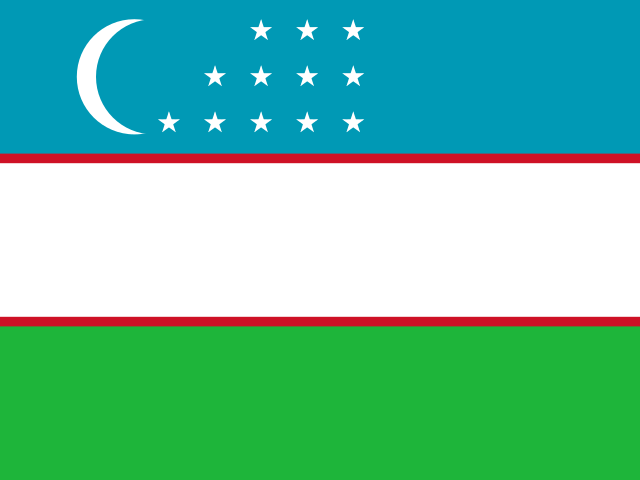 Uzbekistan
Earlier Report Observations
From 2018 to 2020, the bread market volume in Central Asia increased from 108 106 t to 120 135 t. The development of e-commerce in Uzbekistan expanded sales channels for bakery products, while state tax reductions for flour and bread producers encouraged higher output. The COVID-19 pandemic in 2020 boosted household demand for staple foods like bread, and government investment compensation programs supported capacity expansion at baking enterprises.
Market volume growth continued from 2021 to 2023, reaching 153 549 t. Ongoing state support for the agri-industrial sector, including investment subsidies and tax benefits, facilitated production increases. The import substitution trend in Kazakhstan focused the market on domestic consumption, and the entry of new players alongside the expansion of niche segments such as gluten-free and artisanal bread attracted additional consumer demand.
Table of content
- 1. Disclaimer
- 2. Terms of use of the report
- 3. Product codes in the statistical classifications used in the report
-
4. Key Market Indicators and Trends
-
4.1. Key Market Indicators
-
4.1.1. In kind
- 4.1.1.1. Production, 2018-2023
- 4.1.1.2. Imports, 2018-2024
- 4.1.1.3. Exports, 2018-2024
- 4.1.1.4. Market size, 2018-2023
-
4.1.2. In value
- 4.1.2.1. Production, 2018-2023
- 4.1.2.2. Imports, 2018-2024
- 4.1.2.3. Exports, 2018-2024
- 4.1.2.4. Market size, 2018-2023
-
4.1.1. In kind
- 4.2. Market Trends and Factors
-
4.1. Key Market Indicators
-
5. Production
-
5.1. Production in Central Asia
- 5.1.1. Annual dynamics of production in Central Asia in kind, 2018-2023, t
-
5.2. Global production by Country, 2018-2023
- 5.2.1. Annual dynamics of production by macroregions in kind, 2018-2023, t
- 5.2.2. Dynamics of production structure by macroregions in kind, 2018-2023
- 5.2.3. Annual dynamics of production by country in kind, 2018-2023, t
- 5.2.4. Structure of production by countries in kind, 2018-2023
- 5.2.5. Dynamics of peoduction structure by countries in kind, 2018-2023
-
5.1. Production in Central Asia
-
6. Imports
-
6.1. Imports (Direct Data*)
- 6.1.1. Imports - Total information
-
6.1.2. Imports in kind, t
- 6.1.2.1. Annual dynamics of product's imports to Kazakhstan in kind, 2018-2024, t
- 6.1.2.2. Dynamics of product's imports in kind to Kazakhstan by countries, 2018-2024, t
- 6.1.2.3. Structure of product's imports in kind by countries, 2018-2024
-
6.1.3. Imports in value, M $ US
- 6.1.3.1. Annual dynamics of product's imports to Kazakhstan in value, 2018-2024, M $ US
- 6.1.3.2. Dynamics of product's imports in value to Kazakhstan by countries, 2018-2024, M $ US
- 6.1.3.3. Structure of product's imports in value by countries, 2018-2024
-
6.1.4. Average price of product's imports, $ US/t
- 6.1.4.1. Annual dynamics of average price of product's imports to Kazakhstan, 2018-2024, $ US/t
- 6.1.4.2. Dynamics of average price of product's imports to Kazakhstan by countries, 2018-2024, $ US/t
-
6.2. Imports (Mirror Data)
- 6.2.1. Imports - Total information
-
6.2.2. Imports in kind, t
- 6.2.2.1. Annual dynamics of product's imports to Kazakhstan in kind, 2018-2024, t
- 6.2.2.2. Dynamics of product's imports in kind to Kazakhstan by countries, 2018-2024, t
- 6.2.2.3. Structure of product's imports in kind by countries, 2018-2024
-
6.2.3. Imports in value, M $ US
- 6.2.3.1. Annual dynamics of product's imports to Kazakhstan in value, 2018-2024, M $ US
- 6.2.3.2. Dynamics of product's imports in value to Kazakhstan by countries, 2018-2024, M $ US
- 6.2.3.3. Structure of product's imports in value by countries, 2018-2024
-
6.2.4. Average price of product's imports, $ US/t
- 6.2.4.1. Annual dynamics of average price of product's imports to Kazakhstan, 2018-2024, $ US/t
- 6.2.4.2. Dynamics of average price of product's imports to Kazakhstan by countries, 2018-2024, $ US/t
-
6.1. Imports (Direct Data*)
-
7. Exports
-
7.1. Exports (Direct Data*)
- 7.1.1. Exports - Total information
-
7.1.2. Exports in kind, t
- 7.1.2.1. Annual dynamics of product's exports from Kazakhstan in kind, 2018-2024, t
- 7.1.2.2. Dynamics of product's exports in kind from Kazakhstan by countries, 2018-2024, t
- 7.1.2.3. Structure of product's exports in kind by countries, 2018-2024
-
7.1.3. Exports in value, M $ US
- 7.1.3.1. Annual dynamics of product's exports from Kazakhstan in value, 2018-2024, M $ US
- 7.1.3.2. Dynamics of product's exports in value from Kazakhstan by countries, 2018-2024, M $ US
- 7.1.3.3. Structure of product's exports in value by countries, 2018-2024
-
7.1.4. Average price of product's exports, $ US/t
- 7.1.4.1. Annual dynamics of average price of product's exports from Kazakhstan, 2018-2024, $ US/t
- 7.1.4.2. Dynamics of average price of product's exports from Kazakhstan by countries, 2018-2024, $ US/t
-
7.2. Exports (Mirror Data)
- 7.2.1. Exports - Total information
-
7.2.2. Exports in kind, t
- 7.2.2.1. Annual dynamics of product's exports from Kazakhstan in kind, 2018-2024, t
- 7.2.2.2. Dynamics of product's exports in kind from Kazakhstan by countries, 2018-2024, t
- 7.2.2.3. Structure of product's exports in kind by countries, 2018-2024
-
7.2.3. Exports in value, M $ US
- 7.2.3.1. Annual dynamics of product's exports from Kazakhstan in value, 2018-2024, M $ US
- 7.2.3.2. Dynamics of product's exports in value from Kazakhstan by countries, 2018-2024, M $ US
- 7.2.3.3. Structure of product's exports in value by countries, 2018-2024
-
7.2.4. Average price of product's exports, $ US/t
- 7.2.4.1. Annual dynamics of average price of product's exports from Kazakhstan, 2018-2024, $ US/t
- 7.2.4.2. Dynamics of average price of product's exports from Kazakhstan by countries, 2018-2024, $ US/t
-
7.1. Exports (Direct Data*)
-
8. Trade balance
-
8.1. Trade balance (Direct Data)
- 8.1.1. In kind, t
- 8.1.2. In value, M $ US
-
8.2. Trade balance (Mirror Data)
- 8.2.1. In kind, t
- 8.2.2. In value, M $ US
-
8.1. Trade balance (Direct Data)
-
9. Top buying and selling countries, 2018-2024
-
9.1. Direct Data
- 9.1.1. Import in Value by Countries-buyers
- 9.1.2. Export in Value by Countries-suppliers
-
9.2. Mirror Data
- 9.2.1. Import in Value by Countries-buyers
- 9.2.2. Export in Value by Countries-suppliers
-
9.1. Direct Data
Production bread in Central Asia
In kind, 2017-2020, t
Top producers of bread, 2017-2020
World map of production of bread, 2017-2020
Bread production in Central Asia has grown for the third year in a row. In 2020, the region produced 59 998 tonnes of bread, representing a 1.7% increase compared to 2019. Looking at the period from 2017 to 2020, production rose by 9.8%, which translates to an average annual growth rate of 3.2%.
Annual dynamics of production in Central Asia in kind, 2017-2020, t
| Parameter | 2018 | 2019 | 2020 | CAGR | |
|---|---|---|---|---|---|
| 1 | Change from last year | 4.6% | 3.1% | 1.7% | 3.2% |
Exports bread from Central Asia
Exports in kind, t
Bread exports from Central Asia have increased for the third consecutive year. In 2020, exports reached 9 284 tonnes, showing a significant year-over-year rise of 13.7%. Over the 2017-2020 period, exports surged by 179.7%, with a compound annual growth rate of 40.9%.
Annual dynamics of product's exports from Central Asia in kind, 2017-2020, t
| Parameter | 2018 | 2019 | 2020 | CAGR | |
|---|---|---|---|---|---|
| 1 | Change from last year | 84.0% | 33.7% | 13.7% | 40.9% |
From 2017 to 2020, the main destinations for Central Asian bread exports in volume terms were Russia (24.0% of exports), Mongolia (13.2%), and China (3.1%). Together, these three countries accounted for 40.3% of total bread exports from the region.
Structure of product's exports in kind by countries, 2017-2020
World map of product's exports from Central Asia in kind, 2017-2020
Exports in value, M $ US
Bread exports from Central Asia have grown in value for the third year running. In 2020, export revenues totaled 23.0 million US dollars, marking a substantial 20.6% increase compared to the previous year. Between 2017 and 2020, the value of exports rose by 76.8%, equivalent to an average annual growth rate of 20.9%.
Annual dynamics of product's exports from Central Asia in value, 2017-2020, M $ US
| Parameter | 2018 | 2019 | 2020 | CAGR | |
|---|---|---|---|---|---|
| 1 | Change from last year | 28.0% | 14.5% | 20.6% | 20.9% |
During the 2017-2020 period, Russia (15.8% of export value), Mongolia (7.9%), and China (1.5%) remained the primary buyers of Central Asian bread in monetary terms. Collectively, these three markets represented 25.2% of total export value.
Structure of product's exports in value by countries, 2017-2020
World map of product's exports from Central Asia in value, 2017-2020
Imports bread to Central Asia
Imports in kind, t
Bread imports into Central Asia have risen for the third consecutive year. In 2020, the region imported a total of value_last_year tonnes of bread, which is 14.2% higher than in 2019. Over the 2017-2020 period, import volumes increased by 52.3%, corresponding to an average annual growth rate of 15.1%.
Annual dynamics of product's imports to Central Asia in kind, 2017-2020, t
| Parameter | 2018 | 2019 | 2020 | CAGR | |
|---|---|---|---|---|---|
| 1 | Change from last year | 25.1% | 6.6% | 14.2% | 15.1% |
From 2017 to 2020, Russia was the dominant source for bread imports into Central Asia in volume terms, accounting for 81.2% of total imports. All other markets combined made up the remaining share.
Structure of product's imports in kind by countries, 2017-2020
World map of product's imports to Central Asia in kind, 2017-2020
Imports in value, M $ US
Bread imports into Central Asia have increased in value for the third year in a row. In 2020, import expenditures reached 130.9 million US dollars, reflecting a 4.2% advance compared to 2019. Between 2017 and 2020, the value of imports grew by 44.7%, which equates to an average annual rate of 13.1%.
Annual dynamics of product's imports to Central Asia in value, 2017-2020, M $ US
| Parameter | 2018 | 2019 | 2020 | CAGR | |
|---|---|---|---|---|---|
| 1 | Change from last year | 13.8% | 22.0% | 4.2% | 13.1% |
Throughout the 2017-2020 period, Russia maintained its leading position in Central Asia's bread import market in value terms, with a 76.2% share of total import value. Other markets held relatively smaller shares.
Structure of product's imports in value by countries, 2017-2020
World map of product's imports to Central Asia in value, 2017-2020
Related Reports

2026-03-30
2026-03-30
2026-03-30
Bread market in the United Kingdom
2026-03-30


2026-03-30

Uncooked pasta market in Central Asia
2026-03-29

Why Choose Us?
Only Verified Data
No Hidden Costs or Separate Fees
Smarter Subscription Pricing
Contact Our Team
Submit your inquiry using the form below — our team will get back to you within 24 hours.