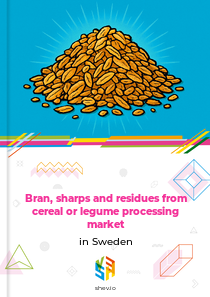







Earlier Report Observations
The market volume for bran, sharps and residues from cereal or legume processing in Sweden fluctuated between 2018 and 2024. It reached a peak of 180.1 thousand tonnes in 2022, followed by a sharp contraction to 129.1 thousand tonnes in 2023. A partial recovery to 132.3 thousand tonnes occurred in 2024, though the volume remained below the 148.9 thousand tonnes recorded in 2018.
Production trends were a key driver of market volume movements. Output surged to 195.5 thousand tonnes in 2022, supporting market growth, before dropping to 134.1 thousand tonnes in 2023. Trade flows also played a role, with imports falling to a low of 5.9 thousand tonnes in 2022 and exports declining in 2023, affecting domestic availability.
In value terms, the market showed a different pattern, reaching $32.98 million in 2022 before declining to $20.91 million by 2024. This divergence from volume trends points to significant changes in unit prices or the product mix over the period.
Table of content
- 1. Disclaimer
- 2. Terms of use of the report
- 3. Product codes in the statistical classifications used in the report
-
4. Key Market Indicators and Trends
-
4.1. Key Market Indicators
-
4.1.1. In kind
- 4.1.1.1. Production, 2018-2024
- 4.1.1.2. Imports, 2018-2024
- 4.1.1.3. Exports, 2018-2024
- 4.1.1.4. Market size, 2018-2024
-
4.1.2. In value
- 4.1.2.1. Production, 2019-2024
- 4.1.2.2. Imports, 2018-2024
- 4.1.2.3. Exports, 2018-2024
- 4.1.2.4. Market size, 2019-2024
-
4.1.1. In kind
- 4.2. Market Trends and Factors
-
4.1. Key Market Indicators
-
5. Production
-
5.1. Production in Sweden
- 5.1.1. In kind, 2018-2024, K t
- 5.1.2. In value, 2019-2024, K $ US
-
5.2. Production in the EU, 2018-2024
- 5.2.1. In kind, 2018-2024, K t
- 5.2.2. In value, 2018-2024, K $ US
-
5.3. Global production by Country, 2018-2023
-
5.3.1. Global Production by Country in kind
- 5.3.1.1. Annual dynamics of production by country in kind, 2018-2023, K t
- 5.3.1.2. Structure of production by countries in kind, 2018-2023
- 5.3.1.3. Dynamics of peoduction structure by countries in kind, 2018-2023
-
5.3.1. Global Production by Country in kind
-
5.1. Production in Sweden
-
6. Imports
-
6.1. Imports (Direct Data)
- 6.1.1. Imports - Total information
-
6.1.2. Imports in kind, t
- 6.1.2.1. Annual dynamics of product's imports to Sweden in kind, 2018-2024, t
- 6.1.2.2. Dynamics of product's imports in kind to Sweden by countries, 2018-2024, t
- 6.1.2.3. Structure of product's imports in kind by countries, 2018-2024
-
6.1.3. Imports in value, K $ US
- 6.1.3.1. Annual dynamics of product's imports to Sweden in value, 2018-2024, K $ US
- 6.1.3.2. Dynamics of product's imports in value to Sweden by countries, 2018-2024, K $ US
- 6.1.3.3. Structure of product's imports in value by countries, 2018-2024
-
6.1.4. Average price of product's imports, $ US/t
- 6.1.4.1. Annual dynamics of average price of product's imports to Sweden, 2018-2024, $ US/t
- 6.1.4.2. Dynamics of average price of product's imports to Sweden by countries, 2018-2024, $ US/t
-
6.2. Imports (Mirror Data)
- 6.2.1. Imports - Total information
-
6.2.2. Imports in kind, t
- 6.2.2.1. Annual dynamics of product's imports to Sweden in kind, 2018-2024, t
- 6.2.2.2. Dynamics of product's imports in kind to Sweden by countries, 2018-2024, t
- 6.2.2.3. Structure of product's imports in kind by countries, 2018-2024
-
6.2.3. Imports in value, K $ US
- 6.2.3.1. Annual dynamics of product's imports to Sweden in value, 2018-2024, K $ US
- 6.2.3.2. Dynamics of product's imports in value to Sweden by countries, 2018-2024, K $ US
- 6.2.3.3. Structure of product's imports in value by countries, 2018-2024
-
6.2.4. Average price of product's imports, $ US/t
- 6.2.4.1. Annual dynamics of average price of product's imports to Sweden, 2018-2024, $ US/t
- 6.2.4.2. Dynamics of average price of product's imports to Sweden by countries, 2018-2024, $ US/t
-
6.1. Imports (Direct Data)
-
7. Exports
-
7.1. Exports (Direct Data)
- 7.1.1. Exports - Total information
-
7.1.2. Exports in kind, t
- 7.1.2.1. Annual dynamics of product's exports from Sweden in kind, 2018-2024, t
- 7.1.2.2. Dynamics of product's exports in kind from Sweden by countries, 2018-2024, t
- 7.1.2.3. Structure of product's exports in kind by countries, 2018-2024
-
7.1.3. Exports in value, K $ US
- 7.1.3.1. Annual dynamics of product's exports from Sweden in value, 2018-2024, K $ US
- 7.1.3.2. Dynamics of product's exports in value from Sweden by countries, 2018-2024, K $ US
- 7.1.3.3. Structure of product's exports in value by countries, 2018-2024
-
7.1.4. Average price of product's exports, $ US/t
- 7.1.4.1. Annual dynamics of average price of product's exports from Sweden, 2018-2024, $ US/t
- 7.1.4.2. Dynamics of average price of product's exports from Sweden by countries, 2018-2024, $ US/t
-
7.2. Exports (Mirror Data)
- 7.2.1. Exports - Total information
-
7.2.2. Exports in kind, t
- 7.2.2.1. Annual dynamics of product's exports from Sweden in kind, 2018-2024, t
- 7.2.2.2. Dynamics of product's exports in kind from Sweden by countries, 2018-2024, t
- 7.2.2.3. Structure of product's exports in kind by countries, 2018-2024
-
7.2.3. Exports in value, K $ US
- 7.2.3.1. Annual dynamics of product's exports from Sweden in value, 2018-2024, K $ US
- 7.2.3.2. Dynamics of product's exports in value from Sweden by countries, 2018-2024, K $ US
- 7.2.3.3. Structure of product's exports in value by countries, 2018-2024
-
7.2.4. Average price of product's exports, $ US/t
- 7.2.4.1. Annual dynamics of average price of product's exports from Sweden, 2018-2024, $ US/t
- 7.2.4.2. Dynamics of average price of product's exports from Sweden by countries, 2018-2024, $ US/t
-
7.1. Exports (Direct Data)
-
8. Trade balance
-
8.1. Trade balance (Direct Data)
- 8.1.1. In kind, t
- 8.1.2. In value, K $ US
-
8.2. Trade balance (Mirror Data)
- 8.2.1. In kind, t
- 8.2.2. In value, K $ US
-
8.1. Trade balance (Direct Data)
-
9. Top buying and selling countries, 2018-2024
-
9.1. Direct Data
- 9.1.1. Import in Value by Countries-buyers
- 9.1.2. Export in Value by Countries-suppliers
-
9.2. Mirror Data
- 9.2.1. Import in Value by Countries-buyers
- 9.2.2. Export in Value by Countries-suppliers
-
9.1. Direct Data
Production bran, sharps and residues from cereal or legume processing in Sweden
In value, 2017-2020, K $ US
In 2020, Sweden's output of bran, sharps, and residues from cereal or legume processing was valued at 28,126 thousand US dollars, marking a significant decline of 13.7% compared to the previous year.
Annual dynamics of production in Sweden in value, 2017-2020, K $ US
| Parameter | 2018 | 2019 | 2020 | CAGR | |
|---|---|---|---|---|---|
| 1 | Change from last year | n/a | n/a | (13.7%) | - |
In kind, 2017-2020, K t
Top producers of bran, sharps and residues from cereal or legume processing, 2017-2020
World map of production of bran, sharps and residues from cereal or legume processing, 2017-2020
In 2020, Sweden produced 152.1 thousand tons of bran, sharps, and residues from cereal or legume processing, representing a 1.9% increase over the previous year. The highest production level was recorded in 2018 at 156.7 thousand tons. The largest decline occurred in 2019, with a drop of 4.7%, while the largest increase was in 2018, at 3.1%.
Annual dynamics of production in Sweden in kind, 2017-2020, K t
| Parameter | 2018 | 2019 | 2020 | CAGR | |
|---|---|---|---|---|---|
| 1 | Change from last year | 3.1% | (4.7%) | 1.9% | 0.0% |
Exports bran, sharps and residues from cereal or legume processing from Sweden
Exports in kind, t
Following two years of growth, Sweden's exports of bran, sharps, and residues from cereal or legume processing declined. In 2020, exports reached 18,555 tons, down 7.3% from the previous year. Over the period from 2017 to 2020, exports increased by 31.4%, with a compound annual growth rate of 9.5%. The peak was in 2019 at 20,020 tons, which also saw the largest increase of 22.7%.
Annual dynamics of product's exports from Sweden in kind, 2017-2020, t
| Parameter | 2018 | 2019 | 2020 | CAGR | |
|---|---|---|---|---|---|
| 1 | Change from last year | 15.6% | 22.7% | (7.3%) | 9.5% |
From 2017 to 2020, Denmark and Finland were the leading markets for Sweden's exports in kind of bran, sharps, and residues from cereal or legume processing, together accounting for 82.9% of total flows, with the remainder distributed among other destinations.
Structure of product's exports in kind by countries, 2017-2020
World map of product's exports from Sweden in kind, 2017-2020
Exports in value, K $ US
After two years of decline, Sweden's exports of bran, sharps, and residues from cereal or legume processing in value terms increased. In 2020, exports totaled 12,394 thousand US dollars, up 28.3% from the previous year. Between 2017 and 2020, exports decreased by 16.9%, equivalent to an annualized rate of 6.0%. The lowest value was recorded in 2019 at 9,660 thousand US dollars, with the largest decline occurring in 2018 at 34.7%.
Annual dynamics of product's exports from Sweden in value, 2017-2020, K $ US
| Parameter | 2018 | 2019 | 2020 | CAGR | |
|---|---|---|---|---|---|
| 1 | Change from last year | (34.7%) | (0.9%) | 28.3% | (6.0%) |
From 2017 to 2020, the Netherlands, Finland, and Denmark were the principal buyers of Sweden's bran, sharps, and residues from cereal or legume processing in value terms, accounting for 43.8%, 19.1%, and 9.6% of exports, respectively. Together, they represented 72.5% of total export value.
Structure of product's exports in value by countries, 2017-2020
World map of product's exports from Sweden in value, 2017-2020
Imports bran, sharps and residues from cereal or legume processing to Sweden
Imports in kind, t
Sweden's imports of bran, sharps, and residues from cereal or legume processing in kind increased for the second consecutive year. In 2020, import volume amounted to 11,620 tons, showing a significant rise of 12.0% compared to the previous year. Between 2017 and 2020, imports grew by 27.5%, with an annualized rate of 8.4%. The lowest volume was in 2018 at 8,601 tons, which also experienced the largest decline of 5.6%. The largest increase occurred in 2019, at 20.6%.
Annual dynamics of product's imports to Sweden in kind, 2017-2020, t
| Parameter | 2018 | 2019 | 2020 | CAGR | |
|---|---|---|---|---|---|
| 1 | Change from last year | (5.6%) | 20.6% | 12.0% | 8.4% |
Throughout 2017 to 2020, Denmark, Germany, and Finland formed the key group of partners for Sweden's imports in kind of bran, sharps, and residues from cereal or legume processing, representing 38.1%, 35.9%, and 22.1% of imports, respectively. Together, they accounted for 96.0% of total flows.
Structure of product's imports in kind by countries, 2017-2020
World map of product's imports to Sweden in kind, 2017-2020
Imports in value, K $ US
Sweden's imports of bran, sharps, and residues from cereal or legume processing in value terms increased for the third consecutive year. In 2020, imports totaled 2,651 thousand US dollars, reflecting a modest improvement of 0.6% over the past year. Between 2017 and 2020, imports rose by 42%, equivalent to an annualized rate of 12.4%.
Annual dynamics of product's imports to Sweden in value, 2017-2020, K $ US
| Parameter | 2018 | 2019 | 2020 | CAGR | |
|---|---|---|---|---|---|
| 1 | Change from last year | 19.2% | 18.4% | 0.6% | 12.4% |
Over the period from 2017 to 2020, Germany, Denmark, and Finland were the main destinations for Sweden's imports in value terms of bran, sharps, and residues from cereal or legume processing, accounting for 41.3%, 19.9%, and 16.7% of imports, respectively. Together, they absorbed 77.9% of total import value.
Structure of product's imports in value by countries, 2017-2020
World map of product's imports to Sweden in value, 2017-2020
Related Reports

Animal feed preparations market in Sweden
2026-03-29


Starch-manufacture residues market in Sweden
2026-03-29
Why Choose Us?
Only Verified Data
No Hidden Costs or Separate Fees
Smarter Subscription Pricing
Contact Our Team
Submit your inquiry using the form below — our team will get back to you within 24 hours.