






"ECOWAS" region includes following countries:
 Benin
Benin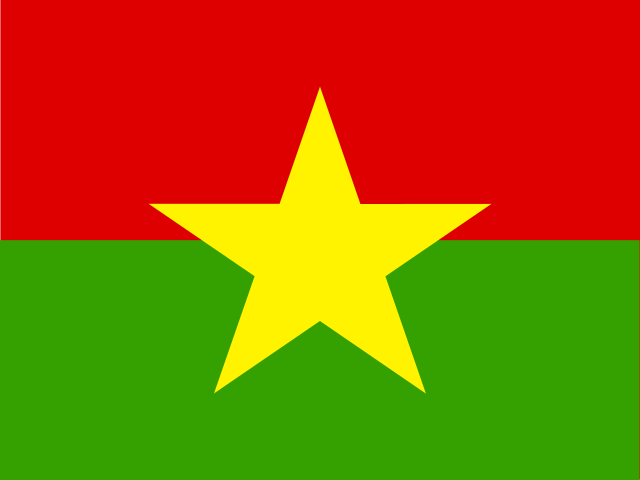 Burkina Faso
 Gambia
 Ghana
Ghana Guinea
 Guinea-Bissau
 Côte d'Ivoire
 Cabo Verde
 Liberia
 Mali
Mali Niger
Niger Nigeria
 Senegal
 Sierra Leone
 Togo
TogoEarlier Report Observations
The banana market volume in ECOWAS grew consistently from 4 988 thousand tons in 2018 to 6 639 thousand tons in 2020, then accelerated to 8 628 thousand tons in 2021. This marked a rise of over 70% in three years, with the most pronounced increase occurring between 2020 and 2021. The market subsequently contracted to 8 493 thousand tons in 2022 and further to 7 635 thousand tons in 2023.
In value terms, the market followed a different trajectory. After a slight decrease to $2 557 million in 2019, it surged to $3 649 million in 2020 and peaked at $4 589 million in 2021. The value then fell to $4 205 million in 2022 before stabilizing at $4 215 million in 2023. The divergence between volume and value, particularly in 2019 when volume rose but value fell, indicates shifts in average prices or possible changes in the composition of bananas traded.
Table of content
- 1. Disclaimer
- 2. Terms of use of the report
- 3. Product codes in the statistical classifications used in the report
-
4. Key Market Indicators and Trends
-
4.1. Key Market Indicators
-
4.1.1. In kind
- 4.1.1.1. Production, 2018-2023
- 4.1.1.2. Imports, 2018-2024
- 4.1.1.3. Exports, 2018-2024
- 4.1.1.4. Market size, 2018-2023
-
4.1.2. In value
- 4.1.2.1. Production, 2018-2023
- 4.1.2.2. Imports, 2018-2024
- 4.1.2.3. Exports, 2018-2024
- 4.1.2.4. Market size, 2018-2023
-
4.1.1. In kind
- 4.2. Market Trends and Factors
-
4.1. Key Market Indicators
-
5. Production
-
5.1. Production in ECOWAS
- 5.1.1. Annual dynamics of production in ECOWAS in kind, 2018-2023, K t
-
5.2. Global production by Country, 2018-2023
- 5.2.1. Annual dynamics of production by macroregions in kind, 2018-2023, K t
- 5.2.2. Dynamics of production structure by macroregions in kind, 2018-2023
- 5.2.3. Annual dynamics of production by country in kind, 2018-2023, K t
- 5.2.4. Structure of production by countries in kind, 2018-2023
- 5.2.5. Dynamics of peoduction structure by countries in kind, 2018-2023
-
5.1. Production in ECOWAS
-
6. Imports
-
6.1. Imports (Direct Data*)
- 6.1.1. Imports - Total information
-
6.1.2. Imports in kind, K t
- 6.1.2.1. Annual dynamics of product's imports to Benin in kind, 2018-2024, K t
- 6.1.2.2. Dynamics of product's imports in kind to Benin by countries, 2018-2024, K t
- 6.1.2.3. Structure of product's imports in kind by countries, 2018-2024
-
6.1.3. Imports in value, M $ US
- 6.1.3.1. Annual dynamics of product's imports to Benin in value, 2018-2024, M $ US
- 6.1.3.2. Dynamics of product's imports in value to Benin by countries, 2018-2024, M $ US
- 6.1.3.3. Structure of product's imports in value by countries, 2018-2024
-
6.1.4. Average price of product's imports, $ US/t
- 6.1.4.1. Annual dynamics of average price of product's imports to Benin, 2018-2024, $ US/t
- 6.1.4.2. Dynamics of average price of product's imports to Benin by countries, 2018-2024, $ US/t
-
6.2. Imports (Mirror Data)
- 6.2.1. Imports - Total information
-
6.2.2. Imports in kind, K t
- 6.2.2.1. Annual dynamics of product's imports to Benin in kind, 2018-2024, K t
- 6.2.2.2. Dynamics of product's imports in kind to Benin by countries, 2018-2024, K t
- 6.2.2.3. Structure of product's imports in kind by countries, 2018-2024
-
6.2.3. Imports in value, M $ US
- 6.2.3.1. Annual dynamics of product's imports to Benin in value, 2018-2024, M $ US
- 6.2.3.2. Dynamics of product's imports in value to Benin by countries, 2018-2024, M $ US
- 6.2.3.3. Structure of product's imports in value by countries, 2018-2024
-
6.2.4. Average price of product's imports, $ US/t
- 6.2.4.1. Annual dynamics of average price of product's imports to Benin, 2018-2024, $ US/t
- 6.2.4.2. Dynamics of average price of product's imports to Benin by countries, 2018-2024, $ US/t
-
6.1. Imports (Direct Data*)
-
7. Exports
-
7.1. Exports (Direct Data*)
- 7.1.1. Exports - Total information
-
7.1.2. Exports in kind, K t
- 7.1.2.1. Annual dynamics of product's exports from Benin in kind, 2018-2024, K t
- 7.1.2.2. Dynamics of product's exports in kind from Benin by countries, 2018-2024, K t
- 7.1.2.3. Structure of product's exports in kind by countries, 2018-2024
-
7.1.3. Exports in value, M $ US
- 7.1.3.1. Annual dynamics of product's exports from Benin in value, 2018-2024, M $ US
- 7.1.3.2. Dynamics of product's exports in value from Benin by countries, 2018-2024, M $ US
- 7.1.3.3. Structure of product's exports in value by countries, 2018-2024
-
7.1.4. Average price of product's exports, $ US/t
- 7.1.4.1. Annual dynamics of average price of product's exports from Benin, 2018-2024, $ US/t
- 7.1.4.2. Dynamics of average price of product's exports from Benin by countries, 2018-2024, $ US/t
-
7.2. Exports (Mirror Data)
- 7.2.1. Exports - Total information
-
7.2.2. Exports in kind, K t
- 7.2.2.1. Annual dynamics of product's exports from Benin in kind, 2018-2024, K t
- 7.2.2.2. Dynamics of product's exports in kind from Benin by countries, 2018-2024, K t
- 7.2.2.3. Structure of product's exports in kind by countries, 2018-2024
-
7.2.3. Exports in value, M $ US
- 7.2.3.1. Annual dynamics of product's exports from Benin in value, 2018-2024, M $ US
- 7.2.3.2. Dynamics of product's exports in value from Benin by countries, 2018-2024, M $ US
- 7.2.3.3. Structure of product's exports in value by countries, 2018-2024
-
7.2.4. Average price of product's exports, $ US/t
- 7.2.4.1. Annual dynamics of average price of product's exports from Benin, 2018-2024, $ US/t
- 7.2.4.2. Dynamics of average price of product's exports from Benin by countries, 2018-2024, $ US/t
-
7.1. Exports (Direct Data*)
-
8. Trade balance
-
8.1. Trade balance (Direct Data)
- 8.1.1. In kind, K t
- 8.1.2. In value, M $ US
-
8.2. Trade balance (Mirror Data)
- 8.2.1. In kind, K t
- 8.2.2. In value, M $ US
-
8.1. Trade balance (Direct Data)
-
9. Top buying and selling countries, 2018-2024
-
9.1. Direct Data
- 9.1.1. Import in Value by Countries-buyers
- 9.1.2. Export in Value by Countries-suppliers
-
9.2. Mirror Data
- 9.2.1. Import in Value by Countries-buyers
- 9.2.2. Export in Value by Countries-suppliers
-
9.1. Direct Data
Production bananas in ECOWAS
In kind, 2017-2020, K t
Top producers of bananas, 2017-2020
World map of production of bananas, 2017-2020
ECOWAS has seen its banana production volume grow for the third consecutive year. In 2020, the region produced 7 039 thousand tonnes of bananas, marking a 13.2% increase from the previous year. Between 2017 and 2020, production rose by 37.8%, which translates to an average annual growth rate of 11.3%.
Annual dynamics of production in ECOWAS in kind, 2017-2020, K t
| Parameter | 2018 | 2019 | 2020 | CAGR | |
|---|---|---|---|---|---|
| 1 | Change from last year | 5.9% | 14.9% | 13.2% | 11.3% |
Exports bananas from ECOWAS
Exports in kind, K t
Following two years of growth, banana exports from ECOWAS declined in 2020. The region exported 412.1 thousand tonnes of bananas that year, reflecting an 8.5% decrease compared to 2019. The peak export volume was recorded in 2019 at 450.3 thousand tonnes, with the largest annual increase of 6.3% also occurring that year.
Annual dynamics of product's exports from ECOWAS in kind, 2017-2020, K t
| Parameter | 2018 | 2019 | 2020 | CAGR | |
|---|---|---|---|---|---|
| 1 | Change from last year | 3.8% | 6.3% | (8.5%) | 0.3% |
From 2017 to 2020, France, Belgium, and the United Kingdom remained the top buyers of bananas from ECOWAS. France accounted for 48.8% of exports in kind, Belgium for 18.8%, and the United Kingdom for 11.0%. Together, these three countries represented 78.6% of total banana exports in kind from the region.
Structure of product's exports in kind by countries, 2017-2020
World map of product's exports from ECOWAS in kind, 2017-2020
Exports in value, M $ US
In 2020, ECOWAS's banana export value reached 226.4 million US dollars, showing a strong year-over-year increase of 13.5%. Between 2017 and 2020, export value grew by 25.8%, equivalent to an average annual rate of 8.0%. The largest decline occurred in 2019 at 9.4%, while the largest increase was recorded in 2018 at 22.4%.
Annual dynamics of product's exports from ECOWAS in value, 2017-2020, M $ US
| Parameter | 2018 | 2019 | 2020 | CAGR | |
|---|---|---|---|---|---|
| 1 | Change from last year | 22.4% | (9.4%) | 13.5% | 8.0% |
During the 2017–2020 period, France, Belgium, and the United Kingdom were the leading buyers of bananas from ECOWAS in value terms. France represented 49.1% of export value, Belgium 16.5%, and the United Kingdom 12.9%. Collectively, these three countries made up 78.5% of total banana export value from the region.
Structure of product's exports in value by countries, 2017-2020
World map of product's exports from ECOWAS in value, 2017-2020
Imports bananas to ECOWAS
Imports in kind, K t
The banana import market in ECOWAS showed an unstable trend over the period. The lowest import volume was recorded in 2017, while the highest was reached in 2020, with a peak-to-trough ratio of 63 times. In 2020, ECOWAS imported 12.4 thousand tonnes of bananas, a dramatic increase of 649.1% compared to the previous year. The largest decline occurred in 2019 at 22.8%, and the largest increase was in 2018 at 982.0%.
Annual dynamics of product's imports to ECOWAS in kind, 2017-2020, K t
| Parameter | 2018 | 2019 | 2020 | CAGR | |
|---|---|---|---|---|---|
| 1 | Change from last year | 982.0% | (22.8%) | 649.1% | 297.0% |
From 2017 to 2020, Cameroon was the primary source of banana imports to ECOWAS, accounting for 1.1% of total imports in kind.
Structure of product's imports in kind by countries, 2017-2020
World map of product's imports to ECOWAS in kind, 2017-2020
Imports in value, M $ US
Volatility characterized the banana import market in ECOWAS during these years. The minimum import value was recorded in 2019 at 1.3 million US dollars, while the maximum was in 2020, showing a 7.1-fold variation between these two years. In 2020, ECOWAS imported 9.0 million US dollars worth of bananas, representing a substantial year-over-year rise of 613.6%. The largest decline occurred in 2019 at 23.6%.
Annual dynamics of product's imports to ECOWAS in value, 2017-2020, M $ US
| Parameter | 2018 | 2019 | 2020 | CAGR | |
|---|---|---|---|---|---|
| 1 | Change from last year | (12.8%) | (23.6%) | 613.6% | 68.1% |
Between 2017 and 2020, France, Cameroon, and Portugal were the main sources of banana imports to ECOWAS in value terms. France accounted for 2.7% of import value, Cameroon for 2.4%, and Portugal for 0.7%. Together, these three countries represented 5.9% of total banana import value for the region.
Structure of product's imports in value by countries, 2017-2020
World map of product's imports to ECOWAS in value, 2017-2020
Related Reports

2026-03-28
Bananas market in Southern Europe
2026-03-28
Bananas market in Western Africa
2026-03-28
2026-03-28

2026-03-28

2026-03-28

Fresh papayas market in ECOWAS
2026-03-28

Why Choose Us?
Only Verified Data
No Hidden Costs or Separate Fees
Smarter Subscription Pricing
Contact Our Team
Submit your inquiry using the form below — our team will get back to you within 24 hours.