Malaysia sources nearly 80% of its coconut needs from Indonesia
Malaysia obtains nearly 80% of its coconut requirements from Indonesia, according to Indonesia’s Agriculture Ministry. Jakarta wants to use that demand to shift exports toward higher-value processed products while addressing declining acreage and low farm productivity.
Malaysia’s industry depends on Indonesian supply
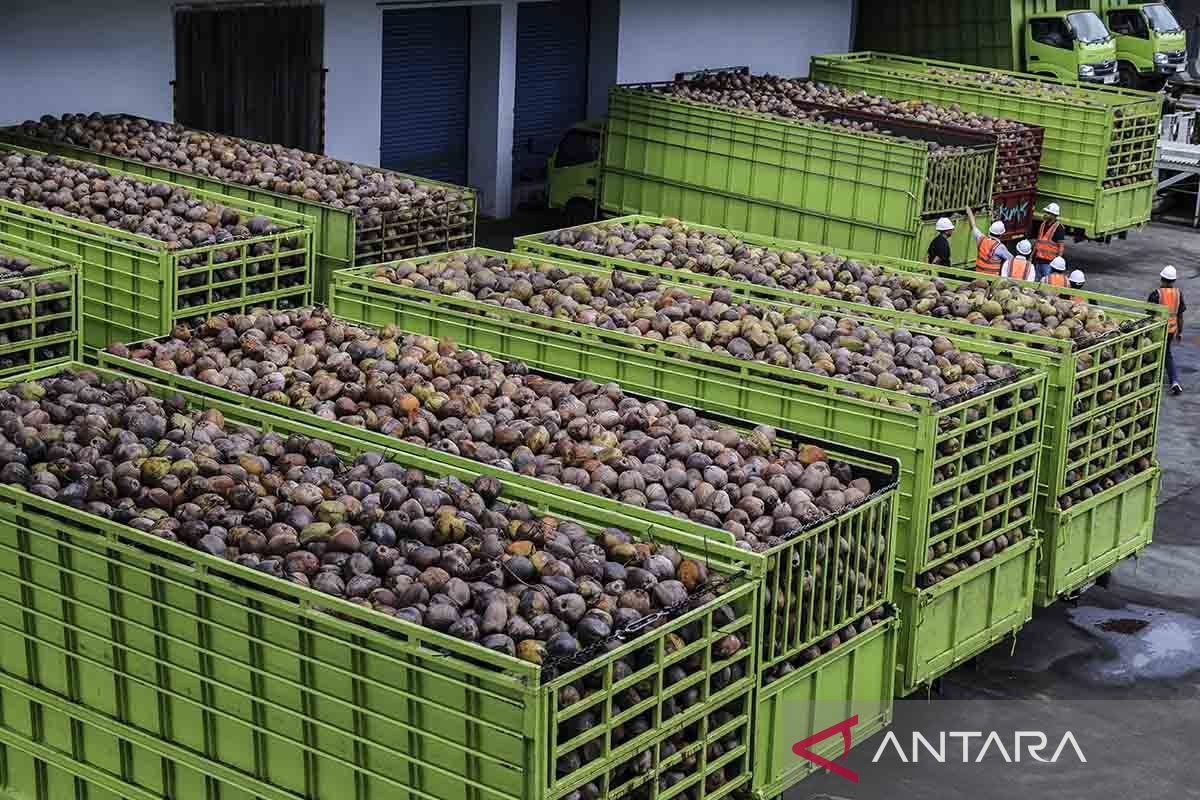
Malaysia sources nearly 80% of its coconut requirements from Indonesia, making the neighboring market highly exposed to changes in Indonesian supply and export policy. Agus Rosyid, an agricultural product quality supervisor at Indonesia’s Agriculture Ministry, said Malaysian representatives approached the ministry during a raw-material shortage two years ago and asked it not to restrict coconut exports because of the potential impact on their industry, according to ANTARA.
The ministry sees this dependence, together with wider regional and global demand, as an opportunity to expand Indonesia’s domestic processing industry. It wants exports to move away from a concentration on raw coconuts and toward products that retain more value inside the country. The products identified as having market potential include coconut cream, coconut milk, coconut oil, virgin coconut oil and other processed goods.
Large producer with a productivity gap
International Coconut Community and Agriculture Ministry data for 2023 placed Indonesia as the world’s second-largest coconut producer after the Philippines. Indonesia produced 2.87 million tonnes in copra equivalent from approximately 3.34 million hectares, accounting for about 24% of global output. The Philippines produced approximately 3.18 million tonnes, or 27% of world production, from around 3.6 million hectares.
Indonesia’s industry is overwhelmingly based on smallholder production. About 98% of its coconut plantations are managed by roughly 5.5 million farmers. Of the country’s total coconut area, approximately 2.55 million hectares, or 76.5%, consists of productive trees. This structure means policies covering planting material, farm yields and purchasing conditions will directly affect millions of rural producers as well as processors and exporters.
Current productivity remains about 1.1 tonnes per hectare, well below the estimated potential of 3.5-5 tonnes per hectare. The ministry also reports a downward trend in national coconut acreage and production, citing land conversion to other crops, pest attacks and unstable farmgate prices. Agus said prolonged periods of low coconut prices have encouraged farmers to consider crops such as palm oil, whose prices are viewed as more stable.
Government targets downstream investment
Indonesia plans to support coconut downstream development across 151,554 hectares in 2026, with a budget of approximately Rp427 billion. The program will cover 28 provinces and include the development of production areas, provision of improved planting material, measures to raise productivity and efforts to strengthen supply chains. Its commercial effect will depend on whether these measures can increase farm output while creating reliable raw-material flows for domestic processors.
The Agriculture Ministry estimates that using the whole coconut—including the husk, shell, flesh and water—could generate as much as $6.55 billion in added value. ICC data put Indonesia’s coconut-product exports at approximately $2.11 billion in 2022. The comparison underpins the government’s case for processing more output domestically, but Malaysia’s dependence also highlights a balancing act: Indonesia must supply an established regional customer while securing enough raw material for its own expanding processing capacity.
Full market analysis