Korean Haegeum Gold Kiwi Moves Toward Commercial Production in Southern Hemisphere
South Korea’s Haegeum gold-kiwi cultivar is moving toward commercial production in New Zealand, Chile and South Africa under an overseas licensing agreement with Bostock NZ. The partners plan to expand cultivation to more than 100 hectares by 2038, creating a potential year-round supply base for the Korean-bred variety.
Overseas license opens three production markets
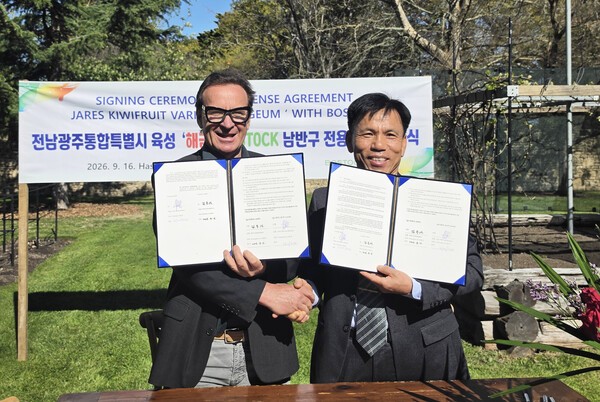
A South Korean gold-kiwi cultivar is moving toward commercial production across the Southern Hemisphere, creating a route for Korean agricultural intellectual property to reach international fruit markets. The Jeonnam-Gwangju agricultural research authority has signed an exclusive overseas licensing agreement for the Haegeum variety with Bostock NZ, a New Zealand-based agrifood company that exports agricultural products to more than 20 countries, The Leaders reported.
Under the agreement, Bostock NZ may produce and sell Haegeum nursery plants and undertake commercial cultivation in New Zealand, Chile and South Africa. The company may also sell fruit grown in those countries on the global market. The arrangement therefore covers both the propagation of planting material and the downstream commercialization of harvested kiwifruit.
Testing and variety protection support commercialization
Haegeum was developed by the Korean agricultural research authority and has been undergoing trial cultivation and variety evaluation in New Zealand since 2016. According to The Leaders, the cultivar completed New Zealand plant-variety protection registration this year, allowing the partners to move forward with nursery sales and broader commercial development.
The research authority and Bostock NZ plan to increase the area planted with Haegeum to more than 100 hectares by 2038, with Chile and South Africa expected to be the principal expansion markets. No interim planting targets, production volumes or expected fruit prices were disclosed. The long timetable indicates that commercial scaling will depend on orchard establishment, local agronomic performance and the development of reliable quality and distribution systems.
If the planted area reaches 100 hectares and commercial production stabilizes, annual variety-royalty income could be around KRW 200 million, depending on output and selling prices, The Leaders reported. The estimate gives the Korean breeder a direct financial interest in overseas production while allowing a locally established operator to manage nursery supply, orchards and market access.
Southern supply could extend the sales season
The licensing strategy is intended to do more than distribute a Korean cultivar abroad. Production in the Southern Hemisphere could supply Haegeum fruit during the off-season for South Korean-grown kiwifruit, supporting year-round market presence. For growers and distributors, counter-seasonal production can widen the selling window, although consistency in fruit quality, storage performance and post-harvest handling will determine whether supplies from several origins can be marketed under a common variety identity.
The Korean research authority said it will continue monitoring local adaptability, fruit quality, storage and distribution characteristics. It also plans to improve cultivation methods and post-harvest management techniques to support stable overseas deployment and the development of Haegeum as a global brand. Kim Dong-gwan, acting head of the authority, said the Southern Hemisphere initiative would test the competitiveness of the Jeonnam-Gwangju-bred kiwi in overseas markets and help expand the global commercialization of Korean-developed cultivars.
For the wider kiwifruit sector, the project introduces another licensed gold variety into three established Southern Hemisphere growing regions. Its eventual impact will depend on the pace of planting, yields, market acceptance and the ability of Bostock NZ and its partners to coordinate production across New Zealand, Chile and South Africa. The immediate significance lies in the commercial model: a Korean public breeder is using overseas variety protection and an international operator to turn a domestically developed cultivar into a multi-country production asset.