EU egg imports rise 90.8% as prices reach €241.19 per 100 kilograms
EU egg and egg-product imports rose 90.8% year on year to 120,496 tonnes of egg equivalent between January and May 2026. The average EU price reached €241.19 per 100 kilograms in week 36, while Spain remained the bloc’s third-largest producer.
Imports nearly double in five months
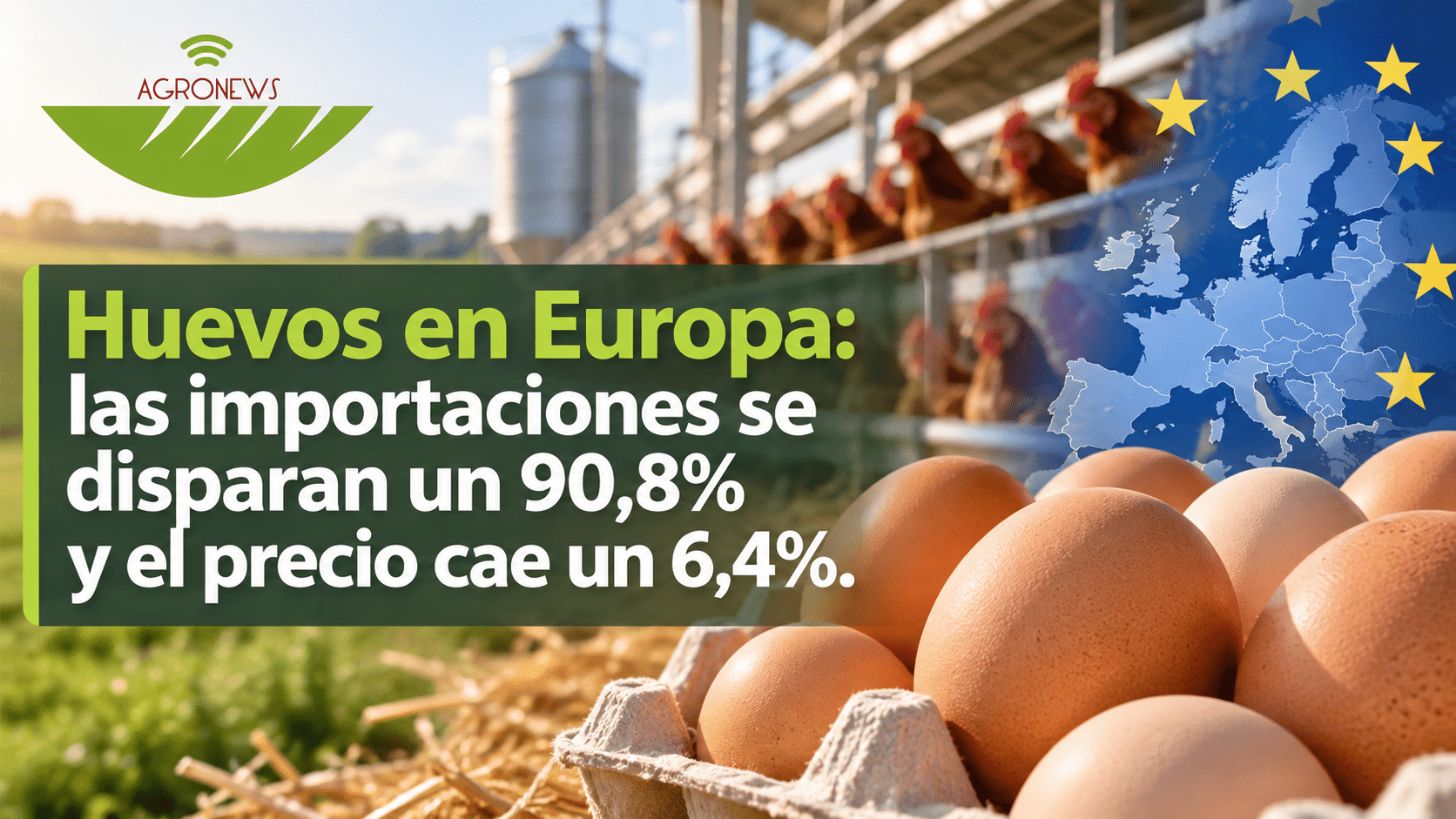
European Union imports of eggs and egg products reached 120,496 tonnes of egg equivalent between January and May 2026, up 90.8% from 63,159 tonnes in the same period of 2025. The figures come from the European Commission’s latest market situation dashboard, updated on September 9, 2026, as reported by AgroNews Castilla y León.
The increase extends a trend already visible in annual trade. EU purchases from non-member countries climbed to 189,000 tonnes in 2025 from 122,000 tonnes in 2024. Ukraine remained the leading external supplier, shipping 60,282 tonnes in the first five months of 2026, 26.8% more than a year earlier. Turkey recorded the sharpest expansion: its deliveries increased from 991 tonnes to 32,053 tonnes, a rise of 3,133.1%. China’s shipments grew 635.9% to 6,044 tonnes.
Prices recover from the summer low
The average EU price for category A eggs stood at €241.19 per 100 kilograms in week 36 of 2026. It increased 1.4% over one week and 3.4% over one month but remained 6.4% below its year-earlier level. Prices began 2026 near €290 per 100 kilograms, moved above €300 during the spring and then declined toward €230 in the summer before recovering.
EU eggs remain substantially more expensive than eggs in several major international markets. The Commission’s comparison showed that the EU price was more than twice the US level and almost three times the Indian level. The EU benchmark is a weighted average of member-state prices for large and medium eggs; the US reference comes from the USDA, while Brazilian and Indian figures are drawn from their national markets.
Exports grow more slowly than imports
EU egg exports increased 4.5% to 177,011 tonnes between January and May 2026, compared with 169,339 tonnes a year earlier. Annual exports had remained broadly stable at around 361,000 tonnes in both 2024 and 2025. Switzerland became the largest destination, receiving 62,723 tonnes. Shipments to the United Kingdom fell to 54,488 tonnes, while Japan reduced purchases by 12.4% to 21,905 tonnes.
The gap between import and export growth points to a rapid change in the sources serving the European market. Imports expanded by 57,337 tonnes year on year during the five-month period, while exports rose by 7,672 tonnes. Ukraine and Turkey together supplied 92,335 tonnes, accounting for more than three-quarters of the EU’s reported external purchases.
Spain remains a major producer
Spain produced 962,000 tonnes of eggs in 2024, approximately 14% of total EU output, making it the bloc’s third-largest producer behind France and Germany. EU production reached 6.664 million tonnes, including eggs for consumption and hatching. Only 46,000 tonnes separated Spain from France, the leading producer.
Spain has declared capacity for 47,223,460 laying hens, equivalent to 11.8% of the EU flock and the fourth-largest national capacity after France, Germany and Poland. Across the EU, maximum declared capacity reached 401.1 million hens in 2025. Of these, 258 million, or 64.3%, were housed outside enriched cages. Floor systems are now the dominant method in the bloc, while organic and free-range eggs command higher prices than eggs from floor and cage systems.