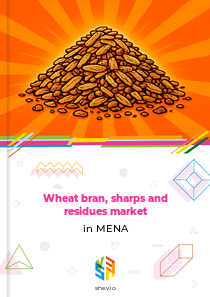







"MENA" region includes following countries:
 Algeria
 Bahrain
 Djibouti
 Egypt
Egypt Israel
 Jordan
 Iran
Iran Iraq
Iraq Qatar
Qatar Kuwait
 Lebanon
 Libya
Libya Malta
Malta Morocco
 the United Arab Emirates
 Oman
Oman Saudi Arabia
 Syria
Syria Tunisia
 Yemen
YemenEarlier Report Observations
The market for wheat bran, sharps and residues in the MENA region expanded from 9.96 million tonnes in 2018 to 10.66 million tonnes in 2023. The most significant annual increase occurred in 2019, when market volume jumped by over 5% to 10.49 million tonnes. This was followed by a slight decline in 2020, bringing the market to 10.28 million tonnes.
From 2021 onward, the market entered a phase of steady growth, climbing to 10.52 million tonnes in 2021 and then to a peak of 10.8 million tonnes in 2022. The following year saw a modest correction, with volume dropping to 10.66 million tonnes in 2023. Overall, the period was characterized by gradual expansion interrupted by short-term fluctuations.
Table of content
- 1. Disclaimer
- 2. Terms of use of the report
- 3. Product codes in the statistical classifications used in the report
-
4. Key Market Indicators and Trends
-
4.1. Key Market Indicators
-
4.1.1. In kind
- 4.1.1.1. Production, 2018-2023
- 4.1.1.2. Imports, 2018-2024
- 4.1.1.3. Exports, 2018-2024
- 4.1.1.4. Market size, 2018-2023
-
4.1.1. In kind
- 4.2. Market Trends and Factors
-
4.1. Key Market Indicators
-
5. Production
-
5.1. Production in MENA
- 5.1.1. Annual dynamics of production in MENA in kind, 2018-2023, K t
-
5.2. Global production by Country, 2018-2023
- 5.2.1. Annual dynamics of production by macroregions in kind, 2018-2023, K t
- 5.2.2. Dynamics of production structure by macroregions in kind, 2018-2023
- 5.2.3. Annual dynamics of production by country in kind, 2018-2023, K t
- 5.2.4. Structure of production by countries in kind, 2018-2023
- 5.2.5. Dynamics of peoduction structure by countries in kind, 2018-2023
-
5.1. Production in MENA
-
6. Imports
-
6.1. Imports (Direct Data*)
- 6.1.1. Imports - Total information
-
6.1.2. Imports in kind, K t
- 6.1.2.1. Annual dynamics of product's imports to Algeria in kind, 2018-2024, K t
- 6.1.2.2. Dynamics of product's imports in kind to Algeria by countries, 2018-2024, K t
- 6.1.2.3. Structure of product's imports in kind by countries, 2018-2024
-
6.1.3. Imports in value, M $ US
- 6.1.3.1. Annual dynamics of product's imports to Algeria in value, 2018-2024, M $ US
- 6.1.3.2. Dynamics of product's imports in value to Algeria by countries, 2018-2024, M $ US
- 6.1.3.3. Structure of product's imports in value by countries, 2018-2024
-
6.1.4. Average price of product's imports, $ US/t
- 6.1.4.1. Annual dynamics of average price of product's imports to Algeria, 2018-2024, $ US/t
- 6.1.4.2. Dynamics of average price of product's imports to Algeria by countries, 2018-2024, $ US/t
-
6.2. Imports (Mirror Data)
- 6.2.1. Imports - Total information
-
6.2.2. Imports in kind, K t
- 6.2.2.1. Annual dynamics of product's imports to Algeria in kind, 2018-2024, K t
- 6.2.2.2. Dynamics of product's imports in kind to Algeria by countries, 2018-2024, K t
- 6.2.2.3. Structure of product's imports in kind by countries, 2018-2024
-
6.2.3. Imports in value, M $ US
- 6.2.3.1. Annual dynamics of product's imports to Algeria in value, 2018-2024, M $ US
- 6.2.3.2. Dynamics of product's imports in value to Algeria by countries, 2018-2024, M $ US
- 6.2.3.3. Structure of product's imports in value by countries, 2018-2024
-
6.2.4. Average price of product's imports, $ US/t
- 6.2.4.1. Annual dynamics of average price of product's imports to Algeria, 2018-2024, $ US/t
- 6.2.4.2. Dynamics of average price of product's imports to Algeria by countries, 2018-2024, $ US/t
-
6.1. Imports (Direct Data*)
-
7. Exports
-
7.1. Exports (Direct Data*)
- 7.1.1. Exports - Total information
-
7.1.2. Exports in kind, K t
- 7.1.2.1. Annual dynamics of product's exports from Algeria in kind, 2018-2024, K t
- 7.1.2.2. Dynamics of product's exports in kind from Algeria by countries, 2018-2024, K t
- 7.1.2.3. Structure of product's exports in kind by countries, 2018-2024
-
7.1.3. Exports in value, M $ US
- 7.1.3.1. Annual dynamics of product's exports from Algeria in value, 2018-2024, M $ US
- 7.1.3.2. Dynamics of product's exports in value from Algeria by countries, 2018-2024, M $ US
- 7.1.3.3. Structure of product's exports in value by countries, 2018-2024
-
7.1.4. Average price of product's exports, $ US/t
- 7.1.4.1. Annual dynamics of average price of product's exports from Algeria, 2018-2024, $ US/t
- 7.1.4.2. Dynamics of average price of product's exports from Algeria by countries, 2018-2024, $ US/t
-
7.2. Exports (Mirror Data)
- 7.2.1. Exports - Total information
-
7.2.2. Exports in kind, K t
- 7.2.2.1. Annual dynamics of product's exports from Algeria in kind, 2018-2024, K t
- 7.2.2.2. Dynamics of product's exports in kind from Algeria by countries, 2018-2024, K t
- 7.2.2.3. Structure of product's exports in kind by countries, 2018-2024
-
7.2.3. Exports in value, M $ US
- 7.2.3.1. Annual dynamics of product's exports from Algeria in value, 2018-2024, M $ US
- 7.2.3.2. Dynamics of product's exports in value from Algeria by countries, 2018-2024, M $ US
- 7.2.3.3. Structure of product's exports in value by countries, 2018-2024
-
7.2.4. Average price of product's exports, $ US/t
- 7.2.4.1. Annual dynamics of average price of product's exports from Algeria, 2018-2024, $ US/t
- 7.2.4.2. Dynamics of average price of product's exports from Algeria by countries, 2018-2024, $ US/t
-
7.1. Exports (Direct Data*)
-
8. Trade balance
-
8.1. Trade balance (Direct Data)
- 8.1.1. In kind, K t
- 8.1.2. In value, M $ US
-
8.2. Trade balance (Mirror Data)
- 8.2.1. In kind, K t
- 8.2.2. In value, M $ US
-
8.1. Trade balance (Direct Data)
-
9. Top buying and selling countries, 2018-2024
-
9.1. Direct Data
- 9.1.1. Import in Value by Countries-buyers
- 9.1.2. Export in Value by Countries-suppliers
-
9.2. Mirror Data
- 9.2.1. Import in Value by Countries-buyers
- 9.2.2. Export in Value by Countries-suppliers
-
9.1. Direct Data
Production wheat bran, sharps and residues in MENA
In kind, 2017-2020, K t
Top producers of wheat bran, sharps and residues, 2017-2020
World map of production of wheat bran, sharps and residues, 2017-2020
In the MENA region, production of wheat bran, sharps and residues remained relatively stable in 2020, reaching 9 406 thousand tonnes. Over the four-year period from 2017 to 2020, production grew by 8%, with an average annual growth rate of 2.6%. The highest production level was recorded in 2019 at 9 407 thousand tonnes, which also saw the largest annual increase of 5.3%.
Annual dynamics of production in MENA in kind, 2017-2020, K t
| Parameter | 2018 | 2019 | 2020 | CAGR | |
|---|---|---|---|---|---|
| 1 | Change from last year | 2.5% | 5.3% | (0.0%) | 2.6% |
Exports wheat bran, sharps and residues from MENA
Exports in kind, K t
Export volumes of wheat bran, sharps and residues from the MENA region showed significant volatility during the observed period. The lowest exports were recorded in 2019 at 77 thousand tonnes, while 2020 saw the highest level at 356 thousand tonnes - representing a dramatic 361.5% increase from the previous year. The gap between these years was substantial, with 2020 exports being 4.6 times higher than in 2019. The largest decline occurred in 2019, falling by 59.0%.
Annual dynamics of product's exports from MENA in kind, 2017-2020, K t
| Parameter | 2018 | 2019 | 2020 | CAGR | |
|---|---|---|---|---|---|
| 1 | Change from last year | 53.0% | (59.0%) | 361.5% | 42.6% |
Between 2017 and 2020, Vietnam and Bangladesh emerged as the two main export destinations for wheat bran, sharps and residues from the MENA region, together accounting for 13.4% of total export volumes.
Structure of product's exports in kind by countries, 2017-2020
World map of product's exports from MENA in kind, 2017-2020
Exports in value, M $ US
Export values of wheat bran, sharps and residues from the MENA region increased for the third consecutive year in 2020, reaching 64.8 million US dollars. This represented a substantial 73.2% gain compared to 2019. Over the 2017-2020 period, export values grew by 234.7%, with an impressive compound annual growth rate of 49.6%.
Annual dynamics of product's exports from MENA in value, 2017-2020, M $ US
| Parameter | 2018 | 2019 | 2020 | CAGR | |
|---|---|---|---|---|---|
| 1 | Change from last year | 81.1% | 6.7% | 73.2% | 49.6% |
During the 2017-2020 period, Vietnam and Bangladesh continued to be the key partner countries for wheat bran, sharps and residues exports from the MENA region in value terms, jointly accounting for 9.5% of total export flows.
Structure of product's exports in value by countries, 2017-2020
World map of product's exports from MENA in value, 2017-2020
Imports wheat bran, sharps and residues to MENA
Imports in kind, K t
In 2020, the MENA region imported 1 234 thousand tonnes of wheat bran, sharps and residues, showing a modest 6.9% increase from the previous year. Over the 2017-2020 period, import volumes grew by 28.4%, with an average annual growth rate of 8.7%. The largest increase occurred in 2018, rising by 26.0%, while the largest decline was recorded in 2019, falling by 4.6%.
Annual dynamics of product's imports to MENA in kind, 2017-2020, K t
| Parameter | 2018 | 2019 | 2020 | CAGR | |
|---|---|---|---|---|---|
| 1 | Change from last year | 26.0% | (4.6%) | 6.9% | 8.7% |
The import structure for wheat bran, sharps and residues in the MENA region remained fragmented between 2017 and 2020. Argentina (9.5% of import volumes), Tanzania (8.5%), and Kenya (8.2%) were the top three sources, but together they accounted for only 26.3% of total flows, with no single country achieving a dominant market share.
Structure of product's imports in kind by countries, 2017-2020
World map of product's imports to MENA in kind, 2017-2020
Imports in value, M $ US
Import values of wheat bran, sharps and residues to the MENA region reached 252.2 million US dollars in 2020, marking a notable 20.4% increase year-over-year. Over the 2017-2020 period, import values grew by 46.3%, with an average annual growth rate of 13.5%. The highest value was recorded in 2018 at 276.0 million US dollars, which also saw the largest annual increase of 60.1%. The largest decline occurred in 2019, falling by 24.2%.
Annual dynamics of product's imports to MENA in value, 2017-2020, M $ US
| Parameter | 2018 | 2019 | 2020 | CAGR | |
|---|---|---|---|---|---|
| 1 | Change from last year | 60.1% | (24.2%) | 20.4% | 13.5% |
Between 2017 and 2020, imports of wheat bran, sharps and residues to the MENA region in value terms were not concentrated among a few key suppliers. Sudan (13.3% of import values), Tanzania (9.2%), and Argentina (8.9%) were the top three sources, but together they accounted for only 31.4% of total import flows.
Structure of product's imports in value by countries, 2017-2020
World map of product's imports to MENA in value, 2017-2020
Related Reports


Cottonseed oil-cake market in MENA
2026-03-29

Groundnutoil-cake market in MENA
2026-03-29

Linseed oil-cake market in MENA
2026-03-29

Why Choose Us?
Only Verified Data
No Hidden Costs or Separate Fees
Smarter Subscription Pricing
Contact Our Team
Submit your inquiry using the form below — our team will get back to you within 24 hours.