






"Middle Africa" region includes following countries:
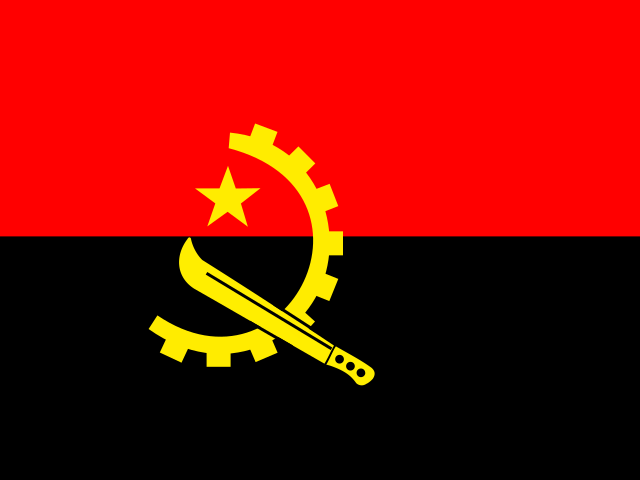 Angola
 Cameroon
 Central African Republic
 Chad
Chad Congo
Congo Democratic Republic of the Congo
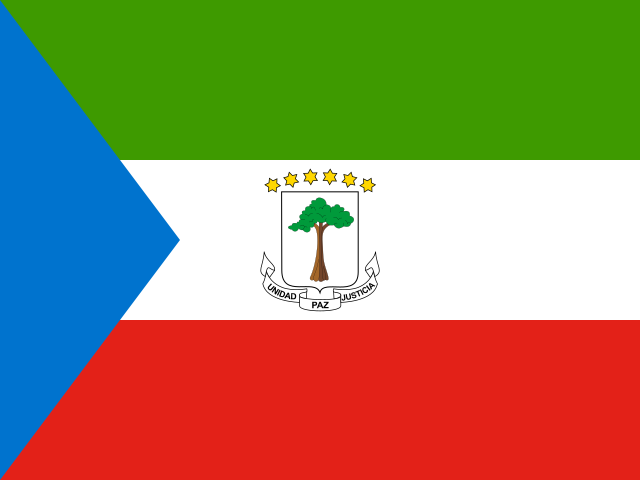 Equatorial Guinea
 Gabon
Gabon Sao Tome and Principe
Earlier Report Observations
The market volume for vegetables, pulses and potatoes preserved in vinegar in Middle Africa stood at 712 tons in 2018. It declined to 581 tons the following year, then recovered to 668 tons in 2020.
After growing to 794 tons in 2021, the market contracted to 701 tons in 2022. A strong expansion followed in 2023, with volume reaching 1 177 tons, the peak for the period.
Table of content
- 1. Disclaimer
- 2. Terms of use of the report
- 3. Product codes in the statistical classifications used in the report
-
4. Key Market Indicators and Trends
-
4.1. Key Market Indicators
-
4.1.1. In kind
- 4.1.1.1. Production, 2018-2023
- 4.1.1.2. Imports, 2018-2024
- 4.1.1.3. Exports, 2018-2024
- 4.1.1.4. Market size, 2018-2023
-
4.1.1. In kind
- 4.2. Market Trends and Factors
-
4.1. Key Market Indicators
-
5. Production
-
5.1. Production in Middle Africa
- 5.1.1. Annual dynamics of production in Middle Africa in kind, 2018-2023, t
-
5.2. Global production by Country, 2018-2023
- 5.2.1. Annual dynamics of production by macroregions in kind, 2018-2023, t
- 5.2.2. Dynamics of production structure by macroregions in kind, 2018-2023
- 5.2.3. Annual dynamics of production by country in kind, 2018-2023, t
- 5.2.4. Structure of production by countries in kind, 2018-2023
- 5.2.5. Dynamics of peoduction structure by countries in kind, 2018-2023
-
5.1. Production in Middle Africa
-
6. Imports
-
6.1. Imports (Direct Data*)
- 6.1.1. Imports - Total information
-
6.1.2. Imports in kind, t
- 6.1.2.1. Annual dynamics of product's imports to Angola in kind, 2018-2024, t
- 6.1.2.2. Dynamics of product's imports in kind to Angola by countries, 2018-2024, t
- 6.1.2.3. Structure of product's imports in kind by countries, 2018-2024
-
6.1.3. Imports in value, K $ US
- 6.1.3.1. Annual dynamics of product's imports to Angola in value, 2018-2024, K $ US
- 6.1.3.2. Dynamics of product's imports in value to Angola by countries, 2018-2024, K $ US
- 6.1.3.3. Structure of product's imports in value by countries, 2018-2024
-
6.1.4. Average price of product's imports, $ US/t
- 6.1.4.1. Annual dynamics of average price of product's imports to Angola, 2018-2024, $ US/t
- 6.1.4.2. Dynamics of average price of product's imports to Angola by countries, 2018-2024, $ US/t
-
6.2. Imports (Mirror Data)
- 6.2.1. Imports - Total information
-
6.2.2. Imports in kind, t
- 6.2.2.1. Annual dynamics of product's imports to Angola in kind, 2018-2024, t
- 6.2.2.2. Dynamics of product's imports in kind to Angola by countries, 2018-2024, t
- 6.2.2.3. Structure of product's imports in kind by countries, 2018-2024
-
6.2.3. Imports in value, K $ US
- 6.2.3.1. Annual dynamics of product's imports to Angola in value, 2018-2024, K $ US
- 6.2.3.2. Dynamics of product's imports in value to Angola by countries, 2018-2024, K $ US
- 6.2.3.3. Structure of product's imports in value by countries, 2018-2024
-
6.2.4. Average price of product's imports, $ US/t
- 6.2.4.1. Annual dynamics of average price of product's imports to Angola, 2018-2024, $ US/t
- 6.2.4.2. Dynamics of average price of product's imports to Angola by countries, 2018-2024, $ US/t
-
6.1. Imports (Direct Data*)
-
7. Exports
-
7.1. Exports (Direct Data*)
- 7.1.1. Exports - Total information
-
7.1.2. Exports in kind, t
- 7.1.2.1. Annual dynamics of product's exports from Angola in kind, 2018-2024, t
- 7.1.2.2. Dynamics of product's exports in kind from Angola by countries, 2018-2024, t
- 7.1.2.3. Structure of product's exports in kind by countries, 2018-2024
-
7.1.3. Exports in value, K $ US
- 7.1.3.1. Annual dynamics of product's exports from Angola in value, 2018-2024, K $ US
- 7.1.3.2. Dynamics of product's exports in value from Angola by countries, 2018-2024, K $ US
- 7.1.3.3. Structure of product's exports in value by countries, 2018-2024
-
7.1.4. Average price of product's exports, $ US/t
- 7.1.4.1. Annual dynamics of average price of product's exports from Angola, 2018-2024, $ US/t
- 7.1.4.2. Dynamics of average price of product's exports from Angola by countries, 2018-2024, $ US/t
-
7.2. Exports (Mirror Data)
- 7.2.1. Exports - Total information
-
7.2.2. Exports in kind, t
- 7.2.2.1. Annual dynamics of product's exports from Angola in kind, 2018-2024, t
- 7.2.2.2. Dynamics of product's exports in kind from Angola by countries, 2018-2024, t
- 7.2.2.3. Structure of product's exports in kind by countries, 2018-2024
-
7.2.3. Exports in value, K $ US
- 7.2.3.1. Annual dynamics of product's exports from Angola in value, 2018-2024, K $ US
- 7.2.3.2. Dynamics of product's exports in value from Angola by countries, 2018-2024, K $ US
- 7.2.3.3. Structure of product's exports in value by countries, 2018-2024
-
7.2.4. Average price of product's exports, $ US/t
- 7.2.4.1. Annual dynamics of average price of product's exports from Angola, 2018-2024, $ US/t
- 7.2.4.2. Dynamics of average price of product's exports from Angola by countries, 2018-2024, $ US/t
-
7.1. Exports (Direct Data*)
-
8. Trade balance
-
8.1. Trade balance (Direct Data)
- 8.1.1. In kind, t
- 8.1.2. In value, K $ US
-
8.2. Trade balance (Mirror Data)
- 8.2.1. In kind, t
- 8.2.2. In value, K $ US
-
8.1. Trade balance (Direct Data)
-
9. Top buying and selling countries, 2018-2024
-
9.1. Direct Data
- 9.1.1. Import in Value by Countries-buyers
- 9.1.2. Export in Value by Countries-suppliers
-
9.2. Mirror Data
- 9.2.1. Import in Value by Countries-buyers
- 9.2.2. Export in Value by Countries-suppliers
-
9.1. Direct Data
Production vegetables, pulses and potatoes in vinegar in Middle Africa
In kind, 2017-2020, t
Top producers of vegetables, pulses and potatoes in vinegar, 2017-2020
World map of production of vegetables, pulses and potatoes in vinegar, 2017-2020
In 2020, Middle Africa produced 99.6 tonnes of vegetables, pulses, and potatoes in vinegar, marking a slight decrease of 1.1% compared to the previous year. The highest production level was recorded in 2018 at 100.7 tonnes, which also saw the largest annual increase of 0.4%.
Annual dynamics of production in Middle Africa in kind, 2017-2020, t
| Parameter | 2018 | 2019 | 2020 | CAGR | |
|---|---|---|---|---|---|
| 1 | Change from last year | 0.4% | (0.0%) | (1.1%) | (0.2%) |
Exports vegetables, pulses and potatoes in vinegar from Middle Africa
Exports in kind, t
The market exhibited significant volatility during the observed period. Import levels fluctuated dramatically, with a 1 449-fold difference between the peak in 2017 and the low point in 2019. In 2020, exports of vegetables, pulses, and potatoes in vinegar from Middle Africa reached 1.3 tonnes, representing a substantial increase of 283.5% compared to the previous year. The lowest export volume was recorded in 2019 at 0.3 tonnes, which also experienced the largest decline of 99.1%.
Annual dynamics of product's exports from Middle Africa in kind, 2017-2020, t
| Parameter | 2018 | 2019 | 2020 | CAGR | |
|---|---|---|---|---|---|
| 1 | Change from last year | (92.1%) | (99.1%) | 283.5% | (86.2%) |
From 2017 to 2020, France and Belgium dominated as the primary export markets in kind, jointly accounting for 97.4% of total flows, while other countries made up the remaining share.
Structure of product's exports in kind by countries, 2017-2020
World map of product's exports from Middle Africa in kind, 2017-2020
Exports in value, K $ US
The data reveals irregular changes, indicating a volatile market environment. Export volumes in value terms peaked in 2017 and fell to their lowest point in 2019, with a top-to-bottom ratio of 1 210 times. In 2020, foreign supplies of vegetables, pulses, and potatoes in vinegar from Middle Africa were recorded at 1 000 US dollars, showing a year-on-year increase of 68.7%. The minimum value was recorded in 2019 at 500 US dollars, which also saw the largest decline of 98.9%.
Annual dynamics of product's exports from Middle Africa in value, 2017-2020, K $ US
| Parameter | 2018 | 2019 | 2020 | CAGR | |
|---|---|---|---|---|---|
| 1 | Change from last year | (92.2%) | (98.9%) | 68.7% | (88.8%) |
Throughout 2017–2020, Belgium and France remained the key partner countries for exports in value terms, with a combined share of 96.0% of total flows; other partners accounted for the remainder.
Structure of product's exports in value by countries, 2017-2020
World map of product's exports from Middle Africa in value, 2017-2020
Imports vegetables, pulses and potatoes in vinegar to Middle Africa
Imports in kind, t
In 2020, imports of vegetables, pulses, and potatoes in vinegar into Middle Africa totalled 569.4 tonnes, representing a notable increase of 18.4% over the past year. Over the period from 2017 to 2020, imports grew by 3.5%, with a compound annual growth rate of 1.2%. The minimum import volume was recorded in 2019 at 480.7 tonnes, while the maximum was in 2018 at 649.4 tonnes. The largest decline occurred in 2019, with a drop of 26.0%.
Annual dynamics of product's imports to Middle Africa in kind, 2017-2020, t
| Parameter | 2018 | 2019 | 2020 | CAGR | |
|---|---|---|---|---|---|
| 1 | Change from last year | 18.1% | (26.0%) | 18.4% | 1.2% |
Throughout 2017–2020, France (26.2% of imports in kind), Belgium (22.1% of imports in kind), and Portugal (16.4% of imports in kind) remained the key sources for imports in kind, together accounting for 64.8% of total flows.
Structure of product's imports in kind by countries, 2017-2020
World map of product's imports to Middle Africa in kind, 2017-2020
Imports in value, K $ US
Foreign supplies of vegetables, pulses, and potatoes in vinegar to Middle Africa declined for the second consecutive year. In 2020, Middle Africa imported a total of 1 000 US dollars worth of these products, down by 54.7% from 2019. Between 2017 and 2020, imports decreased by 57.2%, equating to an annualized rate of 24.6%. The maximum value was recorded in 2018 at 1 364 000 US dollars, which also saw the largest increase of 13.8%.
Annual dynamics of product's imports to Middle Africa in value, 2017-2020, K $ US
| Parameter | 2018 | 2019 | 2020 | CAGR | |
|---|---|---|---|---|---|
| 1 | Change from last year | 13.8% | (16.8%) | (54.7%) | (24.6%) |
Over 2017–2020, Belgium (35.4% of imports in value terms), Portugal (20.7% of imports in value terms), and France (20.4% of imports in value terms) made the biggest contribution to imports in value terms, jointly accounting for 76.5% of total flows.
Structure of product's imports in value by countries, 2017-2020
World map of product's imports to Middle Africa in value, 2017-2020
Related Reports



Groundnutoil-cake market in Middle Africa
2026-03-29


Palm-kernel oilcake market in Middle Africa
2026-03-29
Why Choose Us?
Only Verified Data
No Hidden Costs or Separate Fees
Smarter Subscription Pricing
Contact Our Team
Submit your inquiry using the form below — our team will get back to you within 24 hours.