






"MERCOSUR" region includes following countries:
 Brazil
 Argentina
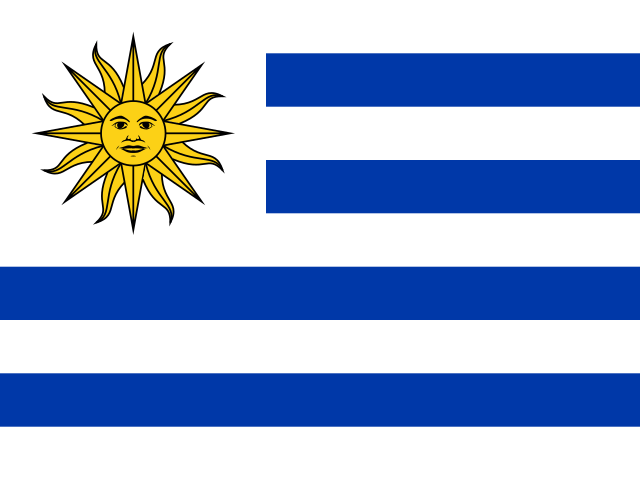 Uruguay
 Paraguay
Earlier Report Observations
The cocoa powder and cake market in MERCOSUR showed moderate movements between 2018 and 2020, with market volume fluctuating between 136 thousand tons and 143 thousand tons. In value terms, the market remained around $720 million to $725 million, reflecting stable underlying demand despite minor shifts in production and trade flows.
A pronounced expansion occurred in 2021, when market volume surged by 25% to 180 thousand tons and its value jumped 41% to $1.0 billion. This peak was followed by a contraction in 2022, with volume dropping to 145 thousand tons and value falling to $893 million. A partial recovery took place in 2023, with volume reaching 150 thousand tons and market value climbing to $1.1 billion.
Preliminary 2024 trade data indicates a sharp 33% drop in exports to 21 thousand tons, while imports held steady near 56 thousand tons. This shift coincided with record-high global cocoa prices, driven by supply shortages in West Africa, and the provisional implementation of the EU-MERCOSUR trade agreement, which altered tariff structures for cocoa products within the bloc.
Table of content
- 1. Disclaimer
- 2. Terms of use of the report
- 3. Product codes in the statistical classifications used in the report
-
4. Key Market Indicators and Trends
-
4.1. Key Market Indicators
-
4.1.1. In kind
- 4.1.1.1. Production, 2018-2023
- 4.1.1.2. Imports, 2018-2024
- 4.1.1.3. Exports, 2018-2024
- 4.1.1.4. Market size, 2018-2023
-
4.1.2. In value
- 4.1.2.1. Production, 2018-2023
- 4.1.2.2. Imports, 2018-2024
- 4.1.2.3. Exports, 2018-2024
- 4.1.2.4. Market size, 2018-2023
-
4.1.1. In kind
- 4.2. Market Trends and Factors
-
4.1. Key Market Indicators
-
5. Production
-
5.1. Production in MERCOSUR
- 5.1.1. Annual dynamics of production in MERCOSUR in kind, 2018-2023, K t
-
5.2. Global production by Country, 2018-2023
- 5.2.1. Annual dynamics of production by macroregions in kind, 2018-2023, K t
- 5.2.2. Dynamics of production structure by macroregions in kind, 2018-2023
- 5.2.3. Annual dynamics of production by country in kind, 2018-2023, K t
- 5.2.4. Structure of production by countries in kind, 2018-2023
- 5.2.5. Dynamics of peoduction structure by countries in kind, 2018-2023
-
5.1. Production in MERCOSUR
-
6. Imports
-
6.1. Imports (Direct Data)
- 6.1.1. Imports - Total information
-
6.1.2. Imports in kind, t
- 6.1.2.1. Annual dynamics of product's imports to Brazil in kind, 2018-2024, t
- 6.1.2.2. Dynamics of product's imports in kind to Brazil by countries, 2018-2024, t
- 6.1.2.3. Structure of product's imports in kind by countries, 2018-2024
-
6.1.3. Imports in value, M $ US
- 6.1.3.1. Annual dynamics of product's imports to Brazil in value, 2018-2024, M $ US
- 6.1.3.2. Dynamics of product's imports in value to Brazil by countries, 2018-2024, M $ US
- 6.1.3.3. Structure of product's imports in value by countries, 2018-2024
-
6.1.4. Average price of product's imports, $ US/t
- 6.1.4.1. Annual dynamics of average price of product's imports to Brazil, 2018-2024, $ US/t
- 6.1.4.2. Dynamics of average price of product's imports to Brazil by countries, 2018-2024, $ US/t
-
6.2. Imports (Mirror Data)
- 6.2.1. Imports - Total information
-
6.2.2. Imports in kind, t
- 6.2.2.1. Annual dynamics of product's imports to Brazil in kind, 2018-2024, t
- 6.2.2.2. Dynamics of product's imports in kind to Brazil by countries, 2018-2024, t
- 6.2.2.3. Structure of product's imports in kind by countries, 2018-2024
-
6.2.3. Imports in value, M $ US
- 6.2.3.1. Annual dynamics of product's imports to Brazil in value, 2018-2024, M $ US
- 6.2.3.2. Dynamics of product's imports in value to Brazil by countries, 2018-2024, M $ US
- 6.2.3.3. Structure of product's imports in value by countries, 2018-2024
-
6.2.4. Average price of product's imports, $ US/t
- 6.2.4.1. Annual dynamics of average price of product's imports to Brazil, 2018-2024, $ US/t
- 6.2.4.2. Dynamics of average price of product's imports to Brazil by countries, 2018-2024, $ US/t
-
6.1. Imports (Direct Data)
-
7. Exports
-
7.1. Exports (Direct Data)
- 7.1.1. Exports - Total information
-
7.1.2. Exports in kind, t
- 7.1.2.1. Annual dynamics of product's exports from Brazil in kind, 2018-2024, t
- 7.1.2.2. Dynamics of product's exports in kind from Brazil by countries, 2018-2024, t
- 7.1.2.3. Structure of product's exports in kind by countries, 2018-2024
-
7.1.3. Exports in value, M $ US
- 7.1.3.1. Annual dynamics of product's exports from Brazil in value, 2018-2024, M $ US
- 7.1.3.2. Dynamics of product's exports in value from Brazil by countries, 2018-2024, M $ US
- 7.1.3.3. Structure of product's exports in value by countries, 2018-2024
-
7.1.4. Average price of product's exports, $ US/t
- 7.1.4.1. Annual dynamics of average price of product's exports from Brazil, 2018-2024, $ US/t
- 7.1.4.2. Dynamics of average price of product's exports from Brazil by countries, 2018-2024, $ US/t
-
7.2. Exports (Mirror Data)
- 7.2.1. Exports - Total information
-
7.2.2. Exports in kind, t
- 7.2.2.1. Annual dynamics of product's exports from Brazil in kind, 2018-2024, t
- 7.2.2.2. Dynamics of product's exports in kind from Brazil by countries, 2018-2024, t
- 7.2.2.3. Structure of product's exports in kind by countries, 2018-2024
-
7.2.3. Exports in value, M $ US
- 7.2.3.1. Annual dynamics of product's exports from Brazil in value, 2018-2024, M $ US
- 7.2.3.2. Dynamics of product's exports in value from Brazil by countries, 2018-2024, M $ US
- 7.2.3.3. Structure of product's exports in value by countries, 2018-2024
-
7.2.4. Average price of product's exports, $ US/t
- 7.2.4.1. Annual dynamics of average price of product's exports from Brazil, 2018-2024, $ US/t
- 7.2.4.2. Dynamics of average price of product's exports from Brazil by countries, 2018-2024, $ US/t
-
7.1. Exports (Direct Data)
-
8. Trade balance
-
8.1. Trade balance (Direct Data)
- 8.1.1. In kind, t
- 8.1.2. In value, M $ US
-
8.2. Trade balance (Mirror Data)
- 8.2.1. In kind, t
- 8.2.2. In value, M $ US
-
8.1. Trade balance (Direct Data)
-
9. Top buying and selling countries, 2018-2024
-
9.1. Direct Data
- 9.1.1. Import in Value by Countries-buyers
- 9.1.2. Export in Value by Countries-suppliers
-
9.2. Mirror Data
- 9.2.1. Import in Value by Countries-buyers
- 9.2.2. Export in Value by Countries-suppliers
-
9.1. Direct Data
Production cocoa powder and cake in MERCOSUR
In kind, 2017-2020, K t
Top producers of cocoa powder and cake, 2017-2020
World map of production of cocoa powder and cake, 2017-2020
MERCOSUR's cocoa powder and cake production has increased for the third consecutive year. In 2020, production reached 114.5 K t, remaining nearly unchanged from 2019. Over the period from 2017 to 2020, production grew by 7.4%, which translates to an annualized growth rate of 2.4%.
Annual dynamics of production in MERCOSUR in kind, 2017-2020, K t
| Parameter | 2018 | 2019 | 2020 | CAGR | |
|---|---|---|---|---|---|
| 1 | Change from last year | 2.0% | 4.7% | 0.5% | 2.4% |
In value, 2017-2020, M $ US
MERCOSUR's cocoa powder and cake production has risen for the second consecutive year. In 2020, the output was valued at 304.9 M $ US, marking a 3.5% increase compared to 2019. The lowest value was recorded in 2018 at 285.8 M $ US, which also saw the largest decline of 4.6%.
Annual dynamics of production in MERCOSUR in value, 2017-2020, M $ US
| Parameter | 2018 | 2019 | 2020 | CAGR | |
|---|---|---|---|---|---|
| 1 | Change from last year | (4.6%) | 3.1% | 3.5% | 0.6% |
Exports cocoa powder and cake from MERCOSUR
Exports in kind, t
In 2020, MERCOSUR exported 24 412 t of cocoa powder and cake, representing a 5.4% year-on-year decrease. From 2017 to 2020, exports increased by 2.6%, with an annualized growth rate of 0.9%. The lowest export volume was in 2018 at 22 466 t, while the highest was in 2019 at 25 810 t. The largest decline occurred in 2018 at 5.6%, and the largest increase was in 2019 at 14.9%.
Annual dynamics of product's exports from MERCOSUR in kind, 2017-2020, t
| Parameter | 2018 | 2019 | 2020 | CAGR | |
|---|---|---|---|---|---|
| 1 | Change from last year | (5.6%) | 14.9% | (5.4%) | 0.9% |
The structure of exports in kind from 2017 to 2020 was diversified, with the Netherlands (12.4% of exports in kind), Chile (9.6% of exports in kind), and the United States (9.2% of exports in kind) collectively accounting for 31.2% of total flows. No single country held a clearly dominant position.
Structure of product's exports in kind by countries, 2017-2020
World map of product's exports from MERCOSUR in kind, 2017-2020
Exports in value, M $ US
In 2020, MERCOSUR exported 65.0 M $ US of cocoa powder and cake, showing a slight decline of 2.6% compared to 2019. Between 2017 and 2020, exports decreased by 2.7%, with an annualized rate of 0.9%. The lowest value was recorded in 2018 at 59.0 M $ US, which also experienced the largest decline of 11.7%. The largest increase occurred in 2019 at 13.1%.
Annual dynamics of product's exports from MERCOSUR in value, 2017-2020, M $ US
| Parameter | 2018 | 2019 | 2020 | CAGR | |
|---|---|---|---|---|---|
| 1 | Change from last year | (11.7%) | 13.1% | (2.6%) | (0.9%) |
From 2017 to 2020, exports in value terms of cocoa powder and cake from MERCOSUR were not heavily concentrated. The Netherlands (14.3% of exports in value terms), the United States (10.5% of exports in value terms), and Chile (9.5% of exports in value terms) together captured only 34.4% of total flows.
Structure of product's exports in value by countries, 2017-2020
World map of product's exports from MERCOSUR in value, 2017-2020
Imports cocoa powder and cake to MERCOSUR
Imports in kind, t
In 2020, cocoa powder and cake shipments to MERCOSUR from abroad stood at 53 121 t, reflecting a solid improvement of 11.4% compared to 2019. Between 2017 and 2020, imports increased by 33.4%, with an annualized growth rate of 10.1%. The highest import volume was recorded in 2018 at 54 993 t. The largest decline occurred in 2019 at 13.3%, while the largest increase was in 2018 at 38.2%.
Annual dynamics of product's imports to MERCOSUR in kind, 2017-2020, t
| Parameter | 2018 | 2019 | 2020 | CAGR | |
|---|---|---|---|---|---|
| 1 | Change from last year | 38.2% | (13.3%) | 11.4% | 10.1% |
From 2017 to 2020, Indonesia (21.6% of imports in kind), Malaysia (10.0% of imports in kind), and the Netherlands (8.3% of imports in kind) were the largest suppliers of cocoa powder and cake to MERCOSUR, but they were not dominant. Together, they accounted for 39.9% of total imports in kind, with many smaller partners contributing to the overall trade.
Structure of product's imports in kind by countries, 2017-2020
World map of product's imports to MERCOSUR in kind, 2017-2020
Imports in value, M $ US
In 2020, cocoa powder and cake deliveries to MERCOSUR amounted to 127.6 M $ US, showing an abrupt gain of 31.9% compared with 2019. Over the period from 2017 to 2020, imports increased by 36.9%, with a compound annual growth rate (CAGR) of 11.0%. The largest decline was recorded in 2019 at 11.9%.
Annual dynamics of product's imports to MERCOSUR in value, 2017-2020, M $ US
| Parameter | 2018 | 2019 | 2020 | CAGR | |
|---|---|---|---|---|---|
| 1 | Change from last year | 17.9% | (11.9%) | 31.9% | 11.0% |
From 2017 to 2020, imports in value terms of cocoa powder and cake to MERCOSUR relied on a wide range of partner countries. Indonesia (18.0% of imports in value terms), Malaysia (10.2% of imports in value terms), and the Netherlands (8.4% of imports in value terms) together took just 36.6% of total flows.
Structure of product's imports in value by countries, 2017-2020
World map of product's imports to MERCOSUR in value, 2017-2020
Related Reports

Cocoa powder and cake market in Croatia
2026-03-30
Cocoa powder and cake market in South Korea
2026-03-30
Cocoa powder and cake market in ASEAN
2026-03-30

Not defatted cocoa paste market in MERCOSUR
2026-03-29

Cocoa butter market in MERCOSUR
2026-03-29


Cocoa beans market in MERCOSUR
2026-03-29
Why Choose Us?
Only Verified Data
No Hidden Costs or Separate Fees
Smarter Subscription Pricing
Contact Our Team
Submit your inquiry using the form below — our team will get back to you within 24 hours.