






"SADC" region includes following countries:
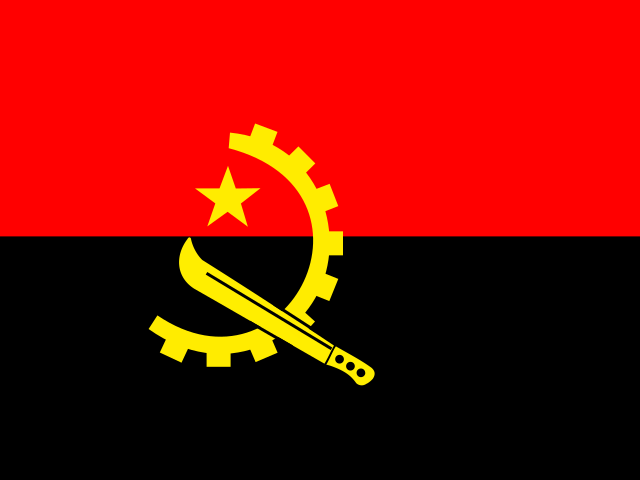 Angola
 Botswana
 Comoros
 Democratic Republic of the Congo
 Eswatini
 Lesotho
 Madagascar
 Malawi
 Mauritius
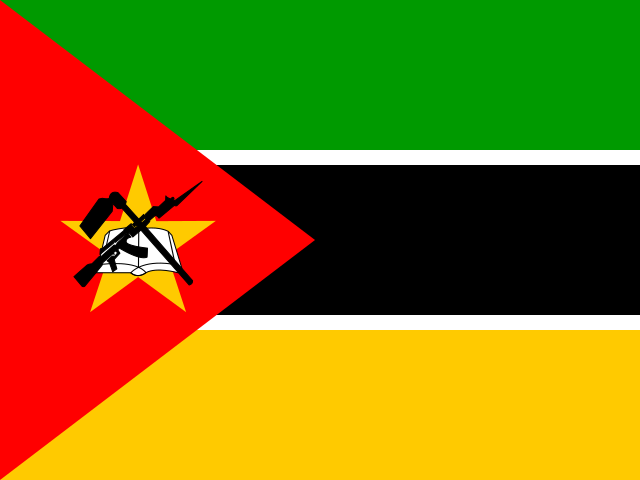 Mozambique
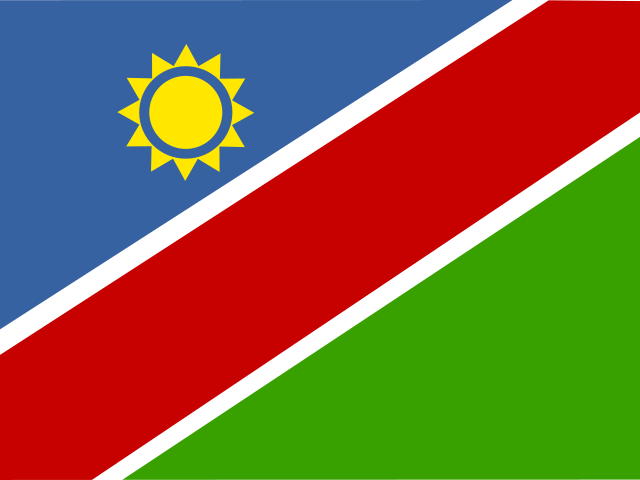 Namibia
 Seychelles
 South Africa
 Tanzania
 Zambia
 Zimbabwe
Earlier Report Observations
The market volume for prepared or preserved poultry meat or offal in the SADC region showed considerable volatility from 2018 to 2023. Starting at 12 293 tonnes in 2018, it jumped by 31% to 16 074 tonnes in 2019. However, this was followed by a 22% contraction in 2020, bringing the market down to 12 540 tonnes. The market stabilized in 2021 with a slight increase to 12 674 tonnes, then rebounded by 22% in 2022 to reach 15 507 tonnes. The most dramatic shift occurred in 2023, when the market plummeted by 40% to 9 232 tonnes.
Domestic production followed a similar pattern, rising from 6 884 tonnes in 2018 to a high of 9 079 tonnes in 2022 before dropping to 6 629 tonnes in 2023. Imports played a significant role, surging to 9 819 tonnes in 2019 and then falling back, with 2023 imports at only 4 025 tonnes. Exports remained below 1 500 tonnes throughout the period but showed variability, contributing to the net market size.
Table of content
- 1. Disclaimer
- 2. Terms of use of the report
- 3. Product codes in the statistical classifications used in the report
-
4. Key Market Indicators and Trends
-
4.1. Key Market Indicators
-
4.1.1. In kind
- 4.1.1.1. Production, 2018-2023
- 4.1.1.2. Imports, 2018-2024
- 4.1.1.3. Exports, 2018-2024
- 4.1.1.4. Market size, 2018-2023
-
4.1.1. In kind
- 4.2. Market Trends and Factors
-
4.1. Key Market Indicators
-
5. Production
-
5.1. Production in SADC
- 5.1.1. Annual dynamics of production in SADC in kind, 2018-2023, t
-
5.2. Global production by Country, 2018-2023
- 5.2.1. Annual dynamics of production by macroregions in kind, 2018-2023, t
- 5.2.2. Dynamics of production structure by macroregions in kind, 2018-2023
- 5.2.3. Annual dynamics of production by country in kind, 2018-2023, t
- 5.2.4. Structure of production by countries in kind, 2018-2023
- 5.2.5. Dynamics of peoduction structure by countries in kind, 2018-2023
-
5.1. Production in SADC
-
6. Imports
-
6.1. Imports (Direct Data*)
- 6.1.1. Imports - Total information
-
6.1.2. Imports in kind, t
- 6.1.2.1. Annual dynamics of product's imports to Angola in kind, 2018-2024, t
- 6.1.2.2. Dynamics of product's imports in kind to Angola by countries, 2018-2024, t
- 6.1.2.3. Structure of product's imports in kind by countries, 2018-2024
-
6.1.3. Imports in value, K $ US
- 6.1.3.1. Annual dynamics of product's imports to Angola in value, 2018-2024, K $ US
- 6.1.3.2. Dynamics of product's imports in value to Angola by countries, 2018-2024, K $ US
- 6.1.3.3. Structure of product's imports in value by countries, 2018-2024
-
6.1.4. Average price of product's imports, $ US/t
- 6.1.4.1. Annual dynamics of average price of product's imports to Angola, 2018-2024, $ US/t
- 6.1.4.2. Dynamics of average price of product's imports to Angola by countries, 2018-2024, $ US/t
-
6.2. Imports (Mirror Data)
- 6.2.1. Imports - Total information
-
6.2.2. Imports in kind, t
- 6.2.2.1. Annual dynamics of product's imports to Angola in kind, 2018-2024, t
- 6.2.2.2. Dynamics of product's imports in kind to Angola by countries, 2018-2024, t
- 6.2.2.3. Structure of product's imports in kind by countries, 2018-2024
-
6.2.3. Imports in value, K $ US
- 6.2.3.1. Annual dynamics of product's imports to Angola in value, 2018-2024, K $ US
- 6.2.3.2. Dynamics of product's imports in value to Angola by countries, 2018-2024, K $ US
- 6.2.3.3. Structure of product's imports in value by countries, 2018-2024
-
6.2.4. Average price of product's imports, $ US/t
- 6.2.4.1. Annual dynamics of average price of product's imports to Angola, 2018-2024, $ US/t
- 6.2.4.2. Dynamics of average price of product's imports to Angola by countries, 2018-2024, $ US/t
-
6.1. Imports (Direct Data*)
-
7. Exports
-
7.1. Exports (Direct Data*)
- 7.1.1. Exports - Total information
-
7.1.2. Exports in kind, t
- 7.1.2.1. Annual dynamics of product's exports from Angola in kind, 2018-2024, t
- 7.1.2.2. Dynamics of product's exports in kind from Angola by countries, 2018-2024, t
- 7.1.2.3. Structure of product's exports in kind by countries, 2018-2024
-
7.1.3. Exports in value, K $ US
- 7.1.3.1. Annual dynamics of product's exports from Angola in value, 2018-2024, K $ US
- 7.1.3.2. Dynamics of product's exports in value from Angola by countries, 2018-2024, K $ US
- 7.1.3.3. Structure of product's exports in value by countries, 2018-2024
-
7.1.4. Average price of product's exports, $ US/t
- 7.1.4.1. Annual dynamics of average price of product's exports from Angola, 2018-2024, $ US/t
- 7.1.4.2. Dynamics of average price of product's exports from Angola by countries, 2018-2024, $ US/t
-
7.2. Exports (Mirror Data)
- 7.2.1. Exports - Total information
-
7.2.2. Exports in kind, t
- 7.2.2.1. Annual dynamics of product's exports from Angola in kind, 2018-2024, t
- 7.2.2.2. Dynamics of product's exports in kind from Angola by countries, 2018-2024, t
- 7.2.2.3. Structure of product's exports in kind by countries, 2018-2024
-
7.2.3. Exports in value, K $ US
- 7.2.3.1. Annual dynamics of product's exports from Angola in value, 2018-2024, K $ US
- 7.2.3.2. Dynamics of product's exports in value from Angola by countries, 2018-2024, K $ US
- 7.2.3.3. Structure of product's exports in value by countries, 2018-2024
-
7.2.4. Average price of product's exports, $ US/t
- 7.2.4.1. Annual dynamics of average price of product's exports from Angola, 2018-2024, $ US/t
- 7.2.4.2. Dynamics of average price of product's exports from Angola by countries, 2018-2024, $ US/t
-
7.1. Exports (Direct Data*)
-
8. Trade balance
-
8.1. Trade balance (Direct Data)
- 8.1.1. In kind, t
- 8.1.2. In value, K $ US
-
8.2. Trade balance (Mirror Data)
- 8.2.1. In kind, t
- 8.2.2. In value, K $ US
-
8.1. Trade balance (Direct Data)
-
9. Top buying and selling countries, 2018-2024
-
9.1. Direct Data
- 9.1.1. Import in Value by Countries-buyers
- 9.1.2. Export in Value by Countries-suppliers
-
9.2. Mirror Data
- 9.2.1. Import in Value by Countries-buyers
- 9.2.2. Export in Value by Countries-suppliers
-
9.1. Direct Data
Production prepared or preserved poultry meat or offal in SADC
In kind, 2017-2020, t
Top producers of prepared or preserved poultry meat or offal, 2017-2020
World map of production of prepared or preserved poultry meat or offal, 2017-2020
After two consecutive years of decline, production of prepared or preserved poultry meat or offal in SADC rebounded. In 2019, output reached its lowest point at 6 681 tonnes, but by 2020 it had increased by 7.3% to 7 170 tonnes. The most significant production drop occurred in 2018, when output fell by 3.0%.
Annual dynamics of production in SADC in kind, 2017-2020, t
| Parameter | 2018 | 2019 | 2020 | CAGR | |
|---|---|---|---|---|---|
| 1 | Change from last year | (3.0%) | (3.0%) | 7.3% | 0.3% |
Exports prepared or preserved poultry meat or offal from SADC
Exports in kind, t
Export volumes showed considerable volatility during this period. In 2019, shipments hit their lowest level at just 426 tonnes, but they surged dramatically in 2020 to 1 477 tonnes - representing a remarkable 246.2% increase year-over-year. The most substantial decline occurred in 2019, when exports plummeted by 54.2%. Overall, there was a 3.5-fold difference between the peak in 2020 and the trough in 2019.
Annual dynamics of product's exports from SADC in kind, 2017-2020, t
| Parameter | 2018 | 2019 | 2020 | CAGR | |
|---|---|---|---|---|---|
| 1 | Change from last year | (30.9%) | (54.2%) | 246.2% | 3.1% |
From 2017 to 2020, the United Arab Emirates, Special Categories, and Qatar served as the primary destinations for SADC's prepared or preserved poultry meat or offal exports. The UAE accounted for 11.8% of export volumes, Special Categories represented 4.0%, and Qatar contributed 1.9%. Collectively, these three markets represented 17.7% of SADC's total exports in kind.
Structure of product's exports in kind by countries, 2017-2020
World map of product's exports from SADC in kind, 2017-2020
Exports in value, K $ US
Export values followed a different trajectory than volumes. In 2019, SADC's prepared or preserved poultry meat or offal exports reached their highest value at 8 502 thousand US dollars, but they declined sharply in 2020 to 5 564 thousand US dollars - a drop of 34.6% compared to the previous year. The most significant increase occurred in 2019, when export values rose by 49.2%. Over the entire 2017-2020 period, exports decreased by 19.1%, which translates to an annualized decline of 6.8%.
Annual dynamics of product's exports from SADC in value, 2017-2020, K $ US
| Parameter | 2018 | 2019 | 2020 | CAGR | |
|---|---|---|---|---|---|
| 1 | Change from last year | (17.1%) | 49.2% | (34.6%) | (6.8%) |
In value terms from 2017 to 2020, the United Arab Emirates, Special Categories, and Qatar remained the principal buyers of SADC's prepared or preserved poultry meat or offal. The UAE accounted for 12.3% of export value, Special Categories represented 6.0%, and Qatar contributed 1.7%. Together, these three markets accounted for 20.0% of SADC's total export value.
Structure of product's exports in value by countries, 2017-2020
World map of product's exports from SADC in value, 2017-2020
Imports prepared or preserved poultry meat or offal to SADC
Imports in kind, t
Import volumes experienced significant fluctuations. In 2018, imports reached their lowest point at 6 339 tonnes, but they surged to 9 819 tonnes in 2019 - an increase of 54.9%. However, imports then dropped sharply in 2020 to 6 846 tonnes, representing a 30.3% decline compared to the previous year. Over the 2017-2020 period, imports decreased by 10.3%, equivalent to an annualized decline of 3.6%.
Annual dynamics of product's imports to SADC in kind, 2017-2020, t
| Parameter | 2018 | 2019 | 2020 | CAGR | |
|---|---|---|---|---|---|
| 1 | Change from last year | (16.9%) | 54.9% | (30.3%) | (3.6%) |
SADC's import sources for prepared or preserved poultry meat or offal were quite diversified from 2017 to 2020. Brazil was the largest supplier, accounting for 35.5% of import volumes, followed by Portugal at 6.1% and Malaysia at 5.6%. Even combined, these top three suppliers represented just 47.2% of total import flows, indicating a broad partner portfolio.
Structure of product's imports in kind by countries, 2017-2020
World map of product's imports to SADC in kind, 2017-2020
Imports in value, K $ US
Import values followed a similar pattern to volumes. In 2018, imports reached their lowest value at 19 599 thousand US dollars, but they increased to 26 038 thousand US dollars in 2019 - a rise of 32.9%. However, imports then declined to 20 036 thousand US dollars in 2020, representing a 23.1% drop compared to the previous year. Over the 2017-2020 period, imports decreased by 6.1%, equivalent to an annualized decline of 2.1%.
Annual dynamics of product's imports to SADC in value, 2017-2020, K $ US
| Parameter | 2018 | 2019 | 2020 | CAGR | |
|---|---|---|---|---|---|
| 1 | Change from last year | (8.1%) | 32.9% | (23.1%) | (2.1%) |
In value terms from 2017 to 2020, SADC's import sources for prepared or preserved poultry meat or offal showed considerable diversity. Brazil accounted for 22.0% of import value, Malaysia represented 11.6%, and France contributed 5.9%. Together, these three suppliers represented just 39.5% of total import value, reflecting a broad and varied partner portfolio.
Structure of product's imports in value by countries, 2017-2020
World map of product's imports to SADC in value, 2017-2020
Related Reports





Why Choose Us?
Only Verified Data
No Hidden Costs or Separate Fees
Smarter Subscription Pricing
Contact Our Team
Submit your inquiry using the form below — our team will get back to you within 24 hours.