






"Central Asia" region includes following countries:
 Kazakhstan
 Kyrgyzstan
 Tajikistan
 Turkmenistan
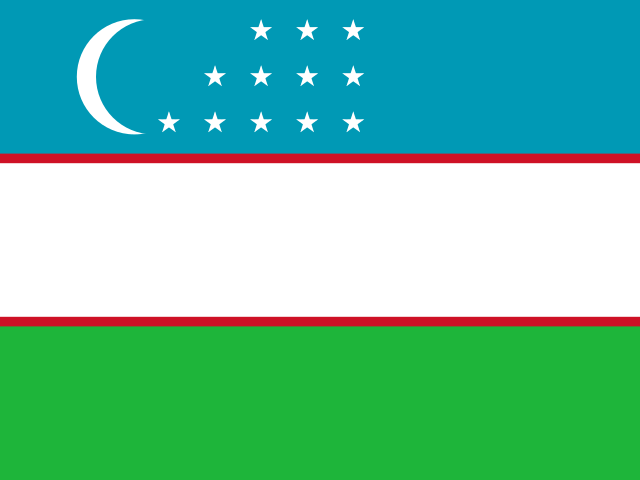 Uzbekistan
Earlier Report Observations
From 2018 to 2020, the starch market in Central Asia showed variable dynamics, influenced by investment in production capacity and shifting demand. The launch of a new maltodextrin production line at a major plant in 2018 strengthened domestic manufacturing capabilities. Market volume dipped to 95 689 t in 2019 before recovering to 102 106 t in 2020, a period where the growth in modified starch production and its expanding use in the food industry provided stability despite the disruptive impact of the COVID-19 pandemic.
Beginning in 2021, trade sanctions and reduced imports from Western suppliers spurred a significant import-substitution drive, boosting domestic output. This led to a sharp market expansion, with volume reaching 110 500 t in 2021. After a contraction to 99 855 t in 2022, the market surged to a record 118 982 t in 2023. This growth was driven by increased production of corn-based and modified starches, which offset a shortage of potato raw material that constrained potato starch output.
Table of content
- 1. Disclaimer
- 2. Terms of use of the report
- 3. Product codes in the statistical classifications used in the report
-
4. Key Market Indicators and Trends
-
4.1. Key Market Indicators
-
4.1.1. In kind
- 4.1.1.1. Production, 2018-2023
- 4.1.1.2. Imports, 2018-2024
- 4.1.1.3. Exports, 2018-2024
- 4.1.1.4. Market size, 2018-2023
-
4.1.1. In kind
- 4.2. Market Trends and Factors
-
4.1. Key Market Indicators
-
5. Production
-
5.1. Production in Central Asia
- 5.1.1. Annual dynamics of production in Central Asia in kind, 2018-2023, t
-
5.2. Global production by Country, 2018-2023
- 5.2.1. Annual dynamics of production by macroregions in kind, 2018-2023, t
- 5.2.2. Dynamics of production structure by macroregions in kind, 2018-2023
- 5.2.3. Annual dynamics of production by country in kind, 2018-2023, t
- 5.2.4. Structure of production by countries in kind, 2018-2023
- 5.2.5. Dynamics of peoduction structure by countries in kind, 2018-2023
-
5.1. Production in Central Asia
-
6. Imports
-
6.1. Imports (Direct Data*)
- 6.1.1. Imports - Total information
-
6.1.2. Imports in kind, t
- 6.1.2.1. Annual dynamics of product's imports to Kazakhstan in kind, 2018-2024, t
- 6.1.2.2. Dynamics of product's imports in kind to Kazakhstan by countries, 2018-2024, t
- 6.1.2.3. Structure of product's imports in kind by countries, 2018-2024
-
6.1.3. Imports in value, K $ US
- 6.1.3.1. Annual dynamics of product's imports to Kazakhstan in value, 2018-2024, K $ US
- 6.1.3.2. Dynamics of product's imports in value to Kazakhstan by countries, 2018-2024, K $ US
- 6.1.3.3. Structure of product's imports in value by countries, 2018-2024
-
6.1.4. Average price of product's imports, $ US/t
- 6.1.4.1. Annual dynamics of average price of product's imports to Kazakhstan, 2018-2024, $ US/t
- 6.1.4.2. Dynamics of average price of product's imports to Kazakhstan by countries, 2018-2024, $ US/t
-
6.2. Imports (Mirror Data)
- 6.2.1. Imports - Total information
-
6.2.2. Imports in kind, t
- 6.2.2.1. Annual dynamics of product's imports to Kazakhstan in kind, 2018-2024, t
- 6.2.2.2. Dynamics of product's imports in kind to Kazakhstan by countries, 2018-2024, t
- 6.2.2.3. Structure of product's imports in kind by countries, 2018-2024
-
6.2.3. Imports in value, K $ US
- 6.2.3.1. Annual dynamics of product's imports to Kazakhstan in value, 2018-2024, K $ US
- 6.2.3.2. Dynamics of product's imports in value to Kazakhstan by countries, 2018-2024, K $ US
- 6.2.3.3. Structure of product's imports in value by countries, 2018-2024
-
6.2.4. Average price of product's imports, $ US/t
- 6.2.4.1. Annual dynamics of average price of product's imports to Kazakhstan, 2018-2024, $ US/t
- 6.2.4.2. Dynamics of average price of product's imports to Kazakhstan by countries, 2018-2024, $ US/t
-
6.1. Imports (Direct Data*)
-
7. Exports
-
7.1. Exports (Direct Data*)
- 7.1.1. Exports - Total information
-
7.1.2. Exports in kind, t
- 7.1.2.1. Annual dynamics of product's exports from Kazakhstan in kind, 2018-2024, t
- 7.1.2.2. Dynamics of product's exports in kind from Kazakhstan by countries, 2018-2024, t
- 7.1.2.3. Structure of product's exports in kind by countries, 2018-2024
-
7.1.3. Exports in value, K $ US
- 7.1.3.1. Annual dynamics of product's exports from Kazakhstan in value, 2018-2024, K $ US
- 7.1.3.2. Dynamics of product's exports in value from Kazakhstan by countries, 2018-2024, K $ US
- 7.1.3.3. Structure of product's exports in value by countries, 2018-2024
-
7.1.4. Average price of product's exports, $ US/t
- 7.1.4.1. Annual dynamics of average price of product's exports from Kazakhstan, 2018-2024, $ US/t
- 7.1.4.2. Dynamics of average price of product's exports from Kazakhstan by countries, 2018-2024, $ US/t
-
7.2. Exports (Mirror Data)
- 7.2.1. Exports - Total information
-
7.2.2. Exports in kind, t
- 7.2.2.1. Annual dynamics of product's exports from Kazakhstan in kind, 2018-2024, t
- 7.2.2.2. Dynamics of product's exports in kind from Kazakhstan by countries, 2018-2024, t
- 7.2.2.3. Structure of product's exports in kind by countries, 2018-2024
-
7.2.3. Exports in value, K $ US
- 7.2.3.1. Annual dynamics of product's exports from Kazakhstan in value, 2018-2024, K $ US
- 7.2.3.2. Dynamics of product's exports in value from Kazakhstan by countries, 2018-2024, K $ US
- 7.2.3.3. Structure of product's exports in value by countries, 2018-2024
-
7.2.4. Average price of product's exports, $ US/t
- 7.2.4.1. Annual dynamics of average price of product's exports from Kazakhstan, 2018-2024, $ US/t
- 7.2.4.2. Dynamics of average price of product's exports from Kazakhstan by countries, 2018-2024, $ US/t
-
7.1. Exports (Direct Data*)
-
8. Trade balance
-
8.1. Trade balance (Direct Data)
- 8.1.1. In kind, t
- 8.1.2. In value, K $ US
-
8.2. Trade balance (Mirror Data)
- 8.2.1. In kind, t
- 8.2.2. In value, K $ US
-
8.1. Trade balance (Direct Data)
-
9. Top buying and selling countries, 2018-2024
-
9.1. Direct Data
- 9.1.1. Import in Value by Countries-buyers
- 9.1.2. Export in Value by Countries-suppliers
-
9.2. Mirror Data
- 9.2.1. Import in Value by Countries-buyers
- 9.2.2. Export in Value by Countries-suppliers
-
9.1. Direct Data
Production starches in Central Asia
In kind, 2017-2020, t
Top producers of starches, 2017-2020
World map of production of starches, 2017-2020
In 2019, Central Asia's starch production reached its lowest point at 68 455 tons, marking a 9.6% decline. However, production rebounded in 2020 to 77 404 tons, representing a 13.1% increase from the previous year. Over the period from 2017 to 2020, overall production grew by 6.5%, which translates to an average annual growth rate of 2.1%.
Annual dynamics of production in Central Asia in kind, 2017-2020, t
| Parameter | 2018 | 2019 | 2020 | CAGR | |
|---|---|---|---|---|---|
| 1 | Change from last year | 4.2% | (9.6%) | 13.1% | 2.1% |
In value, 2017-2020, K $ US
In 2019, the value of starch production in Central Asia hit its minimum at 37 282 thousand US dollars, with a 10.6% decrease. The following year, in 2020, output surged to 41 946 thousand US dollars, showing a strong gain of 12.5% compared to 2019. From 2017 to 2020, production value increased by 6.2%, averaging an annual growth rate of 2.0%.
Annual dynamics of production in Central Asia in value, 2017-2020, K $ US
| Parameter | 2018 | 2019 | 2020 | CAGR | |
|---|---|---|---|---|---|
| 1 | Change from last year | 5.6% | (10.6%) | 12.5% | 2.0% |
Exports starches from Central Asia
Exports in kind, t
Starch exports from Central Asia have been rising for three consecutive years. In 2020, exports reached 6 196 tons, a sharp 39.7% increase from 2019. Over the four-year span from 2017 to 2020, exports grew by 120%, with an average annual growth rate of 30.1%.
Annual dynamics of product's exports from Central Asia in kind, 2017-2020, t
| Parameter | 2018 | 2019 | 2020 | CAGR | |
|---|---|---|---|---|---|
| 1 | Change from last year | 21.1% | 30.0% | 39.7% | 30.1% |
From 2017 to 2020, Russia was the leading destination for starch exports from Central Asia in terms of volume, accounting for 4.0% of total exports.
Structure of product's exports in kind by countries, 2017-2020
World map of product's exports from Central Asia in kind, 2017-2020
Exports in value, K $ US
Starch shipments from Central Asia to international markets have increased for the third year in a row. In 2020, exports were valued at 3 357 thousand US dollars, reflecting a sharp 39.0% rise from 2019. Between 2017 and 2020, export value grew by 119.2%, with a compound annual growth rate of 29.9%.
Annual dynamics of product's exports from Central Asia in value, 2017-2020, K $ US
| Parameter | 2018 | 2019 | 2020 | CAGR | |
|---|---|---|---|---|---|
| 1 | Change from last year | 22.8% | 28.5% | 39.0% | 29.9% |
Throughout 2017 to 2020, Russia held the top position as the largest buyer of starches from Central Asia in value terms, with a share of 3.3%.
Structure of product's exports in value by countries, 2017-2020
World map of product's exports from Central Asia in value, 2017-2020
Imports starches to Central Asia
Imports in kind, t
After two years of growth, starch imports into Central Asia declined in 2020. Imports peaked in 2019 at 31 669 tons, with a significant 22.0% increase that year. In 2020, imports fell to 30 897 tons, a slight reduction of 2.4% from the previous year. Overall, from 2017 to 2020, imports increased by 44.2%, averaging an annual growth rate of 13.0%.
Annual dynamics of product's imports to Central Asia in kind, 2017-2020, t
| Parameter | 2018 | 2019 | 2020 | CAGR | |
|---|---|---|---|---|---|
| 1 | Change from last year | 21.2% | 22.0% | (2.4%) | 13.0% |
Between 2017 and 2020, Russia, Poland, and Belarus were the top suppliers of starches to Central Asia in volume terms. Russia led with 44.4% of imports, followed by Poland at 21.8%, and Belarus at 5.4%. Together, these three countries accounted for 71.6% of total starch imports by volume.
Structure of product's imports in kind by countries, 2017-2020
World map of product's imports to Central Asia in kind, 2017-2020
Imports in value, K $ US
Following two years of gains, starch imports into Central Asia decreased in 2020. The maximum value was recorded in 2019 at 17 038 thousand US dollars, with a substantial 27.7% increase that year. In 2020, imports dropped to 16 100 thousand US dollars, a modest 5.5% reduction from 2019. Over the period from 2017 to 2020, import value rose by 34.9%, with an average annual growth rate of 10.5%.
Annual dynamics of product's imports to Central Asia in value, 2017-2020, K $ US
| Parameter | 2018 | 2019 | 2020 | CAGR | |
|---|---|---|---|---|---|
| 1 | Change from last year | 11.8% | 27.7% | (5.5%) | 10.5% |
From 2017 to 2020, Russia, Poland, and Belarus dominated the supply of starches to Central Asia in value terms. Russia accounted for 36.6% of imports, Poland for 29.7%, and Belarus for 8.3%. Collectively, these three suppliers made up 74.5% of total starch imports by value.
Structure of product's imports in value by countries, 2017-2020
World map of product's imports to Central Asia in value, 2017-2020
Related Reports

2026-03-28
Starches market in Northern Europe
2026-03-28
2026-03-28
2026-03-28

Cereal germ market in Central Asia
2026-03-28


Potato starch market in Central Asia
2026-03-28
Why Choose Us?
Only Verified Data
No Hidden Costs or Separate Fees
Smarter Subscription Pricing
Contact Our Team
Submit your inquiry using the form below — our team will get back to you within 24 hours.