






"SADC" region includes following countries:
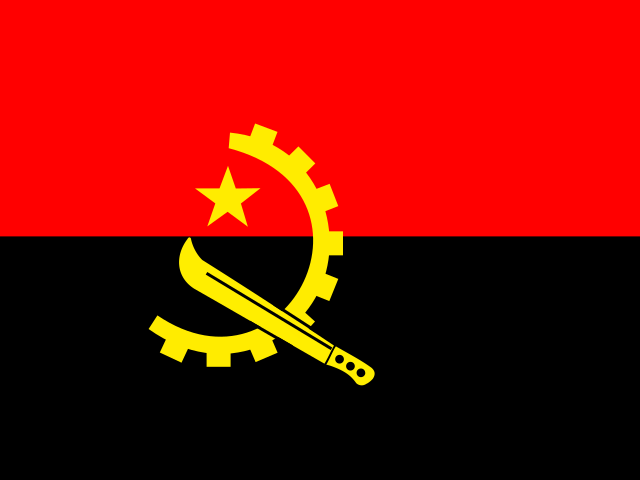 Angola
 Botswana
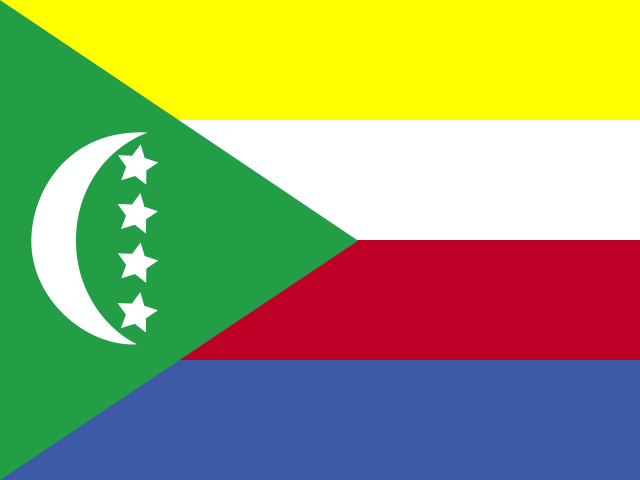 Comoros
 Democratic Republic of the Congo
 Eswatini
 Lesotho
 Madagascar
 Malawi
 Mauritius
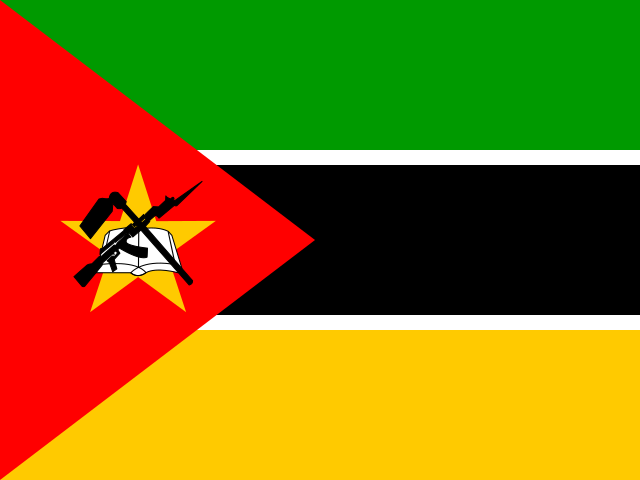 Mozambique
 Namibia
 Seychelles
 South Africa
 Tanzania
 Zambia
 Zimbabwe
Earlier Report Observations
Soybean production in SADC began at 2 224 thousand tons in 2018, with a market volume of 2 197 thousand tons. The planned introduction of a soybean levy from March 2019 encouraged the testing and adoption of new drought-tolerant cultivars and biotechnology, while the expansion of cultivation area to approximately 787 000 hectares boosted processing capacity and local demand.
Following a dip to 1 899 thousand tons of production in 2019, output recovered consistently, reaching 4 008 thousand tons by 2023. Market volume grew in parallel, rising to 3 101 thousand tons in 2023. This sustained growth was partly driven by soybean cultivation expanding in western South Africa, where it replaced white maize and sunflower crops, increasing planted area and local consumption.
In 2024, drought and port logistics challenges presented headwinds for soybean growth. Concurrently, domestic crushing capacity investments raised capacity to around 2.2 million tons, and the Tripartite Free Trade Area agreement entering force in July 2024 expanded market access for SADC soybeans across 26 countries.
Table of content
- 1. Disclaimer
- 2. Terms of use of the report
- 3. Product codes in the statistical classifications used in the report
-
4. Key Market Indicators and Trends
-
4.1. Key Market Indicators
-
4.1.1. In kind
- 4.1.1.1. Production, 2018-2023
- 4.1.1.2. Imports, 2018-2024
- 4.1.1.3. Exports, 2018-2024
- 4.1.1.4. Market size, 2018-2023
-
4.1.1. In kind
- 4.2. Market Trends and Factors
-
4.1. Key Market Indicators
-
5. Production
-
5.1. Production in SADC
- 5.1.1. Annual dynamics of production in SADC in kind, 2018-2023, K t
-
5.2. Global production by Country, 2018-2023
- 5.2.1. Annual dynamics of production by macroregions in kind, 2018-2023, K t
- 5.2.2. Dynamics of production structure by macroregions in kind, 2018-2023
- 5.2.3. Annual dynamics of production by country in kind, 2018-2023, K t
- 5.2.4. Structure of production by countries in kind, 2018-2023
- 5.2.5. Dynamics of peoduction structure by countries in kind, 2018-2023
-
5.1. Production in SADC
-
6. Imports
-
6.1. Imports (Direct Data*)
- 6.1.1. Imports - Total information
-
6.1.2. Imports in kind, K t
- 6.1.2.1. Annual dynamics of product's imports to Angola in kind, 2018-2024, K t
- 6.1.2.2. Dynamics of product's imports in kind to Angola by countries, 2018-2024, K t
- 6.1.2.3. Structure of product's imports in kind by countries, 2018-2024
-
6.1.3. Imports in value, M $ US
- 6.1.3.1. Annual dynamics of product's imports to Angola in value, 2018-2024, M $ US
- 6.1.3.2. Dynamics of product's imports in value to Angola by countries, 2018-2024, M $ US
- 6.1.3.3. Structure of product's imports in value by countries, 2018-2024
-
6.1.4. Average price of product's imports, $ US/t
- 6.1.4.1. Annual dynamics of average price of product's imports to Angola, 2018-2024, $ US/t
- 6.1.4.2. Dynamics of average price of product's imports to Angola by countries, 2018-2024, $ US/t
-
6.2. Imports (Mirror Data)
- 6.2.1. Imports - Total information
-
6.2.2. Imports in kind, K t
- 6.2.2.1. Annual dynamics of product's imports to Angola in kind, 2018-2024, K t
- 6.2.2.2. Dynamics of product's imports in kind to Angola by countries, 2018-2024, K t
- 6.2.2.3. Structure of product's imports in kind by countries, 2018-2024
-
6.2.3. Imports in value, M $ US
- 6.2.3.1. Annual dynamics of product's imports to Angola in value, 2018-2024, M $ US
- 6.2.3.2. Dynamics of product's imports in value to Angola by countries, 2018-2024, M $ US
- 6.2.3.3. Structure of product's imports in value by countries, 2018-2024
-
6.2.4. Average price of product's imports, $ US/t
- 6.2.4.1. Annual dynamics of average price of product's imports to Angola, 2018-2024, $ US/t
- 6.2.4.2. Dynamics of average price of product's imports to Angola by countries, 2018-2024, $ US/t
-
6.1. Imports (Direct Data*)
-
7. Exports
-
7.1. Exports (Direct Data*)
- 7.1.1. Exports - Total information
-
7.1.2. Exports in kind, K t
- 7.1.2.1. Annual dynamics of product's exports from Angola in kind, 2018-2024, K t
- 7.1.2.2. Dynamics of product's exports in kind from Angola by countries, 2018-2024, K t
- 7.1.2.3. Structure of product's exports in kind by countries, 2018-2024
-
7.1.3. Exports in value, M $ US
- 7.1.3.1. Annual dynamics of product's exports from Angola in value, 2018-2024, M $ US
- 7.1.3.2. Dynamics of product's exports in value from Angola by countries, 2018-2024, M $ US
- 7.1.3.3. Structure of product's exports in value by countries, 2018-2024
-
7.1.4. Average price of product's exports, $ US/t
- 7.1.4.1. Annual dynamics of average price of product's exports from Angola, 2018-2024, $ US/t
- 7.1.4.2. Dynamics of average price of product's exports from Angola by countries, 2018-2024, $ US/t
-
7.2. Exports (Mirror Data)
- 7.2.1. Exports - Total information
-
7.2.2. Exports in kind, K t
- 7.2.2.1. Annual dynamics of product's exports from Angola in kind, 2018-2024, K t
- 7.2.2.2. Dynamics of product's exports in kind from Angola by countries, 2018-2024, K t
- 7.2.2.3. Structure of product's exports in kind by countries, 2018-2024
-
7.2.3. Exports in value, M $ US
- 7.2.3.1. Annual dynamics of product's exports from Angola in value, 2018-2024, M $ US
- 7.2.3.2. Dynamics of product's exports in value from Angola by countries, 2018-2024, M $ US
- 7.2.3.3. Structure of product's exports in value by countries, 2018-2024
-
7.2.4. Average price of product's exports, $ US/t
- 7.2.4.1. Annual dynamics of average price of product's exports from Angola, 2018-2024, $ US/t
- 7.2.4.2. Dynamics of average price of product's exports from Angola by countries, 2018-2024, $ US/t
-
7.1. Exports (Direct Data*)
-
8. Trade balance
-
8.1. Trade balance (Direct Data)
- 8.1.1. In kind, K t
- 8.1.2. In value, M $ US
-
8.2. Trade balance (Mirror Data)
- 8.2.1. In kind, K t
- 8.2.2. In value, M $ US
-
8.1. Trade balance (Direct Data)
-
9. Top buying and selling countries, 2018-2024
-
9.1. Direct Data
- 9.1.1. Import in Value by Countries-buyers
- 9.1.2. Export in Value by Countries-suppliers
-
9.2. Mirror Data
- 9.2.1. Import in Value by Countries-buyers
- 9.2.2. Export in Value by Countries-suppliers
-
9.1. Direct Data
Production soybeans in SADC
In kind, 2017-2020, K t
Top producers of soybeans, 2017-2020
World map of production of soybeans, 2017-2020
In 2020, SADC produced 2 090 K t of soybeans, marking a 10.1% increase from the previous year. Over the 2017-2020 period, production grew by 3.1%, with a compound annual growth rate of 1.0%. The lowest production level was recorded in 2019 at 1 899 K t, while the highest was in 2018 at 2 224 K t. The most significant decline occurred in 2019, with a drop of 14.6%.
Annual dynamics of production in SADC in kind, 2017-2020, K t
| Parameter | 2018 | 2019 | 2020 | CAGR | |
|---|---|---|---|---|---|
| 1 | Change from last year | 9.7% | (14.6%) | 10.1% | 1.0% |
Exports soybeans from SADC
Exports in kind, t
The market exhibited volatility during the observed period. Exports reached their lowest point in 2019 at 36 814 t and peaked in 2020 at 73 308 t, showing a two-fold difference between these years. In 2020, SADC's soybean export volume surged by 99.1% compared to the previous year. The largest decline was recorded in 2019, with a decrease of 26.8%.
Annual dynamics of product's exports from SADC in kind, 2017-2020, t
| Parameter | 2018 | 2019 | 2020 | CAGR | |
|---|---|---|---|---|---|
| 1 | Change from last year | 30.8% | (26.8%) | 99.1% | 24.0% |
From 2017 to 2020, the partner structure for soybean exports in kind remained fragmented. India accounted for 18.2% of exports, Turkey for 10.6%, and China for 3.1%, with these three countries together representing only 31.9% of total flows. No single country achieved a dominant share in the export market.
Structure of product's exports in kind by countries, 2017-2020
World map of product's exports from SADC in kind, 2017-2020
Exports in value, K $ US
After a two-year decline, soybean shipments from SADC to international markets increased. In 2020, exports amounted to 36 736 K $ US, reflecting a 15.8% improvement from the previous year. Over the 2017-2020 period, exports decreased by 40.4%, with a compound annual growth rate of 15.8%. The lowest value was recorded in 2019 at 31 716 K $ US, and the largest decline occurred in 2019 with a drop of 37.5%.
Annual dynamics of product's exports from SADC in value, 2017-2020, K $ US
| Parameter | 2018 | 2019 | 2020 | CAGR | |
|---|---|---|---|---|---|
| 1 | Change from last year | (17.7%) | (37.5%) | 15.8% | (15.8%) |
Between 2017 and 2020, SADC exported soybeans to a wide range of markets. India accounted for 10.1% of exports in value terms, Kenya for 7.0%, and Turkey for 6.8%, with these three countries together making up only 23.9% of total export value. The remaining 76.1% was distributed among numerous smaller destinations.
Structure of product's exports in value by countries, 2017-2020
World map of product's exports from SADC in value, 2017-2020
Imports soybeans to SADC
Imports in kind, t
The data shows irregular changes, indicating a volatile market environment. Imports bottomed in 2018 at 23 787 t and peaked in 2020 at 87 228 t, with a 3.7-fold difference between these years. In 2020, SADC's soybean import volume increased dramatically by 172.4% year-over-year. The largest decline was recorded in 2018, with a decrease of 69.8%.
Annual dynamics of product's imports to SADC in kind, 2017-2020, t
| Parameter | 2018 | 2019 | 2020 | CAGR | |
|---|---|---|---|---|---|
| 1 | Change from last year | (69.8%) | 34.6% | 172.4% | 3.5% |
The structure of soybean imports in kind from 2017 to 2020 can be described as diversified. Brazil accounted for 19.9% of imports, the United States for 1.7%, and India for 1.5%, with these three countries together representing just 23.1% of total flows. No single country held a clearly dominant position in the import market.
Structure of product's imports in kind by countries, 2017-2020
World map of product's imports to SADC in kind, 2017-2020
Imports in value, K $ US
Volatility characterized the market behavior during these years. Imports reached their lowest point in 2018 at 15 373 K $ US and peaked in 2017, showing a 3.6-fold change between these years. In 2020, SADC imported 40 282 K $ US of soybeans, marking a dramatic gain of 87.2% compared to 2019. The largest decline was recorded in 2018, with a drop of 72.0%.
Annual dynamics of product's imports to SADC in value, 2017-2020, K $ US
| Parameter | 2018 | 2019 | 2020 | CAGR | |
|---|---|---|---|---|---|
| 1 | Change from last year | (72.0%) | 40.0% | 87.2% | (9.9%) |
From 2017 to 2020, soybeans were supplied to SADC from a broad set of markets. Brazil accounted for 13.9% of imports in value terms, the United States for 7.4%, and Italy for 1.8%, with these three countries together making up only 23.1% of total import value. The remaining 76.9% came from many smaller destinations.
Structure of product's imports in value by countries, 2017-2020
World map of product's imports to SADC in value, 2017-2020
Related Reports

2026-03-28
2026-03-28
Soybeans market in South-eastern Asia
2026-03-28
2026-03-28

2026-03-28

2026-03-28

2026-03-28
In-depth market research on this product
Global Soybean Meal Market 2021–2031: Size, Share, Trends and Forecast
Global market report: size, trends and forecast to 2031 · 196 pages
Why Choose Us?
Only Verified Data
No Hidden Costs or Separate Fees
Smarter Subscription Pricing
Contact Our Team
Submit your inquiry using the form below — our team will get back to you within 24 hours.