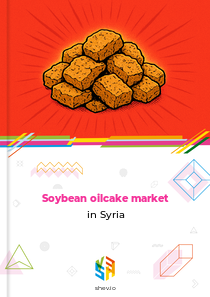







Earlier Report Observations
From 2018 to 2021, the soybean oilcake market in Syria expanded consistently, with volume rising from 57 000 tons to 93 000 tons. This growth was driven primarily by increasing imports, which more than doubled from 54 000 tons to 89 000 tons over the period, while domestic production remained below 5 000 tons annually.
The market contracted sharply in 2022 to 68 000 tons, as imports fell by 30% to 63 000 tons. A shift away from soybean oil imports to local processing, noted in 2021, coincided with a rise in domestic oilcake production to 4 900 tons. Partial recovery followed in 2023, with market volume reaching 72 000 tons alongside a rebound in imports to 67 000 tons. The presence of local soybean processing plants, reported in 2023, supported continued domestic output near 5 000 tons.
In January 2024, the first vegetable oil production plant in the Al-Jazira region commenced operations, expanding local oilseed processing infrastructure.
Table of content
- 1. Disclaimer
- 2. Terms of use of the report
- 3. Product codes in the statistical classifications used in the report
-
4. Key Market Indicators and Trends
-
4.1. Key Market Indicators
-
4.1.1. In kind
- 4.1.1.1. Production, 2018-2023
- 4.1.1.2. Imports, 2018-2024
- 4.1.1.3. Exports, 2018-2024
- 4.1.1.4. Market size, 2018-2023
-
4.1.1. In kind
- 4.2. Market Trends and Factors
-
4.1. Key Market Indicators
-
5. Production
-
5.1. Production in Syria
- 5.1.1. Annual dynamics of production in Syria in kind, 2018-2023, t
- 5.1.2. Annual dynamics of production in Syria in value, 2018-2023, $ US
-
5.2. Global production by Country, 2018-2023
- 5.2.1. Annual dynamics of production by macroregions in kind, 2018-2023, t
- 5.2.2. Dynamics of production structure by macroregions in kind, 2018-2023
- 5.2.3. Annual dynamics of production by country in kind, 2018-2023, t
- 5.2.4. Structure of production by countries in kind, 2018-2023
- 5.2.5. Dynamics of peoduction structure by countries in kind, 2018-2023
-
5.1. Production in Syria
-
6. Imports
-
6.1. Imports (Direct Data*)
- 6.1.1. Imports - Total information
-
6.1.2. Imports in kind, t
- 6.1.2.1. Annual dynamics of product's imports to Syria in kind, 2018-2024, t
- 6.1.2.2. Dynamics of product's imports in kind to Syria by countries, 2018-2024, t
- 6.1.2.3. Structure of product's imports in kind by countries, 2018-2024
-
6.1.3. Imports in value, K $ US
- 6.1.3.1. Annual dynamics of product's imports to Syria in value, 2018-2024, K $ US
- 6.1.3.2. Dynamics of product's imports in value to Syria by countries, 2018-2024, K $ US
- 6.1.3.3. Structure of product's imports in value by countries, 2018-2024
-
6.1.4. Average price of product's imports, $ US/t
- 6.1.4.1. Annual dynamics of average price of product's imports to Syria, 2018-2024, $ US/t
- 6.1.4.2. Dynamics of average price of product's imports to Syria by countries, 2018-2024, $ US/t
-
6.2. Imports (Mirror Data)
- 6.2.1. Imports - Total information
-
6.2.2. Imports in kind, t
- 6.2.2.1. Annual dynamics of product's imports to Syria in kind, 2018-2024, t
- 6.2.2.2. Dynamics of product's imports in kind to Syria by countries, 2018-2024, t
- 6.2.2.3. Structure of product's imports in kind by countries, 2018-2024
-
6.2.3. Imports in value, K $ US
- 6.2.3.1. Annual dynamics of product's imports to Syria in value, 2018-2024, K $ US
- 6.2.3.2. Dynamics of product's imports in value to Syria by countries, 2018-2024, K $ US
- 6.2.3.3. Structure of product's imports in value by countries, 2018-2024
-
6.2.4. Average price of product's imports, $ US/t
- 6.2.4.1. Annual dynamics of average price of product's imports to Syria, 2018-2024, $ US/t
- 6.2.4.2. Dynamics of average price of product's imports to Syria by countries, 2018-2024, $ US/t
-
6.1. Imports (Direct Data*)
-
7. Trade balance
-
7.1. Trade balance (Direct Data)
- 7.1.1. In kind, t
- 7.1.2. In value, K $ US
-
7.2. Trade balance (Mirror Data)
- 7.2.1. In kind, t
- 7.2.2. In value, K $ US
-
7.1. Trade balance (Direct Data)
-
8. Top buying and selling countries, 2018-2024
-
8.1. Direct Data
- 8.1.1. Import in Value by Countries-buyers
- 8.1.2. Export in Value by Countries-suppliers
-
8.2. Mirror Data
- 8.2.1. Import in Value by Countries-buyers
- 8.2.2. Export in Value by Countries-suppliers
-
8.1. Direct Data
Production soybean oilcake in Syria
In kind, 2017-2020, t
Top producers of soybean oilcake, 2017-2020
World map of production of soybean oilcake, 2017-2020
Soybean oilcake production in Syria has increased for the second year in a row. In 2019, Syria produced 3,500 tonnes, which surged to 5,600 tonnes in 2020—a sharp 60.0% increase. Over the 2017-2020 period, production grew by 43.6%, with an average annual growth rate of 12.8%. The lowest production level was in 2018 at 3,100 tonnes, marking the largest decline of 20.5% that year.
Annual dynamics of production in Syria in kind, 2017-2020, t
| Parameter | 2018 | 2019 | 2020 | CAGR | |
|---|---|---|---|---|---|
| 1 | Change from last year | (20.5%) | 12.9% | 60.0% | 12.8% |
Exports soybean oilcake from Syria
According to industry analysis, Syria did not export any soybean oilcake from 2017 to 2020.
Imports soybean oilcake to Syria
Imports in kind, t
Syria's soybean oilcake imports have risen for the second consecutive year. In 2019, imports were 68,600 tonnes, climbing to 79,202 tonnes in 2020—a 15.5% increase. From 2017 to 2020, imports grew by 11.1%, with a compound annual growth rate of 3.6%. The lowest import volume was in 2018 at 53,856 tonnes, which saw the largest decline of 24.5%. The biggest increase occurred in 2019, with a 27.3% rise.
Annual dynamics of product's imports to Syria in kind, 2017-2020, t
| Parameter | 2018 | 2019 | 2020 | CAGR | |
|---|---|---|---|---|---|
| 1 | Change from last year | (24.5%) | 27.3% | 15.5% | 3.6% |
From 2017 to 2020, Turkey was the dominant partner for Syria's soybean oilcake imports in volume, accounting for 80.2% of total flows, while other markets held relatively small shares.
Structure of product's imports in kind by countries, 2017-2020
World map of product's imports to Syria in kind, 2017-2020
Imports in value, K $ US
Soybean oilcake imports into Syria have increased for the second year in a row. In 2019, import value was $25,580,000, rising to $30,523,000 in 2020—a 19.3% increase. Between 2017 and 2020, imports grew by 12.9%, equivalent to an annualized rate of 4.1%. The lowest value was in 2018 at $23,049,000, which experienced the largest decline of 14.8%.
Annual dynamics of product's imports to Syria in value, 2017-2020, K $ US
| Parameter | 2018 | 2019 | 2020 | CAGR | |
|---|---|---|---|---|---|
| 1 | Change from last year | (14.8%) | 11.0% | 19.3% | 4.1% |
During 2017-2020, Syria's import structure in value terms was heavily concentrated on Turkey, which represented 80.0% of total flows, with other partners making up the remainder.
Structure of product's imports in value by countries, 2017-2020
World map of product's imports to Syria in value, 2017-2020
Related Reports

Soybean oilcake market in ECOWAS
2026-03-29
Soybean oilcake market in Thailand
2026-03-29
Soybean oilcake market in Central America
2026-03-29


Starch-manufacture residues market in Syria
2026-03-29

Fruit and vegetable juices market in Syria
2026-03-29
Why Choose Us?
Only Verified Data
No Hidden Costs or Separate Fees
Smarter Subscription Pricing
Contact Our Team
Submit your inquiry using the form below — our team will get back to you within 24 hours.