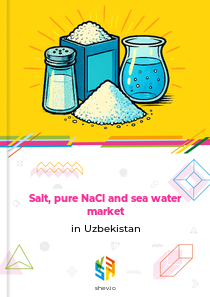







Earlier Report Observations
The salt market in Uzbekistan saw its volume decline from 297.2 thousand tons in 2018 to 279.5 thousand tons in 2019, before a slight recovery to 288.2 thousand tons in 2020.
A sharp expansion occurred in 2021, with the market reaching 428.8 thousand tons as imports jumped to 23.3 thousand tons. This was followed by a contraction to 260.8 thousand tons in 2022, when imports fell back and exports increased to 11.0 thousand tons.
In 2023 and 2024, exports remained high at 17.3 thousand tons and 15.8 thousand tons respectively, while imports stayed low. The supply of Russian salt to Uzbekistan influenced import patterns, and growth in retail turnover and remittances from abroad supported consumer demand.
Table of content
- 1. Disclaimer
- 2. Terms of use of the report
- 3. Product codes in the statistical classifications used in the report
-
4. Key Market Indicators and Trends
-
4.1. Key Market Indicators
-
4.1.1. In kind
- 4.1.1.1. Production, 2018-2022
- 4.1.1.2. Imports, 2018-2024
- 4.1.1.3. Exports, 2018-2024
- 4.1.1.4. Market size, 2018-2022
-
4.1.1. In kind
- 4.2. Market Trends and Factors
-
4.1. Key Market Indicators
-
5. Production
-
5.1. Production in Uzbekistan
- 5.1.1. Annual dynamics of production in Uzbekistan in kind, 2018-2022, K t
- 5.1.2. Annual dynamics of production in Uzbekistan in value, 2018-2022, $ US
-
5.2. Global production by Country, 2018-2022
- 5.2.1. Annual dynamics of production by country in kind, 2018-2022, K t
- 5.2.2. Structure of production by countries in kind, 2018-2022
- 5.2.3. Dynamics of peoduction structure by countries in kind, 2018-2022
-
5.1. Production in Uzbekistan
-
6. Exports
-
6.1. Exports (Direct Data)
- 6.1.1. Exports - Total information
-
6.1.2. Exports in kind, t
- 6.1.2.1. Annual dynamics of product's exports from Uzbekistan in kind, 2018-2024, t
- 6.1.2.2. Dynamics of product's exports in kind from Uzbekistan by countries, 2018-2024, t
- 6.1.2.3. Structure of product's exports in kind by countries, 2018-2024
-
6.1.3. Exports in value, K $ US
- 6.1.3.1. Annual dynamics of product's exports from Uzbekistan in value, 2018-2024, K $ US
- 6.1.3.2. Dynamics of product's exports in value from Uzbekistan by countries, 2018-2024, K $ US
- 6.1.3.3. Structure of product's exports in value by countries, 2018-2024
-
6.1.4. Average price of product's exports, $ US/t
- 6.1.4.1. Annual dynamics of average price of product's exports from Uzbekistan, 2018-2024, $ US/t
- 6.1.4.2. Dynamics of average price of product's exports from Uzbekistan by countries, 2018-2024, $ US/t
-
6.2. Exports (Mirror Data)
- 6.2.1. Exports - Total information
-
6.2.2. Exports in kind, t
- 6.2.2.1. Annual dynamics of product's exports from Uzbekistan in kind, 2018-2024, t
- 6.2.2.2. Dynamics of product's exports in kind from Uzbekistan by countries, 2018-2024, t
- 6.2.2.3. Structure of product's exports in kind by countries, 2018-2024
-
6.2.3. Exports in value, K $ US
- 6.2.3.1. Annual dynamics of product's exports from Uzbekistan in value, 2018-2024, K $ US
- 6.2.3.2. Dynamics of product's exports in value from Uzbekistan by countries, 2018-2024, K $ US
- 6.2.3.3. Structure of product's exports in value by countries, 2018-2024
-
6.2.4. Average price of product's exports, $ US/t
- 6.2.4.1. Annual dynamics of average price of product's exports from Uzbekistan, 2018-2024, $ US/t
- 6.2.4.2. Dynamics of average price of product's exports from Uzbekistan by countries, 2018-2024, $ US/t
-
6.1. Exports (Direct Data)
-
7. Imports
-
7.1. Imports (Direct Data)
- 7.1.1. Imports - Total information
-
7.1.2. Imports in kind, t
- 7.1.2.1. Annual dynamics of product's imports to Uzbekistan in kind, 2018-2024, t
- 7.1.2.2. Dynamics of product's imports in kind to Uzbekistan by countries, 2018-2024, t
- 7.1.2.3. Structure of product's imports in kind by countries, 2018-2024
-
7.1.3. Imports in value, K $ US
- 7.1.3.1. Annual dynamics of product's imports to Uzbekistan in value, 2018-2024, K $ US
- 7.1.3.2. Dynamics of product's imports in value to Uzbekistan by countries, 2018-2024, K $ US
- 7.1.3.3. Structure of product's imports in value by countries, 2018-2024
-
7.1.4. Average price of product's imports, $ US/t
- 7.1.4.1. Annual dynamics of average price of product's imports to Uzbekistan, 2018-2024, $ US/t
- 7.1.4.2. Dynamics of average price of product's imports to Uzbekistan by countries, 2018-2024, $ US/t
-
7.2. Imports (Mirror Data)
- 7.2.1. Imports - Total information
-
7.2.2. Imports in kind, t
- 7.2.2.1. Annual dynamics of product's imports to Uzbekistan in kind, 2018-2024, t
- 7.2.2.2. Dynamics of product's imports in kind to Uzbekistan by countries, 2018-2024, t
- 7.2.2.3. Structure of product's imports in kind by countries, 2018-2024
-
7.2.3. Imports in value, K $ US
- 7.2.3.1. Annual dynamics of product's imports to Uzbekistan in value, 2018-2024, K $ US
- 7.2.3.2. Dynamics of product's imports in value to Uzbekistan by countries, 2018-2024, K $ US
- 7.2.3.3. Structure of product's imports in value by countries, 2018-2024
-
7.2.4. Average price of product's imports, $ US/t
- 7.2.4.1. Annual dynamics of average price of product's imports to Uzbekistan, 2018-2024, $ US/t
- 7.2.4.2. Dynamics of average price of product's imports to Uzbekistan by countries, 2018-2024, $ US/t
-
7.1. Imports (Direct Data)
-
8. Trade balance
-
8.1. Trade balance (Direct Data)
- 8.1.1. In kind, t
- 8.1.2. In value, K $ US
-
8.2. Trade balance (Mirror Data)
- 8.2.1. In kind, t
- 8.2.2. In value, K $ US
-
8.1. Trade balance (Direct Data)
-
9. Top buying and selling countries, 2018-2024
-
9.1. Direct Data
- 9.1.1. Import in Value by Countries-buyers
- 9.1.2. Export in Value by Countries-suppliers
-
9.2. Mirror Data
- 9.2.1. Import in Value by Countries-buyers
- 9.2.2. Export in Value by Countries-suppliers
-
9.1. Direct Data
Production salt, pure NaCl and sea water in Uzbekistan
In kind, 2017-2020, K t
Top producers of salt, pure NaCl and sea water, 2017-2020
World map of production of salt, pure NaCl and sea water, 2017-2020
The market exhibited volatility during the observed period. Production reached its lowest point in 2017, followed by a peak in 2018, showing a fivefold fluctuation between these years. In 2020, Uzbekistan produced 292.7 K t of salt, pure NaCl, and sea water, representing a 3.9% increase from the previous year. The highest production level was recorded in 2018 at 300.7 K t. The largest decline occurred in 2019 with a 6.3% drop, while the most significant increase was in 2018 at 401.1%.
Annual dynamics of production in Uzbekistan in kind, 2017-2020, K t
| Parameter | 2018 | 2019 | 2020 | CAGR | |
|---|---|---|---|---|---|
| 1 | Change from last year | 401.1% | (6.3%) | 3.9% | 69.6% |
In value, 2017-2020, K $ US
The market demonstrated volatility throughout the period. The minimum value was recorded in 2017, with the maximum in 2018, showing a 4.8-fold variation between these years. In 2020, the output of salt, pure NaCl, and sea water in Uzbekistan was valued at 14 291 K $ US, marking a moderate decline of 8.2% compared to 2019. The highest value was in 2018 at 17 192 K $ US. The largest decline occurred in 2019 with a 9.5% decrease, while the most significant increase was in 2018 at 377.4%.
Annual dynamics of production in Uzbekistan in value, 2017-2020, K $ US
| Parameter | 2018 | 2019 | 2020 | CAGR | |
|---|---|---|---|---|---|
| 1 | Change from last year | 377.4% | (9.5%) | (8.2%) | 58.3% |
Exports salt, pure NaCl and sea water from Uzbekistan
Exports in kind, t
Salt, pure NaCl, and sea water exports from Uzbekistan increased for the second consecutive year. In 2020, exports amounted to 5 647 t, reflecting a 25.3% improvement from the previous year. Between 2017 and 2020, exports grew by 19%, equating to an annualized rate of 6.0%. The lowest value was recorded in 2018 at 4 405 t, with the largest decline occurring that year at 7.1%.
Annual dynamics of product's exports from Uzbekistan in kind, 2017-2020, t
| Parameter | 2018 | 2019 | 2020 | CAGR | |
|---|---|---|---|---|---|
| 1 | Change from last year | (7.1%) | 2.3% | 25.3% | 6.0% |
From 2017 to 2020, Kazakhstan and Kyrgyzstan together accounted for 83.4% of total exports in kind, while the remaining flows were distributed thinly across other markets.
Structure of product's exports in kind by countries, 2017-2020
World map of product's exports from Uzbekistan in kind, 2017-2020
Exports in value, K $ US
After a two-year decline, exports of salt, pure NaCl, and sea water from Uzbekistan increased. In 2020, exports amounted to 276 K $ US, which is 10.8% above the year-over-year level. Between 2017 and 2020, exports decreased by 3.2%, equating to an annualized rate of 1.1%. The lowest value was recorded in 2019 at 249 K $ US, with the largest decline occurring in 2018 at 11.5%.
Annual dynamics of product's exports from Uzbekistan in value, 2017-2020, K $ US
| Parameter | 2018 | 2019 | 2020 | CAGR | |
|---|---|---|---|---|---|
| 1 | Change from last year | (11.5%) | (1.2%) | 10.8% | (1.1%) |
From 2017 to 2020, two markets—Kazakhstan and Kyrgyzstan—played leading roles in exports in value terms, together accounting for 85.5% of total flows, while the rest was distributed among other destinations.
Structure of product's exports in value by countries, 2017-2020
World map of product's exports from Uzbekistan in value, 2017-2020
Imports salt, pure NaCl and sea water to Uzbekistan
Imports in kind, t
The market showed volatility over the observed period. Imports reached their lowest point in 2017 and peaked in 2019, with a 3.2-fold variation between these years. In 2020, salt, pure NaCl, and sea water shipments to Uzbekistan from abroad registered 1 138 t, amounting to a steep fall of 48.6% versus the previous year. The maximum value was recorded in 2019 at 2 213 t, with the largest increase occurring that year at 134.8%.
Annual dynamics of product's imports to Uzbekistan in kind, 2017-2020, t
| Parameter | 2018 | 2019 | 2020 | CAGR | |
|---|---|---|---|---|---|
| 1 | Change from last year | 36.0% | 134.8% | (48.6%) | 18.0% |
From 2017 to 2020, three main markets—Russia, Tajikistan, and China—together absorbed 72.3% of total imports in kind of salt, pure NaCl, and sea water to Uzbekistan.
Structure of product's imports in kind by countries, 2017-2020
World map of product's imports to Uzbekistan in kind, 2017-2020
Imports in value, K $ US
Salt, pure NaCl, and sea water shipments to Uzbekistan from abroad increased for the third consecutive year. In 2020, imports amounted to 1 120 K $ US, which is 50.4% greater year-over-year. Over the period 2017-2020, imports increased by 297.9%, with a compound annual growth rate of 58.5%.
Annual dynamics of product's imports to Uzbekistan in value, 2017-2020, K $ US
| Parameter | 2018 | 2019 | 2020 | CAGR | |
|---|---|---|---|---|---|
| 1 | Change from last year | 71.4% | 54.4% | 50.4% | 58.5% |
From 2017 to 2020, China (32.5% of imports in value terms), Russia (15.4% of imports in value terms), and Lithuania (14.8% of imports in value terms) together accounted for 62.7% of total imports in value terms, remaining the main destinations for salt, pure NaCl, and sea water to Uzbekistan.
Structure of product's imports in value by countries, 2017-2020
World map of product's imports to Uzbekistan in value, 2017-2020
Related Reports

Salt, pure NaCl and sea water market in Asia
2026-03-29

2026-03-30

Dried mushrooms market in Uzbekistan
2026-03-27
In-depth market research on this product
Global Sea Salt Market 2021–2031: Size, Share, Trends and Forecast
Global market report: size, trends and forecast to 2031 · 184 pages
Why Choose Us?
Only Verified Data
No Hidden Costs or Separate Fees
Smarter Subscription Pricing
Contact Our Team
Submit your inquiry using the form below — our team will get back to you within 24 hours.