






"Latin America and the Caribbean" region includes following countries:
 Argentina
 Bolivia
 Brazil
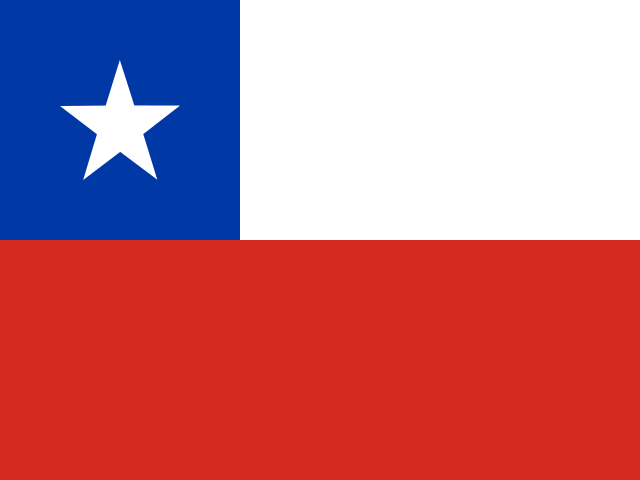 Chile
Chile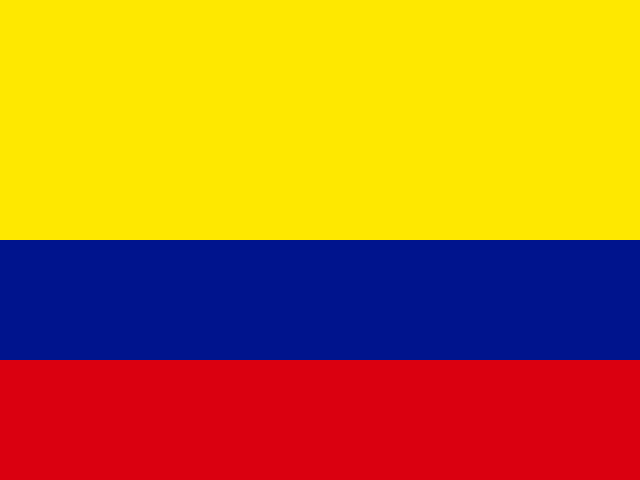 Colombia
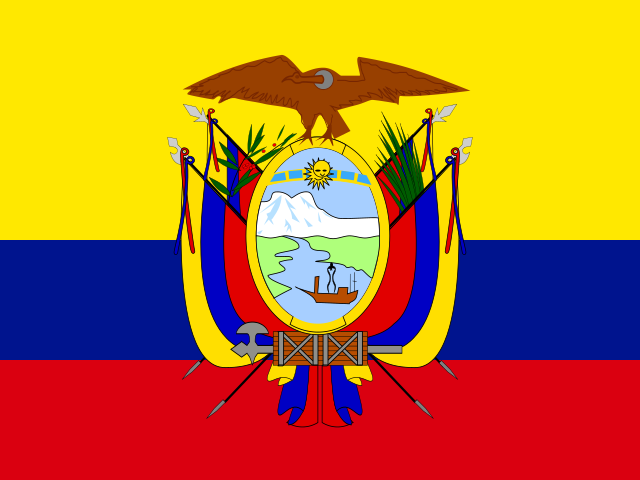 Ecuador
 Falkland Islands (Malvinas)
 French Guiana
 Guyana
 Paraguay
 Peru
Peru Suriname
 Uruguay
 Venezuela
 Belize
 Costa Rica
 El Salvador
 Guatemala
 Honduras
 Mexico
 Nicaragua
 Panama
 Antigua and Barbuda
 the Bahamas
 Barbados
 British Virgin Islands
 Cayman Islands
 Cuba
Cuba Dominica
 Dominican Republic
 Grenada
 Guadeloupe
 Haiti
Haiti Jamaica
 Martinique
 Montserrat
 Curacao
 Aruba
Aruba Saint Maarten (Dutch part)
 Bonaire
 Puerto Rico
 Saint Kitts and Nevis
 Anguilla
 Saint Lucia
 Saint-Martin (French Part)
 Saint Vincent and the Grenadines
 Trinidad and Tobago
 Turks and Caicos Islands
 United States Virgin Islands
Earlier Report Observations
The salt market in Latin America and the Caribbean showed notable volatility between 2018 and 2022. After stable volumes around 16 000 thousand tons in 2018-2019, consumption rose to 17 836 thousand tons in 2020. This increase coincided with strategic investments by the major producer Exportadora de Sal SA (ESSA), which began expanding its transport and stacking capacity on Isla de Cedros to boost its international export footprint. However, the market contracted sharply in 2021 to 12 069 thousand tons.
A recovery to 14 428 thousand tons occurred in 2022, supported by shifting consumer preferences. Growing demand for premium salt varieties, such as Himalayan pink salt and gourmet salt, gained traction due to health trends, urbanization, and higher disposable income, favoring products perceived as organic and healthier. These niche segments contributed to the market's rebound in both volume and value, with the market value reaching $626.1 million.
Structural changes in the regional salt industry continued beyond 2022. In 2024, the Mexican government nationalized ESSA by acquiring a 49% stake from Mitsubishi Corp., aiming to diversify the market and improve price competitiveness. ESSA maintained plans to increase its annual production and export capacity to 8.5 million tons through logistics improvements at its Isla de Cedros operations.
Table of content
- 1. Disclaimer
- 2. Terms of use of the report
- 3. Product codes in the statistical classifications used in the report
-
4. Key Market Indicators and Trends
-
4.1. Key Market Indicators
-
4.1.1. In kind
- 4.1.1.1. Production, 2018-2022
- 4.1.1.2. Imports, 2018-2024
- 4.1.1.3. Exports, 2018-2024
- 4.1.1.4. Market size, 2018-2022
-
4.1.2. In value
- 4.1.2.1. Production, 2018-2022
- 4.1.2.2. Imports, 2018-2024
- 4.1.2.3. Exports, 2018-2024
- 4.1.2.4. Market size, 2018-2022
-
4.1.1. In kind
- 4.2. Market Trends and Factors
-
4.1. Key Market Indicators
-
5. Production
-
5.1. Production in Latin America and the Caribbean
- 5.1.1. Annual dynamics of production in Latin America and the Caribbean in kind, 2018-2022, K t
-
5.2. Global production by Country, 2018-2022
- 5.2.1. Annual dynamics of production by country in kind, 2018-2022, K t
- 5.2.2. Structure of production by countries in kind, 2018-2022
- 5.2.3. Dynamics of peoduction structure by countries in kind, 2018-2022
-
5.1. Production in Latin America and the Caribbean
-
6. Exports
-
6.1. Exports (Direct Data*)
- 6.1.1. Exports - Total information
-
6.1.2. Exports in kind, K t
- 6.1.2.1. Annual dynamics of product's exports from Argentina in kind, 2018-2024, K t
- 6.1.2.2. Dynamics of product's exports in kind from Argentina by countries, 2018-2024, K t
- 6.1.2.3. Structure of product's exports in kind by countries, 2018-2024
-
6.1.3. Exports in value, M $ US
- 6.1.3.1. Annual dynamics of product's exports from Argentina in value, 2018-2024, M $ US
- 6.1.3.2. Dynamics of product's exports in value from Argentina by countries, 2018-2024, M $ US
- 6.1.3.3. Structure of product's exports in value by countries, 2018-2024
-
6.1.4. Average price of product's exports, $ US/t
- 6.1.4.1. Annual dynamics of average price of product's exports from Argentina, 2018-2024, $ US/t
- 6.1.4.2. Dynamics of average price of product's exports from Argentina by countries, 2018-2024, $ US/t
-
6.2. Exports (Mirror Data)
- 6.2.1. Exports - Total information
-
6.2.2. Exports in kind, K t
- 6.2.2.1. Annual dynamics of product's exports from Argentina in kind, 2018-2024, K t
- 6.2.2.2. Dynamics of product's exports in kind from Argentina by countries, 2018-2024, K t
- 6.2.2.3. Structure of product's exports in kind by countries, 2018-2024
-
6.2.3. Exports in value, M $ US
- 6.2.3.1. Annual dynamics of product's exports from Argentina in value, 2018-2024, M $ US
- 6.2.3.2. Dynamics of product's exports in value from Argentina by countries, 2018-2024, M $ US
- 6.2.3.3. Structure of product's exports in value by countries, 2018-2024
-
6.2.4. Average price of product's exports, $ US/t
- 6.2.4.1. Annual dynamics of average price of product's exports from Argentina, 2018-2024, $ US/t
- 6.2.4.2. Dynamics of average price of product's exports from Argentina by countries, 2018-2024, $ US/t
-
6.1. Exports (Direct Data*)
-
7. Imports
-
7.1. Imports (Direct Data*)
- 7.1.1. Imports - Total information
-
7.1.2. Imports in kind, K t
- 7.1.2.1. Annual dynamics of product's imports to Argentina in kind, 2018-2024, K t
- 7.1.2.2. Dynamics of product's imports in kind to Argentina by countries, 2018-2024, K t
- 7.1.2.3. Structure of product's imports in kind by countries, 2018-2024
-
7.1.3. Imports in value, M $ US
- 7.1.3.1. Annual dynamics of product's imports to Argentina in value, 2018-2024, M $ US
- 7.1.3.2. Dynamics of product's imports in value to Argentina by countries, 2018-2024, M $ US
- 7.1.3.3. Structure of product's imports in value by countries, 2018-2024
-
7.1.4. Average price of product's imports, $ US/t
- 7.1.4.1. Annual dynamics of average price of product's imports to Argentina, 2018-2024, $ US/t
- 7.1.4.2. Dynamics of average price of product's imports to Argentina by countries, 2018-2024, $ US/t
-
7.2. Imports (Mirror Data)
- 7.2.1. Imports - Total information
-
7.2.2. Imports in kind, K t
- 7.2.2.1. Annual dynamics of product's imports to Argentina in kind, 2018-2024, K t
- 7.2.2.2. Dynamics of product's imports in kind to Argentina by countries, 2018-2024, K t
- 7.2.2.3. Structure of product's imports in kind by countries, 2018-2024
-
7.2.3. Imports in value, M $ US
- 7.2.3.1. Annual dynamics of product's imports to Argentina in value, 2018-2024, M $ US
- 7.2.3.2. Dynamics of product's imports in value to Argentina by countries, 2018-2024, M $ US
- 7.2.3.3. Structure of product's imports in value by countries, 2018-2024
-
7.2.4. Average price of product's imports, $ US/t
- 7.2.4.1. Annual dynamics of average price of product's imports to Argentina, 2018-2024, $ US/t
- 7.2.4.2. Dynamics of average price of product's imports to Argentina by countries, 2018-2024, $ US/t
-
7.1. Imports (Direct Data*)
-
8. Trade balance
-
8.1. Trade balance (Direct Data)
- 8.1.1. In kind, K t
- 8.1.2. In value, M $ US
-
8.2. Trade balance (Mirror Data)
- 8.2.1. In kind, K t
- 8.2.2. In value, M $ US
-
8.1. Trade balance (Direct Data)
-
9. Top buying and selling countries, 2018-2024
-
9.1. Direct Data
- 9.1.1. Import in Value by Countries-buyers
- 9.1.2. Export in Value by Countries-suppliers
-
9.2. Mirror Data
- 9.2.1. Import in Value by Countries-buyers
- 9.2.2. Export in Value by Countries-suppliers
-
9.1. Direct Data
Production salt, pure NaCl and sea water in Latin America and the Caribbean
In kind, 2017-2020, K t
Top producers of salt, pure NaCl and sea water, 2017-2020
World map of production of salt, pure NaCl and sea water, 2017-2020
Latin America and the Caribbean saw their salt, pure NaCl, and seawater production decline for the third year in a row. In 2020, the region produced 23 846 thousand tons, marking a moderate decrease of 4.8% from the previous year. Looking at the period from 2017 to 2020, production fell by 19.6%, which translates to an average annual decline of 7.0%.
Annual dynamics of production in Latin America and the Caribbean in kind, 2017-2020, K t
| Parameter | 2018 | 2019 | 2020 | CAGR | |
|---|---|---|---|---|---|
| 1 | Change from last year | (12.1%) | (4.0%) | (4.8%) | (7.0%) |
In value, 2017-2020, M $ US
Following a two-year decline, salt, pure NaCl, and seawater production in Latin America and the Caribbean rebounded in value terms. In 2020, the output was valued at 759.1 million US dollars, reflecting a strong increase of 11.6% compared to 2019. Over the 2017-2020 period, however, production value decreased by 17.3%, with a compound annual growth rate of -6.1%. The lowest value was recorded in 2019 at 680.0 million US dollars, while the largest drop occurred in 2018 with a 19.7% decrease.
Annual dynamics of production in Latin America and the Caribbean in value, 2017-2020, M $ US
| Parameter | 2018 | 2019 | 2020 | CAGR | |
|---|---|---|---|---|---|
| 1 | Change from last year | (19.7%) | (7.8%) | 11.6% | (6.1%) |
Exports salt, pure NaCl and sea water from Latin America and the Caribbean
Exports in kind, K t
Salt, pure NaCl, and seawater exports from Latin America and the Caribbean fell for the second consecutive year. In 2020, the region exported 7 119 thousand tons, down by 25.1% year-on-year. The peak was in 2018 with 10 265 thousand tons, which also saw the largest increase of 43.7%.
Annual dynamics of product's exports from Latin America and the Caribbean in kind, 2017-2020, K t
| Parameter | 2018 | 2019 | 2020 | CAGR | |
|---|---|---|---|---|---|
| 1 | Change from last year | 43.7% | (7.5%) | (25.1%) | (0.1%) |
From 2017 to 2020, the United States, Canada, and Nigeria were the top contributors to exports in volume. The United States accounted for 69.9% of exports, Canada for 8.6%, and Nigeria for 3.1%. Together, these three countries made up 81.6% of total export flows.
Structure of product's exports in kind by countries, 2017-2020
World map of product's exports from Latin America and the Caribbean in kind, 2017-2020
Exports in value, M $ US
Salt, pure NaCl, and seawater exports from Latin America and the Caribbean declined for the second year in a row in value terms. In 2020, exports totaled 226.6 million US dollars, representing a 12.2% decrease from the previous year. Over the 2017-2020 period, exports increased by 2.5%, with a compound annual growth rate of 0.8%. The highest value was recorded in 2018 at 290.4 million US dollars, which also experienced the largest increase of 31.3%.
Annual dynamics of product's exports from Latin America and the Caribbean in value, 2017-2020, M $ US
| Parameter | 2018 | 2019 | 2020 | CAGR | |
|---|---|---|---|---|---|
| 1 | Change from last year | 31.3% | (11.2%) | (12.2%) | 0.8% |
Between 2017 and 2020, the United States, Canada, and Nigeria led in export value contributions. The United States held 62.2% of exports in value terms, Canada 8.6%, and Nigeria 2.7%. Collectively, these three countries accounted for 73.5% of total export flows.
Structure of product's exports in value by countries, 2017-2020
World map of product's exports from Latin America and the Caribbean in value, 2017-2020
Imports salt, pure NaCl and sea water to Latin America and the Caribbean
Imports in kind, K t
Salt, pure NaCl, and seawater imports into Latin America and the Caribbean rose for the third consecutive year. In 2020, the region imported a total of value_last_year thousand tons, equivalent to a significant gain of 148.9% compared to the previous year. From 2017 to 2020, imports surged by 248.6%, averaging an annualized growth rate of 51.6%.
Annual dynamics of product's imports to Latin America and the Caribbean in kind, 2017-2020, K t
| Parameter | 2018 | 2019 | 2020 | CAGR | |
|---|---|---|---|---|---|
| 1 | Change from last year | 16.8% | 19.9% | 148.9% | 51.6% |
Over the 2017-2020 period, the United States, the Netherlands, and China were the main sources of imports in volume for Latin America and the Caribbean. The United States accounted for 10.6% of imports, the Netherlands for 2.2%, and China for 0.6%. Together, these three countries absorbed 13.4% of total import flows.
Structure of product's imports in kind by countries, 2017-2020
World map of product's imports to Latin America and the Caribbean in kind, 2017-2020
Imports in value, M $ US
Salt, pure NaCl, and seawater imports into Latin America and the Caribbean increased for the second year in a row in value terms. In 2020, imports amounted to 161.7 million US dollars, showing a modest gain of 2.5% from a year earlier. Between 2017 and 2020, imports grew by 4.2%, with an annualized rate of 1.4%. The lowest value was in 2018 at 142.9 million US dollars, which saw the largest decline of 7.9%. In contrast, 2019 recorded the largest increase of 10.3%.
Annual dynamics of product's imports to Latin America and the Caribbean in value, 2017-2020, M $ US
| Parameter | 2018 | 2019 | 2020 | CAGR | |
|---|---|---|---|---|---|
| 1 | Change from last year | (7.9%) | 10.3% | 2.5% | 1.4% |
From 2017 to 2020, the United States, the Netherlands, and Pakistan played notable roles as suppliers of salt, pure NaCl, and seawater to Latin America and the Caribbean in value terms. The United States accounted for 18.8% of imports, while the Netherlands and Pakistan each contributed 2.8%. However, their combined share reached only 24.3% of total imports, indicating they were not dominant in the market.
Structure of product's imports in value by countries, 2017-2020
World map of product's imports to Latin America and the Caribbean in value, 2017-2020
Related Reports





In-depth market research on this product
Global Sea Salt Market 2021–2031: Size, Share, Trends and Forecast
Global market report: size, trends and forecast to 2031 · 184 pages
Why Choose Us?
Only Verified Data
No Hidden Costs or Separate Fees
Smarter Subscription Pricing
Contact Our Team
Submit your inquiry using the form below — our team will get back to you within 24 hours.