






"Americas" region includes following countries:
 Bermuda
 Canada
 Greenland
 Saint Pierre and Miquelon
 the United States
 Argentina
 Bolivia
 Brazil
 Chile
Chile Colombia
 Ecuador
 Falkland Islands (Malvinas)
 French Guiana
 Guyana
 Paraguay
 Peru
Peru Suriname
 Uruguay
 Venezuela
 Belize
 Costa Rica
 El Salvador
 Guatemala
 Honduras
 Mexico
 Nicaragua
 Panama
 Antigua and Barbuda
 the Bahamas
 Barbados
 British Virgin Islands
 Cayman Islands
 Cuba
Cuba Dominica
 Dominican Republic
 Grenada
 Guadeloupe
 Haiti
Haiti Jamaica
 Martinique
 Montserrat
 Curacao
 Aruba
Aruba Saint Maarten (Dutch part)
 Bonaire
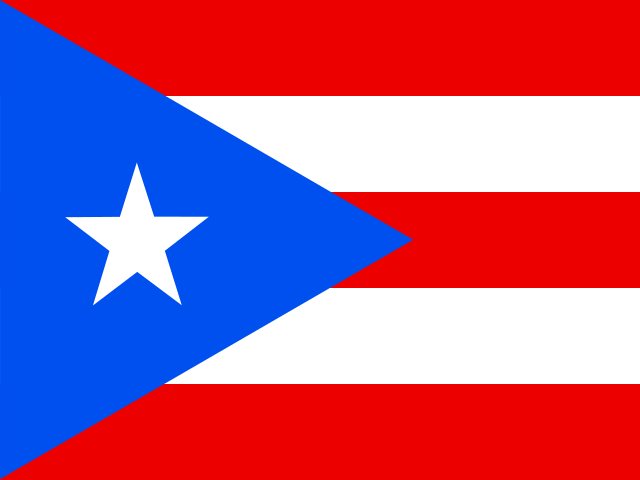 Puerto Rico
 Saint Kitts and Nevis
 Anguilla
 Saint Lucia
 Saint-Martin (French Part)
 Saint Vincent and the Grenadines
 Trinidad and Tobago
 Turks and Caicos Islands
 United States Virgin Islands
Earlier Report Observations
The preserved olives market in the Americas experienced significant fluctuations in volume from 2018 to 2023. Initially, market volume reached 347.9 thousand tons in 2018, supported by a rapid 16% increase in imports which expanded available supply. The following year, volume contracted to 243.7 thousand tons despite import activity peaking, as a surge in exports redirected product away from the domestic market. In 2020, supply chain and market access challenges emerged, likely related to the COVID-19 pandemic, yet import volumes still rose, contributing to a market recovery to 279.2 thousand tons.
Market volume then surged to a period high of 348.2 thousand tons in 2021 before declining to 278.6 thousand tons in 2022. By 2023, volume fell sharply to 188.9 thousand tons, a year in which the market's value peaked, indicating substantial price increases and a shift in demand dynamics that reduced physical consumption.
In 2024, import volumes continued to grow, rising by 8.4%, while the average import price increased by 17%, reflecting ongoing cost pressures. Concurrently, the launch of innovative, eco-friendly aluminum packaging with a reusable cap by Neolea for olive oil highlighted a broader industry trend toward packaging innovations aimed at preserving quality and freshness, which can influence adjacent segments like preserved olives.
Table of content
- 1. Disclaimer
- 2. Terms of use of the report
- 3. Product codes in the statistical classifications used in the report
-
4. Key Market Indicators and Trends
-
4.1. Key Market Indicators
-
4.1.1. In kind
- 4.1.1.1. Production, 2018-2023
- 4.1.1.2. Imports, 2018-2024
- 4.1.1.3. Exports, 2018-2024
- 4.1.1.4. Market size, 2018-2023
-
4.1.1. In kind
- 4.2. Market Trends and Factors
-
4.1. Key Market Indicators
-
5. Production
-
5.1. Production in Americas
- 5.1.1. Annual dynamics of production in Americas in kind, 2018-2023, K t
-
5.2. Global production by Country, 2018-2023
- 5.2.1. Annual dynamics of production by macroregions in kind, 2018-2023, K t
- 5.2.2. Dynamics of production structure by macroregions in kind, 2018-2023
- 5.2.3. Annual dynamics of production by country in kind, 2018-2023, K t
- 5.2.4. Structure of production by countries in kind, 2018-2023
- 5.2.5. Dynamics of peoduction structure by countries in kind, 2018-2023
-
5.1. Production in Americas
-
6. Exports
-
6.1. Exports (Direct Data*)
- 6.1.1. Exports - Total information
-
6.1.2. Exports in kind, K t
- 6.1.2.1. Annual dynamics of product's exports from Bermuda in kind, 2018-2024, K t
- 6.1.2.2. Dynamics of product's exports in kind from Bermuda by countries, 2018-2024, K t
- 6.1.2.3. Structure of product's exports in kind by countries, 2018-2024
-
6.1.3. Exports in value, M $ US
- 6.1.3.1. Annual dynamics of product's exports from Bermuda in value, 2018-2024, M $ US
- 6.1.3.2. Dynamics of product's exports in value from Bermuda by countries, 2018-2024, M $ US
- 6.1.3.3. Structure of product's exports in value by countries, 2018-2024
-
6.1.4. Average price of product's exports, $ US/t
- 6.1.4.1. Annual dynamics of average price of product's exports from Bermuda, 2018-2024, $ US/t
- 6.1.4.2. Dynamics of average price of product's exports from Bermuda by countries, 2018-2024, $ US/t
-
6.2. Exports (Mirror Data)
- 6.2.1. Exports - Total information
-
6.2.2. Exports in kind, K t
- 6.2.2.1. Annual dynamics of product's exports from Bermuda in kind, 2018-2024, K t
- 6.2.2.2. Dynamics of product's exports in kind from Bermuda by countries, 2018-2024, K t
- 6.2.2.3. Structure of product's exports in kind by countries, 2018-2024
-
6.2.3. Exports in value, M $ US
- 6.2.3.1. Annual dynamics of product's exports from Bermuda in value, 2018-2024, M $ US
- 6.2.3.2. Dynamics of product's exports in value from Bermuda by countries, 2018-2024, M $ US
- 6.2.3.3. Structure of product's exports in value by countries, 2018-2024
-
6.2.4. Average price of product's exports, $ US/t
- 6.2.4.1. Annual dynamics of average price of product's exports from Bermuda, 2018-2024, $ US/t
- 6.2.4.2. Dynamics of average price of product's exports from Bermuda by countries, 2018-2024, $ US/t
-
6.1. Exports (Direct Data*)
-
7. Imports
-
7.1. Imports (Direct Data*)
- 7.1.1. Imports - Total information
-
7.1.2. Imports in kind, K t
- 7.1.2.1. Annual dynamics of product's imports to Bermuda in kind, 2018-2024, K t
- 7.1.2.2. Dynamics of product's imports in kind to Bermuda by countries, 2018-2024, K t
- 7.1.2.3. Structure of product's imports in kind by countries, 2018-2024
-
7.1.3. Imports in value, M $ US
- 7.1.3.1. Annual dynamics of product's imports to Bermuda in value, 2018-2024, M $ US
- 7.1.3.2. Dynamics of product's imports in value to Bermuda by countries, 2018-2024, M $ US
- 7.1.3.3. Structure of product's imports in value by countries, 2018-2024
-
7.1.4. Average price of product's imports, $ US/t
- 7.1.4.1. Annual dynamics of average price of product's imports to Bermuda, 2018-2024, $ US/t
- 7.1.4.2. Dynamics of average price of product's imports to Bermuda by countries, 2018-2024, $ US/t
-
7.2. Imports (Mirror Data)
- 7.2.1. Imports - Total information
-
7.2.2. Imports in kind, K t
- 7.2.2.1. Annual dynamics of product's imports to Bermuda in kind, 2018-2024, K t
- 7.2.2.2. Dynamics of product's imports in kind to Bermuda by countries, 2018-2024, K t
- 7.2.2.3. Structure of product's imports in kind by countries, 2018-2024
-
7.2.3. Imports in value, M $ US
- 7.2.3.1. Annual dynamics of product's imports to Bermuda in value, 2018-2024, M $ US
- 7.2.3.2. Dynamics of product's imports in value to Bermuda by countries, 2018-2024, M $ US
- 7.2.3.3. Structure of product's imports in value by countries, 2018-2024
-
7.2.4. Average price of product's imports, $ US/t
- 7.2.4.1. Annual dynamics of average price of product's imports to Bermuda, 2018-2024, $ US/t
- 7.2.4.2. Dynamics of average price of product's imports to Bermuda by countries, 2018-2024, $ US/t
-
7.1. Imports (Direct Data*)
-
8. Trade balance
-
8.1. Trade balance (Direct Data)
- 8.1.1. In kind, K t
- 8.1.2. In value, M $ US
-
8.2. Trade balance (Mirror Data)
- 8.2.1. In kind, K t
- 8.2.2. In value, M $ US
-
8.1. Trade balance (Direct Data)
-
9. Top buying and selling countries, 2018-2024
-
9.1. Direct Data
- 9.1.1. Import in Value by Countries-buyers
- 9.1.2. Export in Value by Countries-suppliers
-
9.2. Mirror Data
- 9.2.1. Import in Value by Countries-buyers
- 9.2.2. Export in Value by Countries-suppliers
-
9.1. Direct Data
Production preserved olives in Americas
In kind, 2017-2020, K t
Top producers of preserved olives, 2017-2020
World map of production of preserved olives, 2017-2020
Production of preserved olives in the Americas declined for the second year in a row. In 2020, the region produced 235.7 thousand tons, marking a modest decrease of 7.4% compared to 2019. Looking at the broader period from 2017 to 2020, production actually grew by 45.4%, which translates to an average annual increase of 13.3%. The peak was reached in 2018 with 259.2 thousand tons, when production surged by 60.0%—the largest annual gain during this timeframe.
Annual dynamics of production in Americas in kind, 2017-2020, K t
| Parameter | 2018 | 2019 | 2020 | CAGR | |
|---|---|---|---|---|---|
| 1 | Change from last year | 60.0% | (1.9%) | (7.4%) | 13.3% |
Exports preserved olives from Americas
Exports in kind, K t
The export market for preserved olives from the Americas experienced notable volatility over the observed period. Exports hit their lowest point in 2018 at 88.7 thousand tons and peaked in 2019 at 185.4 thousand tons, representing a 2.1-fold difference between these years. In 2020, cross-border shipments totaled 159.4 thousand tons, down 14.0% from the previous year. The largest decline occurred in 2018, falling by 43.2%, while the most significant increase was in 2019, jumping by 109.1%.
Annual dynamics of product's exports from Americas in kind, 2017-2020, K t
| Parameter | 2018 | 2019 | 2020 | CAGR | |
|---|---|---|---|---|---|
| 1 | Change from last year | (43.2%) | 109.1% | (14.0%) | 0.7% |
From 2017 to 2020, the top buyers of preserved olives from the Americas were Spain (accounting for 2.8% of exports in volume), Germany (2.7%), and the United Kingdom (1.5%). However, their combined share was just 7.0% of total exports, highlighting a highly diversified country structure with many smaller partners.
Structure of product's exports in kind by countries, 2017-2020
World map of product's exports from Americas in kind, 2017-2020
Exports in value, M $ US
In 2020, the Americas exported preserved olives worth 510.2 million US dollars, showing a limited decline of 3.2% compared to the previous year. Over the period from 2017 to 2020, exports increased by 10.3%, averaging an annual growth rate of 3.3%. The lowest value was recorded in 2018 at 417.9 million US dollars, while the highest was in 2019 at 527.1 million US dollars. The largest decline occurred in 2018, dropping by 9.6%, and the biggest increase was in 2019, rising by 26.1%.
Annual dynamics of product's exports from Americas in value, 2017-2020, M $ US
| Parameter | 2018 | 2019 | 2020 | CAGR | |
|---|---|---|---|---|---|
| 1 | Change from last year | (9.6%) | 26.1% | (3.2%) | 3.3% |
Between 2017 and 2020, Germany (2.9% of exports by value), Spain (2.4%), and the United Kingdom (1.6%) were the largest buyers of preserved olives from the Americas, but they were not dominant. Together, they accounted for only 6.9% of total export value, reflecting a broad and varied network of smaller trading partners.
Structure of product's exports in value by countries, 2017-2020
World map of product's exports from Americas in value, 2017-2020
Imports preserved olives to Americas
Imports in kind, K t
Import volumes of preserved olives into the Americas showed noticeable fluctuations during this period. The lowest point was in 2019 at 174.8 thousand tons, while the peak was in 2017, resulting in a 3.7-fold variation between these years. In 2020, imports reached a total of value_last_year thousand tons, indicating an uptick of 16.1% relative to the prior year. The largest decline was recorded in 2018, falling by 72.7%.
Annual dynamics of product's imports to Americas in kind, 2017-2020, K t
| Parameter | 2018 | 2019 | 2020 | CAGR | |
|---|---|---|---|---|---|
| 1 | Change from last year | (72.7%) | (1.5%) | 16.1% | (32.1%) |
From 2017 to 2020, imports of preserved olives to the Americas were spread across many countries. Spain (17.2% of imports by volume), Egypt (11.0%), and Greece (3.3%) were the top suppliers, but together they accounted for only 31.4% of total flows, underscoring a diverse import structure.
Structure of product's imports in kind by countries, 2017-2020
World map of product's imports to Americas in kind, 2017-2020
Imports in value, M $ US
After two consecutive years of growth, import volumes of preserved olives into the Americas declined. In 2020, imports totaled 451.3 million US dollars, down 1.1% from the previous year. Over the 2017–2020 period, imports increased by 2.2%, averaging an annual rate of 0.7%. The highest value was recorded in 2019 at 456.5 million US dollars, with the largest increase occurring in 2018, rising by 2.5%.
Annual dynamics of product's imports to Americas in value, 2017-2020, M $ US
| Parameter | 2018 | 2019 | 2020 | CAGR | |
|---|---|---|---|---|---|
| 1 | Change from last year | 2.5% | 0.9% | (1.1%) | 0.7% |
Between 2017 and 2020, the supplier portfolio for preserved olives to the Americas was broad. Spain (20.9% of imports by value), Greece (7.3%), and Egypt (5.3%) were the leading sources, but their combined contribution was just 33.5% of total import value. Many other countries held smaller yet significant shares, indicating a well-diversified import market.
Structure of product's imports in value by countries, 2017-2020
World map of product's imports to Americas in value, 2017-2020
Related Reports

Preserved olives market in MENA
2026-03-30
Preserved olives market in Saudi Arabia
2026-03-30
Preserved olives market in Argentina
2026-03-30
Preserved olives market in MERCOSUR
2026-03-30

Sweet potatoe market in Americas
2026-03-27

Mushrooms and truffles market in Americas
2026-03-27

2026-03-27

2026-03-27
Why Choose Us?
Only Verified Data
No Hidden Costs or Separate Fees
Smarter Subscription Pricing
Contact Our Team
Submit your inquiry using the form below — our team will get back to you within 24 hours.