






"Northern Europe" region includes following countries:
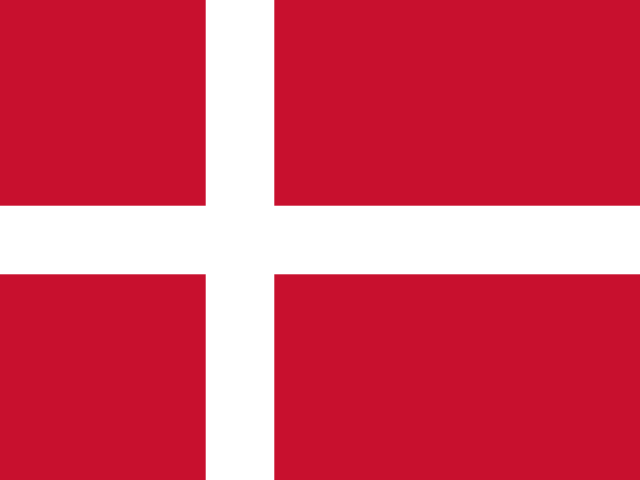 Denmark
 Estonia
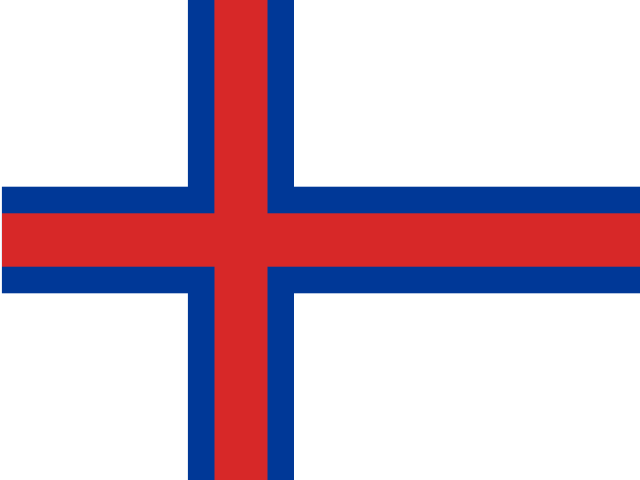 Faroe Islands
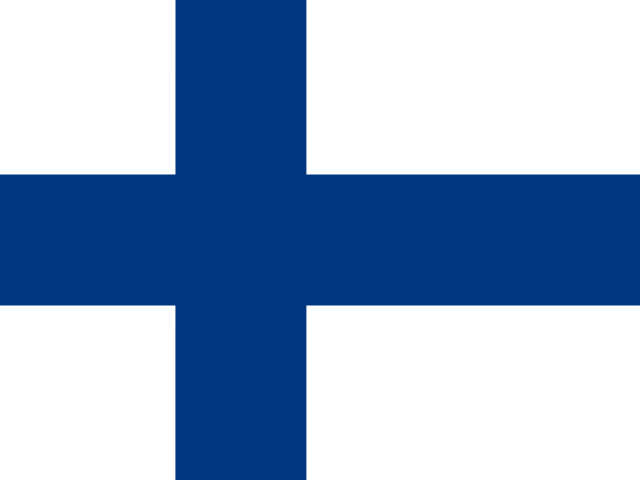 Finland
 Iceland
 Ireland
 Latvia
 Lithuania
 Sweden
 the United Kingdom
 Isle of Man
Earlier Report Observations
The potato starch market in Northern Europe saw notable fluctuations in volume from 2018 to 2023. After starting at 350.7 thousand tons in 2018, it reached a peak of 423.1 thousand tons in 2021. This growth was initially fueled by heightened consumer interest in potato products during the COVID-19 pandemic in 2020, which boosted demand for starch. Support from the EU in 2021, aimed at maintaining price levels and competitiveness for industrial potato growers in Sweden, further sustained the expansion. The market then contracted to 346.6 thousand tons in 2022, a period that coincided with shifting consumer preferences in Sweden, including a decline in boiled potato consumption, which affected demand for certain starch-based products. Recovery followed in 2023, with volume rising to 388.4 thousand tons.
Supply-side developments were crucial throughout the period. In Finland, state-influenced companies such as Finnamyl and Lapuan Peruna invested in product development and environmental adaptation. Sweden approved new potato varieties in 2022 to improve production efficiency and starch quality. By 2023, increased profitability for starch potato cultivation led to a shift in crop area, with more land dedicated to starch potatoes and record harvests, enhancing raw material availability. Looking ahead, Denmark significantly expanded its potato cultivation area to 65 000 hectares in 2024, particularly for starch potatoes, while Norway implemented a tariff change from a fixed to a percentage-based duty on potato products, affecting import costs and market access.
Demand factors evolved alongside these supply changes. Potato starch has a stable industrial base, being widely used in Finland's food and paper manufacturing sectors. The pandemic accelerated digitalization, influencing marketing and distribution strategies for starch products. Globally, demand for potato starch grew at about 10% annually, creating export opportunities for Nordic producers. Companies like KMC in Denmark invested in new applications, such as vegan and allergy-friendly products, to tap into emerging segments. However, consumer trends in Sweden, including a move away from traditional potato preparations, introduced some volatility in demand for specific starch product categories.
Table of content
- 1. Disclaimer
- 2. Terms of use of the report
- 3. Product codes in the statistical classifications used in the report
-
4. Key Market Indicators and Trends
-
4.1. Key Market Indicators
-
4.1.1. In kind
- 4.1.1.1. Production, 2018-2023
- 4.1.1.2. Imports, 2018-2024
- 4.1.1.3. Exports, 2018-2024
- 4.1.1.4. Market size, 2018-2023
-
4.1.1. In kind
- 4.2. Market Trends and Factors
-
4.1. Key Market Indicators
-
5. Production
-
5.1. Production in Northern Europe
- 5.1.1. Annual dynamics of production in Northern Europe in kind, 2018-2023, K t
-
5.2. Global production by Country, 2018-2023
- 5.2.1. Annual dynamics of production by macroregions in kind, 2018-2023, K t
- 5.2.2. Dynamics of production structure by macroregions in kind, 2018-2023
- 5.2.3. Annual dynamics of production by country in kind, 2018-2023, K t
- 5.2.4. Structure of production by countries in kind, 2018-2023
- 5.2.5. Dynamics of peoduction structure by countries in kind, 2018-2023
-
5.1. Production in Northern Europe
-
6. Imports
-
6.1. Imports (Direct Data*)
- 6.1.1. Imports - Total information
-
6.1.2. Imports in kind, K t
- 6.1.2.1. Annual dynamics of product's imports to Denmark in kind, 2018-2024, K t
- 6.1.2.2. Dynamics of product's imports in kind to Denmark by countries, 2018-2024, K t
- 6.1.2.3. Structure of product's imports in kind by countries, 2018-2024
-
6.1.3. Imports in value, M $ US
- 6.1.3.1. Annual dynamics of product's imports to Denmark in value, 2018-2024, M $ US
- 6.1.3.2. Dynamics of product's imports in value to Denmark by countries, 2018-2024, M $ US
- 6.1.3.3. Structure of product's imports in value by countries, 2018-2024
-
6.1.4. Average price of product's imports, $ US/t
- 6.1.4.1. Annual dynamics of average price of product's imports to Denmark, 2018-2024, $ US/t
- 6.1.4.2. Dynamics of average price of product's imports to Denmark by countries, 2018-2024, $ US/t
-
6.2. Imports (Mirror Data)
- 6.2.1. Imports - Total information
-
6.2.2. Imports in kind, K t
- 6.2.2.1. Annual dynamics of product's imports to Denmark in kind, 2018-2024, K t
- 6.2.2.2. Dynamics of product's imports in kind to Denmark by countries, 2018-2024, K t
- 6.2.2.3. Structure of product's imports in kind by countries, 2018-2024
-
6.2.3. Imports in value, M $ US
- 6.2.3.1. Annual dynamics of product's imports to Denmark in value, 2018-2024, M $ US
- 6.2.3.2. Dynamics of product's imports in value to Denmark by countries, 2018-2024, M $ US
- 6.2.3.3. Structure of product's imports in value by countries, 2018-2024
-
6.2.4. Average price of product's imports, $ US/t
- 6.2.4.1. Annual dynamics of average price of product's imports to Denmark, 2018-2024, $ US/t
- 6.2.4.2. Dynamics of average price of product's imports to Denmark by countries, 2018-2024, $ US/t
-
6.1. Imports (Direct Data*)
-
7. Exports
-
7.1. Exports (Direct Data*)
- 7.1.1. Exports - Total information
-
7.1.2. Exports in kind, K t
- 7.1.2.1. Annual dynamics of product's exports from Denmark in kind, 2018-2024, K t
- 7.1.2.2. Dynamics of product's exports in kind from Denmark by countries, 2018-2024, K t
- 7.1.2.3. Structure of product's exports in kind by countries, 2018-2024
-
7.1.3. Exports in value, M $ US
- 7.1.3.1. Annual dynamics of product's exports from Denmark in value, 2018-2024, M $ US
- 7.1.3.2. Dynamics of product's exports in value from Denmark by countries, 2018-2024, M $ US
- 7.1.3.3. Structure of product's exports in value by countries, 2018-2024
-
7.1.4. Average price of product's exports, $ US/t
- 7.1.4.1. Annual dynamics of average price of product's exports from Denmark, 2018-2024, $ US/t
- 7.1.4.2. Dynamics of average price of product's exports from Denmark by countries, 2018-2024, $ US/t
-
7.2. Exports (Mirror Data)
- 7.2.1. Exports - Total information
-
7.2.2. Exports in kind, K t
- 7.2.2.1. Annual dynamics of product's exports from Denmark in kind, 2018-2024, K t
- 7.2.2.2. Dynamics of product's exports in kind from Denmark by countries, 2018-2024, K t
- 7.2.2.3. Structure of product's exports in kind by countries, 2018-2024
-
7.2.3. Exports in value, M $ US
- 7.2.3.1. Annual dynamics of product's exports from Denmark in value, 2018-2024, M $ US
- 7.2.3.2. Dynamics of product's exports in value from Denmark by countries, 2018-2024, M $ US
- 7.2.3.3. Structure of product's exports in value by countries, 2018-2024
-
7.2.4. Average price of product's exports, $ US/t
- 7.2.4.1. Annual dynamics of average price of product's exports from Denmark, 2018-2024, $ US/t
- 7.2.4.2. Dynamics of average price of product's exports from Denmark by countries, 2018-2024, $ US/t
-
7.1. Exports (Direct Data*)
-
8. Trade balance
-
8.1. Trade balance (Direct Data)
- 8.1.1. In kind, K t
- 8.1.2. In value, M $ US
-
8.2. Trade balance (Mirror Data)
- 8.2.1. In kind, K t
- 8.2.2. In value, M $ US
-
8.1. Trade balance (Direct Data)
-
9. Top buying and selling countries, 2018-2024
-
9.1. Direct Data
- 9.1.1. Import in Value by Countries-buyers
- 9.1.2. Export in Value by Countries-suppliers
-
9.2. Mirror Data
- 9.2.1. Import in Value by Countries-buyers
- 9.2.2. Export in Value by Countries-suppliers
-
9.1. Direct Data
Production potato starch in Northern Europe
In kind, 2017-2020, K t
Top producers of potato starch, 2017-2020
World map of production of potato starch, 2017-2020
In Northern Europe, potato starch production reached 280.6 thousand tonnes in 2020, marking a 15.9% increase compared to the previous year. The lowest production level was recorded in 2019 at 242.1 thousand tonnes, which represented a 5.8% decline from the prior year. Over the period from 2017 to 2020, production grew by 14.1%, translating to an average annual growth rate of 4.5%.
Annual dynamics of production in Northern Europe in kind, 2017-2020, K t
| Parameter | 2018 | 2019 | 2020 | CAGR | |
|---|---|---|---|---|---|
| 1 | Change from last year | 4.5% | (5.8%) | 15.9% | 4.5% |
Exports potato starch from Northern Europe
Exports in kind, K t
Potato starch exports from Northern Europe increased in 2020 after two consecutive years of decline. In 2020, exports totaled 9.5 thousand tonnes, reflecting a significant 64.5% rise from the previous year. The lowest export volume was recorded in 2019 at 5.8 thousand tonnes. Over the 2017-2020 period, exports decreased by 31.5%, with an average annual decline of 11.9%. The sharpest drop occurred in 2018, when exports fell by 50.8%.
Annual dynamics of product's exports from Northern Europe in kind, 2017-2020, K t
| Parameter | 2018 | 2019 | 2020 | CAGR | |
|---|---|---|---|---|---|
| 1 | Change from last year | (50.8%) | (15.5%) | 64.5% | (11.9%) |
From 2017 to 2020, Northern Europe's potato starch export market featured a diverse range of trading partners. The United States accounted for 12.4% of exports in volume, Kazakhstan for 7.1%, and the Netherlands for 6.4%. Together, these three countries represented 25.9% of total export flows, indicating a relatively broad distribution rather than heavy concentration.
Structure of product's exports in kind by countries, 2017-2020
World map of product's exports from Northern Europe in kind, 2017-2020
Exports in value, K $ US
Northern Europe's potato starch export value increased in 2020 following a two-year decline. In 2020, exports amounted to 8 346 thousand US dollars, showing a 37.2% year-over-year increase. The lowest value was recorded in 2019 at 6 082 thousand US dollars. Over the 2017-2020 period, export value decreased by 15.1%, with an average annual decline of 5.3%. The most substantial drop occurred in 2018, when export value fell by 31.0%.
Annual dynamics of product's exports from Northern Europe in value, 2017-2020, K $ US
| Parameter | 2018 | 2019 | 2020 | CAGR | |
|---|---|---|---|---|---|
| 1 | Change from last year | (31.0%) | (10.3%) | 37.2% | (5.3%) |
Between 2017 and 2020, Northern Europe's potato starch export value was distributed across multiple partners rather than being concentrated in a few markets. The United States accounted for 13.8% of export value, the Netherlands for 6.3%, and Kazakhstan for 4.6%. Collectively, these three countries represented 24.7% of total export flows, while numerous other countries accounted for the remaining 75.3%.
Structure of product's exports in value by countries, 2017-2020
World map of product's exports from Northern Europe in value, 2017-2020
Imports potato starch to Northern Europe
Imports in kind, K t
Potato starch imports into Northern Europe grew for the second consecutive year in 2020. Import volume reached 115.0 thousand tonnes in 2020, representing an 11.6% increase from 2019. The lowest import volume was recorded in 2018 at 100.6 thousand tonnes, which saw a slight 0.3% decline from the previous year. Over the 2017-2020 period, imports increased by 14%, with an average annual growth rate of 4.5%.
Annual dynamics of product's imports to Northern Europe in kind, 2017-2020, K t
| Parameter | 2018 | 2019 | 2020 | CAGR | |
|---|---|---|---|---|---|
| 1 | Change from last year | (0.3%) | 2.4% | 11.6% | 4.5% |
From 2017 to 2020, the Netherlands, Germany, and France were the primary sources of potato starch imports into Northern Europe. The Netherlands accounted for 38.3% of import volume, Germany for 14.4%, and France for 9.9%. Together, these three countries represented 62.7% of total import flows, forming the core group of suppliers.
Structure of product's imports in kind by countries, 2017-2020
World map of product's imports to Northern Europe in kind, 2017-2020
Imports in value, K $ US
Potato starch import value into Northern Europe increased for the third consecutive year in 2020. Import value reached 95 533 thousand US dollars in 2020, reflecting a modest 1.8% increase from the previous year. Over the 2017-2020 period, import value grew by 29.3%, with an average annual growth rate of 8.9%.
Annual dynamics of product's imports to Northern Europe in value, 2017-2020, K $ US
| Parameter | 2018 | 2019 | 2020 | CAGR | |
|---|---|---|---|---|---|
| 1 | Change from last year | 8.7% | 16.9% | 1.8% | 8.9% |
Between 2017 and 2020, the Netherlands, Germany, and France were the largest suppliers of potato starch to Northern Europe in value terms. The Netherlands accounted for 36.1% of import value, Germany for 16.9%, and France for 9.6%. Together, these three countries represented 62.7% of total import value, highlighting their dominant role in the market.
Structure of product's imports in value by countries, 2017-2020
World map of product's imports to Northern Europe in value, 2017-2020
Related Reports
Potato starch market in Africa
2026-03-28
Potato starch market in Denmark
2026-03-30
2026-03-28
Potato starch market in Kyrgyzstan
2026-03-28

Wheat gluten market in Northern Europe
2026-03-28


Cereal germ market in Northern Europe
2026-03-28
Why Choose Us?
Only Verified Data
No Hidden Costs or Separate Fees
Smarter Subscription Pricing
Contact Our Team
Submit your inquiry using the form below — our team will get back to you within 24 hours.