






"Western Africa" region includes following countries:
 Cabo Verde
 Benin
Benin Gambia
 Ghana
Ghana Guinea
 Côte d'Ivoire
 Liberia
 Mali
Mali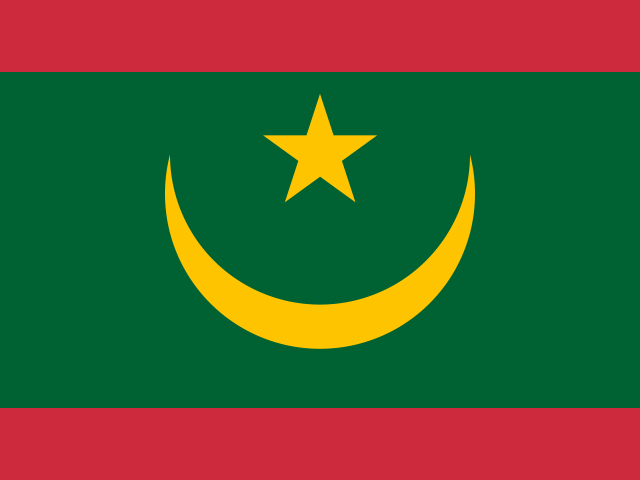 Mauritania
 Niger
Niger Nigeria
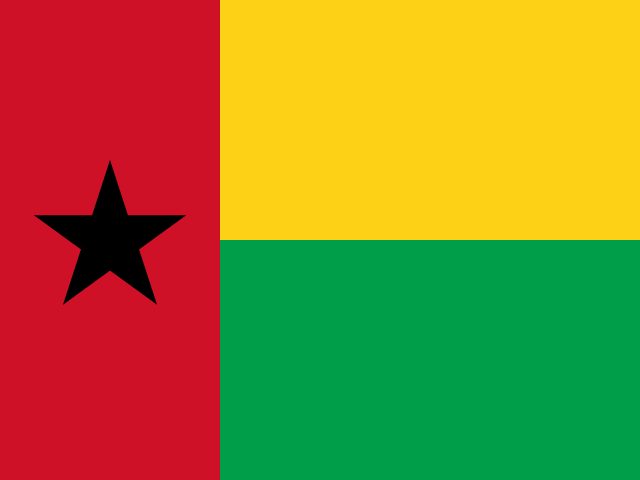 Guinea-Bissau
 Saint Helena, Ascension and Tristan da Cunha
 Senegal
 Sierra Leone
 Togo
Togo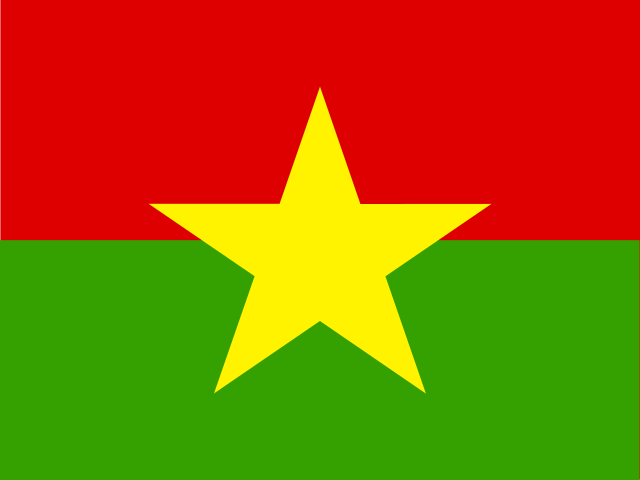 Burkina Faso
Earlier Report Observations
Paddy rice production in West Africa maintained a steady upward trajectory from 2018, supported by strong state and ECOWAS engagement in the sector. Professionalization of producers and processors, alongside guaranteed access to land and water, provided a solid foundation. Specific projects, such as Taiwan-supported initiatives in Burkina Faso offering inputs and storage, and Senegal's partnership with the Japan International Cooperation Agency for its national rice development strategy, contributed to stable output.
Following a period of stabilization around 2020, production growth accelerated markedly from 2021. This surge was primarily driven by the expansion of contract farming between millers and smallholder farmers, ensuring supply, coupled with increased investments in artificial irrigation to boost yields. Concurrently, regional production programs gained momentum, most notably in Côte d'Ivoire with the launch of its rice revolution plan and a dedicated 26 million USD promotion program aimed at seed access, perimeter development, and processing.
By 2023, production exceeded 24 million tons, with continued expansion fueled by large-scale initiatives. The development included the official handover of contracts for ten paddy-to-white-rice processing units in Côte d'Ivoire and the introduction of new product segments like fortified rice in Kenya. Support from institutions such as the African Development Bank for irrigated rice cultivation in The Gambia and the AGGRi Alliance's provision of improved seed varieties to smallholders further solidified the region's production capacity.
Table of content
- 1. Disclaimer
- 2. Terms of use of the report
- 3. Product codes in the statistical classifications used in the report
-
4. Key Market Indicators and Trends
-
4.1. Key Market Indicators
-
4.1.1. In kind
- 4.1.1.1. Production, 2018-2023
- 4.1.1.2. Imports, 2018-2024
- 4.1.1.3. Exports, 2018-2024
- 4.1.1.4. Market size, 2018-2023
-
4.1.2. In value
- 4.1.2.1. Production, 2018-2023
- 4.1.2.2. Imports, 2018-2024
- 4.1.2.3. Exports, 2018-2024
- 4.1.2.4. Market size, 2018-2023
-
4.1.1. In kind
- 4.2. Market Trends and Factors
-
4.1. Key Market Indicators
-
5. Production
-
5.1. Production in Western Africa
- 5.1.1. Annual dynamics of production in Western Africa in kind, 2018-2023, K t
-
5.2. Global production by Country, 2018-2023
- 5.2.1. Annual dynamics of production by macroregions in kind, 2018-2023, K t
- 5.2.2. Dynamics of production structure by macroregions in kind, 2018-2023
- 5.2.3. Annual dynamics of production by country in kind, 2018-2023, K t
- 5.2.4. Structure of production by countries in kind, 2018-2023
- 5.2.5. Dynamics of peoduction structure by countries in kind, 2018-2023
-
5.1. Production in Western Africa
-
6. Imports
-
6.1. Imports (Direct Data*)
- 6.1.1. Imports - Total information
-
6.1.2. Imports in kind, t
- 6.1.2.1. Annual dynamics of product's imports to Cabo Verde in kind, 2018-2024, t
- 6.1.2.2. Dynamics of product's imports in kind to Cabo Verde by countries, 2018-2024, t
- 6.1.2.3. Structure of product's imports in kind by countries, 2018-2024
-
6.1.3. Imports in value, K $ US
- 6.1.3.1. Annual dynamics of product's imports to Cabo Verde in value, 2018-2024, K $ US
- 6.1.3.2. Dynamics of product's imports in value to Cabo Verde by countries, 2018-2024, K $ US
- 6.1.3.3. Structure of product's imports in value by countries, 2018-2024
-
6.1.4. Average price of product's imports, $ US/t
- 6.1.4.1. Annual dynamics of average price of product's imports to Cabo Verde, 2018-2024, $ US/t
- 6.1.4.2. Dynamics of average price of product's imports to Cabo Verde by countries, 2018-2024, $ US/t
-
6.2. Imports (Mirror Data)
- 6.2.1. Imports - Total information
-
6.2.2. Imports in kind, t
- 6.2.2.1. Annual dynamics of product's imports to Cabo Verde in kind, 2018-2024, t
- 6.2.2.2. Dynamics of product's imports in kind to Cabo Verde by countries, 2018-2024, t
- 6.2.2.3. Structure of product's imports in kind by countries, 2018-2024
-
6.2.3. Imports in value, K $ US
- 6.2.3.1. Annual dynamics of product's imports to Cabo Verde in value, 2018-2024, K $ US
- 6.2.3.2. Dynamics of product's imports in value to Cabo Verde by countries, 2018-2024, K $ US
- 6.2.3.3. Structure of product's imports in value by countries, 2018-2024
-
6.2.4. Average price of product's imports, $ US/t
- 6.2.4.1. Annual dynamics of average price of product's imports to Cabo Verde, 2018-2024, $ US/t
- 6.2.4.2. Dynamics of average price of product's imports to Cabo Verde by countries, 2018-2024, $ US/t
-
6.1. Imports (Direct Data*)
-
7. Exports
-
7.1. Exports (Direct Data*)
- 7.1.1. Exports - Total information
-
7.1.2. Exports in kind, t
- 7.1.2.1. Annual dynamics of product's exports from Cabo Verde in kind, 2018-2024, t
- 7.1.2.2. Dynamics of product's exports in kind from Cabo Verde by countries, 2018-2024, t
- 7.1.2.3. Structure of product's exports in kind by countries, 2018-2024
-
7.1.3. Exports in value, K $ US
- 7.1.3.1. Annual dynamics of product's exports from Cabo Verde in value, 2018-2024, K $ US
- 7.1.3.2. Dynamics of product's exports in value from Cabo Verde by countries, 2018-2024, K $ US
- 7.1.3.3. Structure of product's exports in value by countries, 2018-2024
-
7.1.4. Average price of product's exports, $ US/t
- 7.1.4.1. Annual dynamics of average price of product's exports from Cabo Verde, 2018-2024, $ US/t
- 7.1.4.2. Dynamics of average price of product's exports from Cabo Verde by countries, 2018-2024, $ US/t
-
7.2. Exports (Mirror Data)
- 7.2.1. Exports - Total information
-
7.2.2. Exports in kind, t
- 7.2.2.1. Annual dynamics of product's exports from Cabo Verde in kind, 2018-2024, t
- 7.2.2.2. Dynamics of product's exports in kind from Cabo Verde by countries, 2018-2024, t
- 7.2.2.3. Structure of product's exports in kind by countries, 2018-2024
-
7.2.3. Exports in value, K $ US
- 7.2.3.1. Annual dynamics of product's exports from Cabo Verde in value, 2018-2024, K $ US
- 7.2.3.2. Dynamics of product's exports in value from Cabo Verde by countries, 2018-2024, K $ US
- 7.2.3.3. Structure of product's exports in value by countries, 2018-2024
-
7.2.4. Average price of product's exports, $ US/t
- 7.2.4.1. Annual dynamics of average price of product's exports from Cabo Verde, 2018-2024, $ US/t
- 7.2.4.2. Dynamics of average price of product's exports from Cabo Verde by countries, 2018-2024, $ US/t
-
7.1. Exports (Direct Data*)
-
8. Trade balance
-
8.1. Trade balance (Direct Data)
- 8.1.1. In kind, t
- 8.1.2. In value, K $ US
-
8.2. Trade balance (Mirror Data)
- 8.2.1. In kind, t
- 8.2.2. In value, K $ US
-
8.1. Trade balance (Direct Data)
-
9. Top buying and selling countries, 2018-2024
-
9.1. Direct Data
- 9.1.1. Import in Value by Countries-buyers
- 9.1.2. Export in Value by Countries-suppliers
-
9.2. Mirror Data
- 9.2.1. Import in Value by Countries-buyers
- 9.2.2. Export in Value by Countries-suppliers
-
9.1. Direct Data
Production paddy rice in Western Africa
In kind, 2017-2020, K t
Top producers of paddy rice, 2017-2020
World map of production of paddy rice, 2017-2020
Western Africa's paddy rice production volume declined after two consecutive years of growth. In 2019, production reached its peak at 20 732 K t, but then fell slightly by 1.4% to 20 441 K t in 2020. Over the entire period from 2017 to 2020, production increased by 7.1%, which translates to an average annual growth rate of 2.3%. The most significant year-on-year increase occurred in 2018, when production rose by 8.2%.
Annual dynamics of production in Western Africa in kind, 2017-2020, K t
| Parameter | 2018 | 2019 | 2020 | CAGR | |
|---|---|---|---|---|---|
| 1 | Change from last year | 8.2% | 0.4% | (1.4%) | 2.3% |
In value, 2017-2020, M $ US
In 2020, the value of paddy rice output in Western Africa was 17 865 M $ US, remaining largely unchanged from the previous year. Looking at the broader period from 2017 to 2020, the value of production grew by 19.8%, with a compound annual growth rate of 6.2%. The highest value was recorded in 2019 at 17 870 M $ US. The largest year-on-year increase took place in 2018, when the value surged by 18.6%.
Annual dynamics of production in Western Africa in value, 2017-2020, M $ US
| Parameter | 2018 | 2019 | 2020 | CAGR | |
|---|---|---|---|---|---|
| 1 | Change from last year | 18.6% | 1.1% | (0.0%) | 6.2% |
Exports paddy rice from Western Africa
Exports in kind, t
Paddy rice exports from Western Africa showed considerable volatility during this period. Exports reached their lowest point in 2019 at 1 050 t, then rebounded sharply to 2 680 t in 2020, marking a dramatic increase of 155.3% compared to the previous year. Over the years from 2017 to 2019, exports varied by a factor of 3.3, with the largest decline occurring in 2018 at 45.7%.
Annual dynamics of product's exports from Western Africa in kind, 2017-2020, t
| Parameter | 2018 | 2019 | 2020 | CAGR | |
|---|---|---|---|---|---|
| 1 | Change from last year | (45.7%) | (44.5%) | 155.3% | (8.4%) |
From 2017 to 2020, Congo, Madagascar, and Turkey were the main destinations for paddy rice exports from Western Africa in volume terms. Congo accounted for 3.0% of exports, while Madagascar and Turkey each contributed 0.7%. Together, these three countries represented 4.4% of total export flows.
Structure of product's exports in kind by countries, 2017-2020
World map of product's exports from Western Africa in kind, 2017-2020
Exports in value, K $ US
The value of paddy rice exports from Western Africa exhibited significant volatility over the observed period. Exports hit their lowest point in 2019 at 905 K $ US, then jumped to 2 342 K $ US in 2020, representing a substantial year-over-year increase of 158.8%. Between 2017 and 2019, export values swung by a factor of 3, with the sharpest decline recorded in 2019 at 44.1%.
Annual dynamics of product's exports from Western Africa in value, 2017-2020, K $ US
| Parameter | 2018 | 2019 | 2020 | CAGR | |
|---|---|---|---|---|---|
| 1 | Change from last year | (40.5%) | (44.1%) | 158.8% | (4.9%) |
Throughout 2017–2020, Congo and Madagascar were the leading partners for paddy rice exports from Western Africa in value terms. Together, they accounted for 6.3% of total export flows.
Structure of product's exports in value by countries, 2017-2020
World map of product's exports from Western Africa in value, 2017-2020
Imports paddy rice to Western Africa
Imports in kind, t
Paddy rice imports into Western Africa experienced notable fluctuations during this period. Imports peaked in 2018 at 17 145 t, then dropped to their lowest point in 2019 at 3 330 t, representing a dramatic decline of 80.6%. In 2020, imports rebounded to 12 766 t, marking a substantial increase of 283.4% compared to the previous year. The swing from the peak in 2018 to the trough in 2019 was 5.1-fold.
Annual dynamics of product's imports to Western Africa in kind, 2017-2020, t
| Parameter | 2018 | 2019 | 2020 | CAGR | |
|---|---|---|---|---|---|
| 1 | Change from last year | 15.7% | (80.6%) | 283.4% | (4.8%) |
From 2017 to 2020, paddy rice imports into Western Africa in volume terms were distributed across numerous countries. India was the largest source, accounting for 18.7% of imports, followed by Brazil at 15.3% and the United States at 11.2%. Together, these three countries represented 45.2% of total import flows.
Structure of product's imports in kind by countries, 2017-2020
World map of product's imports to Western Africa in kind, 2017-2020
Imports in value, K $ US
The value of paddy rice imports into Western Africa showed significant volatility during this period. Imports reached their lowest point in 2019 at 2 428 K $ US, then surged to their peak in 2020, representing an intense year-over-year rise of 520.6%. The swing from the trough in 2019 to the peak in 2020 was 6.2-fold, with the largest decline occurring in 2019 at 82.8%.
Annual dynamics of product's imports to Western Africa in value, 2017-2020, K $ US
| Parameter | 2018 | 2019 | 2020 | CAGR | |
|---|---|---|---|---|---|
| 1 | Change from last year | 43.0% | (82.8%) | 520.6% | 15.2% |
Throughout 2017–2020, India, Brazil, and the United States were the key partners for paddy rice imports into Western Africa in value terms. India accounted for 29.5% of imports, Brazil for 18.7%, and the United States for 9.9%. Collectively, these three countries represented 58.1% of total import flows.
Structure of product's imports in value by countries, 2017-2020
World map of product's imports to Western Africa in value, 2017-2020
Related Reports

Paddy rice market in Eastern Africa
2026-03-28
2026-03-28
2026-03-28
Paddy rice market in Middle Africa
2026-03-28

Sorghum market in Western Africa
2026-03-28

2026-03-28


Fonio market in Western Africa
2026-03-28
Why Choose Us?
Only Verified Data
No Hidden Costs or Separate Fees
Smarter Subscription Pricing
Contact Our Team
Submit your inquiry using the form below — our team will get back to you within 24 hours.