






"Southern Asia" region includes following countries:
 Afghanistan
 Bangladesh
 Bhutan
 Sri Lanka
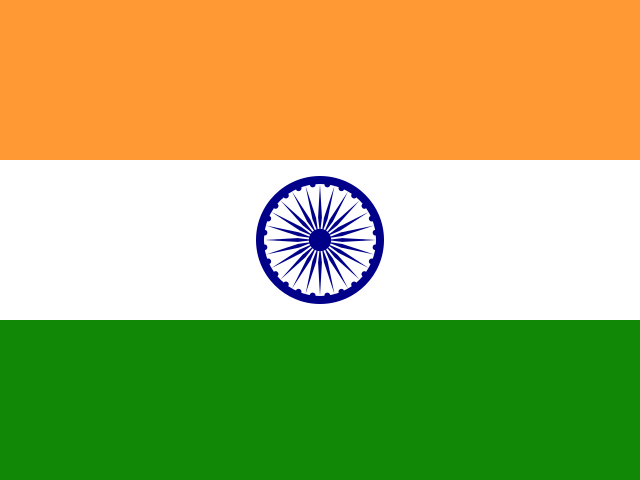 India
India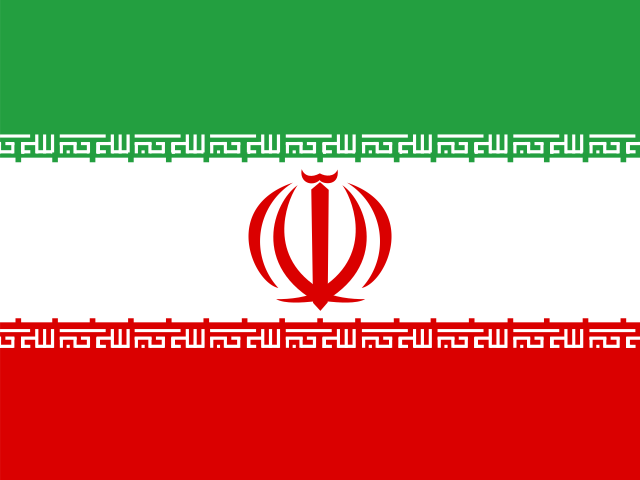 Iran
Iran Maldives
 Nepal
Nepal Pakistan
Earlier Report Observations
The market for nutmeg, mace and cardamoms in Southern Asia, heavily reliant on Indian production where the state of Kerala accounts for over half of cardamom output, experienced notable volume shifts between 2018 and 2023. After reaching 61 584 tonnes in 2018, the market volume declined to 55 715 tonnes in 2019 before recovering to 63 028 tonnes in 2020.
A sustained expansion followed, with market volume climbing to 71 826 tonnes in 2021 and peaking at 77 925 tonnes in 2022. This growth was primarily driven by market innovation, including the blending of traditional spices and the emergence of new product segments catering to global culinary trends. Furthermore, a rising consumer preference for premium and organic spices during this period stimulated demand and influenced product offerings.
The trend reversed in 2023 as market volume fell to 71 438 tonnes. This contraction was directly caused by a sharp 40-45% drop in cardamom production in key supplying countries, India and Guatemala, which created tight supply conditions. While strong demand during festive periods like Ramadan supported consumption, it could not offset the significant production shortfall. In the 2023-2024 season, export demand for Indian spices surged by 15% in volume and value, reflecting continued international market strength.
Table of content
- 1. Disclaimer
- 2. Terms of use of the report
- 3. Product codes in the statistical classifications used in the report
-
4. Key Market Indicators and Trends
-
4.1. Key Market Indicators
-
4.1.1. In kind
- 4.1.1.1. Production, 2018-2023
- 4.1.1.2. Imports, 2018-2024
- 4.1.1.3. Exports, 2018-2024
- 4.1.1.4. Market size, 2018-2023
-
4.1.2. In value
- 4.1.2.1. Production, 2018-2023
- 4.1.2.2. Imports, 2018-2024
- 4.1.2.3. Exports, 2018-2024
- 4.1.2.4. Market size, 2018-2023
-
4.1.1. In kind
- 4.2. Market Trends and Factors
-
4.1. Key Market Indicators
-
5. Production
-
5.1. Production in Southern Asia
- 5.1.1. Annual dynamics of production in Southern Asia in kind, 2018-2023, t
-
5.2. Global production by Country, 2018-2023
- 5.2.1. Annual dynamics of production by macroregions in kind, 2018-2023, t
- 5.2.2. Dynamics of production structure by macroregions in kind, 2018-2023
- 5.2.3. Annual dynamics of production by country in kind, 2018-2023, t
- 5.2.4. Structure of production by countries in kind, 2018-2023
- 5.2.5. Dynamics of peoduction structure by countries in kind, 2018-2023
-
5.1. Production in Southern Asia
-
6. Imports
-
6.1. Imports (Direct Data*)
- 6.1.1. Imports - Total information
-
6.1.2. Imports in kind, t
- 6.1.2.1. Annual dynamics of product's imports to Afghanistan in kind, 2018-2024, t
- 6.1.2.2. Dynamics of product's imports in kind to Afghanistan by countries, 2018-2024, t
- 6.1.2.3. Structure of product's imports in kind by countries, 2018-2024
-
6.1.3. Imports in value, M $ US
- 6.1.3.1. Annual dynamics of product's imports to Afghanistan in value, 2018-2024, M $ US
- 6.1.3.2. Dynamics of product's imports in value to Afghanistan by countries, 2018-2024, M $ US
- 6.1.3.3. Structure of product's imports in value by countries, 2018-2024
-
6.1.4. Average price of product's imports, $ US/kg
- 6.1.4.1. Annual dynamics of average price of product's imports to Afghanistan, 2018-2024, $ US/kg
- 6.1.4.2. Dynamics of average price of product's imports to Afghanistan by countries, 2018-2024, $ US/kg
-
6.2. Imports (Mirror Data)
- 6.2.1. Imports - Total information
-
6.2.2. Imports in kind, t
- 6.2.2.1. Annual dynamics of product's imports to Afghanistan in kind, 2018-2024, t
- 6.2.2.2. Dynamics of product's imports in kind to Afghanistan by countries, 2018-2024, t
- 6.2.2.3. Structure of product's imports in kind by countries, 2018-2024
-
6.2.3. Imports in value, M $ US
- 6.2.3.1. Annual dynamics of product's imports to Afghanistan in value, 2018-2024, M $ US
- 6.2.3.2. Dynamics of product's imports in value to Afghanistan by countries, 2018-2024, M $ US
- 6.2.3.3. Structure of product's imports in value by countries, 2018-2024
-
6.2.4. Average price of product's imports, $ US/kg
- 6.2.4.1. Annual dynamics of average price of product's imports to Afghanistan, 2018-2024, $ US/kg
- 6.2.4.2. Dynamics of average price of product's imports to Afghanistan by countries, 2018-2024, $ US/kg
-
6.1. Imports (Direct Data*)
-
7. Exports
-
7.1. Exports (Direct Data*)
- 7.1.1. Exports - Total information
-
7.1.2. Exports in kind, t
- 7.1.2.1. Annual dynamics of product's exports from Afghanistan in kind, 2018-2024, t
- 7.1.2.2. Dynamics of product's exports in kind from Afghanistan by countries, 2018-2024, t
- 7.1.2.3. Structure of product's exports in kind by countries, 2018-2024
-
7.1.3. Exports in value, M $ US
- 7.1.3.1. Annual dynamics of product's exports from Afghanistan in value, 2018-2024, M $ US
- 7.1.3.2. Dynamics of product's exports in value from Afghanistan by countries, 2018-2024, M $ US
- 7.1.3.3. Structure of product's exports in value by countries, 2018-2024
-
7.1.4. Average price of product's exports, $ US/kg
- 7.1.4.1. Annual dynamics of average price of product's exports from Afghanistan, 2018-2024, $ US/kg
- 7.1.4.2. Dynamics of average price of product's exports from Afghanistan by countries, 2018-2024, $ US/kg
-
7.2. Exports (Mirror Data)
- 7.2.1. Exports - Total information
-
7.2.2. Exports in kind, t
- 7.2.2.1. Annual dynamics of product's exports from Afghanistan in kind, 2018-2024, t
- 7.2.2.2. Dynamics of product's exports in kind from Afghanistan by countries, 2018-2024, t
- 7.2.2.3. Structure of product's exports in kind by countries, 2018-2024
-
7.2.3. Exports in value, M $ US
- 7.2.3.1. Annual dynamics of product's exports from Afghanistan in value, 2018-2024, M $ US
- 7.2.3.2. Dynamics of product's exports in value from Afghanistan by countries, 2018-2024, M $ US
- 7.2.3.3. Structure of product's exports in value by countries, 2018-2024
-
7.2.4. Average price of product's exports, $ US/kg
- 7.2.4.1. Annual dynamics of average price of product's exports from Afghanistan, 2018-2024, $ US/kg
- 7.2.4.2. Dynamics of average price of product's exports from Afghanistan by countries, 2018-2024, $ US/kg
-
7.1. Exports (Direct Data*)
-
8. Trade balance
-
8.1. Trade balance (Direct Data)
- 8.1.1. In kind, t
- 8.1.2. In value, M $ US
-
8.2. Trade balance (Mirror Data)
- 8.2.1. In kind, t
- 8.2.2. In value, M $ US
-
8.1. Trade balance (Direct Data)
-
9. Top buying and selling countries, 2018-2024
-
9.1. Direct Data
- 9.1.1. Import in Value by Countries-buyers
- 9.1.2. Export in Value by Countries-suppliers
-
9.2. Mirror Data
- 9.2.1. Import in Value by Countries-buyers
- 9.2.2. Export in Value by Countries-suppliers
-
9.1. Direct Data
Production nutmeg, mace and cardamoms in Southern Asia
In kind, 2017-2020, t
Top producers of nutmeg, mace and cardamoms, 2017-2020
World map of production of nutmeg, mace and cardamoms, 2017-2020
Southern Asia produced 52,840 tonnes of nutmeg, mace, and cardamoms in 2020, representing a 3.1% increase compared to the previous year. Looking at the broader period from 2017 to 2020, production declined by 2.9%, which translates to an average annual decrease of 1.0%. The lowest production level was recorded in 2019 at 51,248 tonnes, while the highest was in 2018 with 54,993 tonnes. The most significant drop occurred in 2019, when production fell by 6.8%.
Annual dynamics of production in Southern Asia in kind, 2017-2020, t
| Parameter | 2018 | 2019 | 2020 | CAGR | |
|---|---|---|---|---|---|
| 1 | Change from last year | 1.0% | (6.8%) | 3.1% | (1.0%) |
In value, 2017-2020, M $ US
Southern Asia's production value of nutmeg, mace, and cardamoms has grown for the third year in a row. In 2020, the output was valued at 951.0 million US dollars, showing a strong year-over-year increase of 10.8%. From 2017 to 2020, production value rose by 21.1%, averaging an annual growth rate of 6.6%.
Annual dynamics of production in Southern Asia in value, 2017-2020, M $ US
| Parameter | 2018 | 2019 | 2020 | CAGR | |
|---|---|---|---|---|---|
| 1 | Change from last year | 1.0% | 8.2% | 10.8% | 6.6% |
Exports nutmeg, mace and cardamoms from Southern Asia
Exports in kind, t
In 2020, Southern Asia's exports of nutmeg, mace, and cardamoms amounted to 4,345 tonnes, marking a significant decline of 13.7% compared to 2019. Over the 2017-2020 period, exports decreased by 25.5%, with a compound annual growth rate (CAGR) of -9.4%. The largest drop was recorded in 2018 at 21.1%, while the biggest increase occurred in 2019 with a 9.3% rise.
Annual dynamics of product's exports from Southern Asia in kind, 2017-2020, t
| Parameter | 2018 | 2019 | 2020 | CAGR | |
|---|---|---|---|---|---|
| 1 | Change from last year | (21.1%) | 9.3% | (13.7%) | (9.4%) |
From 2017 to 2020, the United Arab Emirates (accounting for 4.3% of exports in kind), China (1.0%), and Germany (1.0%) were the largest buyers of nutmeg, mace, and cardamoms from Southern Asia. However, these countries were not dominant, as together they represented just 6.3% of total exports in kind, with many smaller partners making up the remainder.
Structure of product's exports in kind by countries, 2017-2020
World map of product's exports from Southern Asia in kind, 2017-2020
Exports in value, M $ US
In 2020, the value of nutmeg, mace, and cardamoms exported from Southern Asia reached 78.2 million US dollars, down 7.3% year-over-year. Between 2017 and 2020, export value decreased by 7.1%, with a CAGR of -2.4%. The lowest value was recorded in 2018 at 66.5 million US dollars, and the highest in 2019 at 84.3 million US dollars. The most substantial decline happened in 2018 with a 21.1% drop, while the largest increase was in 2019 with a 26.9% rise.
Annual dynamics of product's exports from Southern Asia in value, 2017-2020, M $ US
| Parameter | 2018 | 2019 | 2020 | CAGR | |
|---|---|---|---|---|---|
| 1 | Change from last year | (21.1%) | 26.9% | (7.3%) | (2.4%) |
From 2017 to 2020, exports in value terms of nutmeg, mace, and cardamoms from Southern Asia were distributed across a wide range of partner countries. The United Arab Emirates (3.5% of exports in value terms), Germany (1.8%), and the United States (0.9%) were the top buyers, but together they accounted for only 6.3% of total export flows.
Structure of product's exports in value by countries, 2017-2020
World map of product's exports from Southern Asia in value, 2017-2020
Imports nutmeg, mace and cardamoms to Southern Asia
Imports in kind, t
Following a two-year decline, Southern Asia's imports of nutmeg, mace, and cardamoms increased in volume. In 2020, import volume totaled 14,533 tonnes, up 52.9% from the previous year. Over the 2017-2020 period, imports grew by 20.7%, with a CAGR of 6.5%. The lowest volume was recorded in 2019 at 9,503 tonnes, and the largest decline occurred that same year with a 15.1% drop.
Annual dynamics of product's imports to Southern Asia in kind, 2017-2020, t
| Parameter | 2018 | 2019 | 2020 | CAGR | |
|---|---|---|---|---|---|
| 1 | Change from last year | (7.0%) | (15.1%) | 52.9% | 6.5% |
From 2017 to 2020, Guatemala (53.8% of imports in kind), Indonesia (8.5%), and the United Arab Emirates (6.7%) consistently held the top positions in Southern Asia's import structure for nutmeg, mace, and cardamoms. Together, these three countries accounted for 69.0% of total import flows.
Structure of product's imports in kind by countries, 2017-2020
World map of product's imports to Southern Asia in kind, 2017-2020
Imports in value, M $ US
Southern Asia's import value of nutmeg, mace, and cardamoms has increased for the third consecutive year. In 2020, imports stood at 184.7 million US dollars, reflecting a substantial gain of 65.4% compared to the previous year. Between 2017 and 2020, import value surged by 121.3%, with a CAGR of 30.3%.
Annual dynamics of product's imports to Southern Asia in value, 2017-2020, M $ US
| Parameter | 2018 | 2019 | 2020 | CAGR | |
|---|---|---|---|---|---|
| 1 | Change from last year | 1.1% | 32.3% | 65.4% | 30.3% |
From 2017 to 2020, Guatemala (55.0% of imports in value terms), the United Arab Emirates (9.5%), and Singapore (6.1%) consistently led in Southern Asia's import structure for nutmeg, mace, and cardamoms. Collectively, these three countries represented 70.6% of total import flows.
Structure of product's imports in value by countries, 2017-2020
World map of product's imports to Southern Asia in value, 2017-2020
Related Reports

Nutmeg, mace and cardamoms market in ASEAN
2026-03-28
Nutmeg, mace and cardamoms market in Africa
2026-03-28
Nutmeg, mace and cardamoms market in Laos
2026-03-28

2026-03-28



Pepper market in Southern Asia
2026-03-28
In-depth market research on this product
Global Nutmeg Market 2021–2031: Size, Share, Trends and Forecast
Global market report: size, trends and forecast to 2031 · 184 pages
Global Cardamom Market 2021–2031: Size, Share, Trends and Forecast
Global market report: size, trends and forecast to 2031 · 184 pages
Global Mace Market 2021–2031: Size, Share, Trends and Forecast
Global market report: size, trends and forecast to 2031 · 184 pages
Why Choose Us?
Only Verified Data
No Hidden Costs or Separate Fees
Smarter Subscription Pricing
Contact Our Team
Submit your inquiry using the form below — our team will get back to you within 24 hours.