






"Western Africa" region includes following countries:
 Cabo Verde
 Benin
Benin Gambia
 Ghana
Ghana Guinea
 Côte d'Ivoire
 Liberia
 Mali
Mali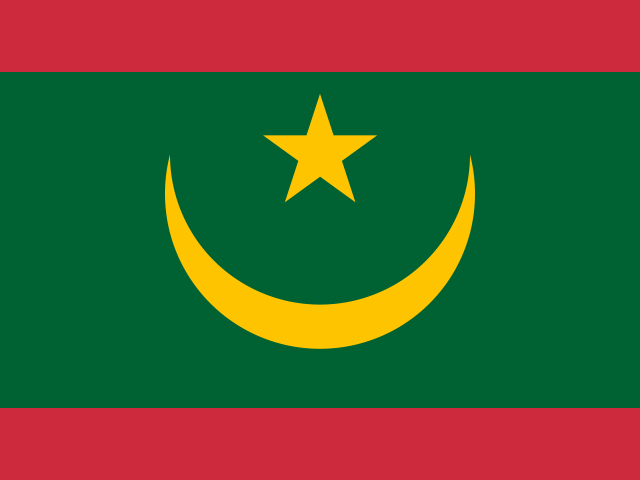 Mauritania
 Niger
Niger Nigeria
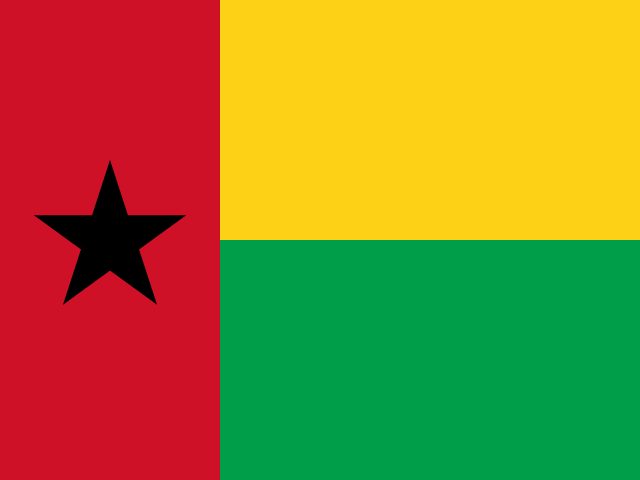 Guinea-Bissau
 Saint Helena, Ascension and Tristan da Cunha
 Senegal
 Sierra Leone
 Togo
Togo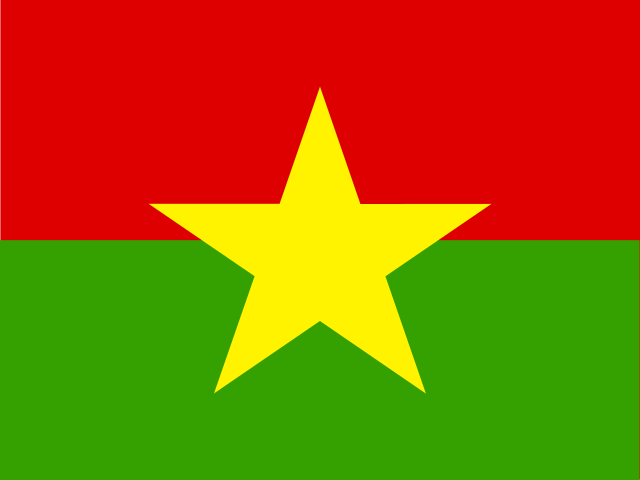 Burkina Faso
Earlier Report Observations
The not carded or combed cotton market in Western Africa stood at 2.8 million tons in 2018, with the product being a cornerstone of Benin's exports, highlighting the significant role of state-owned and private enterprises in the sector. Market volume grew by 18% to 3.4 million tons in 2019, driven by a global cotton supply deficit which pushed prices higher. Unfavorable weather in key producing regions like the United States and India reduced harvests, encouraging increased production in West Africa to meet international demand. However, the market contracted by 20% to 2.7 million tons in 2020 as the COVID-19 pandemic caused an 11% drop in global cotton demand, leading to gin closures, order cancellations, and severe disruptions to the textile supply chain.
A strong recovery followed in 2021, with the market expanding by 23% to 3.3 million tons. Global cotton prices remained elevated due to robust demand and ongoing pandemic-related supply chain issues, incentivizing production. Shifts in global production shares, with growth in Brazil and a decline in China, also affected trade flows. The market volume then fell by 17% to 2.7 million tons in 2022 amid volatility in world prices, trade policies, and international demand, particularly from China and other Asian markets. Notably, cotton remained Benin's primary export commodity during this period. In 2023, the market saw a moderate 8% increase, reaching 3.0 million tons.
Table of content
- 1. Disclaimer
- 2. Terms of use of the report
- 3. Product codes in the statistical classifications used in the report
-
4. Key Market Indicators and Trends
-
4.1. Key Market Indicators
-
4.1.1. In kind
- 4.1.1.1. Production, 2018-2023
- 4.1.1.2. Imports, 2018-2024
- 4.1.1.3. Exports, 2018-2024
- 4.1.1.4. Market size, 2018-2023
-
4.1.2. In value
- 4.1.2.1. Production, 2018-2023
- 4.1.2.2. Imports, 2018-2024
- 4.1.2.3. Exports, 2018-2024
- 4.1.2.4. Market size, 2018-2023
-
4.1.1. In kind
- 4.2. Market Trends and Factors
-
4.1. Key Market Indicators
-
5. Production
-
5.1. Production in Western Africa
- 5.1.1. Annual dynamics of production in Western Africa in kind, 2018-2023, K t
-
5.2. Global production by Country, 2018-2023
- 5.2.1. Annual dynamics of production by macroregions in kind, 2018-2023, K t
- 5.2.2. Dynamics of production structure by macroregions in kind, 2018-2023
- 5.2.3. Annual dynamics of production by country in kind, 2018-2023, K t
- 5.2.4. Structure of production by countries in kind, 2018-2023
- 5.2.5. Dynamics of peoduction structure by countries in kind, 2018-2023
-
5.1. Production in Western Africa
-
6. Imports
-
6.1. Imports (Direct Data*)
- 6.1.1. Imports - Total information
-
6.1.2. Imports in kind, K t
- 6.1.2.1. Annual dynamics of product's imports to Cabo Verde in kind, 2018-2024, K t
- 6.1.2.2. Dynamics of product's imports in kind to Cabo Verde by countries, 2018-2024, K t
- 6.1.2.3. Structure of product's imports in kind by countries, 2018-2024
-
6.1.3. Imports in value, M $ US
- 6.1.3.1. Annual dynamics of product's imports to Cabo Verde in value, 2018-2024, M $ US
- 6.1.3.2. Dynamics of product's imports in value to Cabo Verde by countries, 2018-2024, M $ US
- 6.1.3.3. Structure of product's imports in value by countries, 2018-2024
-
6.1.4. Average price of product's imports, $ US/t
- 6.1.4.1. Annual dynamics of average price of product's imports to Cabo Verde, 2018-2024, $ US/t
- 6.1.4.2. Dynamics of average price of product's imports to Cabo Verde by countries, 2018-2024, $ US/t
-
6.2. Imports (Mirror Data)
- 6.2.1. Imports - Total information
-
6.2.2. Imports in kind, K t
- 6.2.2.1. Annual dynamics of product's imports to Cabo Verde in kind, 2018-2024, K t
- 6.2.2.2. Dynamics of product's imports in kind to Cabo Verde by countries, 2018-2024, K t
- 6.2.2.3. Structure of product's imports in kind by countries, 2018-2024
-
6.2.3. Imports in value, M $ US
- 6.2.3.1. Annual dynamics of product's imports to Cabo Verde in value, 2018-2024, M $ US
- 6.2.3.2. Dynamics of product's imports in value to Cabo Verde by countries, 2018-2024, M $ US
- 6.2.3.3. Structure of product's imports in value by countries, 2018-2024
-
6.2.4. Average price of product's imports, $ US/t
- 6.2.4.1. Annual dynamics of average price of product's imports to Cabo Verde, 2018-2024, $ US/t
- 6.2.4.2. Dynamics of average price of product's imports to Cabo Verde by countries, 2018-2024, $ US/t
-
6.1. Imports (Direct Data*)
-
7. Exports
-
7.1. Exports (Direct Data*)
- 7.1.1. Exports - Total information
-
7.1.2. Exports in kind, K t
- 7.1.2.1. Annual dynamics of product's exports from Cabo Verde in kind, 2018-2024, K t
- 7.1.2.2. Dynamics of product's exports in kind from Cabo Verde by countries, 2018-2024, K t
- 7.1.2.3. Structure of product's exports in kind by countries, 2018-2024
-
7.1.3. Exports in value, M $ US
- 7.1.3.1. Annual dynamics of product's exports from Cabo Verde in value, 2018-2024, M $ US
- 7.1.3.2. Dynamics of product's exports in value from Cabo Verde by countries, 2018-2024, M $ US
- 7.1.3.3. Structure of product's exports in value by countries, 2018-2024
-
7.1.4. Average price of product's exports, $ US/t
- 7.1.4.1. Annual dynamics of average price of product's exports from Cabo Verde, 2018-2024, $ US/t
- 7.1.4.2. Dynamics of average price of product's exports from Cabo Verde by countries, 2018-2024, $ US/t
-
7.2. Exports (Mirror Data)
- 7.2.1. Exports - Total information
-
7.2.2. Exports in kind, K t
- 7.2.2.1. Annual dynamics of product's exports from Cabo Verde in kind, 2018-2024, K t
- 7.2.2.2. Dynamics of product's exports in kind from Cabo Verde by countries, 2018-2024, K t
- 7.2.2.3. Structure of product's exports in kind by countries, 2018-2024
-
7.2.3. Exports in value, M $ US
- 7.2.3.1. Annual dynamics of product's exports from Cabo Verde in value, 2018-2024, M $ US
- 7.2.3.2. Dynamics of product's exports in value from Cabo Verde by countries, 2018-2024, M $ US
- 7.2.3.3. Structure of product's exports in value by countries, 2018-2024
-
7.2.4. Average price of product's exports, $ US/t
- 7.2.4.1. Annual dynamics of average price of product's exports from Cabo Verde, 2018-2024, $ US/t
- 7.2.4.2. Dynamics of average price of product's exports from Cabo Verde by countries, 2018-2024, $ US/t
-
7.1. Exports (Direct Data*)
-
8. Trade balance
-
8.1. Trade balance (Direct Data)
- 8.1.1. In kind, K t
- 8.1.2. In value, M $ US
-
8.2. Trade balance (Mirror Data)
- 8.2.1. In kind, K t
- 8.2.2. In value, M $ US
-
8.1. Trade balance (Direct Data)
-
9. Top buying and selling countries, 2018-2024
-
9.1. Direct Data
- 9.1.1. Import in Value by Countries-buyers
- 9.1.2. Export in Value by Countries-suppliers
-
9.2. Mirror Data
- 9.2.1. Import in Value by Countries-buyers
- 9.2.2. Export in Value by Countries-suppliers
-
9.1. Direct Data
Production not carded or combed cotton in Western Africa
In kind, 2017-2020, K t
Top producers of not carded or combed cotton, 2017-2020
World map of production of not carded or combed cotton, 2017-2020
In Western Africa, production of not carded or combed cotton reached 3 376 K t in 2020, representing a significant year-over-year decline of 18.3%. Over the 2017-2020 period, production decreased by 13.5%, with a compound annual growth rate of -4.7%. The peak production occurred in 2019 at 4 133 K t, which also saw the largest annual increase of 17.2%.
Annual dynamics of production in Western Africa in kind, 2017-2020, K t
| Parameter | 2018 | 2019 | 2020 | CAGR | |
|---|---|---|---|---|---|
| 1 | Change from last year | (9.6%) | 17.2% | (18.3%) | (4.7%) |
In value, 2017-2020, M $ US
The value of not carded or combed cotton production in Western Africa stood at 5 324 M $ US in 2020, reflecting a 22.7% decrease compared to 2019. From 2017 to 2020, production value declined by 11.7%, equivalent to an annualized rate of -4.0%. The highest value was recorded in 2019 at 6 891 M $ US, which also experienced the largest annual increase of 15.2%.
Annual dynamics of production in Western Africa in value, 2017-2020, M $ US
| Parameter | 2018 | 2019 | 2020 | CAGR | |
|---|---|---|---|---|---|
| 1 | Change from last year | (0.7%) | 15.2% | (22.7%) | (4.0%) |
Exports not carded or combed cotton from Western Africa
Exports in kind, K t
Following two consecutive years of growth, exports of not carded or combed cotton from Western Africa declined in 2020. Export volumes reached 691.0 K t, marking a modest year-over-year decrease of 10.0%. Over the 2017-2020 period, exports increased by 8.1%, with a compound annual growth rate of 2.6%. The peak export volume occurred in 2019 at 767.5 K t, which also saw the largest annual increase of 12.5%.
Annual dynamics of product's exports from Western Africa in kind, 2017-2020, K t
| Parameter | 2018 | 2019 | 2020 | CAGR | |
|---|---|---|---|---|---|
| 1 | Change from last year | 6.7% | 12.5% | (10.0%) | 2.6% |
Between 2017 and 2020, the geographical distribution of exports in kind was highly diversified. Bangladesh accounted for 27.3% of exports, Singapore for 12.6%, and Vietnam for 9.3%, collectively representing 49.2% of total flows. The remaining 50.8% was distributed among numerous smaller trading partners.
Structure of product's exports in kind by countries, 2017-2020
World map of product's exports from Western Africa in kind, 2017-2020
Exports in value, M $ US
After two years of consecutive gains, the value of not carded or combed cotton exports from Western Africa declined in 2020. Export value reached 1 090 M $ US, reflecting a 14.8% decrease compared to 2019. Over the 2017-2020 period, export value increased by 10.4%, with a compound annual growth rate of 3.3%. The peak value was recorded in 2019 at 1 279 M $ US, while the largest annual increase occurred in 2018 at 17.2%.
Annual dynamics of product's exports from Western Africa in value, 2017-2020, M $ US
| Parameter | 2018 | 2019 | 2020 | CAGR | |
|---|---|---|---|---|---|
| 1 | Change from last year | 17.2% | 10.5% | (14.8%) | 3.3% |
From 2017 to 2020, Bangladesh, Singapore, and Vietnam remained the primary destinations for not carded or combed cotton exports from Western Africa in value terms. Bangladesh accounted for 27.9% of exports, Singapore for 12.9%, and Vietnam for 9.3%, collectively representing 50.2% of total export value.
Structure of product's exports in value by countries, 2017-2020
World map of product's exports from Western Africa in value, 2017-2020
Imports not carded or combed cotton to Western Africa
Imports in kind, K t
Import data reveals irregular changes, indicating a volatile market environment. In 2019, imports reached their lowest point at 0.3 K t, marking a 45.0% decline. By 2020, imports surged to 1.7 K t, representing a substantial 542.1% increase from the previous year. The difference between the peak in 2020 and the trough in 2019 was 6.4-fold.
Annual dynamics of product's imports to Western Africa in kind, 2017-2020, K t
| Parameter | 2018 | 2019 | 2020 | CAGR | |
|---|---|---|---|---|---|
| 1 | Change from last year | 49.3% | (45.0%) | 542.1% | 74.1% |
Throughout the 2017-2020 period, China and Denmark remained the principal suppliers of not carded or combed cotton to Western Africa in kind, collectively accounting for 26.7% of total imports.
Structure of product's imports in kind by countries, 2017-2020
World map of product's imports to Western Africa in kind, 2017-2020
Imports in value, M $ US
Import value data shows irregular fluctuations, reflecting a volatile market environment. In 2018, imports saw the largest annual increase of 264.9%. By 2019, import value peaked at 3 M $ US, then declined slightly to 3 M $ US in 2020, representing a 2.2% decrease from the previous year. The difference between the peak in 2019 and the trough in 2017 was 4.3-fold.
Annual dynamics of product's imports to Western Africa in value, 2017-2020, M $ US
| Parameter | 2018 | 2019 | 2020 | CAGR | |
|---|---|---|---|---|---|
| 1 | Change from last year | 264.9% | 17.9% | (2.2%) | 61.4% |
Between 2017 and 2020, China, the United Arab Emirates, and France were the main sources of imports in value terms for Western Africa. China accounted for 16.2% of imports, the United Arab Emirates for 1.1%, and France for 0.6%, collectively representing 17.9% of total import flows.
Structure of product's imports in value by countries, 2017-2020
World map of product's imports to Western Africa in value, 2017-2020
Related Reports

Not carded or combed cotton market in CIS
2026-03-30
Not carded or combed cotton market in MENA
2026-03-30


2026-03-30

Kola nuts market in Western Africa
2026-03-28

Why Choose Us?
Only Verified Data
No Hidden Costs or Separate Fees
Smarter Subscription Pricing
Contact Our Team
Submit your inquiry using the form below — our team will get back to you within 24 hours.