






"Central Asia" region includes following countries:
 Kazakhstan
 Kyrgyzstan
 Tajikistan
 Turkmenistan
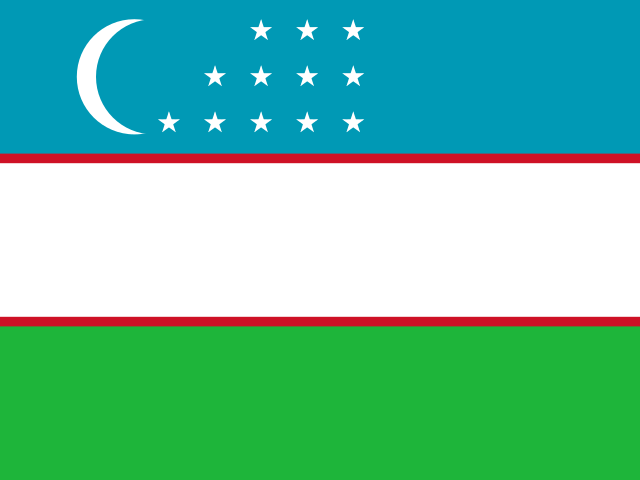 Uzbekistan
Earlier Report Observations
The market for not carded or combed cotton in Central Asia grew from 5.0 million tons in 2018 to 6.9 million tons in 2022. This expansion was largely fueled by a series of state-led reforms in Uzbekistan, initiated by a 2017 presidential decree to accelerate textile industry development, which boosted cotton farming investments and raised the country's raw cotton harvest by 30.4% in 2019.
After reaching a peak in 2022, the market volume declined to 6.3 million tons in 2023. This contraction was influenced by a sharp drop in cotton production and processing in Tajikistan, which offset a record output increase in Kazakhstan driven by the entry of a major new player—the Chinese holding Xinjiang Lihua—launching an integrated cotton processing project.
Table of content
- 1. Disclaimer
- 2. Terms of use of the report
- 3. Product codes in the statistical classifications used in the report
-
4. Key Market Indicators and Trends
-
4.1. Key Market Indicators
-
4.1.1. In kind
- 4.1.1.1. Production, 2018-2023
- 4.1.1.2. Imports, 2018-2024
- 4.1.1.3. Exports, 2018-2024
- 4.1.1.4. Market size, 2018-2023
-
4.1.1. In kind
- 4.2. Market Trends and Factors
-
4.1. Key Market Indicators
-
5. Production
-
5.1. Production in Central Asia
- 5.1.1. Annual dynamics of production in Central Asia in kind, 2018-2023, K t
-
5.2. Global production by Country, 2018-2023
- 5.2.1. Annual dynamics of production by macroregions in kind, 2018-2023, K t
- 5.2.2. Dynamics of production structure by macroregions in kind, 2018-2023
- 5.2.3. Annual dynamics of production by country in kind, 2018-2023, K t
- 5.2.4. Structure of production by countries in kind, 2018-2023
- 5.2.5. Dynamics of peoduction structure by countries in kind, 2018-2023
-
5.1. Production in Central Asia
-
6. Imports
-
6.1. Imports (Direct Data*)
- 6.1.1. Imports - Total information
-
6.1.2. Imports in kind, K t
- 6.1.2.1. Annual dynamics of product's imports to Kazakhstan in kind, 2018-2024, K t
- 6.1.2.2. Dynamics of product's imports in kind to Kazakhstan by countries, 2018-2024, K t
- 6.1.2.3. Structure of product's imports in kind by countries, 2018-2024
-
6.1.3. Imports in value, M $ US
- 6.1.3.1. Annual dynamics of product's imports to Kazakhstan in value, 2018-2024, M $ US
- 6.1.3.2. Dynamics of product's imports in value to Kazakhstan by countries, 2018-2024, M $ US
- 6.1.3.3. Structure of product's imports in value by countries, 2018-2024
-
6.1.4. Average price of product's imports, $ US/t
- 6.1.4.1. Annual dynamics of average price of product's imports to Kazakhstan, 2018-2024, $ US/t
- 6.1.4.2. Dynamics of average price of product's imports to Kazakhstan by countries, 2018-2024, $ US/t
-
6.2. Imports (Mirror Data)
- 6.2.1. Imports - Total information
-
6.2.2. Imports in kind, K t
- 6.2.2.1. Annual dynamics of product's imports to Kazakhstan in kind, 2018-2024, K t
- 6.2.2.2. Dynamics of product's imports in kind to Kazakhstan by countries, 2018-2024, K t
- 6.2.2.3. Structure of product's imports in kind by countries, 2018-2024
-
6.2.3. Imports in value, M $ US
- 6.2.3.1. Annual dynamics of product's imports to Kazakhstan in value, 2018-2024, M $ US
- 6.2.3.2. Dynamics of product's imports in value to Kazakhstan by countries, 2018-2024, M $ US
- 6.2.3.3. Structure of product's imports in value by countries, 2018-2024
-
6.2.4. Average price of product's imports, $ US/t
- 6.2.4.1. Annual dynamics of average price of product's imports to Kazakhstan, 2018-2024, $ US/t
- 6.2.4.2. Dynamics of average price of product's imports to Kazakhstan by countries, 2018-2024, $ US/t
-
6.1. Imports (Direct Data*)
-
7. Exports
-
7.1. Exports (Direct Data*)
- 7.1.1. Exports - Total information
-
7.1.2. Exports in kind, K t
- 7.1.2.1. Annual dynamics of product's exports from Kazakhstan in kind, 2018-2024, K t
- 7.1.2.2. Dynamics of product's exports in kind from Kazakhstan by countries, 2018-2024, K t
- 7.1.2.3. Structure of product's exports in kind by countries, 2018-2024
-
7.1.3. Exports in value, M $ US
- 7.1.3.1. Annual dynamics of product's exports from Kazakhstan in value, 2018-2024, M $ US
- 7.1.3.2. Dynamics of product's exports in value from Kazakhstan by countries, 2018-2024, M $ US
- 7.1.3.3. Structure of product's exports in value by countries, 2018-2024
-
7.1.4. Average price of product's exports, $ US/t
- 7.1.4.1. Annual dynamics of average price of product's exports from Kazakhstan, 2018-2024, $ US/t
- 7.1.4.2. Dynamics of average price of product's exports from Kazakhstan by countries, 2018-2024, $ US/t
-
7.2. Exports (Mirror Data)
- 7.2.1. Exports - Total information
-
7.2.2. Exports in kind, K t
- 7.2.2.1. Annual dynamics of product's exports from Kazakhstan in kind, 2018-2024, K t
- 7.2.2.2. Dynamics of product's exports in kind from Kazakhstan by countries, 2018-2024, K t
- 7.2.2.3. Structure of product's exports in kind by countries, 2018-2024
-
7.2.3. Exports in value, M $ US
- 7.2.3.1. Annual dynamics of product's exports from Kazakhstan in value, 2018-2024, M $ US
- 7.2.3.2. Dynamics of product's exports in value from Kazakhstan by countries, 2018-2024, M $ US
- 7.2.3.3. Structure of product's exports in value by countries, 2018-2024
-
7.2.4. Average price of product's exports, $ US/t
- 7.2.4.1. Annual dynamics of average price of product's exports from Kazakhstan, 2018-2024, $ US/t
- 7.2.4.2. Dynamics of average price of product's exports from Kazakhstan by countries, 2018-2024, $ US/t
-
7.1. Exports (Direct Data*)
-
8. Trade balance
-
8.1. Trade balance (Direct Data)
- 8.1.1. In kind, K t
- 8.1.2. In value, M $ US
-
8.2. Trade balance (Mirror Data)
- 8.2.1. In kind, K t
- 8.2.2. In value, M $ US
-
8.1. Trade balance (Direct Data)
-
9. Top buying and selling countries, 2018-2024
-
9.1. Direct Data
- 9.1.1. Import in Value by Countries-buyers
- 9.1.2. Export in Value by Countries-suppliers
-
9.2. Mirror Data
- 9.2.1. Import in Value by Countries-buyers
- 9.2.2. Export in Value by Countries-suppliers
-
9.1. Direct Data
Production not carded or combed cotton in Central Asia
In kind, 2017-2020, K t
Top producers of not carded or combed cotton, 2017-2020
World map of production of not carded or combed cotton, 2017-2020
Central Asia's production of not carded or combed cotton grew for the second year in a row. In 2019, output reached 5,919 thousand tons, then increased by 12.4% to 6,542 thousand tons in 2020. Over the 2017-2020 period, production rose by 6.9%, with an average annual growth rate of 2.3%. The lowest production level was recorded in 2018 at 5,266 thousand tons, which represented a 13.9% decline from the previous year.
Annual dynamics of production in Central Asia in kind, 2017-2020, K t
| Parameter | 2018 | 2019 | 2020 | CAGR | |
|---|---|---|---|---|---|
| 1 | Change from last year | (13.9%) | 12.4% | 10.5% | 2.3% |
In value, 2017-2020, M $ US
In 2020, the value of not carded or combed cotton production in Central Asia was $9,196 million, down 4.1% from 2019. Over the 2017-2020 period, production value fell by 9.7%, with an average annual decline of 3.4%. The largest decrease occurred in 2018 at 6.4%, while 2019 saw a modest increase of 0.6%.
Annual dynamics of production in Central Asia in value, 2017-2020, M $ US
| Parameter | 2018 | 2019 | 2020 | CAGR | |
|---|---|---|---|---|---|
| 1 | Change from last year | (6.4%) | 0.6% | (4.1%) | (3.4%) |
Exports not carded or combed cotton from Central Asia
Exports in kind, K t
In 2020, Central Asia exported 279.0 thousand tons of not carded or combed cotton, an 18.3% decrease from 2019. Over the 2017-2020 period, exports dropped by 35%, with an average annual decline of 13.4%. The lowest export volume was recorded in 2018 at 278.0 thousand tons, which marked a 35.3% fall from the previous year. In contrast, 2019 saw exports grow by 22.7%.
Annual dynamics of product's exports from Central Asia in kind, 2017-2020, K t
| Parameter | 2018 | 2019 | 2020 | CAGR | |
|---|---|---|---|---|---|
| 1 | Change from last year | (35.3%) | 22.7% | (18.3%) | (13.4%) |
From 2017 to 2020, Iran, Turkey, and China were the main markets for Central Asia's not carded or combed cotton exports in volume terms. Iran accounted for 26.8% of exports, Turkey for 19.6%, and China for 18.1%. Together, these three countries represented 64.6% of total export flows.
Structure of product's exports in kind by countries, 2017-2020
World map of product's exports from Central Asia in kind, 2017-2020
Exports in value, M $ US
In 2020, the value of not carded or combed cotton exports from Central Asia totaled $392.2 million, a 29.1% year-on-year decrease. Over the 2017-2020 period, export value fell by 45.2%, with an average annual decline of 18.2%. The largest drop occurred in 2018 at 29.6%, while 2019 saw an increase of 9.9%.
Annual dynamics of product's exports from Central Asia in value, 2017-2020, M $ US
| Parameter | 2018 | 2019 | 2020 | CAGR | |
|---|---|---|---|---|---|
| 1 | Change from last year | (29.6%) | 9.9% | (29.1%) | (18.2%) |
Between 2017 and 2020, Iran, China, and Turkey were the top three markets for Central Asia's not carded or combed cotton exports in value terms. Together, they accounted for 66.1% of total export value.
Structure of product's exports in value by countries, 2017-2020
World map of product's exports from Central Asia in value, 2017-2020
Imports not carded or combed cotton to Central Asia
Imports in kind, K t
Import volumes showed significant volatility during this period. The lowest point was in 2018 at 0.2 thousand tons, while imports peaked in 2020 at 10.7 thousand tons, representing a 47-fold increase from the trough. Compared to 2019, 2020 imports surged by 2,191.6%. The largest decline occurred in 2018 at 33.1%.
Annual dynamics of product's imports to Central Asia in kind, 2017-2020, K t
| Parameter | 2018 | 2019 | 2020 | CAGR | |
|---|---|---|---|---|---|
| 1 | Change from last year | (33.1%) | 105.3% | 2 191.6% | 215.8% |
From 2017 to 2020, Bangladesh and Turkey were the primary sources for Central Asia's not carded or combed cotton imports in volume terms, together accounting for 18.6% of total import flows.
Structure of product's imports in kind by countries, 2017-2020
World map of product's imports to Central Asia in kind, 2017-2020
Imports in value, M $ US
Import values exhibited irregular changes, indicating a volatile market. The lowest value was recorded in 2018 at $0.5 million, while 2020 saw a peak of $17.4 million, a 39-fold increase. Compared to 2019, 2020 import value rose by 274.2%. The largest decline occurred in 2018 at 29.6%, while 2019 saw a dramatic increase of 932.1%.
Annual dynamics of product's imports to Central Asia in value, 2017-2020, M $ US
| Parameter | 2018 | 2019 | 2020 | CAGR | |
|---|---|---|---|---|---|
| 1 | Change from last year | (29.6%) | 932.1% | 274.2% | 200.7% |
Over the 2017-2020 period, Bangladesh and Turkey were the main sources for Central Asia's not carded or combed cotton imports in value terms, together representing 17.9% of total import value.
Structure of product's imports in value by countries, 2017-2020
World map of product's imports to Central Asia in value, 2017-2020
Related Reports

Not carded or combed cotton market in Benin
2026-03-30

Raw silk market in Central Asia
2026-03-30

Silkworm cocoons market in Central Asia
2026-03-30

2026-03-30

Why Choose Us?
Only Verified Data
No Hidden Costs or Separate Fees
Smarter Subscription Pricing
Contact Our Team
Submit your inquiry using the form below — our team will get back to you within 24 hours.