







"Australia and New Zealand" region includes following countries:
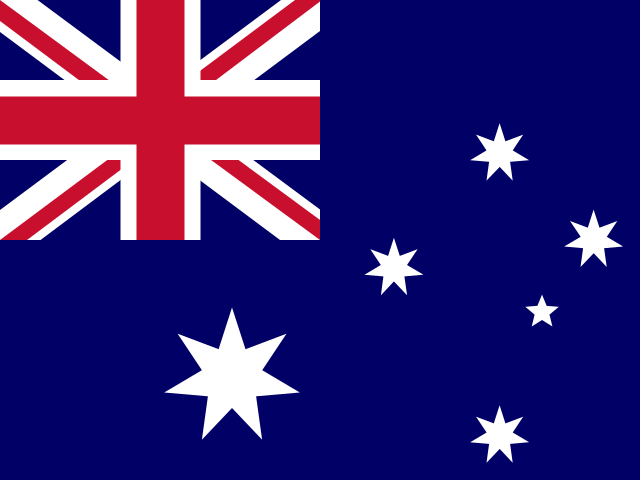 Australia
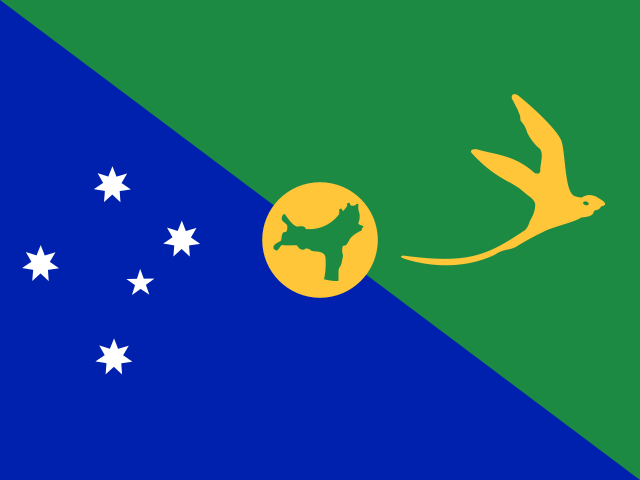 Christmas Island
 Cocos (Keeling) Islands
 New Zealand
 Norfolk Island
Earlier Report Observations
The market volume for non-vegetable waxes in Australia and New Zealand stood at 689.3 tonnes in 2018, rose sharply to 831.8 tonnes in 2019, then gradually declined to 739.3 tonnes by 2021.
In 2022, the market rebounded to 814.1 tonnes. This increase coincided with a growing consumer preference for natural and eco-friendly waxes like beeswax, driven by environmental awareness, and a rise in their use within cosmetics and personal care products. The market contracted significantly to 588.5 tonnes in 2023, a period during which global crude oil price volatility continued to influence supply and costs for mineral waxes.
Table of content
- 1. Disclaimer
- 2. Terms of use of the report
- 3. Product codes in the statistical classifications used in the report
-
4. Key Market Indicators and Trends
-
4.1. Key Market Indicators
-
4.1.1. In kind
- 4.1.1.1. Production, 2018-2023
- 4.1.1.2. Imports, 2018-2025
- 4.1.1.3. Exports, 2018-2025
- 4.1.1.4. Market size, 2018-2023
-
4.1.1. In kind
- 4.2. Market Trends and Factors
-
4.1. Key Market Indicators
-
5. Production
-
5.1. Production in Australia and New Zealand
- 5.1.1. Annual dynamics of production in Australia and New Zealand in kind, 2018-2023, t
-
5.2. Global production by Country, 2018-2023
- 5.2.1. Annual dynamics of production by macroregions in kind, 2018-2023, t
- 5.2.2. Dynamics of production structure by macroregions in kind, 2018-2023
- 5.2.3. Annual dynamics of production by country in kind, 2018-2023, t
- 5.2.4. Structure of production by countries in kind, 2018-2023
- 5.2.5. Dynamics of peoduction structure by countries in kind, 2018-2023
-
5.1. Production in Australia and New Zealand
-
6. Exports
-
6.1. Exports (Direct Data*)
- 6.1.1. Exports - Total information
-
6.1.2. Exports in kind, t
- 6.1.2.1. Annual dynamics of product's exports from Australia in kind, 2018-2025, t
- 6.1.2.2. Dynamics of product's exports in kind from Australia by countries, 2018-2025, t
- 6.1.2.3. Structure of product's exports in kind by countries, 2018-2025
-
6.1.3. Exports in value, K $ US
- 6.1.3.1. Annual dynamics of product's exports from Australia in value, 2018-2025, K $ US
- 6.1.3.2. Dynamics of product's exports in value from Australia by countries, 2018-2025, K $ US
- 6.1.3.3. Structure of product's exports in value by countries, 2018-2025
-
6.1.4. Average price of product's exports, $ US/kg
- 6.1.4.1. Annual dynamics of average price of product's exports from Australia, 2018-2025, $ US/kg
- 6.1.4.2. Dynamics of average price of product's exports from Australia by countries, 2018-2025, $ US/kg
-
6.2. Exports (Mirror Data)
- 6.2.1. Exports - Total information
-
6.2.2. Exports in kind, t
- 6.2.2.1. Annual dynamics of product's exports from Australia in kind, 2018-2025, t
- 6.2.2.2. Dynamics of product's exports in kind from Australia by countries, 2018-2025, t
- 6.2.2.3. Structure of product's exports in kind by countries, 2018-2025
-
6.2.3. Exports in value, K $ US
- 6.2.3.1. Annual dynamics of product's exports from Australia in value, 2018-2025, K $ US
- 6.2.3.2. Dynamics of product's exports in value from Australia by countries, 2018-2025, K $ US
- 6.2.3.3. Structure of product's exports in value by countries, 2018-2025
-
6.2.4. Average price of product's exports, $ US/kg
- 6.2.4.1. Annual dynamics of average price of product's exports from Australia, 2018-2025, $ US/kg
- 6.2.4.2. Dynamics of average price of product's exports from Australia by countries, 2018-2025, $ US/kg
-
6.1. Exports (Direct Data*)
-
7. Imports
-
7.1. Imports (Direct Data*)
- 7.1.1. Imports - Total information
-
7.1.2. Imports in kind, t
- 7.1.2.1. Annual dynamics of product's imports to Australia in kind, 2018-2025, t
- 7.1.2.2. Dynamics of product's imports in kind to Australia by countries, 2018-2025, t
- 7.1.2.3. Structure of product's imports in kind by countries, 2018-2025
-
7.1.3. Imports in value, K $ US
- 7.1.3.1. Annual dynamics of product's imports to Australia in value, 2018-2025, K $ US
- 7.1.3.2. Dynamics of product's imports in value to Australia by countries, 2018-2025, K $ US
- 7.1.3.3. Structure of product's imports in value by countries, 2018-2025
-
7.1.4. Average price of product's imports, $ US/kg
- 7.1.4.1. Annual dynamics of average price of product's imports to Australia, 2018-2025, $ US/kg
- 7.1.4.2. Dynamics of average price of product's imports to Australia by countries, 2018-2025, $ US/kg
-
7.2. Imports (Mirror Data)
- 7.2.1. Imports - Total information
-
7.2.2. Imports in kind, t
- 7.2.2.1. Annual dynamics of product's imports to Australia in kind, 2018-2025, t
- 7.2.2.2. Dynamics of product's imports in kind to Australia by countries, 2018-2025, t
- 7.2.2.3. Structure of product's imports in kind by countries, 2018-2025
-
7.2.3. Imports in value, K $ US
- 7.2.3.1. Annual dynamics of product's imports to Australia in value, 2018-2025, K $ US
- 7.2.3.2. Dynamics of product's imports in value to Australia by countries, 2018-2025, K $ US
- 7.2.3.3. Structure of product's imports in value by countries, 2018-2025
-
7.2.4. Average price of product's imports, $ US/kg
- 7.2.4.1. Annual dynamics of average price of product's imports to Australia, 2018-2025, $ US/kg
- 7.2.4.2. Dynamics of average price of product's imports to Australia by countries, 2018-2025, $ US/kg
-
7.1. Imports (Direct Data*)
-
8. Trade balance
-
8.1. Trade balance (Direct Data)
- 8.1.1. In kind, t
- 8.1.2. In value, K $ US
-
8.2. Trade balance (Mirror Data)
- 8.2.1. In kind, t
- 8.2.2. In value, K $ US
-
8.1. Trade balance (Direct Data)
-
9. Top buying and selling countries, 2018-2025
-
9.1. Direct Data
- 9.1.1. Import in Value by Countries-buyers
- 9.1.2. Export in Value by Countries-suppliers
-
9.2. Mirror Data
- 9.2.1. Import in Value by Countries-buyers
- 9.2.2. Export in Value by Countries-suppliers
-
9.1. Direct Data
Production non-vegetable waxes in Australia and New Zealand
In kind, 2018-2021, t
Top producers of non-vegetable waxes, 2018-2021
World map of production of non-vegetable waxes, 2018-2021
After a two-year decline, production of non-vegetable waxes in Australia and New Zealand rebounded. In 2021, output reached 554.1 t, marking a slight increase of 0.7% compared to 2020. The lowest production level was recorded in 2020 at 550.0 t, while the largest annual decline occurred in 2019 at 0.4%.
Annual dynamics of production in Australia and New Zealand in kind, 2018-2021, t
| Parameter | 2019 | 2020 | 2021 | CAGR | |
|---|---|---|---|---|---|
| 1 | Change from last year | (0.4%) | (0.3%) | 0.7% | 0.0% |
Exports non-vegetable waxes from Australia and New Zealand
Exports in kind, t
Following two years of contraction, exports of non-vegetable waxes from Australia and New Zealand saw a significant recovery. In 2021, exports totaled 214.7 t, representing a dramatic surge of 40.1% from 2020. Over the period from 2018 to 2021, exports decreased by 24.8%, which translates to an annualized decline of 9.1%. The lowest export volume was recorded in 2020 at 153.3 t, with the largest annual drop occurring in 2019 at 36.2%.
Annual dynamics of product's exports from Australia and New Zealand in kind, 2018-2021, t
| Parameter | 2019 | 2020 | 2021 | CAGR | |
|---|---|---|---|---|---|
| 1 | Change from last year | (36.2%) | (15.8%) | 40.1% | (9.1%) |
From 2018 to 2021, Germany, Japan, and the United States were the primary markets for Australia and New Zealand's non-vegetable wax exports by volume. Germany accounted for 44.7% of exports, Japan for 30.5%, and the United States for 9.0%. Together, these three countries represented 84.2% of total export flows.
Structure of product's exports in kind by countries, 2018-2021
World map of product's exports from Australia and New Zealand in kind, 2018-2021
Exports in value, K $ US
After a two-year reduction, the value of non-vegetable wax exports from Australia and New Zealand increased. In 2021, exports amounted to 2 708 K $ US, showing a substantial rise of 43.8% compared to the previous year. Between 2018 and 2021, export values decreased by 35.5%, with a compound annual growth rate (CAGR) of -13.6%. The lowest value was recorded in 2020 at 1 884 K $ US, and the largest annual decline occurred in 2020 at 50.3%.
Annual dynamics of product's exports from Australia and New Zealand in value, 2018-2021, K $ US
| Parameter | 2019 | 2020 | 2021 | CAGR | |
|---|---|---|---|---|---|
| 1 | Change from last year | (9.8%) | (50.3%) | 43.8% | (13.6%) |
From 2018 to 2021, Germany, Japan, and the United States were the main buyers of non-vegetable waxes from Australia and New Zealand by value. Germany held a 48.2% share of exports, Japan 29.9%, and the United States 11.4%. Collectively, these three markets accounted for 89.5% of total export value.
Structure of product's exports in value by countries, 2018-2021
World map of product's exports from Australia and New Zealand in value, 2018-2021
Imports non-vegetable waxes to Australia and New Zealand
Imports in kind, t
Imports of non-vegetable waxes into Australia and New Zealand declined for the second consecutive year. In 2021, imports stood at 399.9 t, reflecting a modest decrease of 3.4% year-over-year. Between 2018 and 2021, imports fell by 5%, equivalent to an annualized decline of 1.7%. The highest import volume was recorded in 2019 at 462.3 t, with the largest annual drop occurring in 2020 at 10.4% and the largest increase in 2019 at 9.9%.
Annual dynamics of product's imports to Australia and New Zealand in kind, 2018-2021, t
| Parameter | 2019 | 2020 | 2021 | CAGR | |
|---|---|---|---|---|---|
| 1 | Change from last year | 9.9% | (10.4%) | (3.4%) | (1.7%) |
From 2018 to 2021, China dominated imports of non-vegetable waxes into Australia and New Zealand by volume, accounting for 75.5% of total flows. The remaining imports were spread across a fragmented group of other markets.
Structure of product's imports in kind by countries, 2018-2021
World map of product's imports to Australia and New Zealand in kind, 2018-2021
Imports in value, K $ US
Imports of non-vegetable waxes into Australia and New Zealand declined for the third consecutive year. In 2021, imports totaled 3 060 K $ US, down by 1.1% compared to the previous year. Over the period from 2018 to 2021, import values decreased by 20.8%, which corresponds to an annualized decline of 7.5%.
Annual dynamics of product's imports to Australia and New Zealand in value, 2018-2021, K $ US
| Parameter | 2019 | 2020 | 2021 | CAGR | |
|---|---|---|---|---|---|
| 1 | Change from last year | (1.3%) | (18.9%) | (1.1%) | (7.5%) |
From 2018 to 2021, China, Germany, and the United States were the leading sources of non-vegetable wax imports into Australia and New Zealand by value. China accounted for 69.8% of imports, Germany for 8.5%, and the United States for 7.9%. Together, these three countries made up 86.1% of total import flows.
Structure of product's imports in value by countries, 2018-2021
World map of product's imports to Australia and New Zealand in value, 2018-2021
Related Reports

Non-vegetable waxes market in Madagascar
2026-03-28
Non-vegetable waxes market in Jamaica
2026-03-28
Non-vegetable waxes market in Honduras
2026-03-28
Non-vegetable waxes market in Southern Asia
2026-03-28




In-depth market research on this product
Global Beeswax Market 2021–2031: Size, Share, Trends and Forecast
Global market report: size, trends and forecast to 2031 · 190 pages
Why Choose Us?
Only Verified Data
No Hidden Costs or Separate Fees
Smarter Subscription Pricing
Contact Our Team
Submit your inquiry using the form below — our team will get back to you within 24 hours.