






"ECOWAS" region includes following countries:
 Benin
Benin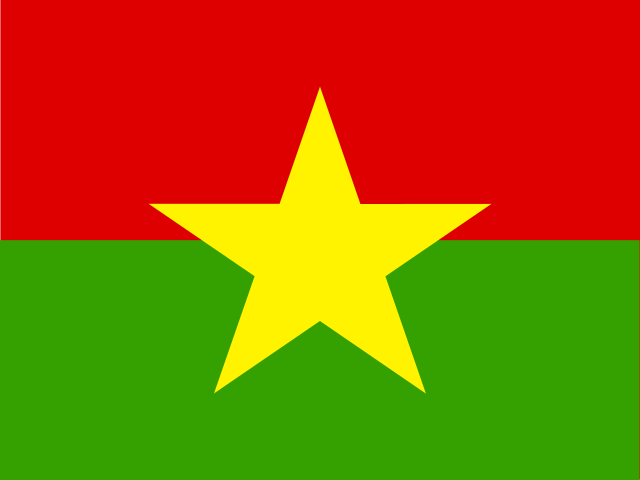 Burkina Faso
 Gambia
 Ghana
Ghana Guinea
 Guinea-Bissau
 Côte d'Ivoire
 Cabo Verde
 Liberia
 Mali
Mali Niger
Niger Nigeria
 Senegal
 Sierra Leone
 Togo
TogoEarlier Report Observations
Between 2018 and 2020, molasses production in ECOWAS grew steadily, driven by ongoing investment and modernization in the sugar industry. In Côte d’Ivoire, SUCRIVOIRE undertook a rehabilitation program for its integrated agricultural units, while government performance contracts with sugar companies aimed to improve competitiveness and output. These measures supported higher sugar production, which in turn increased molasses output as a by-product.
The market volume jumped sharply in 2021, reaching 231 thousand tons, as national sugar production in Côte d’Ivoire approached 206 thousand tons against a domestic need of 240 thousand tons. The government's price caps on sugar helped regulate the market and maintain consumer accessibility, indirectly supporting the molasses supply from expanded sugar processing. A slight dip followed in 2022, with volumes settling at 225 thousand tons.
By 2023, production stabilized around 225 thousand tons. In Senegal, authorities announced plans to build two new sugar plants in Casamance to break the monopoly of the Compagnie Sucrière Sénégalaise (CSS) and reduce import dependence. CSS itself held substantial sugar stocks and pursued investment programs to raise annual output, signaling continued regional focus on sugar—and consequently molasses—production capacity.
Table of content
- 1. Disclaimer
- 2. Terms of use of the report
- 3. Product codes in the statistical classifications used in the report
-
4. Key Market Indicators and Trends
-
4.1. Key Market Indicators
-
4.1.1. In kind
- 4.1.1.1. Production, 2018-2023
- 4.1.1.2. Imports, 2018-2024
- 4.1.1.3. Exports, 2018-2024
- 4.1.1.4. Market size, 2018-2023
-
4.1.2. In value
- 4.1.2.1. Production, 2018-2023
- 4.1.2.2. Imports, 2018-2024
- 4.1.2.3. Exports, 2018-2024
- 4.1.2.4. Market size, 2018-2023
-
4.1.1. In kind
- 4.2. Market Trends and Factors
-
4.1. Key Market Indicators
-
5. Production
-
5.1. Production in ECOWAS
- 5.1.1. Annual dynamics of production in ECOWAS in kind, 2018-2023, K t
-
5.2. Global production by Country, 2018-2023
- 5.2.1. Annual dynamics of production by macroregions in kind, 2018-2023, K t
- 5.2.2. Dynamics of production structure by macroregions in kind, 2018-2023
- 5.2.3. Annual dynamics of production by country in kind, 2018-2023, K t
- 5.2.4. Structure of production by countries in kind, 2018-2023
- 5.2.5. Dynamics of peoduction structure by countries in kind, 2018-2023
-
5.1. Production in ECOWAS
-
6. Imports
-
6.1. Imports (Direct Data*)
- 6.1.1. Imports - Total information
-
6.1.2. Imports in kind, t
- 6.1.2.1. Annual dynamics of product's imports to Benin in kind, 2018-2024, t
- 6.1.2.2. Dynamics of product's imports in kind to Benin by countries, 2018-2024, t
- 6.1.2.3. Structure of product's imports in kind by countries, 2018-2024
-
6.1.3. Imports in value, K $ US
- 6.1.3.1. Annual dynamics of product's imports to Benin in value, 2018-2024, K $ US
- 6.1.3.2. Dynamics of product's imports in value to Benin by countries, 2018-2024, K $ US
- 6.1.3.3. Structure of product's imports in value by countries, 2018-2024
-
6.1.4. Average price of product's imports, $ US/t
- 6.1.4.1. Annual dynamics of average price of product's imports to Benin, 2018-2024, $ US/t
- 6.1.4.2. Dynamics of average price of product's imports to Benin by countries, 2018-2024, $ US/t
-
6.2. Imports (Mirror Data)
- 6.2.1. Imports - Total information
-
6.2.2. Imports in kind, t
- 6.2.2.1. Annual dynamics of product's imports to Benin in kind, 2018-2024, t
- 6.2.2.2. Dynamics of product's imports in kind to Benin by countries, 2018-2024, t
- 6.2.2.3. Structure of product's imports in kind by countries, 2018-2024
-
6.2.3. Imports in value, K $ US
- 6.2.3.1. Annual dynamics of product's imports to Benin in value, 2018-2024, K $ US
- 6.2.3.2. Dynamics of product's imports in value to Benin by countries, 2018-2024, K $ US
- 6.2.3.3. Structure of product's imports in value by countries, 2018-2024
-
6.2.4. Average price of product's imports, $ US/t
- 6.2.4.1. Annual dynamics of average price of product's imports to Benin, 2018-2024, $ US/t
- 6.2.4.2. Dynamics of average price of product's imports to Benin by countries, 2018-2024, $ US/t
-
6.1. Imports (Direct Data*)
-
7. Exports
-
7.1. Exports (Direct Data*)
- 7.1.1. Exports - Total information
-
7.1.2. Exports in kind, t
- 7.1.2.1. Annual dynamics of product's exports from Benin in kind, 2018-2024, t
- 7.1.2.2. Dynamics of product's exports in kind from Benin by countries, 2018-2024, t
- 7.1.2.3. Structure of product's exports in kind by countries, 2018-2024
-
7.1.3. Exports in value, K $ US
- 7.1.3.1. Annual dynamics of product's exports from Benin in value, 2018-2024, K $ US
- 7.1.3.2. Dynamics of product's exports in value from Benin by countries, 2018-2024, K $ US
- 7.1.3.3. Structure of product's exports in value by countries, 2018-2024
-
7.1.4. Average price of product's exports, $ US/t
- 7.1.4.1. Annual dynamics of average price of product's exports from Benin, 2018-2024, $ US/t
- 7.1.4.2. Dynamics of average price of product's exports from Benin by countries, 2018-2024, $ US/t
-
7.2. Exports (Mirror Data)
- 7.2.1. Exports - Total information
-
7.2.2. Exports in kind, t
- 7.2.2.1. Annual dynamics of product's exports from Benin in kind, 2018-2024, t
- 7.2.2.2. Dynamics of product's exports in kind from Benin by countries, 2018-2024, t
- 7.2.2.3. Structure of product's exports in kind by countries, 2018-2024
-
7.2.3. Exports in value, K $ US
- 7.2.3.1. Annual dynamics of product's exports from Benin in value, 2018-2024, K $ US
- 7.2.3.2. Dynamics of product's exports in value from Benin by countries, 2018-2024, K $ US
- 7.2.3.3. Structure of product's exports in value by countries, 2018-2024
-
7.2.4. Average price of product's exports, $ US/t
- 7.2.4.1. Annual dynamics of average price of product's exports from Benin, 2018-2024, $ US/t
- 7.2.4.2. Dynamics of average price of product's exports from Benin by countries, 2018-2024, $ US/t
-
7.1. Exports (Direct Data*)
-
8. Trade balance
-
8.1. Trade balance (Direct Data)
- 8.1.1. In kind, t
- 8.1.2. In value, K $ US
-
8.2. Trade balance (Mirror Data)
- 8.2.1. In kind, t
- 8.2.2. In value, K $ US
-
8.1. Trade balance (Direct Data)
-
9. Top buying and selling countries, 2018-2024
-
9.1. Direct Data
- 9.1.1. Import in Value by Countries-buyers
- 9.1.2. Export in Value by Countries-suppliers
-
9.2. Mirror Data
- 9.2.1. Import in Value by Countries-buyers
- 9.2.2. Export in Value by Countries-suppliers
-
9.1. Direct Data
Production molasses in ECOWAS
In kind, 2017-2020, K t
Top producers of molasses, 2017-2020
World map of production of molasses, 2017-2020
ECOWAS has seen molasses production grow for the third year in a row. In 2020, the region produced 202.3 thousand tons of molasses, marking a modest 3.4% increase from the previous year. Looking at the period from 2017 to 2020, production rose by 14.2%, with an average annual growth rate of 4.5%.
Annual dynamics of production in ECOWAS in kind, 2017-2020, K t
| Parameter | 2018 | 2019 | 2020 | CAGR | |
|---|---|---|---|---|---|
| 1 | Change from last year | 5.8% | 4.3% | 3.4% | 4.5% |
In value, 2017-2020, K $ US
In 2020, the value of molasses output in ECOWAS reached 81 409 thousand US dollars, showing a dramatic 29.8% year-over-year rise. From 2017 to 2020, production value increased by 58.7%, with an average annual growth rate of 16.6%. The largest decline occurred in 2019, at 4.9%.
Annual dynamics of production in ECOWAS in value, 2017-2020, K $ US
| Parameter | 2018 | 2019 | 2020 | CAGR | |
|---|---|---|---|---|---|
| 1 | Change from last year | 28.6% | (4.9%) | 29.8% | 16.6% |
Exports molasses from ECOWAS
Exports in kind, t
The data shows irregular changes, pointing to a volatile market environment. Export volumes hit their lowest point in 2020 and peaked in 2017, with a 3.5-fold difference between these years. In 2020, ECOWAS exported 72 tons of molasses, a 53.1% drop from the previous year. The largest increase was recorded in 2019, at 28.3%.
Annual dynamics of product's exports from ECOWAS in kind, 2017-2020, t
| Parameter | 2018 | 2019 | 2020 | CAGR | |
|---|---|---|---|---|---|
| 1 | Change from last year | (52.8%) | 28.3% | (53.1%) | (34.3%) |
Structure of product's exports in kind by countries, 2017-2020
World map of product's exports from ECOWAS in kind, 2017-2020
Exports in value, K $ US
In 2020, ECOWAS exported 29 thousand US dollars worth of molasses, which is 41.2% lower than in 2019. Over the period from 2017 to 2020, exports fell by 60.6%, with an average annual decline of 26.7%. The largest decrease was in 2018, at 42.7%, while the biggest increase was in 2019, at 16.9%.
Annual dynamics of product's exports from ECOWAS in value, 2017-2020, K $ US
| Parameter | 2018 | 2019 | 2020 | CAGR | |
|---|---|---|---|---|---|
| 1 | Change from last year | (42.7%) | 16.9% | (41.2%) | (26.7%) |
From 2017 to 2020, the Netherlands, Portugal, and Bunkers were the core markets for ECOWAS molasses exports in value terms. The Netherlands accounted for 10.3% of exports, Portugal for 3.0%, and Bunkers for 1.0%, together making up 14.4% of total export flows.
Structure of product's exports in value by countries, 2017-2020
World map of product's exports from ECOWAS in value, 2017-2020
Imports molasses to ECOWAS
Imports in kind, t
After two years of decline, molasses import volumes in ECOWAS have increased. In 2020, imports reached 1 411 tons, a 31.4% rise from the year before. Between 2017 and 2020, imports decreased by 44.5%, equating to an average annual rate of 17.8%. The lowest volume was in 2019, at 1 074 tons, and the largest decline was in 2018, at 50.7%.
Annual dynamics of product's imports to ECOWAS in kind, 2017-2020, t
| Parameter | 2018 | 2019 | 2020 | CAGR | |
|---|---|---|---|---|---|
| 1 | Change from last year | (50.7%) | (14.2%) | 31.4% | (17.8%) |
From 2017 to 2020, India, China, and Morocco were the key partners for molasses imports to ECOWAS in volume terms. India contributed 33.9% of imports, China 10.1%, and Morocco 7.1%, jointly representing 51.1% of total import flows.
Structure of product's imports in kind by countries, 2017-2020
World map of product's imports to ECOWAS in kind, 2017-2020
Imports in value, K $ US
Cross-border shipments of molasses to ECOWAS have increased for the third consecutive year. In 2020, imports totaled 1 741 thousand US dollars, a 112.9% jump from the previous year. Over the period from 2017 to 2020, imports surged by 162.2%, with an average annual growth rate of 37.9%.
Annual dynamics of product's imports to ECOWAS in value, 2017-2020, K $ US
| Parameter | 2018 | 2019 | 2020 | CAGR | |
|---|---|---|---|---|---|
| 1 | Change from last year | 0.3% | 22.8% | 112.9% | 37.9% |
Between 2017 and 2020, Indonesia, India, and China remained the principal suppliers of molasses to ECOWAS in value terms. Indonesia accounted for 25.3% of imports, India for 19.9%, and China for 15.6%, together making up 60.9% of total import value.
Structure of product's imports in value by countries, 2017-2020
World map of product's imports to ECOWAS in value, 2017-2020
Related Reports

Molasses market in South-eastern Asia
2026-03-29
2026-03-29
2026-03-29
Molasses market in South America
2026-03-29


Sucrose in solid form market in ECOWAS
2026-03-28

Fruit and vegetable juices market in ECOWAS
2026-03-29

Why Choose Us?
Only Verified Data
No Hidden Costs or Separate Fees
Smarter Subscription Pricing
Contact Our Team
Submit your inquiry using the form below — our team will get back to you within 24 hours.