





"Eastern Europe (including Northern Asia)" region includes following countries:
 Bulgaria
 Belarus
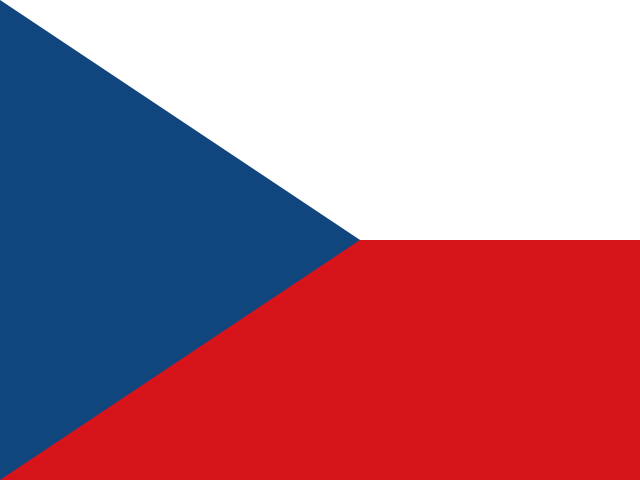 Czechia
 Hungary
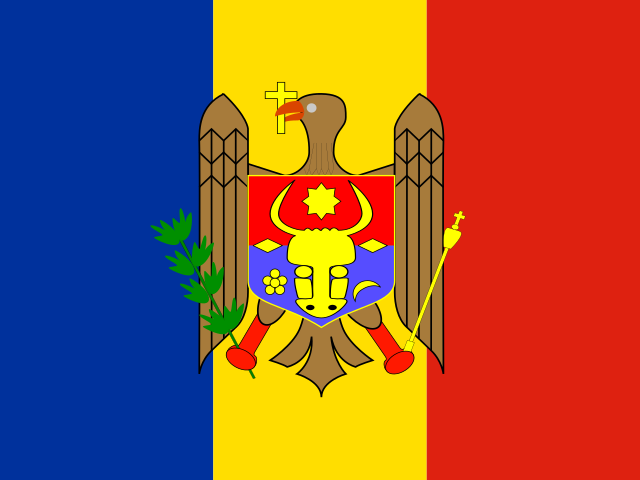 Moldova
 Poland
 Romania
 Russia
 Slovakia
 Ukraine
Earlier Report Observations
Between 2018 and 2023, the milk powder market in Eastern Europe was shaped by trade policies and production shifts. The 2018 ban on imports from Belarus created supply chain disruptions, while ongoing import substitution stimulated domestic manufacturing. This, coupled with rising raw milk production and growing internal demand, supported market expansion into 2019. The COVID-19 pandemic and associated global logistics constraints then moderated consumption in 2020, despite resilient local output.
State food security policies and rising input costs defined the market from 2021 onward. Increased expenses for feed, energy, and labor pushed up producer prices. Continued import restrictions and export promotion measures further bolstered domestic production, though varying trade volumes contributed to market size volatility, with a peak in 2022 followed by a contraction in 2023.
Table of content
- 1. Disclaimer
- 2. Terms of use of the report
- 3. Product codes in the statistical classifications used in the report
-
4. Key Market Indicators and Trends
-
4.1. Key Market Indicators
-
4.1.1. In kind
- 4.1.1.1. Production, 2018-2023
- 4.1.1.2. Imports, 2018-2024
- 4.1.1.3. Exports, 2018-2024
- 4.1.1.4. Market size, 2018-2023
-
4.1.1. In kind
- 4.2. Market Trends and Factors
-
4.1. Key Market Indicators
-
5. Production
-
5.1. Production in Eastern Europe (including Northern Asia)
- 5.1.1. Annual dynamics of production in Eastern Europe (including Northern Asia) in kind, 2018-2023, K t
-
5.2. Global production by Country, 2018-2023
- 5.2.1. Annual dynamics of production by macroregions in kind, 2018-2023, K t
- 5.2.2. Dynamics of production structure by macroregions in kind, 2018-2023
- 5.2.3. Annual dynamics of production by country in kind, 2018-2023, K t
- 5.2.4. Structure of production by countries in kind, 2018-2023
- 5.2.5. Dynamics of peoduction structure by countries in kind, 2018-2023
-
5.1. Production in Eastern Europe (including Northern Asia)
-
6. Imports
-
6.1. Imports (Direct Data*)
- 6.1.1. Imports - Total information
-
6.1.2. Imports in kind, K t
- 6.1.2.1. Annual dynamics of product's imports to Bulgaria in kind, 2018-2024, K t
- 6.1.2.2. Dynamics of product's imports in kind to Bulgaria by countries, 2018-2024, K t
- 6.1.2.3. Structure of product's imports in kind by countries, 2018-2024
-
6.1.3. Imports in value, M $ US
- 6.1.3.1. Annual dynamics of product's imports to Bulgaria in value, 2018-2024, M $ US
- 6.1.3.2. Dynamics of product's imports in value to Bulgaria by countries, 2018-2024, M $ US
- 6.1.3.3. Structure of product's imports in value by countries, 2018-2024
-
6.1.4. Average price of product's imports, $ US/t
- 6.1.4.1. Annual dynamics of average price of product's imports to Bulgaria, 2018-2024, $ US/t
- 6.1.4.2. Dynamics of average price of product's imports to Bulgaria by countries, 2018-2024, $ US/t
-
6.2. Imports (Mirror Data)
- 6.2.1. Imports - Total information
-
6.2.2. Imports in kind, K t
- 6.2.2.1. Annual dynamics of product's imports to Bulgaria in kind, 2018-2024, K t
- 6.2.2.2. Dynamics of product's imports in kind to Bulgaria by countries, 2018-2024, K t
- 6.2.2.3. Structure of product's imports in kind by countries, 2018-2024
-
6.2.3. Imports in value, M $ US
- 6.2.3.1. Annual dynamics of product's imports to Bulgaria in value, 2018-2024, M $ US
- 6.2.3.2. Dynamics of product's imports in value to Bulgaria by countries, 2018-2024, M $ US
- 6.2.3.3. Structure of product's imports in value by countries, 2018-2024
-
6.2.4. Average price of product's imports, $ US/t
- 6.2.4.1. Annual dynamics of average price of product's imports to Bulgaria, 2018-2024, $ US/t
- 6.2.4.2. Dynamics of average price of product's imports to Bulgaria by countries, 2018-2024, $ US/t
-
6.1. Imports (Direct Data*)
-
7. Exports
-
7.1. Exports (Direct Data*)
- 7.1.1. Exports - Total information
-
7.1.2. Exports in kind, K t
- 7.1.2.1. Annual dynamics of product's exports from Bulgaria in kind, 2018-2024, K t
- 7.1.2.2. Dynamics of product's exports in kind from Bulgaria by countries, 2018-2024, K t
- 7.1.2.3. Structure of product's exports in kind by countries, 2018-2024
-
7.1.3. Exports in value, M $ US
- 7.1.3.1. Annual dynamics of product's exports from Bulgaria in value, 2018-2024, M $ US
- 7.1.3.2. Dynamics of product's exports in value from Bulgaria by countries, 2018-2024, M $ US
- 7.1.3.3. Structure of product's exports in value by countries, 2018-2024
-
7.1.4. Average price of product's exports, $ US/t
- 7.1.4.1. Annual dynamics of average price of product's exports from Bulgaria, 2018-2024, $ US/t
- 7.1.4.2. Dynamics of average price of product's exports from Bulgaria by countries, 2018-2024, $ US/t
-
7.2. Exports (Mirror Data)
- 7.2.1. Exports - Total information
-
7.2.2. Exports in kind, K t
- 7.2.2.1. Annual dynamics of product's exports from Bulgaria in kind, 2018-2024, K t
- 7.2.2.2. Dynamics of product's exports in kind from Bulgaria by countries, 2018-2024, K t
- 7.2.2.3. Structure of product's exports in kind by countries, 2018-2024
-
7.2.3. Exports in value, M $ US
- 7.2.3.1. Annual dynamics of product's exports from Bulgaria in value, 2018-2024, M $ US
- 7.2.3.2. Dynamics of product's exports in value from Bulgaria by countries, 2018-2024, M $ US
- 7.2.3.3. Structure of product's exports in value by countries, 2018-2024
-
7.2.4. Average price of product's exports, $ US/t
- 7.2.4.1. Annual dynamics of average price of product's exports from Bulgaria, 2018-2024, $ US/t
- 7.2.4.2. Dynamics of average price of product's exports from Bulgaria by countries, 2018-2024, $ US/t
-
7.1. Exports (Direct Data*)
-
8. Trade balance
-
8.1. Trade balance (Direct Data)
- 8.1.1. In kind, K t
- 8.1.2. In value, M $ US
-
8.2. Trade balance (Mirror Data)
- 8.2.1. In kind, K t
- 8.2.2. In value, M $ US
-
8.1. Trade balance (Direct Data)
-
9. Top buying and selling countries, 2018-2024
-
9.1. Direct Data
- 9.1.1. Import in Value by Countries-buyers
- 9.1.2. Export in Value by Countries-suppliers
-
9.2. Mirror Data
- 9.2.1. Import in Value by Countries-buyers
- 9.2.2. Export in Value by Countries-suppliers
-
9.1. Direct Data
Production milk powder in Eastern Europe (including Northern Asia)
In kind, 2017-2020, K t
Top producers of milk powder, 2017-2020
World map of production of milk powder, 2017-2020
In Eastern Europe (including Northern Asia), milk powder production reached 637.0 thousand tonnes in 2020, marking a 3.2% decrease compared to the previous year. Looking at the period from 2017 to 2020, overall production declined by 2.9%, with an average annual growth rate of -1.0%. The lowest production level was recorded in 2018 at 631.0 thousand tonnes, while the highest was in 2019 at 657.8 thousand tonnes. The most significant drop occurred in 2018 with a 3.8% decrease, whereas the largest increase was in 2019 with a 4.2% rise.
Annual dynamics of production in Eastern Europe (including Northern Asia) in kind, 2017-2020, K t
| Parameter | 2018 | 2019 | 2020 | CAGR | |
|---|---|---|---|---|---|
| 1 | Change from last year | (3.8%) | 4.2% | (3.2%) | (1.0%) |
In value, 2017-2020, M $ US
The value of milk powder output in Eastern Europe (including Northern Asia) was $1,661 million US in 2020, showing no change from 2019. Over the 2017-2020 period, production value grew by 2.2%, translating to an average annual increase of 0.7%. The lowest value was $1,369 million US in 2018, and the highest was $1,662 million US in 2019. The sharpest decline happened in 2018 with a 15.8% drop, while the most notable increase was in 2019 with a 21.4% surge.
Annual dynamics of production in Eastern Europe (including Northern Asia) in value, 2017-2020, M $ US
| Parameter | 2018 | 2019 | 2020 | CAGR | |
|---|---|---|---|---|---|
| 1 | Change from last year | (15.8%) | 21.4% | (0.1%) | 0.7% |
Exports milk powder from Eastern Europe (including Northern Asia)
Exports in kind, K t
Milk powder exports from Eastern Europe (including Northern Asia) fell for the second year in a row. In 2020, exports amounted to 325.1 thousand tonnes, down 1.9% from the previous year. From 2017 to 2020, exports overall increased by 8.3%, with an average annual growth rate of 2.7%. The peak export volume was 343.7 thousand tonnes in 2018. The largest decrease occurred in 2019 with a 3.5% drop, while the biggest increase was in 2018 with a 14.5% rise.
Annual dynamics of product's exports from Eastern Europe (including Northern Asia) in kind, 2017-2020, K t
| Parameter | 2018 | 2019 | 2020 | CAGR | |
|---|---|---|---|---|---|
| 1 | Change from last year | 14.5% | (3.5%) | (1.9%) | 2.7% |
Between 2017 and 2020, the top buyers of milk powder from Eastern Europe (including Northern Asia) were Algeria (11.2% of exports in volume), Kazakhstan (7.6%), and China (6.3%). Together, these three countries accounted for 25.1% of total exports, reflecting a diverse market with many smaller partners.
Structure of product's exports in kind by countries, 2017-2020
World map of product's exports from Eastern Europe (including Northern Asia) in kind, 2017-2020
Exports in value, M $ US
Cross-border shipments of milk powder from Eastern Europe (including Northern Asia) rose for the third consecutive year. In 2020, exports were valued at $847.5 million US, a slight increase of 1.2% compared to 2019. From 2017 to 2020, export value grew by 14%, equivalent to an annualized rate of 4.5%.
Annual dynamics of product's exports from Eastern Europe (including Northern Asia) in value, 2017-2020, M $ US
| Parameter | 2018 | 2019 | 2020 | CAGR | |
|---|---|---|---|---|---|
| 1 | Change from last year | 0.3% | 12.4% | 1.2% | 4.5% |
From 2017 to 2020, milk powder exports from Eastern Europe (including Northern Asia) in value terms were widely distributed across markets. Algeria (10.6% of export value), Kazakhstan (7.2%), and China (5.8%) together made up just 23.6% of total flows, indicating a broad spread among numerous trading partners.
Structure of product's exports in value by countries, 2017-2020
World map of product's exports from Eastern Europe (including Northern Asia) in value, 2017-2020
Imports milk powder to Eastern Europe (including Northern Asia)
Imports in kind, K t
In 2020, Eastern Europe (including Northern Asia) imported 200.6 thousand tonnes of milk powder, a sharp decline of 19.4% from the previous year. Over the 2017-2020 period, imports decreased by 21.3%, with an average annual drop of 7.7%. The lowest import volume was 197.1 thousand tonnes in 2018. The most significant decrease was in 2018 with a 22.7% fall, while the largest increase was in 2019 with a 26.4% rise.
Annual dynamics of product's imports to Eastern Europe (including Northern Asia) in kind, 2017-2020, K t
| Parameter | 2018 | 2019 | 2020 | CAGR | |
|---|---|---|---|---|---|
| 1 | Change from last year | (22.7%) | 26.4% | (19.4%) | (7.7%) |
During 2017-2020, the main suppliers of milk powder to Eastern Europe (including Northern Asia) were Germany (14.5% of imports in volume), Uruguay (3.9%), and France (3.6%). These three countries together accounted for 22.0% of total imports, highlighting a market with many smaller sources.
Structure of product's imports in kind by countries, 2017-2020
World map of product's imports to Eastern Europe (including Northern Asia) in kind, 2017-2020
Imports in value, M $ US
In 2020, the value of milk powder imports into Eastern Europe (including Northern Asia) was $569.3 million US, representing a strong drop of 13.8% compared to the previous year. From 2017 to 2020, import value fell by 14.9%, with an average annual decrease of 5.2%. The lowest value was $474.4 million US in 2018. The steepest decline occurred in 2018 with a 29.1% fall, while the highest increase was in 2019 with a 39.2% rise.
Annual dynamics of product's imports to Eastern Europe (including Northern Asia) in value, 2017-2020, M $ US
| Parameter | 2018 | 2019 | 2020 | CAGR | |
|---|---|---|---|---|---|
| 1 | Change from last year | (29.1%) | 39.2% | (13.8%) | (5.2%) |
Between 2017 and 2020, milk powder imports into Eastern Europe (including Northern Asia) in value terms were spread across numerous countries. Germany (14.8% of import value), Uruguay (4.9%), and France (3.7%) jointly accounted for only 23.4% of total flows, underscoring the diversity of suppliers.
Structure of product's imports in value by countries, 2017-2020
World map of product's imports to Eastern Europe (including Northern Asia) in value, 2017-2020
Related Reports





In-depth market research on this product
Global Skimmed Milk Powder Market 2021–2031: Size, Share, Trends and Forecast
Global market report: size, trends and forecast to 2031 · 192 pages
Global Whole Milk Powder Market 2021–2031: Size, Share, Trends and Forecast
Global market report: size, trends and forecast to 2031 · 214 pages
Why Choose Us?
Only Verified Data
No Hidden Costs or Separate Fees
Smarter Subscription Pricing
Contact Our Team
Submit your inquiry using the form below — our team will get back to you within 24 hours.