






"Latin America and the Caribbean" region includes following countries:
 Argentina
 Bolivia
 Brazil
 Chile
Chile Colombia
 Ecuador
 Falkland Islands (Malvinas)
 French Guiana
 Guyana
 Paraguay
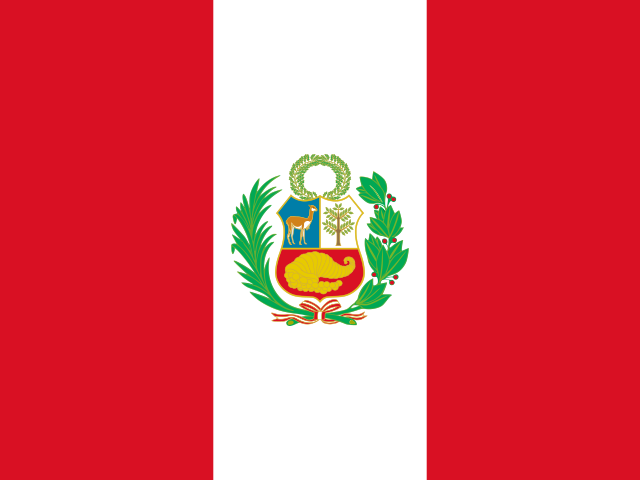 Peru
Peru Suriname
 Uruguay
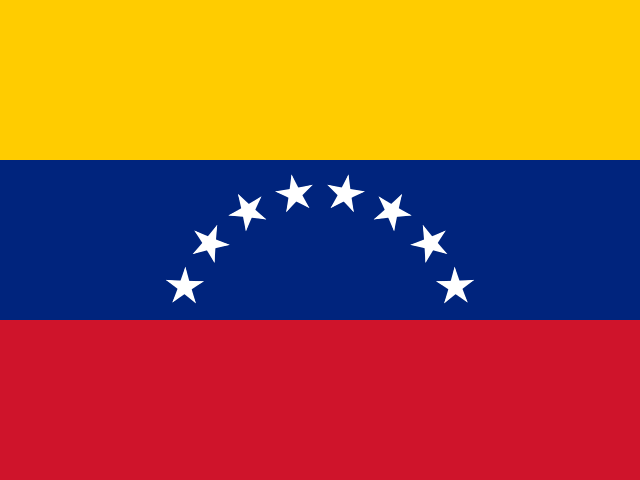 Venezuela
 Belize
 Costa Rica
 El Salvador
 Guatemala
 Honduras
 Mexico
 Nicaragua
 Panama
 Antigua and Barbuda
 the Bahamas
 Barbados
 British Virgin Islands
 Cayman Islands
 Cuba
Cuba Dominica
 Dominican Republic
 Grenada
 Guadeloupe
 Haiti
Haiti Jamaica
 Martinique
 Montserrat
 Curacao
 Aruba
Aruba Saint Maarten (Dutch part)
 Bonaire
 Puerto Rico
 Saint Kitts and Nevis
 Anguilla
 Saint Lucia
 Saint-Martin (French Part)
 Saint Vincent and the Grenadines
 Trinidad and Tobago
 Turks and Caicos Islands
 United States Virgin Islands
Earlier Report Observations
The market volume for in-shell almonds in Latin America and the Caribbean grew from 41,896 t in 2018 to 50,150 t in 2021. This expansion was initially driven by increased production capacity, including the acquisition of 477 acres by the North State Hulling cooperative, and efforts to open new export markets. Technological advancements in precision irrigation improved water efficiency in 2019, supporting sustainable output. Despite the onset of the COVID-19 pandemic and trade disputes in 2020, which disrupted supply chains, record almond yields from high per-acre output ensured continued growth in available supply.
Market growth continued into 2021, reaching 50,150 t, as persistent container shipping disruptions suppressed almond exports, making more product available for domestic consumption. By 2022, the market volume stabilized at 50,253 t. During this period, a shift in consumer preference toward packaged almond products for freshness and hygiene emerged, supported by promotional campaigns that highlighted almonds as healthy snacks. However, water policy challenges began to pose concerns for long-term production sustainability.
In 2023, the market volume declined to 48,050 t. This contraction was primarily due to increasing production costs stemming from labor shortages, high energy prices, and rising fertilizer expenses. Global supply chain disruptions and climatic variability in major producing regions further constrained the market. Factors such as investments in digital platforms for distribution and regulatory focus on water management continue to shape the market environment.
Table of content
- 1. Disclaimer
- 2. Terms of use of the report
- 3. Product codes in the statistical classifications used in the report
-
4. Key Market Indicators and Trends
-
4.1. Key Market Indicators
-
4.1.1. In kind
- 4.1.1.1. Production, 2018-2023
- 4.1.1.2. Imports, 2018-2024
- 4.1.1.3. Exports, 2018-2024
- 4.1.1.4. Market size, 2018-2023
-
4.1.1. In kind
- 4.2. Market Trends and Factors
-
4.1. Key Market Indicators
-
5. Production
-
5.1. Production in Latin America and the Caribbean
- 5.1.1. Annual dynamics of production in Latin America and the Caribbean in kind, 2018-2023, t
-
5.2. Global production by Country, 2018-2023
- 5.2.1. Annual dynamics of production by macroregions in kind, 2018-2023, t
- 5.2.2. Dynamics of production structure by macroregions in kind, 2018-2023
- 5.2.3. Annual dynamics of production by country in kind, 2018-2023, t
- 5.2.4. Structure of production by countries in kind, 2018-2023
- 5.2.5. Dynamics of peoduction structure by countries in kind, 2018-2023
-
5.1. Production in Latin America and the Caribbean
-
6. Exports
-
6.1. Exports (Direct Data*)
- 6.1.1. Exports - Total information
-
6.1.2. Exports in kind, t
- 6.1.2.1. Annual dynamics of product's exports from Argentina in kind, 2018-2024, t
- 6.1.2.2. Dynamics of product's exports in kind from Argentina by countries, 2018-2024, t
- 6.1.2.3. Structure of product's exports in kind by countries, 2018-2024
-
6.1.3. Exports in value, K $ US
- 6.1.3.1. Annual dynamics of product's exports from Argentina in value, 2018-2024, K $ US
- 6.1.3.2. Dynamics of product's exports in value from Argentina by countries, 2018-2024, K $ US
- 6.1.3.3. Structure of product's exports in value by countries, 2018-2024
-
6.1.4. Average price of product's exports, $ US/kg
- 6.1.4.1. Annual dynamics of average price of product's exports from Argentina, 2018-2024, $ US/kg
- 6.1.4.2. Dynamics of average price of product's exports from Argentina by countries, 2018-2024, $ US/kg
-
6.2. Exports (Mirror Data)
- 6.2.1. Exports - Total information
-
6.2.2. Exports in kind, t
- 6.2.2.1. Annual dynamics of product's exports from Argentina in kind, 2018-2024, t
- 6.2.2.2. Dynamics of product's exports in kind from Argentina by countries, 2018-2024, t
- 6.2.2.3. Structure of product's exports in kind by countries, 2018-2024
-
6.2.3. Exports in value, K $ US
- 6.2.3.1. Annual dynamics of product's exports from Argentina in value, 2018-2024, K $ US
- 6.2.3.2. Dynamics of product's exports in value from Argentina by countries, 2018-2024, K $ US
- 6.2.3.3. Structure of product's exports in value by countries, 2018-2024
-
6.2.4. Average price of product's exports, $ US/kg
- 6.2.4.1. Annual dynamics of average price of product's exports from Argentina, 2018-2024, $ US/kg
- 6.2.4.2. Dynamics of average price of product's exports from Argentina by countries, 2018-2024, $ US/kg
-
6.1. Exports (Direct Data*)
-
7. Imports
-
7.1. Imports (Direct Data*)
- 7.1.1. Imports - Total information
-
7.1.2. Imports in kind, t
- 7.1.2.1. Annual dynamics of product's imports to Argentina in kind, 2018-2024, t
- 7.1.2.2. Dynamics of product's imports in kind to Argentina by countries, 2018-2024, t
- 7.1.2.3. Structure of product's imports in kind by countries, 2018-2024
-
7.1.3. Imports in value, K $ US
- 7.1.3.1. Annual dynamics of product's imports to Argentina in value, 2018-2024, K $ US
- 7.1.3.2. Dynamics of product's imports in value to Argentina by countries, 2018-2024, K $ US
- 7.1.3.3. Structure of product's imports in value by countries, 2018-2024
-
7.1.4. Average price of product's imports, $ US/kg
- 7.1.4.1. Annual dynamics of average price of product's imports to Argentina, 2018-2024, $ US/kg
- 7.1.4.2. Dynamics of average price of product's imports to Argentina by countries, 2018-2024, $ US/kg
-
7.2. Imports (Mirror Data)
- 7.2.1. Imports - Total information
-
7.2.2. Imports in kind, t
- 7.2.2.1. Annual dynamics of product's imports to Argentina in kind, 2018-2024, t
- 7.2.2.2. Dynamics of product's imports in kind to Argentina by countries, 2018-2024, t
- 7.2.2.3. Structure of product's imports in kind by countries, 2018-2024
-
7.2.3. Imports in value, K $ US
- 7.2.3.1. Annual dynamics of product's imports to Argentina in value, 2018-2024, K $ US
- 7.2.3.2. Dynamics of product's imports in value to Argentina by countries, 2018-2024, K $ US
- 7.2.3.3. Structure of product's imports in value by countries, 2018-2024
-
7.2.4. Average price of product's imports, $ US/kg
- 7.2.4.1. Annual dynamics of average price of product's imports to Argentina, 2018-2024, $ US/kg
- 7.2.4.2. Dynamics of average price of product's imports to Argentina by countries, 2018-2024, $ US/kg
-
7.1. Imports (Direct Data*)
-
8. Trade balance
-
8.1. Trade balance (Direct Data)
- 8.1.1. In kind, t
- 8.1.2. In value, K $ US
-
8.2. Trade balance (Mirror Data)
- 8.2.1. In kind, t
- 8.2.2. In value, K $ US
-
8.1. Trade balance (Direct Data)
-
9. Top buying and selling countries, 2018-2024
-
9.1. Direct Data
- 9.1.1. Import in Value by Countries-buyers
- 9.1.2. Export in Value by Countries-suppliers
-
9.2. Mirror Data
- 9.2.1. Import in Value by Countries-buyers
- 9.2.2. Export in Value by Countries-suppliers
-
9.1. Direct Data
Production in-shell almonds in Latin America and the Caribbean
In kind, 2017-2020, t
Top producers of in-shell almonds, 2017-2020
World map of production of in-shell almonds, 2017-2020
In-shell almond production in Latin America and the Caribbean has increased for the third consecutive year. In 2020, the region produced 46 003 tonnes of in-shell almonds, marking a gradual rise of 6.2% compared to 2019. Over the period from 2017 to 2020, production grew by 23.2%, with a compound annual growth rate of 7.2%.
Annual dynamics of production in Latin America and the Caribbean in kind, 2017-2020, t
| Parameter | 2018 | 2019 | 2020 | CAGR | |
|---|---|---|---|---|---|
| 1 | Change from last year | 11.1% | 4.3% | 6.2% | 7.2% |
In value, 2017-2020, M $ US
In 2020, the output of in-shell almonds in Latin America and the Caribbean was valued at 241.0 million US dollars, representing a 2.6% increase compared to 2019. Between 2017 and 2020, production value rose by 17.2%, equating to an annualized growth rate of 5.4%. The highest value was recorded in 2018 at 242.2 million US dollars, while the largest decline occurred in 2019 with a 3.0% drop. The most significant increase was seen in 2018, with a 17.8% rise.
Annual dynamics of production in Latin America and the Caribbean in value, 2017-2020, M $ US
| Parameter | 2018 | 2019 | 2020 | CAGR | |
|---|---|---|---|---|---|
| 1 | Change from last year | 17.8% | (3.0%) | 2.6% | 5.4% |
Exports in-shell almonds from Latin America and the Caribbean
Exports in kind, t
The data reveals irregular changes, indicating a volatile market environment. Import levels fluctuated significantly, with a 2.6-fold difference between the low of 2020 and the high of 2019. In 2020, Latin America and the Caribbean exported 93.4 tonnes of in-shell almonds, down by 61.1% compared to the previous year. The maximum volume was recorded in 2019 at 240.0 tonnes, and the largest increase occurred in 2018 with an 83.6% rise.
Annual dynamics of product's exports from Latin America and the Caribbean in kind, 2017-2020, t
| Parameter | 2018 | 2019 | 2020 | CAGR | |
|---|---|---|---|---|---|
| 1 | Change from last year | 83.6% | 25.8% | (61.1%) | (3.5%) |
From 2017 to 2020, Italy, Spain, and India were the principal destinations for in-shell almond exports in kind. Italy accounted for 31.4% of exports, Spain for 15.1%, and India for 10.5%, jointly representing 57.1% of total export flows.
Structure of product's exports in kind by countries, 2017-2020
World map of product's exports from Latin America and the Caribbean in kind, 2017-2020
Exports in value, K $ US
There were noticeable fluctuations in market performance during this period. Exports varied by 2.7 times, from a low in 2020 to a high in 2019. In 2020, the value of in-shell almond exports from Latin America and the Caribbean stood at 490 thousand US dollars, which is 62.4% less compared to 2019. The maximum value was recorded in 2019 at 1 301 thousand US dollars, and the largest increase was in 2018 with a 94.6% rise.
Annual dynamics of product's exports from Latin America and the Caribbean in value, 2017-2020, K $ US
| Parameter | 2018 | 2019 | 2020 | CAGR | |
|---|---|---|---|---|---|
| 1 | Change from last year | 94.6% | 16.9% | (62.4%) | (5.1%) |
Over the period from 2017 to 2020, Italy, Spain, and India remained the leading destinations for in-shell almond exports in value terms. Italy held a 29.3% share, Spain 14.0%, and India 9.6%, together accounting for 52.9% of total export flows.
Structure of product's exports in value by countries, 2017-2020
World map of product's exports from Latin America and the Caribbean in value, 2017-2020
Imports in-shell almonds to Latin America and the Caribbean
Imports in kind, t
In-shell almond deliveries to Latin America and the Caribbean declined for the third consecutive year. In 2020, imports were recorded at 420.1 tonnes, which is 16.5% less compared to the previous year. Over the period from 2017 to 2020, imports decreased by 34.7%, with a compound annual decline rate of 13.3%.
Annual dynamics of product's imports to Latin America and the Caribbean in kind, 2017-2020, t
| Parameter | 2018 | 2019 | 2020 | CAGR | |
|---|---|---|---|---|---|
| 1 | Change from last year | (11.7%) | (11.4%) | (16.5%) | (13.3%) |
From 2017 to 2020, the United States, Portugal, and Spain continued to be the main suppliers of in-shell almonds to Latin America and the Caribbean. The United States accounted for 34.3% of imports in kind, Portugal for 4.4%, and Spain for 1.4%, jointly forming 40.1% of total imports.
Structure of product's imports in kind by countries, 2017-2020
World map of product's imports to Latin America and the Caribbean in kind, 2017-2020
Imports in value, K $ US
Cross-border shipments of in-shell almonds to Latin America and the Caribbean declined for the third consecutive year. In 2020, imports stood at 1 995 thousand US dollars, showing a dramatic decline of 27.7% compared to 2019. Between 2017 and 2020, imports decreased by 43.4%, equating to an annualized decline rate of 17.3%.
Annual dynamics of product's imports to Latin America and the Caribbean in value, 2017-2020, K $ US
| Parameter | 2018 | 2019 | 2020 | CAGR | |
|---|---|---|---|---|---|
| 1 | Change from last year | (7.4%) | (15.5%) | (27.7%) | (17.3%) |
In the period from 2017 to 2020, the country structure of in-shell almond imports in value terms was strongly focused on the United States, whose share reached 70.9% of total flows, with other partners accounting for the remaining volume.
Structure of product's imports in value by countries, 2017-2020
World map of product's imports to Latin America and the Caribbean in value, 2017-2020
Related Reports

In-shell almonds market in Tunisia
2026-03-28
In-shell almonds market in India
2026-03-28
In-shell almonds market in Americas
2026-03-28
In-shell almonds market in Asia
2026-03-28




Why Choose Us?
Only Verified Data
No Hidden Costs or Separate Fees
Smarter Subscription Pricing
Contact Our Team
Submit your inquiry using the form below — our team will get back to you within 24 hours.