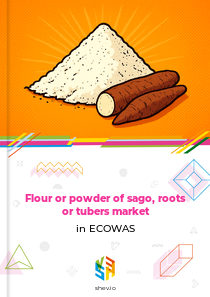







"ECOWAS" region includes following countries:
 Benin
Benin Burkina Faso
 Gambia
 Ghana
Ghana Guinea
 Guinea-Bissau
 Côte d'Ivoire
 Cabo Verde
 Liberia
 Mali
Mali Niger
Niger Nigeria
 Senegal
 Sierra Leone
 Togo
TogoEarlier Report Observations
The market volume for flour or powder of sago, roots or tubers in ECOWAS grew consistently from 3.2 million tons in 2018 to over 5.5 million tons by 2023. The most pronounced increase occurred in 2020, when the market expanded by more than 1.7 million tons, representing a surge of about 50% compared to the previous year. This step-change established a new, higher baseline for the market.
Following the 2020 surge, annual growth continued at a more measured pace through 2023. Global factors began to influence the regional market more visibly. In 2022, worldwide exports of similar starchy flours grew by 20%, with Nigeria standing out as a significant importer within ECOWAS, which supported import flows into the region. Furthermore, enduring shifts in global consumer preferences toward gluten-free and plant-based food products have underpinned demand for these traditional flours.
The market's trajectory is also set against broader agricultural supply chain considerations. Factors such as climate-related challenges affecting cassava root quality and availability, along with the need for investment in processing equipment, represent ongoing conditions that can influence production volumes and costs within the region.
Table of content
- 1. Disclaimer
- 2. Terms of use of the report
- 3. Product codes in the statistical classifications used in the report
-
4. Key Market Indicators and Trends
-
4.1. Key Market Indicators
-
4.1.1. In kind
- 4.1.1.1. Production, 2018-2023
- 4.1.1.2. Imports, 2018-2024
- 4.1.1.3. Exports, 2018-2024
- 4.1.1.4. Market size, 2018-2023
-
4.1.1. In kind
- 4.2. Market Trends and Factors
-
4.1. Key Market Indicators
-
5. Production
-
5.1. Production in ECOWAS
- 5.1.1. Annual dynamics of production in ECOWAS in kind, 2018-2023, K t
-
5.2. Global production by Country, 2018-2023
- 5.2.1. Annual dynamics of production by macroregions in kind, 2018-2023, K t
- 5.2.2. Dynamics of production structure by macroregions in kind, 2018-2023
- 5.2.3. Annual dynamics of production by country in kind, 2018-2023, K t
- 5.2.4. Structure of production by countries in kind, 2018-2023
- 5.2.5. Dynamics of peoduction structure by countries in kind, 2018-2023
-
5.1. Production in ECOWAS
-
6. Imports
-
6.1. Imports (Direct Data*)
- 6.1.1. Imports - Total information
-
6.1.2. Imports in kind, t
- 6.1.2.1. Annual dynamics of product's imports to Benin in kind, 2018-2024, t
- 6.1.2.2. Dynamics of product's imports in kind to Benin by countries, 2018-2024, t
- 6.1.2.3. Structure of product's imports in kind by countries, 2018-2024
-
6.1.3. Imports in value, K $ US
- 6.1.3.1. Annual dynamics of product's imports to Benin in value, 2018-2024, K $ US
- 6.1.3.2. Dynamics of product's imports in value to Benin by countries, 2018-2024, K $ US
- 6.1.3.3. Structure of product's imports in value by countries, 2018-2024
-
6.1.4. Average price of product's imports, $ US/t
- 6.1.4.1. Annual dynamics of average price of product's imports to Benin, 2018-2024, $ US/t
- 6.1.4.2. Dynamics of average price of product's imports to Benin by countries, 2018-2024, $ US/t
-
6.2. Imports (Mirror Data)
- 6.2.1. Imports - Total information
-
6.2.2. Imports in kind, t
- 6.2.2.1. Annual dynamics of product's imports to Benin in kind, 2018-2024, t
- 6.2.2.2. Dynamics of product's imports in kind to Benin by countries, 2018-2024, t
- 6.2.2.3. Structure of product's imports in kind by countries, 2018-2024
-
6.2.3. Imports in value, K $ US
- 6.2.3.1. Annual dynamics of product's imports to Benin in value, 2018-2024, K $ US
- 6.2.3.2. Dynamics of product's imports in value to Benin by countries, 2018-2024, K $ US
- 6.2.3.3. Structure of product's imports in value by countries, 2018-2024
-
6.2.4. Average price of product's imports, $ US/t
- 6.2.4.1. Annual dynamics of average price of product's imports to Benin, 2018-2024, $ US/t
- 6.2.4.2. Dynamics of average price of product's imports to Benin by countries, 2018-2024, $ US/t
-
6.1. Imports (Direct Data*)
-
7. Exports
-
7.1. Exports (Direct Data*)
- 7.1.1. Exports - Total information
-
7.1.2. Exports in kind, t
- 7.1.2.1. Annual dynamics of product's exports from Benin in kind, 2018-2024, t
- 7.1.2.2. Dynamics of product's exports in kind from Benin by countries, 2018-2024, t
- 7.1.2.3. Structure of product's exports in kind by countries, 2018-2024
-
7.1.3. Exports in value, K $ US
- 7.1.3.1. Annual dynamics of product's exports from Benin in value, 2018-2024, K $ US
- 7.1.3.2. Dynamics of product's exports in value from Benin by countries, 2018-2024, K $ US
- 7.1.3.3. Structure of product's exports in value by countries, 2018-2024
-
7.1.4. Average price of product's exports, $ US/t
- 7.1.4.1. Annual dynamics of average price of product's exports from Benin, 2018-2024, $ US/t
- 7.1.4.2. Dynamics of average price of product's exports from Benin by countries, 2018-2024, $ US/t
-
7.2. Exports (Mirror Data)
- 7.2.1. Exports - Total information
-
7.2.2. Exports in kind, t
- 7.2.2.1. Annual dynamics of product's exports from Benin in kind, 2018-2024, t
- 7.2.2.2. Dynamics of product's exports in kind from Benin by countries, 2018-2024, t
- 7.2.2.3. Structure of product's exports in kind by countries, 2018-2024
-
7.2.3. Exports in value, K $ US
- 7.2.3.1. Annual dynamics of product's exports from Benin in value, 2018-2024, K $ US
- 7.2.3.2. Dynamics of product's exports in value from Benin by countries, 2018-2024, K $ US
- 7.2.3.3. Structure of product's exports in value by countries, 2018-2024
-
7.2.4. Average price of product's exports, $ US/t
- 7.2.4.1. Annual dynamics of average price of product's exports from Benin, 2018-2024, $ US/t
- 7.2.4.2. Dynamics of average price of product's exports from Benin by countries, 2018-2024, $ US/t
-
7.1. Exports (Direct Data*)
-
8. Trade balance
-
8.1. Trade balance (Direct Data)
- 8.1.1. In kind, t
- 8.1.2. In value, K $ US
-
8.2. Trade balance (Mirror Data)
- 8.2.1. In kind, t
- 8.2.2. In value, K $ US
-
8.1. Trade balance (Direct Data)
-
9. Top buying and selling countries, 2018-2024
-
9.1. Direct Data
- 9.1.1. Import in Value by Countries-buyers
- 9.1.2. Export in Value by Countries-suppliers
-
9.2. Mirror Data
- 9.2.1. Import in Value by Countries-buyers
- 9.2.2. Export in Value by Countries-suppliers
-
9.1. Direct Data
Production flour or powder of sago, roots or tubers in ECOWAS
In kind, 2017-2020, K t
Top producers of flour or powder of sago, roots or tubers, 2017-2020
World map of production of flour or powder of sago, roots or tubers, 2017-2020
ECOWAS has seen its production of flour or powder from sago, roots, or tubers grow for the third year in a row. In 2020, the region produced 5 107 thousand tonnes, marking a significant 50.4% increase from the previous year. Looking at the period from 2017 to 2020, production rose by 61.6%, with an average annual growth rate of 17.3%.
Annual dynamics of production in ECOWAS in kind, 2017-2020, K t
| Parameter | 2018 | 2019 | 2020 | CAGR | |
|---|---|---|---|---|---|
| 1 | Change from last year | 1.2% | 6.1% | 50.4% | 17.3% |
In value, 2017-2020, M $ US
The market displayed considerable volatility during these years. The lowest value was recorded in 2019 at 1 951 million US dollars, while the peak occurred in 2020 at 3 436 million US dollars, representing a 1.8-fold difference. In 2020, the output value surged by 76.1% compared to the year before. The most substantial decline was in 2018, with a drop of 16.4%.
Annual dynamics of production in ECOWAS in value, 2017-2020, M $ US
| Parameter | 2018 | 2019 | 2020 | CAGR | |
|---|---|---|---|---|---|
| 1 | Change from last year | (16.4%) | (16.0%) | 76.1% | 7.4% |
Exports flour or powder of sago, roots or tubers from ECOWAS
Exports in kind, t
The market exhibited volatility throughout the observed period. The lowest point was in 2017, and the highest in 2020, with a 2.3-fold variation between these years. In 2020, ECOWAS exported 10 112 tonnes of flour or powder from sago, roots, or tubers, a sharp 30.2% increase year-over-year. The largest decline occurred in 2019 at 4.2%, while the biggest rise was in 2018 at 87.1%.
Annual dynamics of product's exports from ECOWAS in kind, 2017-2020, t
| Parameter | 2018 | 2019 | 2020 | CAGR | |
|---|---|---|---|---|---|
| 1 | Change from last year | 87.1% | (4.2%) | 30.2% | 32.6% |
From 2017 to 2020, the export structure in kind was diversified, with no single country holding a clearly dominant position. The United States accounted for 7.1% of exports, France for 5.4%, and the United Kingdom for 5.0%, together making up just 17.5% of total flows.
Structure of product's exports in kind by countries, 2017-2020
World map of product's exports from ECOWAS in kind, 2017-2020
Exports in value, K $ US
In 2020, ECOWAS's exports of flour or powder from sago, roots, or tubers totaled 6 803 thousand US dollars, showing a strong 52.4% increase from the previous year. Over the 2017-2020 period, exports grew by 78.8%, with an average annual growth rate of 21.4%. The largest decline was in 2019 at 24.1%, while the biggest increase was in 2018 at 54.6%.
Annual dynamics of product's exports from ECOWAS in value, 2017-2020, K $ US
| Parameter | 2018 | 2019 | 2020 | CAGR | |
|---|---|---|---|---|---|
| 1 | Change from last year | 54.6% | (24.1%) | 52.4% | 21.4% |
Between 2017 and 2020, the United States, France, and the United Kingdom played notable but not dominant roles as buyers in value terms. The United States held 19.4% of exports, France 13.0%, and the United Kingdom 10.2%, with their combined share reaching 42.6% of total export value.
Structure of product's exports in value by countries, 2017-2020
World map of product's exports from ECOWAS in value, 2017-2020
Imports flour or powder of sago, roots or tubers to ECOWAS
Imports in kind, t
ECOWAS's imports of flour or powder from sago, roots, or tubers have declined for the third consecutive year. In 2020, imports amounted to 760 tonnes, a 16.3% drop from the previous year. From 2017 to 2020, imports decreased by 91.5%, with an average annual decline of 56.0%.
Annual dynamics of product's imports to ECOWAS in kind, 2017-2020, t
| Parameter | 2018 | 2019 | 2020 | CAGR | |
|---|---|---|---|---|---|
| 1 | Change from last year | (37.4%) | (83.8%) | (16.3%) | (56.0%) |
From 2017 to 2020, Turkey and the United States were the primary sources for imports in kind of flour or powder from sago, roots, or tubers into ECOWAS, together accounting for 20.2% of total flows.
Structure of product's imports in kind by countries, 2017-2020
World map of product's imports to ECOWAS in kind, 2017-2020
Imports in value, K $ US
ECOWAS's imports of flour or powder from sago, roots, or tubers in value terms have fallen for the second year in a row. In 2020, import volume stood at 1 201 thousand US dollars, a sharp 39.1% decrease from the previous year. Over the 2017-2020 period, imports dropped by 57.9%, with an average annual decline of 25.1%. The highest value was recorded in 2018 at 4 448 thousand US dollars. The largest decline occurred in 2019 at 55.6%, while the biggest increase was in 2018 at 55.7%.
Annual dynamics of product's imports to ECOWAS in value, 2017-2020, K $ US
| Parameter | 2018 | 2019 | 2020 | CAGR | |
|---|---|---|---|---|---|
| 1 | Change from last year | 55.7% | (55.6%) | (39.1%) | (25.1%) |
In the 2017-2020 period, the partner structure for imports in value terms was balanced rather than concentrated. Turkey accounted for 29.5% of imports, the United States for 3.6%, and Portugal for 1.6%, with these three countries jointly representing 34.8% of total flows, while many other countries made up the remaining 65.2%.
Structure of product's imports in value by countries, 2017-2020
World map of product's imports to ECOWAS in value, 2017-2020
Related Reports




Why Choose Us?
Only Verified Data
No Hidden Costs or Separate Fees
Smarter Subscription Pricing
Contact Our Team
Submit your inquiry using the form below — our team will get back to you within 24 hours.