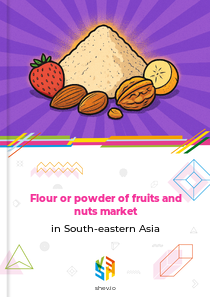







"South-eastern Asia" region includes following countries:
 Brunei Darussalam
 Myanmar
 Cambodia
 Indonesia
 Laos
Laos Malaysia
 the Philippines
 Timor-Leste
 Singapore
 Vietnam
 Thailand
Earlier Report Observations
From 2018 to 2022, the market volume for flour and powder of fruits and nuts in South-eastern Asia increased from 72.3 thousand tonnes to 93.7 thousand tonnes. Public health campaigns in Singapore encouraged greater consumption of whole grains, fruits, and vegetables, boosting demand for related products like fruit and nut flours. The COVID-19 pandemic in 2020 temporarily disrupted factory operations, but it also accelerated a consumer shift toward immune-boosting and functional foods, leading to a significant market jump in 2021. This trend continued into 2022, supported by the growing popularity of nutritious options like sourdough bread and a general preference for convenient, healthy products.
The market volume corrected slightly to 90.7 thousand tonnes in 2023. Throughout the period, underlying consumer interest in health, sustainability, and product innovation—evident in trends such as demand for clear labeling, local sourcing, and functional ingredients—shaped the market's evolution in the region.
Table of content
- 1. Disclaimer
- 2. Terms of use of the report
- 3. Product codes in the statistical classifications used in the report
-
4. Key Market Indicators and Trends
-
4.1. Key Market Indicators
-
4.1.1. In kind
- 4.1.1.1. Production, 2018-2023
- 4.1.1.2. Imports, 2018-2024
- 4.1.1.3. Exports, 2018-2024
- 4.1.1.4. Market size, 2018-2023
-
4.1.1. In kind
- 4.2. Market Trends and Factors
-
4.1. Key Market Indicators
-
5. Production
-
5.1. Production in South-eastern Asia
- 5.1.1. Annual dynamics of production in South-eastern Asia in kind, 2018-2023, K t
-
5.2. Global production by Country, 2018-2023
- 5.2.1. Annual dynamics of production by macroregions in kind, 2018-2023, K t
- 5.2.2. Dynamics of production structure by macroregions in kind, 2018-2023
- 5.2.3. Annual dynamics of production by country in kind, 2018-2023, K t
- 5.2.4. Structure of production by countries in kind, 2018-2023
- 5.2.5. Dynamics of peoduction structure by countries in kind, 2018-2023
-
5.1. Production in South-eastern Asia
-
6. Imports
-
6.1. Imports (Direct Data*)
- 6.1.1. Imports - Total information
-
6.1.2. Imports in kind, t
- 6.1.2.1. Annual dynamics of product's imports to Brunei Darussalam in kind, 2018-2024, t
- 6.1.2.2. Dynamics of product's imports in kind to Brunei Darussalam by countries, 2018-2024, t
- 6.1.2.3. Structure of product's imports in kind by countries, 2018-2024
-
6.1.3. Imports in value, K $ US
- 6.1.3.1. Annual dynamics of product's imports to Brunei Darussalam in value, 2018-2024, K $ US
- 6.1.3.2. Dynamics of product's imports in value to Brunei Darussalam by countries, 2018-2024, K $ US
- 6.1.3.3. Structure of product's imports in value by countries, 2018-2024
-
6.1.4. Average price of product's imports, $ US/t
- 6.1.4.1. Annual dynamics of average price of product's imports to Brunei Darussalam, 2018-2024, $ US/t
- 6.1.4.2. Dynamics of average price of product's imports to Brunei Darussalam by countries, 2018-2024, $ US/t
-
6.2. Imports (Mirror Data)
- 6.2.1. Imports - Total information
-
6.2.2. Imports in kind, t
- 6.2.2.1. Annual dynamics of product's imports to Brunei Darussalam in kind, 2018-2024, t
- 6.2.2.2. Dynamics of product's imports in kind to Brunei Darussalam by countries, 2018-2024, t
- 6.2.2.3. Structure of product's imports in kind by countries, 2018-2024
-
6.2.3. Imports in value, K $ US
- 6.2.3.1. Annual dynamics of product's imports to Brunei Darussalam in value, 2018-2024, K $ US
- 6.2.3.2. Dynamics of product's imports in value to Brunei Darussalam by countries, 2018-2024, K $ US
- 6.2.3.3. Structure of product's imports in value by countries, 2018-2024
-
6.2.4. Average price of product's imports, $ US/t
- 6.2.4.1. Annual dynamics of average price of product's imports to Brunei Darussalam, 2018-2024, $ US/t
- 6.2.4.2. Dynamics of average price of product's imports to Brunei Darussalam by countries, 2018-2024, $ US/t
-
6.1. Imports (Direct Data*)
-
7. Exports
-
7.1. Exports (Direct Data*)
- 7.1.1. Exports - Total information
-
7.1.2. Exports in kind, t
- 7.1.2.1. Annual dynamics of product's exports from Brunei Darussalam in kind, 2018-2024, t
- 7.1.2.2. Dynamics of product's exports in kind from Brunei Darussalam by countries, 2018-2024, t
- 7.1.2.3. Structure of product's exports in kind by countries, 2018-2024
-
7.1.3. Exports in value, K $ US
- 7.1.3.1. Annual dynamics of product's exports from Brunei Darussalam in value, 2018-2024, K $ US
- 7.1.3.2. Dynamics of product's exports in value from Brunei Darussalam by countries, 2018-2024, K $ US
- 7.1.3.3. Structure of product's exports in value by countries, 2018-2024
-
7.1.4. Average price of product's exports, $ US/t
- 7.1.4.1. Annual dynamics of average price of product's exports from Brunei Darussalam, 2018-2024, $ US/t
- 7.1.4.2. Dynamics of average price of product's exports from Brunei Darussalam by countries, 2018-2024, $ US/t
-
7.2. Exports (Mirror Data)
- 7.2.1. Exports - Total information
-
7.2.2. Exports in kind, t
- 7.2.2.1. Annual dynamics of product's exports from Brunei Darussalam in kind, 2018-2024, t
- 7.2.2.2. Dynamics of product's exports in kind from Brunei Darussalam by countries, 2018-2024, t
- 7.2.2.3. Structure of product's exports in kind by countries, 2018-2024
-
7.2.3. Exports in value, K $ US
- 7.2.3.1. Annual dynamics of product's exports from Brunei Darussalam in value, 2018-2024, K $ US
- 7.2.3.2. Dynamics of product's exports in value from Brunei Darussalam by countries, 2018-2024, K $ US
- 7.2.3.3. Structure of product's exports in value by countries, 2018-2024
-
7.2.4. Average price of product's exports, $ US/t
- 7.2.4.1. Annual dynamics of average price of product's exports from Brunei Darussalam, 2018-2024, $ US/t
- 7.2.4.2. Dynamics of average price of product's exports from Brunei Darussalam by countries, 2018-2024, $ US/t
-
7.1. Exports (Direct Data*)
-
8. Trade balance
-
8.1. Trade balance (Direct Data)
- 8.1.1. In kind, t
- 8.1.2. In value, K $ US
-
8.2. Trade balance (Mirror Data)
- 8.2.1. In kind, t
- 8.2.2. In value, K $ US
-
8.1. Trade balance (Direct Data)
-
9. Top buying and selling countries, 2018-2024
-
9.1. Direct Data
- 9.1.1. Import in Value by Countries-buyers
- 9.1.2. Export in Value by Countries-suppliers
-
9.2. Mirror Data
- 9.2.1. Import in Value by Countries-buyers
- 9.2.2. Export in Value by Countries-suppliers
-
9.1. Direct Data
Production flour or powder of fruits and nuts in South-eastern Asia
In kind, 2017-2020, t
Top producers of flour or powder of fruits and nuts, 2017-2020
World map of production of flour or powder of fruits and nuts, 2017-2020
In 2019, production of flour or powder of fruits and nuts in South-eastern Asia reached its lowest point at 83 612 tons. The following year, in 2020, output increased by 2.6% to 85 810 tons. The peak production level was recorded earlier, in 2018, at 87 675 tons. The most significant year-on-year decrease occurred in 2019, when production fell by 4.6%.
Annual dynamics of production in South-eastern Asia in kind, 2017-2020, t
| Parameter | 2018 | 2019 | 2020 | CAGR | |
|---|---|---|---|---|---|
| 1 | Change from last year | 0.8% | (4.6%) | 2.6% | (0.4%) |
Exports flour or powder of fruits and nuts from South-eastern Asia
Exports in kind, t
Exports of flour or powder of fruits and nuts from South-eastern Asia have been declining for three consecutive years. In 2019, exports totaled 13 064 tons, and this figure remained unchanged in 2020. Over the period from 2017 to 2020, exports decreased by 23.9%, which translates to an average annual decline of 8.7%.
Annual dynamics of product's exports from South-eastern Asia in kind, 2017-2020, t
| Parameter | 2018 | 2019 | 2020 | CAGR | |
|---|---|---|---|---|---|
| 1 | Change from last year | (3.5%) | (20.9%) | (0.2%) | (8.7%) |
From 2017 to 2020, exports of flour or powder of fruits and nuts from South-eastern Asia were not heavily concentrated in a few key markets. The top three destinations—South Korea (13.2% of exports), the United States (11.0%), and China (10.8%)—collectively accounted for just 35.1% of total export volumes, indicating a diverse distribution across many partners.
Structure of product's exports in kind by countries, 2017-2020
World map of product's exports from South-eastern Asia in kind, 2017-2020
Exports in value, K $ US
In 2019, the value of flour or powder of fruits and nuts exports from South-eastern Asia declined by 8.4%. However, in 2020, exports surged to 75 823 thousand US dollars, marking a sharp increase of 32.3% compared to the previous year. Over the 2017-2020 period, export values grew by 53.2%, equivalent to an average annual growth rate of 15.3%.
Annual dynamics of product's exports from South-eastern Asia in value, 2017-2020, K $ US
| Parameter | 2018 | 2019 | 2020 | CAGR | |
|---|---|---|---|---|---|
| 1 | Change from last year | 26.4% | (8.4%) | 32.3% | 15.3% |
During 2017-2020, China (14.0% of export value), the United States (12.5%), and Jamaica (8.3%) were significant buyers of flour or powder of fruits and nuts from South-eastern Asia. However, their combined share represented only 34.9% of total export value, with the remaining 65.1% distributed among numerous other trading partners.
Structure of product's exports in value by countries, 2017-2020
World map of product's exports from South-eastern Asia in value, 2017-2020
Imports flour or powder of fruits and nuts to South-eastern Asia
Imports in kind, t
Import volumes of flour or powder of fruits and nuts into South-eastern Asia showed considerable volatility from 2017 to 2020. The lowest point was in 2018, with imports at 1 151 tons, representing a 28.0% decline from the previous year. In 2019, imports surged dramatically by 219.2%. By 2020, imports reached 4 166 tons, a 13.4% increase from 2019. Overall, there was a 3.6-fold difference between the peak in 2020 and the trough in 2018.
Annual dynamics of product's imports to South-eastern Asia in kind, 2017-2020, t
| Parameter | 2018 | 2019 | 2020 | CAGR | |
|---|---|---|---|---|---|
| 1 | Change from last year | (28.0%) | 219.2% | 13.4% | 37.6% |
Between 2017 and 2020, India (16.1% of import volume), the United States (7.1%), and Asia, not elsewhere specified (1.9%) were the largest suppliers of flour or powder of fruits and nuts to South-eastern Asia. Together, they accounted for 25.1% of total imports, while the majority came from a wide array of smaller partners.
Structure of product's imports in kind by countries, 2017-2020
World map of product's imports to South-eastern Asia in kind, 2017-2020
Imports in value, K $ US
The value of flour or powder of fruits and nuts imports into South-eastern Asia has increased for three consecutive years. In 2020, imports reached 20 152 thousand US dollars, up 9.4% from 2019. Over the 2017-2020 period, import values rose by 25.9%, with an average annual growth rate of 8.0%.
Annual dynamics of product's imports to South-eastern Asia in value, 2017-2020, K $ US
| Parameter | 2018 | 2019 | 2020 | CAGR | |
|---|---|---|---|---|---|
| 1 | Change from last year | 3.7% | 10.9% | 9.4% | 8.0% |
From 2017 to 2020, the import market for flour or powder of fruits and nuts in South-eastern Asia was highly diversified. The top three suppliers by value—the United States (13.9%), Italy (5.8%), and Asia, not elsewhere specified (2.9%)—collectively represented just 22.5% of total import value. The remaining 77.5% was sourced from many other countries, reflecting a broad partner landscape.
Structure of product's imports in value by countries, 2017-2020
World map of product's imports to South-eastern Asia in value, 2017-2020
Related Reports


Maize starch market in South-eastern Asia
2026-03-28

Cereal germ market in South-eastern Asia
2026-03-28

Starches market in South-eastern Asia
2026-03-28

Why Choose Us?
Only Verified Data
No Hidden Costs or Separate Fees
Smarter Subscription Pricing
Contact Our Team
Submit your inquiry using the form below — our team will get back to you within 24 hours.