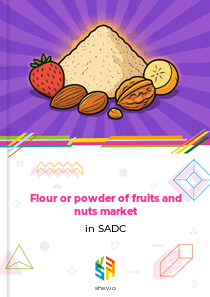







"SADC" region includes following countries:
 Angola
 Botswana
 Comoros
 Democratic Republic of the Congo
 Eswatini
 Lesotho
 Madagascar
 Malawi
 Mauritius
 Mozambique
 Namibia
 Seychelles
 South Africa
 Tanzania
 Zambia
 Zimbabwe
Earlier Report Observations
The market volume for flour and powder of fruits and nuts in the SADC region expanded consistently from 34 488 tonnes in 2018 to 42 541 tonnes in 2023. This sustained growth reflected a gradual increase in both domestic production and net imports over the period.
A significant acceleration occurred in 2023, when the market volume grew by over 2 000 tonnes. This surge was primarily driven by shifting consumer preferences, with rising demand for gluten-free and nutrient-rich alternative flours made from ingredients like banana, chickpea, almond, and coconut. Concurrently, the emergence of plant-based and protein-forward products using nuts and legumes broadened the product range and attracted health-conscious consumers, directly increasing overall consumption.
The trends established in 2023 continued into 2024, reinforced by further regulatory and market developments. Consumer preferences kept shifting towards gluten-free options such as buckwheat, while the ongoing implementation of mandatory nutritional and warning labels on food packaging began to reshape product compliance. Furthermore, the Competition Commission's proposed changes to fresh produce retail and new food safety legislation for dried fruits and nuts indicated evolving supply chain and standardization dynamics that could influence future market conditions.
Table of content
- 1. Disclaimer
- 2. Terms of use of the report
- 3. Product codes in the statistical classifications used in the report
-
4. Key Market Indicators and Trends
-
4.1. Key Market Indicators
-
4.1.1. In kind
- 4.1.1.1. Production, 2018-2023
- 4.1.1.2. Imports, 2018-2024
- 4.1.1.3. Exports, 2018-2024
- 4.1.1.4. Market size, 2018-2023
-
4.1.1. In kind
- 4.2. Market Trends and Factors
-
4.1. Key Market Indicators
-
5. Production
-
5.1. Production in SADC
- 5.1.1. Annual dynamics of production in SADC in kind, 2018-2023, t
-
5.2. Global production by Country, 2018-2023
- 5.2.1. Annual dynamics of production by macroregions in kind, 2018-2023, t
- 5.2.2. Dynamics of production structure by macroregions in kind, 2018-2023
- 5.2.3. Annual dynamics of production by country in kind, 2018-2023, t
- 5.2.4. Structure of production by countries in kind, 2018-2023
- 5.2.5. Dynamics of peoduction structure by countries in kind, 2018-2023
-
5.1. Production in SADC
-
6. Imports
-
6.1. Imports (Direct Data*)
- 6.1.1. Imports - Total information
-
6.1.2. Imports in kind, t
- 6.1.2.1. Annual dynamics of product's imports to Angola in kind, 2018-2024, t
- 6.1.2.2. Dynamics of product's imports in kind to Angola by countries, 2018-2024, t
- 6.1.2.3. Structure of product's imports in kind by countries, 2018-2024
-
6.1.3. Imports in value, K $ US
- 6.1.3.1. Annual dynamics of product's imports to Angola in value, 2018-2024, K $ US
- 6.1.3.2. Dynamics of product's imports in value to Angola by countries, 2018-2024, K $ US
- 6.1.3.3. Structure of product's imports in value by countries, 2018-2024
-
6.1.4. Average price of product's imports, $ US/kg
- 6.1.4.1. Annual dynamics of average price of product's imports to Angola, 2018-2024, $ US/kg
- 6.1.4.2. Dynamics of average price of product's imports to Angola by countries, 2018-2024, $ US/kg
-
6.2. Imports (Mirror Data)
- 6.2.1. Imports - Total information
-
6.2.2. Imports in kind, t
- 6.2.2.1. Annual dynamics of product's imports to Angola in kind, 2018-2024, t
- 6.2.2.2. Dynamics of product's imports in kind to Angola by countries, 2018-2024, t
- 6.2.2.3. Structure of product's imports in kind by countries, 2018-2024
-
6.2.3. Imports in value, K $ US
- 6.2.3.1. Annual dynamics of product's imports to Angola in value, 2018-2024, K $ US
- 6.2.3.2. Dynamics of product's imports in value to Angola by countries, 2018-2024, K $ US
- 6.2.3.3. Structure of product's imports in value by countries, 2018-2024
-
6.2.4. Average price of product's imports, $ US/kg
- 6.2.4.1. Annual dynamics of average price of product's imports to Angola, 2018-2024, $ US/kg
- 6.2.4.2. Dynamics of average price of product's imports to Angola by countries, 2018-2024, $ US/kg
-
6.1. Imports (Direct Data*)
-
7. Exports
-
7.1. Exports (Direct Data*)
- 7.1.1. Exports - Total information
-
7.1.2. Exports in kind, t
- 7.1.2.1. Annual dynamics of product's exports from Angola in kind, 2018-2024, t
- 7.1.2.2. Dynamics of product's exports in kind from Angola by countries, 2018-2024, t
- 7.1.2.3. Structure of product's exports in kind by countries, 2018-2024
-
7.1.3. Exports in value, K $ US
- 7.1.3.1. Annual dynamics of product's exports from Angola in value, 2018-2024, K $ US
- 7.1.3.2. Dynamics of product's exports in value from Angola by countries, 2018-2024, K $ US
- 7.1.3.3. Structure of product's exports in value by countries, 2018-2024
-
7.1.4. Average price of product's exports, $ US/kg
- 7.1.4.1. Annual dynamics of average price of product's exports from Angola, 2018-2024, $ US/kg
- 7.1.4.2. Dynamics of average price of product's exports from Angola by countries, 2018-2024, $ US/kg
-
7.2. Exports (Mirror Data)
- 7.2.1. Exports - Total information
-
7.2.2. Exports in kind, t
- 7.2.2.1. Annual dynamics of product's exports from Angola in kind, 2018-2024, t
- 7.2.2.2. Dynamics of product's exports in kind from Angola by countries, 2018-2024, t
- 7.2.2.3. Structure of product's exports in kind by countries, 2018-2024
-
7.2.3. Exports in value, K $ US
- 7.2.3.1. Annual dynamics of product's exports from Angola in value, 2018-2024, K $ US
- 7.2.3.2. Dynamics of product's exports in value from Angola by countries, 2018-2024, K $ US
- 7.2.3.3. Structure of product's exports in value by countries, 2018-2024
-
7.2.4. Average price of product's exports, $ US/kg
- 7.2.4.1. Annual dynamics of average price of product's exports from Angola, 2018-2024, $ US/kg
- 7.2.4.2. Dynamics of average price of product's exports from Angola by countries, 2018-2024, $ US/kg
-
7.1. Exports (Direct Data*)
-
8. Trade balance
-
8.1. Trade balance (Direct Data)
- 8.1.1. In kind, t
- 8.1.2. In value, K $ US
-
8.2. Trade balance (Mirror Data)
- 8.2.1. In kind, t
- 8.2.2. In value, K $ US
-
8.1. Trade balance (Direct Data)
-
9. Top buying and selling countries, 2018-2024
-
9.1. Direct Data
- 9.1.1. Import in Value by Countries-buyers
- 9.1.2. Export in Value by Countries-suppliers
-
9.2. Mirror Data
- 9.2.1. Import in Value by Countries-buyers
- 9.2.2. Export in Value by Countries-suppliers
-
9.1. Direct Data
Production flour or powder of fruits and nuts in SADC
In kind, 2017-2020, t
Top producers of flour or powder of fruits and nuts, 2017-2020
World map of production of flour or powder of fruits and nuts, 2017-2020
Production of flour or powder from fruits and nuts in SADC has increased for the third consecutive year. In 2020, SADC produced 36 364 tonnes of this product, representing a 4.0% increase compared to 2019. Between 2017 and 2020, production grew by 7%, which translates to an average annual growth rate of 2.3%.
Annual dynamics of production in SADC in kind, 2017-2020, t
| Parameter | 2018 | 2019 | 2020 | CAGR | |
|---|---|---|---|---|---|
| 1 | Change from last year | 0.9% | 1.9% | 4.0% | 2.3% |
Exports flour or powder of fruits and nuts from SADC
Exports in kind, t
In 2020, SADC exported 151.9 tonnes of flour or powder from fruits and nuts, showing a significant decline of 16.9% compared to the previous year. Over the period from 2017 to 2020, exports decreased by 6%, with a compound annual growth rate (CAGR) of -2.0%. The lowest export volume was recorded in 2018 at 147.5 tonnes, while the highest was in 2019 at 182.9 tonnes. The largest year-on-year increase occurred in 2019, with a rise of 24.0%.
Annual dynamics of product's exports from SADC in kind, 2017-2020, t
| Parameter | 2018 | 2019 | 2020 | CAGR | |
|---|---|---|---|---|---|
| 1 | Change from last year | (8.7%) | 24.0% | (16.9%) | (2.0%) |
From 2017 to 2020, exports in kind were distributed across a wide range of partner countries. The United States accounted for 5.8% of exports in kind, the United Kingdom for 3.2%, and Kenya for 2.4%. Together, these three countries represented just 11.3% of total export flows.
Structure of product's exports in kind by countries, 2017-2020
World map of product's exports from SADC in kind, 2017-2020
Exports in value, K $ US
In 2020, SADC's exports of flour or powder from fruits and nuts amounted to 898 thousand US dollars, marking a 14.7% increase year-on-year. Over the period from 2017 to 2020, exports grew by 15.8%, with a compound annual growth rate (CAGR) of 5.0%. The highest export value was recorded in 2018 at 1 178 thousand US dollars. The largest decline occurred in 2019, with a drop of 33.6%, while the largest increase was in 2018, with a rise of 52.0%.
Annual dynamics of product's exports from SADC in value, 2017-2020, K $ US
| Parameter | 2018 | 2019 | 2020 | CAGR | |
|---|---|---|---|---|---|
| 1 | Change from last year | 52.0% | (33.6%) | 14.7% | 5.0% |
From 2017 to 2020, exports in value terms were spread across a diverse set of partner countries. The United States accounted for 21.2% of exports in value terms, the United Kingdom for 16.2%, and the Netherlands for 10.7%. Combined, these three countries represented 48.1% of total export flows.
Structure of product's exports in value by countries, 2017-2020
World map of product's exports from SADC in value, 2017-2020
Imports flour or powder of fruits and nuts to SADC
Imports in kind, t
Imports of flour or powder from fruits and nuts into SADC have increased for the third consecutive year. In 2020, SADC imported 432.4 tonnes of this product, indicating an 11.1% rise compared to the previous year. Between 2017 and 2020, imports grew by 40.1%, which corresponds to an average annual growth rate of 11.9%.
Annual dynamics of product's imports to SADC in kind, 2017-2020, t
| Parameter | 2018 | 2019 | 2020 | CAGR | |
|---|---|---|---|---|---|
| 1 | Change from last year | 12.0% | 12.6% | 11.1% | 11.9% |
The structure of imports in kind from 2017 to 2020 reflects a diversified set of trading partners. Sri Lanka accounted for 7.6% of imports in kind, the United States for 5.6%, and Vietnam for 4.7%. Together, these three countries represented only 17.9% of total import flows, with the remaining 82.1% distributed among numerous smaller markets.
Structure of product's imports in kind by countries, 2017-2020
World map of product's imports to SADC in kind, 2017-2020
Imports in value, K $ US
In 2020, SADC's imports of flour or powder from fruits and nuts totaled 1 962 thousand US dollars, showing a sharp increase of 26.5% compared to the previous year. Between 2017 and 2020, imports grew by 32.3%, equating to an average annual growth rate of 9.8%. The largest decline was recorded in 2019, with a drop of 19.0%, while the largest increase occurred in 2018, with a rise of 29.0%.
Annual dynamics of product's imports to SADC in value, 2017-2020, K $ US
| Parameter | 2018 | 2019 | 2020 | CAGR | |
|---|---|---|---|---|---|
| 1 | Change from last year | 29.0% | (19.0%) | 26.5% | 9.8% |
The structure of imports in value terms from 2017 to 2020 can be described as diversified. France accounted for 16.6% of imports in value terms, the United States for 15.6%, and Spain for 12.2%. Together, these three countries represented just 44.3% of total import flows, with no single country holding a clearly dominant position.
Structure of product's imports in value by countries, 2017-2020
World map of product's imports to SADC in value, 2017-2020
Related Reports


2026-03-28

2026-03-28
Why Choose Us?
Only Verified Data
No Hidden Costs or Separate Fees
Smarter Subscription Pricing
Contact Our Team
Submit your inquiry using the form below — our team will get back to you within 24 hours.