






"Southern Asia" region includes following countries:
 Afghanistan
 Bangladesh
 Bhutan
 Sri Lanka
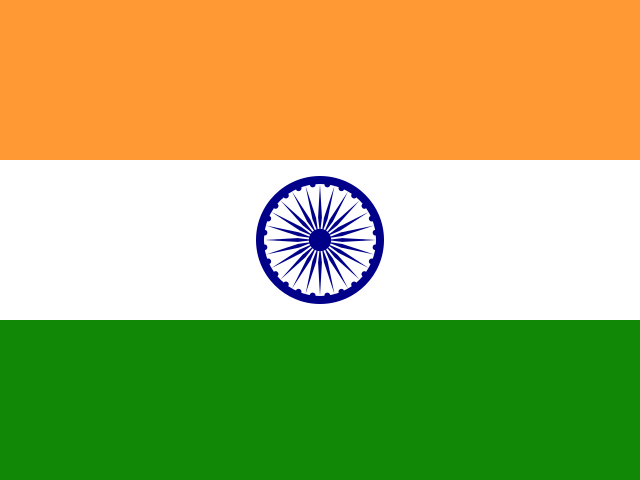 India
India Iran
Iran Maldives
 Nepal
Nepal Pakistan
Earlier Report Observations
The ethyl alcohol market in Southern Asia experienced considerable volume fluctuations between 2018 and 2023. The physical market size declined from 3 704 million liters in 2018 to 2 997 million liters in 2020, before recovering to 3 775 million liters by 2023. In value terms, the market demonstrated consistent growth after 2020, rising from $2 086 million to $2 760 million over the same period. This recovery and expansion in 2023 was shaped by the Food Safety and Standards Authority of India (FSSAI) introducing definitive standards for alcoholic beverages, specifying ethyl alcohol content and labeling rules set to take effect in March 2024, which directed producers toward higher quality benchmarks.
Post-pandemic consumer behavior shifts in India emerged as a key influence by 2024, with household expenditure on alcoholic beverages rising by 15.7%. This trend fueled demand for premium products, craft spirits, and low-alcohol segments, reflecting heightened health consciousness. Major industry players like United Spirits and United Breweries reinforced their market positions through portfolio expansions and strong financial performance, underscoring continued investment and segmentation within the sector.
Table of content
- 1. Disclaimer
- 2. Terms of use of the report
- 3. Product codes in the statistical classifications used in the report
-
4. Key Market Indicators and Trends
-
4.1. Key Market Indicators
-
4.1.1. In kind
- 4.1.1.1. Production, 2018-2023
- 4.1.1.2. Imports, 2018-2024
- 4.1.1.3. Exports, 2018-2024
- 4.1.1.4. Market size, 2018-2023
-
4.1.2. In value
- 4.1.2.1. Production, 2018-2023
- 4.1.2.2. Imports, 2018-2024
- 4.1.2.3. Exports, 2018-2024
- 4.1.2.4. Market size, 2018-2023
-
4.1.1. In kind
- 4.2. Market Trends and Factors
-
4.1. Key Market Indicators
-
5. Production
-
5.1. Production in Southern Asia
- 5.1.1. Annual dynamics of production in Southern Asia in kind, 2018-2023, M l
-
5.2. Global production by Country, 2018-2023
- 5.2.1. Annual dynamics of production by macroregions in kind, 2018-2023, M l
- 5.2.2. Dynamics of production structure by macroregions in kind, 2018-2023
- 5.2.3. Annual dynamics of production by country in kind, 2018-2023, M l
- 5.2.4. Structure of production by countries in kind, 2018-2023
- 5.2.5. Dynamics of peoduction structure by countries in kind, 2018-2023
-
5.1. Production in Southern Asia
-
6. Imports
-
6.1. Imports (Direct Data*)
- 6.1.1. Imports - Total information
-
6.1.2. Imports in kind, M l
- 6.1.2.1. Annual dynamics of product's imports to Afghanistan in kind, 2018-2024, M l
- 6.1.2.2. Dynamics of product's imports in kind to Afghanistan by countries, 2018-2024, M l
- 6.1.2.3. Structure of product's imports in kind by countries, 2018-2024
-
6.1.3. Imports in value, M $ US
- 6.1.3.1. Annual dynamics of product's imports to Afghanistan in value, 2018-2024, M $ US
- 6.1.3.2. Dynamics of product's imports in value to Afghanistan by countries, 2018-2024, M $ US
- 6.1.3.3. Structure of product's imports in value by countries, 2018-2024
-
6.1.4. Average price of product's imports, $ US/K l
- 6.1.4.1. Annual dynamics of average price of product's imports to Afghanistan, 2018-2024, $ US/K l
- 6.1.4.2. Dynamics of average price of product's imports to Afghanistan by countries, 2018-2024, $ US/K l
-
6.2. Imports (Mirror Data)
- 6.2.1. Imports - Total information
-
6.2.2. Imports in kind, M l
- 6.2.2.1. Annual dynamics of product's imports to Afghanistan in kind, 2018-2024, M l
- 6.2.2.2. Dynamics of product's imports in kind to Afghanistan by countries, 2018-2024, M l
- 6.2.2.3. Structure of product's imports in kind by countries, 2018-2024
-
6.2.3. Imports in value, M $ US
- 6.2.3.1. Annual dynamics of product's imports to Afghanistan in value, 2018-2024, M $ US
- 6.2.3.2. Dynamics of product's imports in value to Afghanistan by countries, 2018-2024, M $ US
- 6.2.3.3. Structure of product's imports in value by countries, 2018-2024
-
6.2.4. Average price of product's imports, $ US/K l
- 6.2.4.1. Annual dynamics of average price of product's imports to Afghanistan, 2018-2024, $ US/K l
- 6.2.4.2. Dynamics of average price of product's imports to Afghanistan by countries, 2018-2024, $ US/K l
-
6.1. Imports (Direct Data*)
-
7. Exports
-
7.1. Exports (Direct Data*)
- 7.1.1. Exports - Total information
-
7.1.2. Exports in kind, M l
- 7.1.2.1. Annual dynamics of product's exports from Afghanistan in kind, 2018-2024, M l
- 7.1.2.2. Dynamics of product's exports in kind from Afghanistan by countries, 2018-2024, M l
- 7.1.2.3. Structure of product's exports in kind by countries, 2018-2024
-
7.1.3. Exports in value, M $ US
- 7.1.3.1. Annual dynamics of product's exports from Afghanistan in value, 2018-2024, M $ US
- 7.1.3.2. Dynamics of product's exports in value from Afghanistan by countries, 2018-2024, M $ US
- 7.1.3.3. Structure of product's exports in value by countries, 2018-2024
-
7.1.4. Average price of product's exports, $ US/K l
- 7.1.4.1. Annual dynamics of average price of product's exports from Afghanistan, 2018-2024, $ US/K l
- 7.1.4.2. Dynamics of average price of product's exports from Afghanistan by countries, 2018-2024, $ US/K l
-
7.2. Exports (Mirror Data)
- 7.2.1. Exports - Total information
-
7.2.2. Exports in kind, M l
- 7.2.2.1. Annual dynamics of product's exports from Afghanistan in kind, 2018-2024, M l
- 7.2.2.2. Dynamics of product's exports in kind from Afghanistan by countries, 2018-2024, M l
- 7.2.2.3. Structure of product's exports in kind by countries, 2018-2024
-
7.2.3. Exports in value, M $ US
- 7.2.3.1. Annual dynamics of product's exports from Afghanistan in value, 2018-2024, M $ US
- 7.2.3.2. Dynamics of product's exports in value from Afghanistan by countries, 2018-2024, M $ US
- 7.2.3.3. Structure of product's exports in value by countries, 2018-2024
-
7.2.4. Average price of product's exports, $ US/K l
- 7.2.4.1. Annual dynamics of average price of product's exports from Afghanistan, 2018-2024, $ US/K l
- 7.2.4.2. Dynamics of average price of product's exports from Afghanistan by countries, 2018-2024, $ US/K l
-
7.1. Exports (Direct Data*)
-
8. Trade balance
-
8.1. Trade balance (Direct Data)
- 8.1.1. In kind, M l
- 8.1.2. In value, M $ US
-
8.2. Trade balance (Mirror Data)
- 8.2.1. In kind, M l
- 8.2.2. In value, M $ US
-
8.1. Trade balance (Direct Data)
-
9. Top buying and selling countries, 2018-2024
-
9.1. Direct Data
- 9.1.1. Import in Value by Countries-buyers
- 9.1.2. Export in Value by Countries-suppliers
-
9.2. Mirror Data
- 9.2.1. Import in Value by Countries-buyers
- 9.2.2. Export in Value by Countries-suppliers
-
9.1. Direct Data
Production ethyl alcohol in Southern Asia
In kind, 2017-2020, M l
Top producers of ethyl alcohol, 2017-2020
World map of production of ethyl alcohol, 2017-2020
Ethyl alcohol production in Southern Asia declined for the second year in a row. In 2020, output reached 3 464 million liters, marking a 17.7% decrease compared to 2019. Over the 2017-2020 period, production grew by 7.8%, with an average annual growth rate of 2.5%. The highest production level was recorded in 2018 at 4 537 million liters, which represented a significant 41.2% increase from the previous year.
Annual dynamics of production in Southern Asia in kind, 2017-2020, M l
| Parameter | 2018 | 2019 | 2020 | CAGR | |
|---|---|---|---|---|---|
| 1 | Change from last year | 41.2% | (7.3%) | (17.7%) | 2.5% |
In value, 2017-2020, M $ US
In 2020, the value of ethyl alcohol production in Southern Asia stood at 2 403 million US dollars, showing a 4.4% increase year-over-year. From 2017 to 2020, production value rose by 12.7%, with an average annual growth rate of 4.1%. The peak value was achieved in 2018 at 2 460 million US dollars, reflecting a 15.3% jump. However, 2019 saw a decline of 6.4%.
Annual dynamics of production in Southern Asia in value, 2017-2020, M $ US
| Parameter | 2018 | 2019 | 2020 | CAGR | |
|---|---|---|---|---|---|
| 1 | Change from last year | 15.3% | (6.4%) | 4.4% | 4.1% |
Exports ethyl alcohol from Southern Asia
Exports in kind, M l
Exports of ethyl alcohol from Southern Asia fell for the second consecutive year. In 2020, shipments totaled 501.7 million liters, a sharp 15.4% drop from 2019. Between 2017 and 2020, exports decreased by 16.2%, equivalent to an annualized decline of 5.7%. The highest export volume was recorded in 2018 at 852.1 million liters, which was a 42.3% increase. In contrast, 2019 experienced a substantial 30.4% decrease.
Annual dynamics of product's exports from Southern Asia in kind, 2017-2020, M l
| Parameter | 2018 | 2019 | 2020 | CAGR | |
|---|---|---|---|---|---|
| 1 | Change from last year | 42.3% | (30.4%) | (15.4%) | (5.7%) |
From 2017 to 2020, the country structure of exports in volume terms was highly diversified. South Korea accounted for 22.1% of exports, China for 12.6%, and the Netherlands for 11.6%. Together, these three countries made up only 46.3% of total flows, with the remaining 53.7% distributed among numerous smaller markets.
Structure of product's exports in kind by countries, 2017-2020
World map of product's exports from Southern Asia in kind, 2017-2020
Exports in value, M $ US
In 2020, the value of ethyl alcohol exports from Southern Asia reached 348.1 million US dollars, up 7.3% from 2019. Over the 2017-2020 period, export value declined by 12.4%, with an annualized decrease of 4.3%. The lowest value was recorded in 2019 at 324.4 million US dollars, a 29.8% drop. The peak occurred in 2018 at 461.9 million US dollars, representing a 16.2% increase.
Annual dynamics of product's exports from Southern Asia in value, 2017-2020, M $ US
| Parameter | 2018 | 2019 | 2020 | CAGR | |
|---|---|---|---|---|---|
| 1 | Change from last year | 16.2% | (29.8%) | 7.3% | (4.3%) |
Between 2017 and 2020, the largest buyers of ethyl alcohol from Southern Asia in value terms were South Korea with 22.6% of exports, the Netherlands with 11.7%, and China with 11.1%. However, their combined share was limited to 45.5% of total export value, indicating a diversified market structure.
Structure of product's exports in value by countries, 2017-2020
World map of product's exports from Southern Asia in value, 2017-2020
Imports ethyl alcohol to Southern Asia
Imports in kind, M l
Import volumes showed significant volatility during this period. In 2018, imports hit their lowest point at 19.2 million liters, a 72.0% decline. They then rebounded in 2019 with a 54.1% increase. By 2020, imports reached 35.3 million liters, up 19.2% from 2019. The peak was in 2017, with a 3.6-fold difference compared to the 2018 trough.
Annual dynamics of product's imports to Southern Asia in kind, 2017-2020, M l
| Parameter | 2018 | 2019 | 2020 | CAGR | |
|---|---|---|---|---|---|
| 1 | Change from last year | (72.0%) | 54.1% | 19.2% | (19.9%) |
The partner structure for imports in volume terms from 2017 to 2020 was fragmented. South Africa accounted for 16.9% of imports, Australia for 6.4%, and France for 3.6%. Together, these three countries represented only 27.0% of total flows, with no single country holding a dominant share.
Structure of product's imports in kind by countries, 2017-2020
World map of product's imports to Southern Asia in kind, 2017-2020
Imports in value, M $ US
Imports of ethyl alcohol into Southern Asia increased for the second year in a row. In 2020, import value totaled 31.5 million US dollars, a 24.8% rise from 2019. Over the 2017-2020 period, import value decreased by 12.4%, with an average annual decline of 4.3%. The lowest value was recorded in 2018 at 17.2 million US dollars, a 52.1% drop. This was followed by a 46.5% increase in 2019.
Annual dynamics of product's imports to Southern Asia in value, 2017-2020, M $ US
| Parameter | 2018 | 2019 | 2020 | CAGR | |
|---|---|---|---|---|---|
| 1 | Change from last year | (52.1%) | 46.5% | 24.8% | (4.3%) |
From 2017 to 2020, imports in value terms were spread across many countries. South Africa accounted for 16.1% of imports, France for 8.9%, and Australia for 5.1%. Collectively, these three partners made up only 30.1% of total import flows.
Structure of product's imports in value by countries, 2017-2020
World map of product's imports to Southern Asia in value, 2017-2020
Related Reports

Ethyl alcohol market in Hungary
2026-03-29
Ethyl alcohol market in Melanesia
2026-03-29
Ethyl alcohol market in Nigeria
2026-03-29
Ethyl alcohol market in Papua New Guinea
2026-03-29

Alcoholic beer market in Southern Asia
2026-03-29


Why Choose Us?
Only Verified Data
No Hidden Costs or Separate Fees
Smarter Subscription Pricing
Contact Our Team
Submit your inquiry using the form below — our team will get back to you within 24 hours.