






"SADC" region includes following countries:
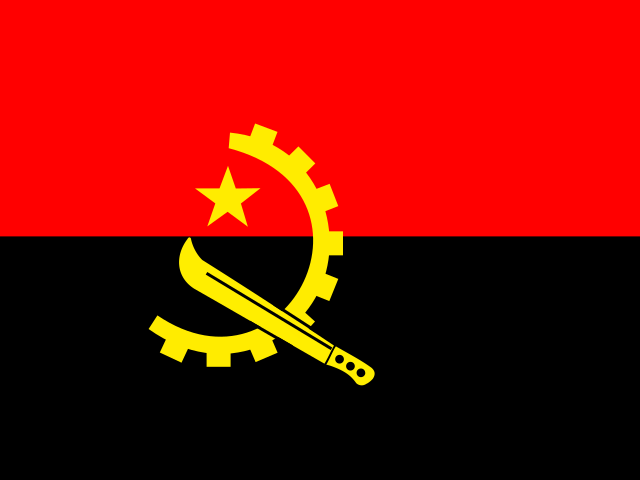 Angola
 Botswana
 Comoros
 Democratic Republic of the Congo
 Eswatini
 Lesotho
 Madagascar
 Malawi
 Mauritius
 Mozambique
 Namibia
 Seychelles
 South Africa
 Tanzania
 Zambia
 Zimbabwe
Earlier Report Observations
The market for fresh or chilled edible brassicas in SADC saw strong expansion from 2018 to 2020, with production rising from 1 143 thousand tons to 1 456 thousand tons and market size growing similarly. After a slight dip of about 2% in 2021, volumes recovered steadily, reaching 1 513 thousand tons of production and a 1 518 thousand ton market by 2023.
Regulatory scrutiny increased in 2023 with the launch of South Africa's Fresh Produce Market Inquiry, aimed at investigating competition barriers in the fresh produce value chain. This period also coincided with a clear shift in consumer preferences towards healthier, plant-based foods, which bolstered demand for fresh vegetables and contributed to the market's resilience and growth trend into 2024.
Table of content
- 1. Disclaimer
- 2. Terms of use of the report
- 3. Product codes in the statistical classifications used in the report
-
4. Key Market Indicators and Trends
-
4.1. Key Market Indicators
-
4.1.1. In kind
- 4.1.1.1. Production, 2018-2023
- 4.1.1.2. Imports, 2018-2024
- 4.1.1.3. Exports, 2018-2024
- 4.1.1.4. Market size, 2018-2023
-
4.1.1. In kind
- 4.2. Market Trends and Factors
-
4.1. Key Market Indicators
-
5. Production
-
5.1. Production in SADC
- 5.1.1. Annual dynamics of production in SADC in kind, 2018-2023, K t
-
5.2. Global production by Country, 2018-2023
- 5.2.1. Annual dynamics of production by macroregions in kind, 2018-2023, K t
- 5.2.2. Dynamics of production structure by macroregions in kind, 2018-2023
- 5.2.3. Annual dynamics of production by country in kind, 2018-2023, K t
- 5.2.4. Structure of production by countries in kind, 2018-2023
- 5.2.5. Dynamics of peoduction structure by countries in kind, 2018-2023
-
5.1. Production in SADC
-
6. Imports
-
6.1. Imports (Direct Data*)
- 6.1.1. Imports - Total information
-
6.1.2. Imports in kind, t
- 6.1.2.1. Annual dynamics of product's imports to Angola in kind, 2018-2024, t
- 6.1.2.2. Dynamics of product's imports in kind to Angola by countries, 2018-2024, t
- 6.1.2.3. Structure of product's imports in kind by countries, 2018-2024
-
6.1.3. Imports in value, K $ US
- 6.1.3.1. Annual dynamics of product's imports to Angola in value, 2018-2024, K $ US
- 6.1.3.2. Dynamics of product's imports in value to Angola by countries, 2018-2024, K $ US
- 6.1.3.3. Structure of product's imports in value by countries, 2018-2024
-
6.1.4. Average price of product's imports, $ US/t
- 6.1.4.1. Annual dynamics of average price of product's imports to Angola, 2018-2024, $ US/t
- 6.1.4.2. Dynamics of average price of product's imports to Angola by countries, 2018-2024, $ US/t
-
6.2. Imports (Mirror Data)
- 6.2.1. Imports - Total information
-
6.2.2. Imports in kind, t
- 6.2.2.1. Annual dynamics of product's imports to Angola in kind, 2018-2024, t
- 6.2.2.2. Dynamics of product's imports in kind to Angola by countries, 2018-2024, t
- 6.2.2.3. Structure of product's imports in kind by countries, 2018-2024
-
6.2.3. Imports in value, K $ US
- 6.2.3.1. Annual dynamics of product's imports to Angola in value, 2018-2024, K $ US
- 6.2.3.2. Dynamics of product's imports in value to Angola by countries, 2018-2024, K $ US
- 6.2.3.3. Structure of product's imports in value by countries, 2018-2024
-
6.2.4. Average price of product's imports, $ US/t
- 6.2.4.1. Annual dynamics of average price of product's imports to Angola, 2018-2024, $ US/t
- 6.2.4.2. Dynamics of average price of product's imports to Angola by countries, 2018-2024, $ US/t
-
6.1. Imports (Direct Data*)
-
7. Exports
-
7.1. Exports (Direct Data*)
- 7.1.1. Exports - Total information
-
7.1.2. Exports in kind, t
- 7.1.2.1. Annual dynamics of product's exports from Angola in kind, 2018-2024, t
- 7.1.2.2. Dynamics of product's exports in kind from Angola by countries, 2018-2024, t
- 7.1.2.3. Structure of product's exports in kind by countries, 2018-2024
-
7.1.3. Exports in value, K $ US
- 7.1.3.1. Annual dynamics of product's exports from Angola in value, 2018-2024, K $ US
- 7.1.3.2. Dynamics of product's exports in value from Angola by countries, 2018-2024, K $ US
- 7.1.3.3. Structure of product's exports in value by countries, 2018-2024
-
7.1.4. Average price of product's exports, $ US/t
- 7.1.4.1. Annual dynamics of average price of product's exports from Angola, 2018-2024, $ US/t
- 7.1.4.2. Dynamics of average price of product's exports from Angola by countries, 2018-2024, $ US/t
-
7.2. Exports (Mirror Data)
- 7.2.1. Exports - Total information
-
7.2.2. Exports in kind, t
- 7.2.2.1. Annual dynamics of product's exports from Angola in kind, 2018-2024, t
- 7.2.2.2. Dynamics of product's exports in kind from Angola by countries, 2018-2024, t
- 7.2.2.3. Structure of product's exports in kind by countries, 2018-2024
-
7.2.3. Exports in value, K $ US
- 7.2.3.1. Annual dynamics of product's exports from Angola in value, 2018-2024, K $ US
- 7.2.3.2. Dynamics of product's exports in value from Angola by countries, 2018-2024, K $ US
- 7.2.3.3. Structure of product's exports in value by countries, 2018-2024
-
7.2.4. Average price of product's exports, $ US/t
- 7.2.4.1. Annual dynamics of average price of product's exports from Angola, 2018-2024, $ US/t
- 7.2.4.2. Dynamics of average price of product's exports from Angola by countries, 2018-2024, $ US/t
-
7.1. Exports (Direct Data*)
-
8. Trade balance
-
8.1. Trade balance (Direct Data)
- 8.1.1. In kind, t
- 8.1.2. In value, K $ US
-
8.2. Trade balance (Mirror Data)
- 8.2.1. In kind, t
- 8.2.2. In value, K $ US
-
8.1. Trade balance (Direct Data)
-
9. Top buying and selling countries, 2018-2024
-
9.1. Direct Data
- 9.1.1. Import in Value by Countries-buyers
- 9.1.2. Export in Value by Countries-suppliers
-
9.2. Mirror Data
- 9.2.1. Import in Value by Countries-buyers
- 9.2.2. Export in Value by Countries-suppliers
-
9.1. Direct Data
Production edible brassicas in SADC
In kind, 2017-2020, K t
Top producers of edible brassicas, 2017-2020
World map of production of edible brassicas, 2017-2020
Edible brassicas production in SADC has increased for the third consecutive year. In 2020, SADC produced 1 456 thousand tonnes of edible brassicas, which represents an 11.2% increase compared to 2019. Between 2017 and 2020, production grew by 30.6%, equating to an annualized growth rate of 9.3%.
Annual dynamics of production in SADC in kind, 2017-2020, K t
| Parameter | 2018 | 2019 | 2020 | CAGR | |
|---|---|---|---|---|---|
| 1 | Change from last year | 2.5% | 14.6% | 11.2% | 9.3% |
Exports edible brassicas from SADC
Exports in kind, t
The market exhibited significant volatility during this period. Exports peaked in 2019 at 5 379 tonnes, then declined sharply to a trough of 803 tonnes in 2020, representing an 85.1% decrease from the previous year. The amplitude between these years was 6.7 times. The largest annual increase occurred in 2019 at 13.6%.
Annual dynamics of product's exports from SADC in kind, 2017-2020, t
| Parameter | 2018 | 2019 | 2020 | CAGR | |
|---|---|---|---|---|---|
| 1 | Change from last year | (8.1%) | 13.6% | (85.1%) | (46.2%) |
Throughout the 2017-2020 period, the United Kingdom and Special Categories remained the primary buyers of edible brassicas from SADC, together accounting for 4.1% of total exports in volume terms.
Structure of product's exports in kind by countries, 2017-2020
World map of product's exports from SADC in kind, 2017-2020
Exports in value, K $ US
In 2020, SADC's cross-border shipments of edible brassicas stood at 5 612 thousand US dollars, down 20.5% from the previous year. The maximum value was recorded in 2019 at 7 061 thousand US dollars, which also saw the largest annual increase of 11.2%. Between 2017 and 2020, exports decreased by 13.7%, equating to an annualized decline of 4.8%.
Annual dynamics of product's exports from SADC in value, 2017-2020, K $ US
| Parameter | 2018 | 2019 | 2020 | CAGR | |
|---|---|---|---|---|---|
| 1 | Change from last year | (2.4%) | 11.2% | (20.5%) | (4.8%) |
Throughout 2017-2020, the United Kingdom (13.7% of exports in value terms), the Netherlands (1.7%), and Special Categories (1.3%) formed the key group of partners for SADC's edible brassicas exports, jointly representing 16.7% of total export value.
Structure of product's exports in value by countries, 2017-2020
World map of product's exports from SADC in value, 2017-2020
Imports edible brassicas to SADC
Imports in kind, t
In 2020, SADC's edible brassicas imports reached 5 817 tonnes, a decrease of 21.3% compared to 2019. The minimum value was recorded in 2018 at 4 497 tonnes, which also saw the largest annual decline of 42.9%. The largest increase occurred in 2019 at 64.5%. Over the 2017-2020 period, imports decreased by 26.1%, with a compound annual growth rate of -9.6%.
Annual dynamics of product's imports to SADC in kind, 2017-2020, t
| Parameter | 2018 | 2019 | 2020 | CAGR | |
|---|---|---|---|---|---|
| 1 | Change from last year | (42.9%) | 64.5% | (21.3%) | (9.6%) |
In 2017-2020, China (4.2% of imports in volume terms), Egypt (2.9%), and Belgium (2.7%) accounted for the largest share of SADC's edible brassicas imports, together comprising 9.8% of total import volume.
Structure of product's imports in kind by countries, 2017-2020
World map of product's imports to SADC in kind, 2017-2020
Imports in value, K $ US
After two years of growth, SADC's edible brassicas imports declined in 2020. The import value stood at 6 740 thousand US dollars, down 18.3% from 2019. The maximum value was recorded in 2019 at 8 246 thousand US dollars, which also saw the largest annual increase of 16.1%. Between 2017 and 2020, imports increased by 6.9%, equating to an annualized growth rate of 2.2%.
Annual dynamics of product's imports to SADC in value, 2017-2020, K $ US
| Parameter | 2018 | 2019 | 2020 | CAGR | |
|---|---|---|---|---|---|
| 1 | Change from last year | 12.6% | 16.1% | (18.3%) | 2.2% |
The analysis of import values from 2017 to 2020 shows a broad distribution across many markets. Belgium (13.6% of imports in value terms), Egypt (6.9%), and China (5.0%) together accounted for 25.5% of total import value, with the remaining 74.5% distributed among other partners.
Structure of product's imports in value by countries, 2017-2020
World map of product's imports to SADC in value, 2017-2020
Related Reports

Edible brassicas market in Northern Europe
2026-03-27
Edible brassicas market in Oman
2026-03-27
Edible brassicas market in Central Asia
2026-03-27

2026-03-27
Frozen potatoes market in SADC
2026-03-27

Dried shelled cow peas market in SADC
2026-03-27

2026-03-27
Why Choose Us?
Only Verified Data
No Hidden Costs or Separate Fees
Smarter Subscription Pricing
Contact Our Team
Submit your inquiry using the form below — our team will get back to you within 24 hours.