






"SADC" region includes following countries:
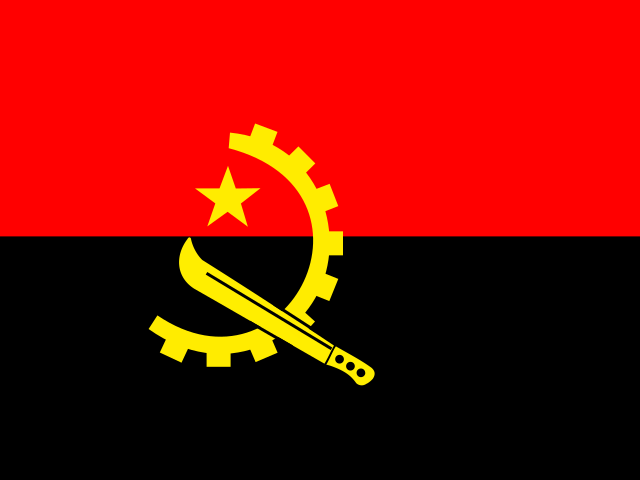 Angola
 Botswana
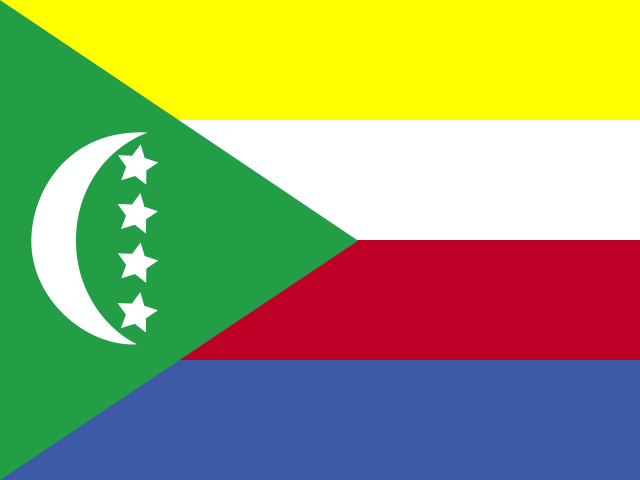 Comoros
 Democratic Republic of the Congo
 Eswatini
 Lesotho
 Madagascar
 Malawi
 Mauritius
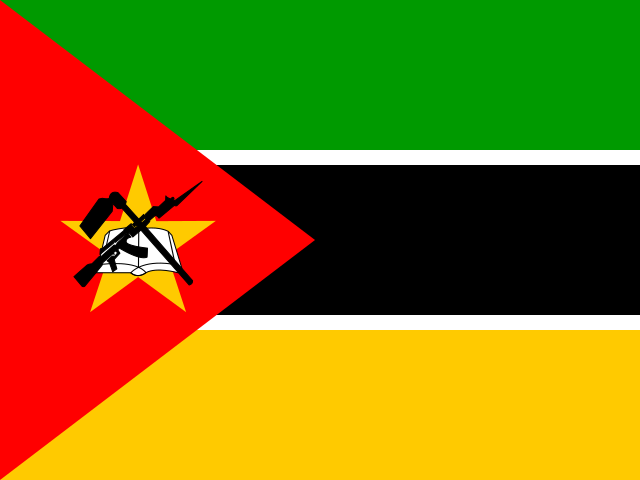 Mozambique
 Namibia
 Seychelles
 South Africa
 Tanzania
 Zambia
 Zimbabwe
Earlier Report Observations
The market volume for dried shelled legumes in SADC fluctuated between 2018 and 2023, starting at 8,002 thousand tons and reaching 9,362 thousand tons by the end of the period. After a decline to 7,732 thousand tons in 2019, volumes recovered to 8,389 thousand tons in 2020 and continued growing to 8,885 thousand tons in 2021, before a temporary drop in 2022 and a significant rebound to the peak in 2023.
The market expansion in 2021, when volume increased by 5.9%, occurred alongside a notable rise in informal cross-border trade activity within SADC, with estimated informal remittances of ZAR 11 billion. This growth in informal trade likely facilitated greater distribution and accessibility of legumes, contributing to the overall market volume increase that year.
Factors emerging by 2024 included state-invested modernization of rail and port logistics in South Africa to improve agricultural market access, while intermittent energy supply presented challenges for production efficiency. Concurrently, strong regional demand was evidenced by growing agricultural export revenues within Africa, and community market garden initiatives promoted local food security and sustainable livelihoods, influencing the market's structure and potential supply.
Table of content
- 1. Disclaimer
- 2. Terms of use of the report
- 3. Product codes in the statistical classifications used in the report
-
4. Key Market Indicators and Trends
-
4.1. Key Market Indicators
-
4.1.1. In kind
- 4.1.1.1. Production, 2018-2023
- 4.1.1.2. Imports, 2018-2024
- 4.1.1.3. Exports, 2018-2024
- 4.1.1.4. Market size, 2018-2023
-
4.1.2. In value
- 4.1.2.1. Production, 2018-2023
- 4.1.2.2. Imports, 2018-2024
- 4.1.2.3. Exports, 2018-2024
- 4.1.2.4. Market size, 2018-2023
-
4.1.1. In kind
- 4.2. Market Trends and Factors
-
4.1. Key Market Indicators
-
5. Production
-
5.1. Production in SADC
- 5.1.1. Annual dynamics of production in SADC in kind, 2018-2023, K t
-
5.2. Global production by Country, 2018-2023
- 5.2.1. Annual dynamics of production by macroregions in kind, 2018-2023, K t
- 5.2.2. Dynamics of production structure by macroregions in kind, 2018-2023
- 5.2.3. Annual dynamics of production by country in kind, 2018-2023, K t
- 5.2.4. Structure of production by countries in kind, 2018-2023
- 5.2.5. Dynamics of peoduction structure by countries in kind, 2018-2023
-
5.1. Production in SADC
-
6. Imports
-
6.1. Imports (Direct Data*)
- 6.1.1. Imports - Total information
-
6.1.2. Imports in kind, K t
- 6.1.2.1. Annual dynamics of product's imports to Angola in kind, 2018-2024, K t
- 6.1.2.2. Dynamics of product's imports in kind to Angola by countries, 2018-2024, K t
- 6.1.2.3. Structure of product's imports in kind by countries, 2018-2024
-
6.1.3. Imports in value, M $ US
- 6.1.3.1. Annual dynamics of product's imports to Angola in value, 2018-2024, M $ US
- 6.1.3.2. Dynamics of product's imports in value to Angola by countries, 2018-2024, M $ US
- 6.1.3.3. Structure of product's imports in value by countries, 2018-2024
-
6.1.4. Average price of product's imports, $ US/t
- 6.1.4.1. Annual dynamics of average price of product's imports to Angola, 2018-2024, $ US/t
- 6.1.4.2. Dynamics of average price of product's imports to Angola by countries, 2018-2024, $ US/t
-
6.2. Imports (Mirror Data)
- 6.2.1. Imports - Total information
-
6.2.2. Imports in kind, K t
- 6.2.2.1. Annual dynamics of product's imports to Angola in kind, 2018-2024, K t
- 6.2.2.2. Dynamics of product's imports in kind to Angola by countries, 2018-2024, K t
- 6.2.2.3. Structure of product's imports in kind by countries, 2018-2024
-
6.2.3. Imports in value, M $ US
- 6.2.3.1. Annual dynamics of product's imports to Angola in value, 2018-2024, M $ US
- 6.2.3.2. Dynamics of product's imports in value to Angola by countries, 2018-2024, M $ US
- 6.2.3.3. Structure of product's imports in value by countries, 2018-2024
-
6.2.4. Average price of product's imports, $ US/t
- 6.2.4.1. Annual dynamics of average price of product's imports to Angola, 2018-2024, $ US/t
- 6.2.4.2. Dynamics of average price of product's imports to Angola by countries, 2018-2024, $ US/t
-
6.1. Imports (Direct Data*)
-
7. Exports
-
7.1. Exports (Direct Data*)
- 7.1.1. Exports - Total information
-
7.1.2. Exports in kind, K t
- 7.1.2.1. Annual dynamics of product's exports from Angola in kind, 2018-2024, K t
- 7.1.2.2. Dynamics of product's exports in kind from Angola by countries, 2018-2024, K t
- 7.1.2.3. Structure of product's exports in kind by countries, 2018-2024
-
7.1.3. Exports in value, M $ US
- 7.1.3.1. Annual dynamics of product's exports from Angola in value, 2018-2024, M $ US
- 7.1.3.2. Dynamics of product's exports in value from Angola by countries, 2018-2024, M $ US
- 7.1.3.3. Structure of product's exports in value by countries, 2018-2024
-
7.1.4. Average price of product's exports, $ US/t
- 7.1.4.1. Annual dynamics of average price of product's exports from Angola, 2018-2024, $ US/t
- 7.1.4.2. Dynamics of average price of product's exports from Angola by countries, 2018-2024, $ US/t
-
7.2. Exports (Mirror Data)
- 7.2.1. Exports - Total information
-
7.2.2. Exports in kind, K t
- 7.2.2.1. Annual dynamics of product's exports from Angola in kind, 2018-2024, K t
- 7.2.2.2. Dynamics of product's exports in kind from Angola by countries, 2018-2024, K t
- 7.2.2.3. Structure of product's exports in kind by countries, 2018-2024
-
7.2.3. Exports in value, M $ US
- 7.2.3.1. Annual dynamics of product's exports from Angola in value, 2018-2024, M $ US
- 7.2.3.2. Dynamics of product's exports in value from Angola by countries, 2018-2024, M $ US
- 7.2.3.3. Structure of product's exports in value by countries, 2018-2024
-
7.2.4. Average price of product's exports, $ US/t
- 7.2.4.1. Annual dynamics of average price of product's exports from Angola, 2018-2024, $ US/t
- 7.2.4.2. Dynamics of average price of product's exports from Angola by countries, 2018-2024, $ US/t
-
7.1. Exports (Direct Data*)
-
8. Trade balance
-
8.1. Trade balance (Direct Data)
- 8.1.1. In kind, K t
- 8.1.2. In value, M $ US
-
8.2. Trade balance (Mirror Data)
- 8.2.1. In kind, K t
- 8.2.2. In value, M $ US
-
8.1. Trade balance (Direct Data)
-
9. Top buying and selling countries, 2018-2024
-
9.1. Direct Data
- 9.1.1. Import in Value by Countries-buyers
- 9.1.2. Export in Value by Countries-suppliers
-
9.2. Mirror Data
- 9.2.1. Import in Value by Countries-buyers
- 9.2.2. Export in Value by Countries-suppliers
-
9.1. Direct Data
Production dried shelled legumes in SADC
In kind, 2017-2020, K t
Top producers of dried shelled legumes, 2017-2020
World map of production of dried shelled legumes, 2017-2020
SADC's production of dried shelled legumes grew for the second year in a row. In 2020, the region produced 8 939 thousand tons, showing a modest increase of 9.3% compared to 2019. Looking at the broader period from 2017 to 2020, production actually declined by 2.7%, which translates to an average annual decrease of 0.9%. The lowest production volume was recorded in 2018 at 8 046 thousand tons, with that year also seeing the sharpest drop of 12.4%.
Annual dynamics of production in SADC in kind, 2017-2020, K t
| Parameter | 2018 | 2019 | 2020 | CAGR | |
|---|---|---|---|---|---|
| 1 | Change from last year | (12.4%) | 1.7% | 9.3% | (0.9%) |
In value, 2017-2020, M $ US
Following two years of decline, the value of dried shelled legumes production in SADC rebounded in 2020. Output was valued at 4 672 million US dollars, up 5.3% year-over-year. However, over the four-year span from 2017 to 2020, production value fell by 20.5%, averaging an annual decline of 7.4%. The lowest value occurred in 2019 at 4 435 million US dollars, while the most significant decrease was in 2018, at 20.6%.
Annual dynamics of production in SADC in value, 2017-2020, M $ US
| Parameter | 2018 | 2019 | 2020 | CAGR | |
|---|---|---|---|---|---|
| 1 | Change from last year | (20.6%) | (4.9%) | 5.3% | (7.4%) |
Exports dried shelled legumes from SADC
Exports in kind, K t
Export volumes of dried shelled legumes from SADC showed considerable volatility between 2017 and 2020. The lowest point was in 2018 at 184.3 thousand tons, while exports peaked in 2020 at 699.2 thousand tons—a 3.8-fold difference. In 2020, deliveries increased by 21.9% compared to the previous year. The largest decline occurred in 2018, dropping 37.8%, whereas the biggest increase was in 2019, surging by 211.1%.
Annual dynamics of product's exports from SADC in kind, 2017-2020, K t
| Parameter | 2018 | 2019 | 2020 | CAGR | |
|---|---|---|---|---|---|
| 1 | Change from last year | (37.8%) | 211.1% | 21.9% | 33.1% |
From 2017 to 2020, India, the United Arab Emirates, and Vietnam were the top destinations for SADC's dried shelled legumes exports by volume. India accounted for 60.0% of exports, followed by the UAE at 6.5% and Vietnam at 5.0%. Together, these three countries represented 71.4% of total export flows.
Structure of product's exports in kind by countries, 2017-2020
World map of product's exports from SADC in kind, 2017-2020
Exports in value, M $ US
The value of dried shelled legumes exports from SADC exhibited notable fluctuations during the observed period. The low point was in 2018 at 106.9 million US dollars, while the high came in 2020 at 365.5 million US dollars—a 3.4-fold increase. In 2020, export value rose by 17.5% year-over-year. The most significant decline was in 2018, down 43.7%, while the largest increase occurred in 2019, jumping 190.9%.
Annual dynamics of product's exports from SADC in value, 2017-2020, M $ US
| Parameter | 2018 | 2019 | 2020 | CAGR | |
|---|---|---|---|---|---|
| 1 | Change from last year | (43.7%) | 190.9% | 17.5% | 24.4% |
Between 2017 and 2020, India, the United Arab Emirates, and Vietnam led as the primary buyers of dried shelled legumes from SADC in value terms. India held a 53.9% share of export value, the UAE accounted for 9.0%, and Vietnam made up 2.9%. Collectively, these three markets represented 65.9% of total export value.
Structure of product's exports in value by countries, 2017-2020
World map of product's exports from SADC in value, 2017-2020
Imports dried shelled legumes to SADC
Imports in kind, K t
After two consecutive years of decline, imports of dried shelled legumes into SADC increased in 2020. Volumes reached 150.0 thousand tons, marking a strong gain of 18.5% compared to 2019. Over the full period from 2017 to 2020, imports decreased by 36.9%, with an average annual decline of 14.2%. The lowest import volume was in 2019 at 126.6 thousand tons, while the sharpest drop occurred in 2018, falling 40.7%.
Annual dynamics of product's imports to SADC in kind, 2017-2020, K t
| Parameter | 2018 | 2019 | 2020 | CAGR | |
|---|---|---|---|---|---|
| 1 | Change from last year | (40.7%) | (10.1%) | 18.5% | (14.2%) |
From 2017 to 2020, Canada, the United States, and Ukraine were notable suppliers of dried shelled legumes to SADC by volume, though their dominance was limited. Canada accounted for 32.4% of imports, the US for 4.8%, and Ukraine for 4.1%. Together, these three countries represented 41.2% of total import volumes.
Structure of product's imports in kind by countries, 2017-2020
World map of product's imports to SADC in kind, 2017-2020
Imports in value, M $ US
Following a two-year reduction, the value of dried shelled legumes imports into SADC rose sharply in 2020. Imports amounted to 160.6 million US dollars, reflecting a significant gain of 36.0% over the previous year. However, between 2017 and 2020, import value decreased by 18.8%, averaging an annual decline of 6.7%. The lowest value was recorded in 2019 at 118.1 million US dollars, while the largest decline occurred in 2018, down 24.3%.
Annual dynamics of product's imports to SADC in value, 2017-2020, M $ US
| Parameter | 2018 | 2019 | 2020 | CAGR | |
|---|---|---|---|---|---|
| 1 | Change from last year | (24.3%) | (21.1%) | 36.0% | (6.7%) |
Between 2017 and 2020, imports of dried shelled legumes into SADC in value terms were not highly concentrated. Canada led with a 36.3% share, followed by the United States at 5.3% and China at 4.9%. Together, these three suppliers accounted for 46.4% of total import value.
Structure of product's imports in value by countries, 2017-2020
World map of product's imports to SADC in value, 2017-2020
Related Reports

Dried shelled legumes market in Croatia
2026-03-27
Dried shelled legumes market in Mozambique
2026-03-30
Frozen potatoes market in SADC
2026-03-27

Carrots and turnips market in SADC
2026-03-27

2026-03-28

2026-03-27
Why Choose Us?
Only Verified Data
No Hidden Costs or Separate Fees
Smarter Subscription Pricing
Contact Our Team
Submit your inquiry using the form below — our team will get back to you within 24 hours.