






"Northern Africa" region includes following countries:
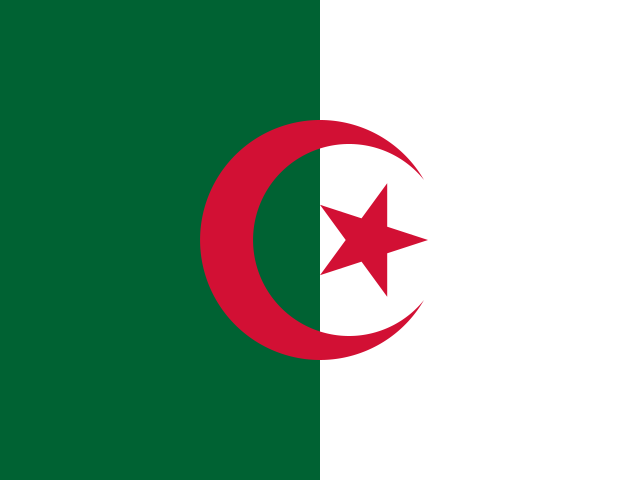 Algeria
 Libya
Libya Morocco
 Sudan
Sudan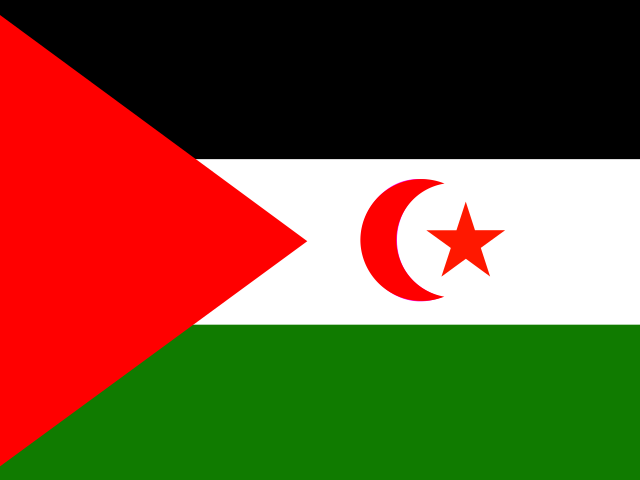 Western Sahara
 Tunisia
 Egypt
EgyptEarlier Report Observations
The cocoa butter market in Northern Africa saw significant fluctuations between 2018 and 2023, starting at 11,151 tons and reaching 15,268 tons. Early growth was partly supported by the expanding use of cocoa butter in cosmetic products like moisturizers and antibacterial ointments, which added new sources of demand. However, the market contracted sharply in 2020, falling 30% to 8,372 tons, as a 15-20% price increase for cocoa butter and climate-driven supply disruptions in West Africa constrained availability.
Volume recovered to 10,063 tons in 2021 and continued to rise strongly, reaching 13,296 tons in 2022 and 15,268 tons in 2023. This expansion occurred alongside adverse weather in West Africa—including heavy rains and drought—that damaged cocoa crops and reduced global supply, contributing to higher prices. In response, the industry channeled major investments into research and development for cocoa butter substitutes to address cost and supply concerns.
By 2024, record cocoa butter prices were driven by droughts, floods, and plant diseases in West Africa, further tightening supply. European deforestation rules and stricter cocoa-content labeling raised compliance costs for processors, while market trends shifted toward premium, sustainable, and traceable products. Strategic moves included Nestlé's partnership with Cargill on carbon-neutral farming and Guan Chong Berhad's acquisition of a stake in a Ivorian processor to strengthen local cocoa grinding.
Table of content
- 1. Disclaimer
- 2. Terms of use of the report
- 3. Product codes in the statistical classifications used in the report
-
4. Key Market Indicators and Trends
-
4.1. Key Market Indicators
-
4.1.1. In kind
- 4.1.1.1. Production, 2018-2023
- 4.1.1.2. Imports, 2018-2024
- 4.1.1.3. Exports, 2018-2024
- 4.1.1.4. Market size, 2018-2023
-
4.1.2. In value
- 4.1.2.1. Production, 2018-2023
- 4.1.2.2. Imports, 2018-2024
- 4.1.2.3. Exports, 2018-2024
- 4.1.2.4. Market size, 2018-2023
-
4.1.1. In kind
- 4.2. Market Trends and Factors
-
4.1. Key Market Indicators
-
5. Production
-
5.1. Production in Northern Africa
- 5.1.1. Annual dynamics of production in Northern Africa in kind, 2018-2023, t
-
5.2. Global production by Country, 2018-2023
- 5.2.1. Annual dynamics of production by macroregions in kind, 2018-2023, t
- 5.2.2. Dynamics of production structure by macroregions in kind, 2018-2023
- 5.2.3. Annual dynamics of production by country in kind, 2018-2023, t
- 5.2.4. Structure of production by countries in kind, 2018-2023
- 5.2.5. Dynamics of peoduction structure by countries in kind, 2018-2023
-
5.1. Production in Northern Africa
-
6. Imports
-
6.1. Imports (Direct Data*)
- 6.1.1. Imports - Total information
-
6.1.2. Imports in kind, t
- 6.1.2.1. Annual dynamics of product's imports to Algeria in kind, 2018-2024, t
- 6.1.2.2. Dynamics of product's imports in kind to Algeria by countries, 2018-2024, t
- 6.1.2.3. Structure of product's imports in kind by countries, 2018-2024
-
6.1.3. Imports in value, K $ US
- 6.1.3.1. Annual dynamics of product's imports to Algeria in value, 2018-2024, K $ US
- 6.1.3.2. Dynamics of product's imports in value to Algeria by countries, 2018-2024, K $ US
- 6.1.3.3. Structure of product's imports in value by countries, 2018-2024
-
6.1.4. Average price of product's imports, $ US/t
- 6.1.4.1. Annual dynamics of average price of product's imports to Algeria, 2018-2024, $ US/t
- 6.1.4.2. Dynamics of average price of product's imports to Algeria by countries, 2018-2024, $ US/t
-
6.2. Imports (Mirror Data)
- 6.2.1. Imports - Total information
-
6.2.2. Imports in kind, t
- 6.2.2.1. Annual dynamics of product's imports to Algeria in kind, 2018-2024, t
- 6.2.2.2. Dynamics of product's imports in kind to Algeria by countries, 2018-2024, t
- 6.2.2.3. Structure of product's imports in kind by countries, 2018-2024
-
6.2.3. Imports in value, K $ US
- 6.2.3.1. Annual dynamics of product's imports to Algeria in value, 2018-2024, K $ US
- 6.2.3.2. Dynamics of product's imports in value to Algeria by countries, 2018-2024, K $ US
- 6.2.3.3. Structure of product's imports in value by countries, 2018-2024
-
6.2.4. Average price of product's imports, $ US/t
- 6.2.4.1. Annual dynamics of average price of product's imports to Algeria, 2018-2024, $ US/t
- 6.2.4.2. Dynamics of average price of product's imports to Algeria by countries, 2018-2024, $ US/t
-
6.1. Imports (Direct Data*)
-
7. Exports
-
7.1. Exports (Direct Data*)
- 7.1.1. Exports - Total information
-
7.1.2. Exports in kind, t
- 7.1.2.1. Annual dynamics of product's exports from Algeria in kind, 2018-2024, t
- 7.1.2.2. Dynamics of product's exports in kind from Algeria by countries, 2018-2024, t
- 7.1.2.3. Structure of product's exports in kind by countries, 2018-2024
-
7.1.3. Exports in value, K $ US
- 7.1.3.1. Annual dynamics of product's exports from Algeria in value, 2018-2024, K $ US
- 7.1.3.2. Dynamics of product's exports in value from Algeria by countries, 2018-2024, K $ US
- 7.1.3.3. Structure of product's exports in value by countries, 2018-2024
-
7.1.4. Average price of product's exports, $ US/t
- 7.1.4.1. Annual dynamics of average price of product's exports from Algeria, 2018-2024, $ US/t
- 7.1.4.2. Dynamics of average price of product's exports from Algeria by countries, 2018-2024, $ US/t
-
7.2. Exports (Mirror Data)
- 7.2.1. Exports - Total information
-
7.2.2. Exports in kind, t
- 7.2.2.1. Annual dynamics of product's exports from Algeria in kind, 2018-2024, t
- 7.2.2.2. Dynamics of product's exports in kind from Algeria by countries, 2018-2024, t
- 7.2.2.3. Structure of product's exports in kind by countries, 2018-2024
-
7.2.3. Exports in value, K $ US
- 7.2.3.1. Annual dynamics of product's exports from Algeria in value, 2018-2024, K $ US
- 7.2.3.2. Dynamics of product's exports in value from Algeria by countries, 2018-2024, K $ US
- 7.2.3.3. Structure of product's exports in value by countries, 2018-2024
-
7.2.4. Average price of product's exports, $ US/t
- 7.2.4.1. Annual dynamics of average price of product's exports from Algeria, 2018-2024, $ US/t
- 7.2.4.2. Dynamics of average price of product's exports from Algeria by countries, 2018-2024, $ US/t
-
7.1. Exports (Direct Data*)
-
8. Trade balance
-
8.1. Trade balance (Direct Data)
- 8.1.1. In kind, t
- 8.1.2. In value, K $ US
-
8.2. Trade balance (Mirror Data)
- 8.2.1. In kind, t
- 8.2.2. In value, K $ US
-
8.1. Trade balance (Direct Data)
-
9. Top buying and selling countries, 2018-2024
-
9.1. Direct Data
- 9.1.1. Import in Value by Countries-buyers
- 9.1.2. Export in Value by Countries-suppliers
-
9.2. Mirror Data
- 9.2.1. Import in Value by Countries-buyers
- 9.2.2. Export in Value by Countries-suppliers
-
9.1. Direct Data
Production cocoa butter in Northern Africa
In kind, 2017-2020, t
Top producers of cocoa butter, 2017-2020
World map of production of cocoa butter, 2017-2020
Following two consecutive years of growth, cocoa butter production in Northern Africa experienced a decline. In 2019, production reached its peak at 7 809 tonnes, but by 2020 it had fallen to 4 455 tonnes, representing a significant 43.0% decrease from the previous year. Over the four-year period from 2017 to 2020, overall production decreased by 21.2%, with an average annual decline of 7.6%. The most substantial year-on-year increase occurred in 2019, when production grew by 18.2%.
Annual dynamics of production in Northern Africa in kind, 2017-2020, t
| Parameter | 2018 | 2019 | 2020 | CAGR | |
|---|---|---|---|---|---|
| 1 | Change from last year | 16.8% | 18.2% | (43.0%) | (7.6%) |
In value, 2017-2020, K $ US
After two years of rising values, cocoa butter production in Northern Africa saw a downturn. In 2019, production value peaked at 41 477 thousand US dollars, but in 2020 it dropped sharply to 24 979 thousand US dollars, marking a 39.8% decrease compared to the previous year. From 2017 to 2020, the overall production value decreased by 8.6%, with an average annual decline of 3.0%. The largest year-on-year increase was recorded in 2018, when production value grew by 26.4%.
Annual dynamics of production in Northern Africa in value, 2017-2020, K $ US
| Parameter | 2018 | 2019 | 2020 | CAGR | |
|---|---|---|---|---|---|
| 1 | Change from last year | 26.4% | 20.0% | (39.8%) | (3.0%) |
Exports cocoa butter from Northern Africa
Exports in kind, t
Following two years of growth, cocoa butter export volumes from Northern Africa declined. In 2019, exports reached their highest point at 2 261 tonnes, but by 2020 they had fallen to 1 101 tonnes, representing a substantial 51.3% decrease from the previous year. Between 2017 and 2020, overall exports decreased by 37.5%, equating to an average annual decline of 14.5%. The most significant year-on-year increase occurred in 2019, when export volumes grew by 26.3%.
Annual dynamics of product's exports from Northern Africa in kind, 2017-2020, t
| Parameter | 2018 | 2019 | 2020 | CAGR | |
|---|---|---|---|---|---|
| 1 | Change from last year | 1.8% | 26.3% | (51.3%) | (14.5%) |
From 2017 to 2020, Germany accounted for 55.8% of Northern Africa's cocoa butter exports by volume, followed by the United Kingdom at 14.2% and the Netherlands at 14.2%. Together, these three countries represented 84.3% of total export flows during this period.
Structure of product's exports in kind by countries, 2017-2020
World map of product's exports from Northern Africa in kind, 2017-2020
Exports in value, K $ US
After two years of increasing values, cocoa butter exports from Northern Africa declined. In 2019, export value reached its peak at 12 009 thousand US dollars, but by 2020 it had dropped to 6 173 thousand US dollars, marking a sharp 48.6% decrease compared to the previous year. Between 2017 and 2020, overall export value decreased by 27.5%, with an average annual decline of 10.2%. The largest year-on-year increase was recorded in 2019, when export value grew by 28.2%.
Annual dynamics of product's exports from Northern Africa in value, 2017-2020, K $ US
| Parameter | 2018 | 2019 | 2020 | CAGR | |
|---|---|---|---|---|---|
| 1 | Change from last year | 10.1% | 28.2% | (48.6%) | (10.2%) |
From 2017 to 2020, Germany was the primary destination for Northern Africa's cocoa butter exports by value, accounting for 56.0% of total exports. The United Kingdom followed with 14.6%, and the Netherlands with 13.6%. Together, these three markets represented 84.2% of total export value during this period.
Structure of product's exports in value by countries, 2017-2020
World map of product's exports from Northern Africa in value, 2017-2020
Imports cocoa butter to Northern Africa
Imports in kind, t
Following two years of growth, cocoa butter import volumes into Northern Africa declined. In 2019, imports peaked at 6 439 tonnes, but by 2020 they had fallen to 5 018 tonnes, representing a substantial 22.1% decrease from the previous year. However, over the broader period from 2017 to 2020, overall imports actually increased by 22.6%, with an average annual growth rate of 7.0%. The most significant year-on-year increase occurred in 2018, when import volumes grew by 54.7%.
Annual dynamics of product's imports to Northern Africa in kind, 2017-2020, t
| Parameter | 2018 | 2019 | 2020 | CAGR | |
|---|---|---|---|---|---|
| 1 | Change from last year | 54.7% | 1.6% | (22.1%) | 7.0% |
From 2017 to 2020, Malaysia was the largest supplier of cocoa butter to Northern Africa by volume, accounting for 37.0% of total imports. Singapore followed with 17.2%, and Indonesia with 16.5%. Together, these three countries supplied 70.7% of Northern Africa's cocoa butter imports during this period.
Structure of product's imports in kind by countries, 2017-2020
World map of product's imports to Northern Africa in kind, 2017-2020
Imports in value, K $ US
After two years of increasing values, cocoa butter imports into Northern Africa declined. In 2019, import value reached its highest point at 35 996 thousand US dollars, but by 2020 it had dropped to 28 739 thousand US dollars, marking a robust 20.2% decrease compared to the previous year. However, between 2017 and 2020, overall import value actually increased by 20.8%, with an average annual growth rate of 6.5%. The largest year-on-year increase was recorded in 2018, when import value grew by 37.4%.
Annual dynamics of product's imports to Northern Africa in value, 2017-2020, K $ US
| Parameter | 2018 | 2019 | 2020 | CAGR | |
|---|---|---|---|---|---|
| 1 | Change from last year | 37.4% | 10.1% | (20.2%) | 6.5% |
From 2017 to 2020, Malaysia was the primary source of cocoa butter imports by value for Northern Africa, accounting for 35.5% of total imports. Singapore followed with 18.0%, and Indonesia with 17.2%. Together, these three markets represented 70.6% of total import value during this period.
Structure of product's imports in value by countries, 2017-2020
World map of product's imports to Northern Africa in value, 2017-2020
Related Reports

2026-03-29
2026-03-29
Cocoa butter market in Switzerland
2026-03-29
Cocoa butter market in the United States
2026-03-29




Apple juice market in Northern Africa
2026-03-29
Why Choose Us?
Only Verified Data
No Hidden Costs or Separate Fees
Smarter Subscription Pricing
Contact Our Team
Submit your inquiry using the form below — our team will get back to you within 24 hours.