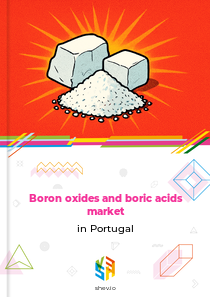







Earlier Report Observations
The market for boron oxides and boric acids in Portugal expanded from 319 tons in 2019 to 559 tons in 2023. This growth was underpinned by the strength of the country's chemical, rubber, and plastics industry, which reported a turnover of 12 billion euros in 2021 and served sectors such as automotive and construction, boosting demand for boron compounds.
In 2024, the European Commission adopted an implementing decision that extended the approval period for the use of boric acid in type 8 biocidal products, directly supporting market demand in Portugal. Concurrently, the global borate mineral market was valued at $2.53 billion, reflecting sustained industrial demand worldwide.
By 2025, new regulatory measures came into effect, including a Portuguese ordinance on the prevention of major accidents involving hazardous substances and EU amendments restricting carcinogenic substances. These changes influenced the conditions for using boric acid, coinciding with a shift in import volumes while exports remained substantial.
Table of content
- 1. Disclaimer
- 2. Terms of use of the report
- 3. Product codes in the statistical classifications used in the report
-
4. Key Market Indicators
-
4.1. In kind
- 4.1.1. Production, 2019-2020, 2023
- 4.1.2. Imports, 2018-2025
- 4.1.3. Exports, 2018-2025
- 4.1.4. Market size, 2019-2020, 2023
-
4.1. In kind
-
5. Production
-
5.1. Production in Portugal
- 5.1.1. In kind, 2019-2020, 2023, kg
- 5.1.2. In value, 2019-2020, 2023, $ US
-
5.2. Production in the EU, 2019-2024
- 5.2.1. In kind, 2019-2024, kg
- 5.2.2. In value, 2019-2024, $ US
-
5.1. Production in Portugal
-
6. Exports
-
6.1. Exports (Direct Data)
- 6.1.1. Exports - Total information
-
6.1.2. Exports in kind, t
- 6.1.2.1. Annual dynamics of product's exports from Portugal in kind, 2018-2025, t
- 6.1.2.2. Dynamics of product's exports in kind from Portugal by countries, 2018-2025, t
- 6.1.2.3. Structure of product's exports in kind by countries, 2018-2025
-
6.1.3. Exports in value, K $ US
- 6.1.3.1. Annual dynamics of product's exports from Portugal in value, 2018-2025, K $ US
- 6.1.3.2. Dynamics of product's exports in value from Portugal by countries, 2018-2025, K $ US
- 6.1.3.3. Structure of product's exports in value by countries, 2018-2025
-
6.1.4. Average price of product's exports, $ US/t
- 6.1.4.1. Annual dynamics of average price of product's exports from Portugal, 2018-2025, $ US/t
- 6.1.4.2. Dynamics of average price of product's exports from Portugal by countries, 2018-2025, $ US/t
-
6.2. Exports (Mirror Data)
- 6.2.1. Exports - Total information
-
6.2.2. Exports in kind, t
- 6.2.2.1. Annual dynamics of product's exports from Portugal in kind, 2018-2025, t
- 6.2.2.2. Dynamics of product's exports in kind from Portugal by countries, 2018-2025, t
- 6.2.2.3. Structure of product's exports in kind by countries, 2018-2025
-
6.2.3. Exports in value, K $ US
- 6.2.3.1. Annual dynamics of product's exports from Portugal in value, 2018-2025, K $ US
- 6.2.3.2. Dynamics of product's exports in value from Portugal by countries, 2018-2025, K $ US
- 6.2.3.3. Structure of product's exports in value by countries, 2018-2025
-
6.2.4. Average price of product's exports, $ US/t
- 6.2.4.1. Annual dynamics of average price of product's exports from Portugal, 2018-2025, $ US/t
- 6.2.4.2. Dynamics of average price of product's exports from Portugal by countries, 2018-2025, $ US/t
-
6.1. Exports (Direct Data)
-
7. Imports
-
7.1. Imports (Direct Data)
- 7.1.1. Imports - Total information
-
7.1.2. Imports in kind, t
- 7.1.2.1. Annual dynamics of product's imports to Portugal in kind, 2018-2025, t
- 7.1.2.2. Dynamics of product's imports in kind to Portugal by countries, 2018-2025, t
- 7.1.2.3. Structure of product's imports in kind by countries, 2018-2025
-
7.1.3. Imports in value, K $ US
- 7.1.3.1. Annual dynamics of product's imports to Portugal in value, 2018-2025, K $ US
- 7.1.3.2. Dynamics of product's imports in value to Portugal by countries, 2018-2025, K $ US
- 7.1.3.3. Structure of product's imports in value by countries, 2018-2025
-
7.1.4. Average price of product's imports, $ US/t
- 7.1.4.1. Annual dynamics of average price of product's imports to Portugal, 2018-2025, $ US/t
- 7.1.4.2. Dynamics of average price of product's imports to Portugal by countries, 2018-2025, $ US/t
-
7.2. Imports (Mirror Data)
- 7.2.1. Imports - Total information
-
7.2.2. Imports in kind, t
- 7.2.2.1. Annual dynamics of product's imports to Portugal in kind, 2018-2025, t
- 7.2.2.2. Dynamics of product's imports in kind to Portugal by countries, 2018-2025, t
- 7.2.2.3. Structure of product's imports in kind by countries, 2018-2025
-
7.2.3. Imports in value, K $ US
- 7.2.3.1. Annual dynamics of product's imports to Portugal in value, 2018-2025, K $ US
- 7.2.3.2. Dynamics of product's imports in value to Portugal by countries, 2018-2025, K $ US
- 7.2.3.3. Structure of product's imports in value by countries, 2018-2025
-
7.2.4. Average price of product's imports, $ US/t
- 7.2.4.1. Annual dynamics of average price of product's imports to Portugal, 2018-2025, $ US/t
- 7.2.4.2. Dynamics of average price of product's imports to Portugal by countries, 2018-2025, $ US/t
-
7.1. Imports (Direct Data)
-
8. Trade balance
-
8.1. Trade balance (Direct Data)
- 8.1.1. In kind, t
- 8.1.2. In value, K $ US
-
8.2. Trade balance (Mirror Data)
- 8.2.1. In kind, t
- 8.2.2. In value, K $ US
-
8.1. Trade balance (Direct Data)
-
9. Top buying and selling countries, 2018-2025
-
9.1. Direct Data
- 9.1.1. Import in Value by Countries-buyers
- 9.1.2. Export in Value by Countries-suppliers
-
9.2. Mirror Data
- 9.2.1. Import in Value by Countries-buyers
- 9.2.2. Export in Value by Countries-suppliers
-
9.1. Direct Data
Production boron oxides and boric acids in Portugal
In value, 2018-2021, $ US
In 2020, Portugal's output of boron oxides and boric acids was valued at 20,508 US dollars, marking a 19.0% increase compared to the previous year.
Annual dynamics of production in Portugal in value, 2018-2021, $ US
| Parameter | 2019 | 2020 | 2021 | CAGR | |
|---|---|---|---|---|---|
| 1 | Change from last year | n/a | 19.0% | n/a | - |
In kind, 2018-2021, kg
In 2020, Portugal produced 8,200 kilograms of boron oxides and boric acids, representing a 15.5% rise year-over-year.
Annual dynamics of production in Portugal in kind, 2018-2021, kg
| Parameter | 2019 | 2020 | 2021 | CAGR | |
|---|---|---|---|---|---|
| 1 | Change from last year | n/a | 15.5% | n/a | - |
Exports boron oxides and boric acids from Portugal
Exports in kind, t
Market performance showed significant fluctuations during this period. Exports reached their lowest point in 2019 at 2.0 tonnes, then peaked in 2021 at 24.2 tonnes, a 12.2-fold difference. In 2021, Portugal exported 24.2 tonnes of boron oxides and boric acids, a 69.7% increase from 2020. The largest decline occurred in 2019, falling by 85.6%, while the largest increase was in 2020, surging by 621.2%.
Annual dynamics of product's exports from Portugal in kind, 2018-2021, t
| Parameter | 2019 | 2020 | 2021 | CAGR | |
|---|---|---|---|---|---|
| 1 | Change from last year | (85.6%) | 621.2% | 69.7% | 20.7% |
From 2018 to 2021, South Africa, Angola, and Spain remained the primary buyers of boron oxides and boric acids from Portugal in terms of volume. South Africa accounted for 47.5% of exports, Angola for 23.1%, and Spain for 9.3%, together making up 79.9% of total exports.
Structure of product's exports in kind by countries, 2018-2021
World map of product's exports from Portugal in kind, 2018-2021
Exports in value, K $ US
The market displayed an unstable trend throughout the timeframe. Exports hit their lowest point in 2019 at 4.3 thousand US dollars, then peaked in 2021 at 83.7 thousand US dollars, a 20-fold change. In 2021, Portugal's exports of boron oxides and boric acids totaled 83.7 thousand US dollars, reflecting a notable 16.3% year-over-year increase. The largest decline was in 2019, dropping by 86.3%, while the largest increase was in 2020, jumping by 1,584.3%.
Annual dynamics of product's exports from Portugal in value, 2018-2021, K $ US
| Parameter | 2019 | 2020 | 2021 | CAGR | |
|---|---|---|---|---|---|
| 1 | Change from last year | (86.3%) | 1 584.3% | 16.3% | 38.9% |
Between 2018 and 2021, South Africa, Angola, and Turkey were the biggest contributors to Portugal's exports in value terms. South Africa made up 58.2% of exports, Angola 11.3%, and Turkey 9.4%, collectively accounting for 78.9% of total flows.
Structure of product's exports in value by countries, 2018-2021
World map of product's exports from Portugal in value, 2018-2021
Imports boron oxides and boric acids to Portugal
Imports in kind, t
Portugal's imports of boron oxides and boric acids increased for the second consecutive year. In 2021, imports totaled 546.7 tonnes, indicating a dramatic 32.2% rise compared to 2020. Over the period from 2018 to 2021, imports grew by 7.7%, with a compound annual growth rate of 2.5%. The minimum value was recorded in 2019 at 313.8 tonnes, with the largest decline that year at 38.2%.
Annual dynamics of product's imports to Portugal in kind, 2018-2021, t
| Parameter | 2019 | 2020 | 2021 | CAGR | |
|---|---|---|---|---|---|
| 1 | Change from last year | (38.2%) | 31.8% | 32.2% | 2.5% |
From 2018 to 2021, Spain and Turkey clearly dominated the partner structure for imports in kind, while other countries together formed the remaining share.
Structure of product's imports in kind by countries, 2018-2021
World map of product's imports to Portugal in kind, 2018-2021
Imports in value, K $ US
After a two-year decline, Portugal's imports of boron oxides and boric acids from abroad increased. In 2021, imports totaled 527.1 thousand US dollars, showing a 27.1% gain versus the previous year. Over the period from 2018 to 2021, imports decreased by 25.7%, with a compound annual growth rate of 9.4%. The minimum value was recorded in 2020 at 414.6 thousand US dollars, and the largest decline occurred in 2019, falling by 40.2%.
Annual dynamics of product's imports to Portugal in value, 2018-2021, K $ US
| Parameter | 2019 | 2020 | 2021 | CAGR | |
|---|---|---|---|---|---|
| 1 | Change from last year | (40.2%) | (2.3%) | 27.1% | (9.4%) |
Between 2018 and 2021, Spain and Turkey were the main directions for imports in value terms, jointly taking 86.5% of total flows, while the residual share was split among other markets.
Structure of product's imports in value by countries, 2018-2021
World map of product's imports to Portugal in value, 2018-2021
Related Reports



Why Choose Us?
Only Verified Data
No Hidden Costs or Separate Fees
Smarter Subscription Pricing
Contact Our Team
Submit your inquiry using the form below — our team will get back to you within 24 hours.