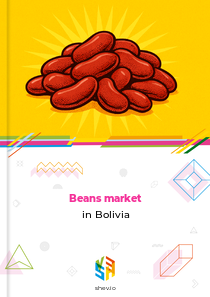







Earlier Report Observations
From 2018 to 2023, Bolivia's fresh or chilled bean market displayed notable stability, with annual production volumes moving within a narrow range of 1 323 t to 1 340 t. This consistent output indicates a well-established domestic production base meeting steady local demand, as imports were negligible throughout the period.
The market environment during these years was shaped by progressive labeling regulations. Starting in 2018, Supreme Decree No. 2452 mandated the labeling of products containing or derived from genetically modified organisms (GMOs), a rule that remained in force and primarily affected the supply chain for imported beans. Concurrently, Bolivian Standard NB 31400-01 established comprehensive labeling requirements for prepackaged foods, including fresh beans, demanding clear nutritional and origin information.
Regulatory focus continued with heightened surveillance of labeling compliance and, in 2022, the government began enforcing a front-of-pack graphic labeling system, giving producers a defined timeline to adjust their packaging. By 2024, further developments included Decree No. 5212, which suspended import tariffs on key agricultural inputs like insecticides and fungicides until mid-2025, a measure discussed since 2023 aimed at reducing production costs for crops including beans.
Table of content
- 1. Disclaimer
- 2. Terms of use of the report
- 3. Product codes in the statistical classifications used in the report
-
4. Key Market Indicators and Trends
-
4.1. Key Market Indicators
-
4.1.1. In kind
- 4.1.1.1. Production, 2018-2023
- 4.1.1.2. Imports, 2018-2024
- 4.1.1.3. Exports, 2018-2024
- 4.1.1.4. Market size, 2018-2023
-
4.1.1. In kind
- 4.2. Market Trends and Factors
-
4.1. Key Market Indicators
-
5. Production
-
5.1. Production in Bolivia
- 5.1.1. Annual dynamics of production in Bolivia in kind, 2018-2023, t
- 5.1.2. Annual dynamics of production in Bolivia in value, 2018-2023, $ US
-
5.2. Global production by Country, 2018-2023
- 5.2.1. Annual dynamics of production by macroregions in kind, 2018-2023, t
- 5.2.2. Dynamics of production structure by macroregions in kind, 2018-2023
- 5.2.3. Annual dynamics of production by country in kind, 2018-2023, t
- 5.2.4. Structure of production by countries in kind, 2018-2023
- 5.2.5. Dynamics of peoduction structure by countries in kind, 2018-2023
-
5.1. Production in Bolivia
-
6. Trade balance
-
6.1. Trade balance (Direct Data)
- 6.1.1. In kind, kg
- 6.1.2. In value, $ US
-
6.2. Trade balance (Mirror Data)
- 6.2.1. In kind, kg
- 6.2.2. In value, $ US
-
6.1. Trade balance (Direct Data)
-
7. Top buying and selling countries, 2018-2024
-
7.1. Direct Data
- 7.1.1. Import in Value by Countries-buyers
- 7.1.2. Export in Value by Countries-suppliers
-
7.2. Mirror Data
- 7.2.1. Import in Value by Countries-buyers
- 7.2.2. Export in Value by Countries-suppliers
-
7.1. Direct Data
Production beans in Bolivia
In kind, 2017-2020, t
Top producers of beans, 2017-2020
World map of production of beans, 2017-2020
Bolivia's bean production has increased for the third year in a row. In 2020, the country produced 1 340 tonnes of beans, marking a slight gain of 0.6% compared to 2019. Over the four-year period from 2017 to 2020, production grew by 3.9%, with an average annual growth rate of 1.3%.
Annual dynamics of production in Bolivia in kind, 2017-2020, t
| Parameter | 2018 | 2019 | 2020 | CAGR | |
|---|---|---|---|---|---|
| 1 | Change from last year | 2.6% | 0.7% | 0.6% | 1.3% |
Exports beans from Bolivia
Industry analysis indicates that Bolivia did not export any beans between 2017 and 2020.
Imports beans to Bolivia
Market research shows that Bolivia did not import any beans from 2017 to 2020.
Related Reports

2026-03-27
2026-03-27
Beans market in Western Europe
2026-03-27
2026-03-27

2026-03-30

2026-03-27
Dried shelled beans market in Bolivia
2026-03-27

Onions and shallots market in Bolivia
2026-03-27
Why Choose Us?
Only Verified Data
No Hidden Costs or Separate Fees
Smarter Subscription Pricing
Contact Our Team
Submit your inquiry using the form below — our team will get back to you within 24 hours.