






"SADC" region includes following countries:
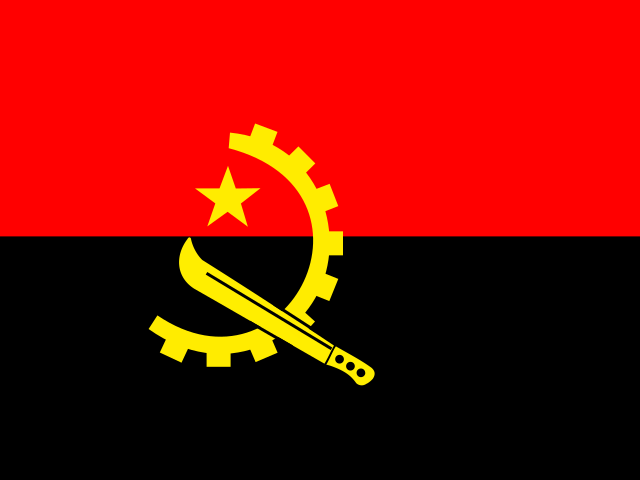 Angola
 Botswana
 Comoros
 Democratic Republic of the Congo
 Eswatini
 Lesotho
 Madagascar
 Malawi
 Mauritius
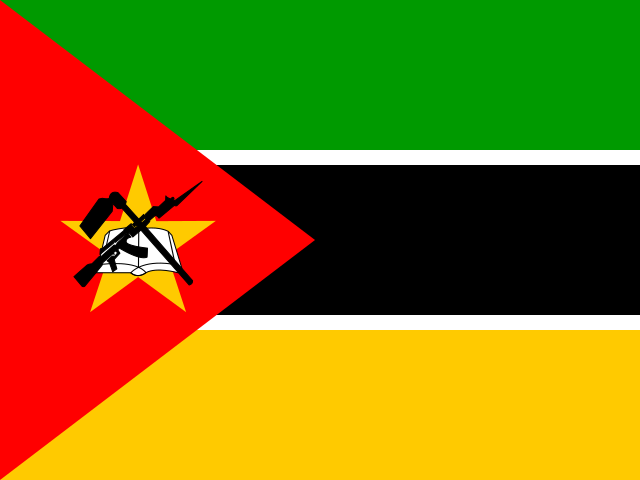 Mozambique
 Namibia
 Seychelles
 South Africa
 Tanzania
 Zambia
 Zimbabwe
Earlier Report Observations
From 2018 to 2020, the banana market volume in SADC initially increased from 10 549 thousand tons to 10 704 thousand tons in 2019, then declined to 10 429 thousand tons in 2020. In value terms, the market dropped sharply to $6 789 million in 2020 from $8 747 million the previous year.
The market recovered strongly in 2021, with volume reaching 10 887 thousand tons and value rising to $8 662 million, partly due to cooler global temperatures that reduced banana production worldwide, tightening supply and supporting prices. Growth continued through 2023, with volume reaching 11 616 thousand tons and value $10 758 million, as local production faced constraints from climatic factors, leading to an 11.5% increase in horticultural product prices.
In 2024, new amendments to pesticide residue limits for bananas were published in South Africa, and the Competition Commission's inquiry highlighted high market concentration among agents, proposing changes to improve competitiveness for small-scale farmers.
Table of content
- 1. Disclaimer
- 2. Terms of use of the report
- 3. Product codes in the statistical classifications used in the report
-
4. Key Market Indicators and Trends
-
4.1. Key Market Indicators
-
4.1.1. In kind
- 4.1.1.1. Production, 2018-2023
- 4.1.1.2. Imports, 2018-2024
- 4.1.1.3. Exports, 2018-2024
- 4.1.1.4. Market size, 2018-2023
-
4.1.2. In value
- 4.1.2.1. Production, 2018-2023
- 4.1.2.2. Imports, 2018-2024
- 4.1.2.3. Exports, 2018-2024
- 4.1.2.4. Market size, 2018-2023
-
4.1.1. In kind
- 4.2. Market Trends and Factors
-
4.1. Key Market Indicators
-
5. Production
-
5.1. Production in SADC
- 5.1.1. Annual dynamics of production in SADC in kind, 2018-2023, K t
-
5.2. Global production by Country, 2018-2023
- 5.2.1. Annual dynamics of production by macroregions in kind, 2018-2023, K t
- 5.2.2. Dynamics of production structure by macroregions in kind, 2018-2023
- 5.2.3. Annual dynamics of production by country in kind, 2018-2023, K t
- 5.2.4. Structure of production by countries in kind, 2018-2023
- 5.2.5. Dynamics of peoduction structure by countries in kind, 2018-2023
-
5.1. Production in SADC
-
6. Exports
-
6.1. Exports (Direct Data*)
- 6.1.1. Exports - Total information
-
6.1.2. Exports in kind, K t
- 6.1.2.1. Annual dynamics of product's exports from Angola in kind, 2018-2024, K t
- 6.1.2.2. Dynamics of product's exports in kind from Angola by countries, 2018-2024, K t
- 6.1.2.3. Structure of product's exports in kind by countries, 2018-2024
-
6.1.3. Exports in value, K $ US
- 6.1.3.1. Annual dynamics of product's exports from Angola in value, 2018-2024, K $ US
- 6.1.3.2. Dynamics of product's exports in value from Angola by countries, 2018-2024, K $ US
- 6.1.3.3. Structure of product's exports in value by countries, 2018-2024
-
6.1.4. Average price of product's exports, $ US/t
- 6.1.4.1. Annual dynamics of average price of product's exports from Angola, 2018-2024, $ US/t
- 6.1.4.2. Dynamics of average price of product's exports from Angola by countries, 2018-2024, $ US/t
-
6.2. Exports (Mirror Data)
- 6.2.1. Exports - Total information
-
6.2.2. Exports in kind, K t
- 6.2.2.1. Annual dynamics of product's exports from Angola in kind, 2018-2024, K t
- 6.2.2.2. Dynamics of product's exports in kind from Angola by countries, 2018-2024, K t
- 6.2.2.3. Structure of product's exports in kind by countries, 2018-2024
-
6.2.3. Exports in value, K $ US
- 6.2.3.1. Annual dynamics of product's exports from Angola in value, 2018-2024, K $ US
- 6.2.3.2. Dynamics of product's exports in value from Angola by countries, 2018-2024, K $ US
- 6.2.3.3. Structure of product's exports in value by countries, 2018-2024
-
6.2.4. Average price of product's exports, $ US/t
- 6.2.4.1. Annual dynamics of average price of product's exports from Angola, 2018-2024, $ US/t
- 6.2.4.2. Dynamics of average price of product's exports from Angola by countries, 2018-2024, $ US/t
-
6.1. Exports (Direct Data*)
-
7. Imports
-
7.1. Imports (Direct Data*)
- 7.1.1. Imports - Total information
-
7.1.2. Imports in kind, K t
- 7.1.2.1. Annual dynamics of product's imports to Angola in kind, 2018-2024, K t
- 7.1.2.2. Dynamics of product's imports in kind to Angola by countries, 2018-2024, K t
- 7.1.2.3. Structure of product's imports in kind by countries, 2018-2024
-
7.1.3. Imports in value, K $ US
- 7.1.3.1. Annual dynamics of product's imports to Angola in value, 2018-2024, K $ US
- 7.1.3.2. Dynamics of product's imports in value to Angola by countries, 2018-2024, K $ US
- 7.1.3.3. Structure of product's imports in value by countries, 2018-2024
-
7.1.4. Average price of product's imports, $ US/t
- 7.1.4.1. Annual dynamics of average price of product's imports to Angola, 2018-2024, $ US/t
- 7.1.4.2. Dynamics of average price of product's imports to Angola by countries, 2018-2024, $ US/t
-
7.2. Imports (Mirror Data)
- 7.2.1. Imports - Total information
-
7.2.2. Imports in kind, K t
- 7.2.2.1. Annual dynamics of product's imports to Angola in kind, 2018-2024, K t
- 7.2.2.2. Dynamics of product's imports in kind to Angola by countries, 2018-2024, K t
- 7.2.2.3. Structure of product's imports in kind by countries, 2018-2024
-
7.2.3. Imports in value, K $ US
- 7.2.3.1. Annual dynamics of product's imports to Angola in value, 2018-2024, K $ US
- 7.2.3.2. Dynamics of product's imports in value to Angola by countries, 2018-2024, K $ US
- 7.2.3.3. Structure of product's imports in value by countries, 2018-2024
-
7.2.4. Average price of product's imports, $ US/t
- 7.2.4.1. Annual dynamics of average price of product's imports to Angola, 2018-2024, $ US/t
- 7.2.4.2. Dynamics of average price of product's imports to Angola by countries, 2018-2024, $ US/t
-
7.1. Imports (Direct Data*)
-
8. Trade balance
-
8.1. Trade balance (Direct Data)
- 8.1.1. In kind, K t
- 8.1.2. In value, K $ US
-
8.2. Trade balance (Mirror Data)
- 8.2.1. In kind, K t
- 8.2.2. In value, K $ US
-
8.1. Trade balance (Direct Data)
-
9. Top buying and selling countries, 2018-2024
-
9.1. Direct Data
- 9.1.1. Import in Value by Countries-buyers
- 9.1.2. Export in Value by Countries-suppliers
-
9.2. Mirror Data
- 9.2.1. Import in Value by Countries-buyers
- 9.2.2. Export in Value by Countries-suppliers
-
9.1. Direct Data
Production bananas in SADC
In kind, 2017-2020, K t
Top producers of bananas, 2017-2020
World map of production of bananas, 2017-2020
Banana production in SADC grew for two years before declining. In 2020, SADC produced 10 499 thousand tonnes of bananas, representing a slight decrease of 2.2% compared to the previous year. Over the 2017-2020 period, production rose by 8.1%, with an average annual growth rate of 2.6%. The highest production level was recorded in 2019 at 10 732 thousand tonnes, while the largest year-on-year increase occurred in 2018 at 8.9%.
Annual dynamics of production in SADC in kind, 2017-2020, K t
| Parameter | 2018 | 2019 | 2020 | CAGR | |
|---|---|---|---|---|---|
| 1 | Change from last year | 8.9% | 1.5% | (2.2%) | 2.6% |
Exports bananas from SADC
Exports in kind, K t
Banana exports from SADC have increased for three consecutive years. In 2020, SADC exported 75.5 thousand tonnes of bananas, showing a sharp rise of 58.7% compared to 2019. Between 2017 and 2020, exports surged by 3 071.5%, translating to an average annual growth rate of 216.5%.
Annual dynamics of product's exports from SADC in kind, 2017-2020, K t
| Parameter | 2018 | 2019 | 2020 | CAGR | |
|---|---|---|---|---|---|
| 1 | Change from last year | 1 444.8% | 29.3% | 58.7% | 216.5% |
From 2017 to 2020, Portugal and Saudi Arabia consistently led the export structure in volume terms, together accounting for 4.0% of total export flows.
Structure of product's exports in kind by countries, 2017-2020
World map of product's exports from SADC in kind, 2017-2020
Exports in value, K $ US
Banana exports from SADC have grown for the third year in a row. In 2020, exports reached 48 778 thousand US dollars, up by 26.1% from 2019. Between 2017 and 2020, export value increased by 581.2%, corresponding to an average annual rate of 89.6%.
Annual dynamics of product's exports from SADC in value, 2017-2020, K $ US
| Parameter | 2018 | 2019 | 2020 | CAGR | |
|---|---|---|---|---|---|
| 1 | Change from last year | 339.5% | 22.9% | 26.1% | 89.6% |
Throughout 2017-2020, the three largest markets—Portugal, Saudi Arabia, and the United Arab Emirates—dominated exports in value terms, collectively representing 5.0% of total export flows.
Structure of product's exports in value by countries, 2017-2020
World map of product's exports from SADC in value, 2017-2020
Imports bananas to SADC
Imports in kind, K t
Import volumes showed significant volatility during this period. In 2019, imports peaked at 19.4 thousand tonnes, but by 2020 they had fallen to 5.7 thousand tonnes—a dramatic drop of 70.8% year-on-year. This created a 3.4-fold difference between the highest and lowest points from 2019 to 2020. The largest increase occurred in 2018 at 46.9%.
Annual dynamics of product's imports to SADC in kind, 2017-2020, K t
| Parameter | 2018 | 2019 | 2020 | CAGR | |
|---|---|---|---|---|---|
| 1 | Change from last year | 46.9% | 41.2% | (70.8%) | (15.4%) |
From 2017 to 2020, Ecuador remained the key supplier of bananas to SADC, accounting for 2.9% of total import volumes.
Structure of product's imports in kind by countries, 2017-2020
World map of product's imports to SADC in kind, 2017-2020
Imports in value, K $ US
After rising for two years, banana imports into SADC declined. In 2020, SADC imported approximately 50 666 thousand US dollars worth of bananas, marking a moderate decrease of 4.5% compared to the previous year. Between 2017 and 2020, import value increased by 21.4%, with an average annual growth rate of 6.7%. The highest value was recorded in 2019 at 53 056 thousand US dollars, while the largest increase occurred in 2018 at 14.4%.
Annual dynamics of product's imports to SADC in value, 2017-2020, K $ US
| Parameter | 2018 | 2019 | 2020 | CAGR | |
|---|---|---|---|---|---|
| 1 | Change from last year | 14.4% | 11.1% | (4.5%) | 6.7% |
Throughout 2017-2020, Ecuador was the primary supplier of bananas to SADC in value terms, consistently representing 4.7% of total import value.
Structure of product's imports in value by countries, 2017-2020
World map of product's imports to SADC in value, 2017-2020
Related Reports

2026-03-28
Bananas market in Eastern Asia
2026-03-28
Bananas market in Southern Asia
2026-03-28
2026-03-28

2026-03-28

Watermelons and melons market in SADC
2026-03-28


Lemons and limes market in SADC
2026-03-28
Why Choose Us?
Only Verified Data
No Hidden Costs or Separate Fees
Smarter Subscription Pricing
Contact Our Team
Submit your inquiry using the form below — our team will get back to you within 24 hours.