






"MERCOSUR" region includes following countries:
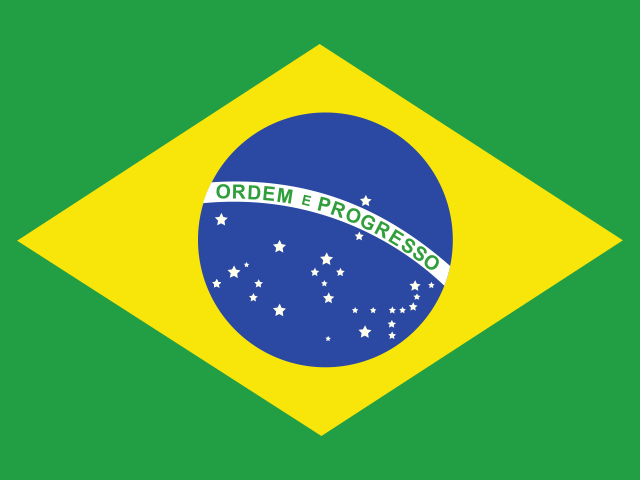 Brazil
 Argentina
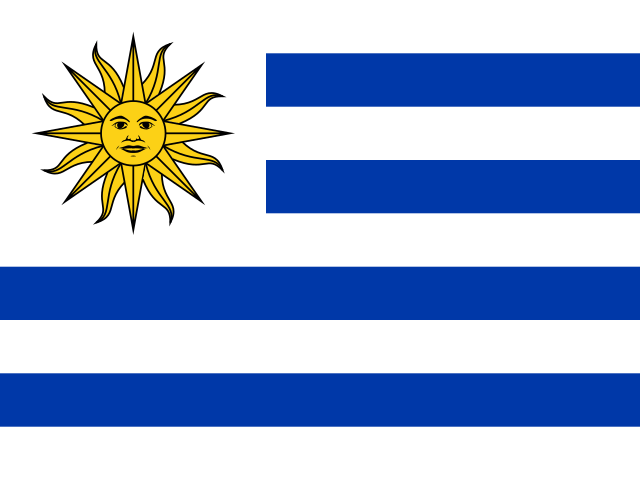 Uruguay
 Paraguay
Earlier Report Observations
The banana market in MERCOSUR began the period at 7.4 million tonnes in 2018, with Brazil established as the main regional supplier. Volume dipped to 7.3 million tonnes in 2020, a decline linked to the introduction of preferential tariff conditions for banana exports from MERCOSUR to the European Union, which increased external shipments and reduced domestic availability.
Market volume recovered to 7.5 million tonnes in 2021 as continued risks of oversupply in Europe under the trade opening dampened export pressure, retaining more supply within the region. Growth extended into 2022, reaching 7.7 million tonnes, supported by drought in key Brazilian exporting areas that constrained harvests and likely limited export flows.
In 2023, the market softened to 7.6 million tonnes, influenced by the MERCOSUR‑EU agreement which stimulated fruit exports from the bloc. For 2024, new sanitary registration rules for banana imports in Argentina and persistent climatic factors such as drought continued to affect the production and trade landscape across South America.
Table of content
- 1. Disclaimer
- 2. Terms of use of the report
- 3. Product codes in the statistical classifications used in the report
-
4. Key Market Indicators and Trends
-
4.1. Key Market Indicators
-
4.1.1. In kind
- 4.1.1.1. Production, 2018-2023
- 4.1.1.2. Imports, 2018-2024
- 4.1.1.3. Exports, 2018-2024
- 4.1.1.4. Market size, 2018-2023
-
4.1.1. In kind
- 4.2. Market Trends and Factors
-
4.1. Key Market Indicators
-
5. Production
-
5.1. Production in MERCOSUR
- 5.1.1. Annual dynamics of production in MERCOSUR in kind, 2018-2023, K t
-
5.2. Global production by Country, 2018-2023
- 5.2.1. Annual dynamics of production by macroregions in kind, 2018-2023, K t
- 5.2.2. Dynamics of production structure by macroregions in kind, 2018-2023
- 5.2.3. Annual dynamics of production by country in kind, 2018-2023, K t
- 5.2.4. Structure of production by countries in kind, 2018-2023
- 5.2.5. Dynamics of peoduction structure by countries in kind, 2018-2023
-
5.1. Production in MERCOSUR
-
6. Imports
-
6.1. Imports (Direct Data)
- 6.1.1. Imports - Total information
-
6.1.2. Imports in kind, K t
- 6.1.2.1. Annual dynamics of product's imports to Brazil in kind, 2018-2024, K t
- 6.1.2.2. Dynamics of product's imports in kind to Brazil by countries, 2018-2024, K t
- 6.1.2.3. Structure of product's imports in kind by countries, 2018-2024
-
6.1.3. Imports in value, M $ US
- 6.1.3.1. Annual dynamics of product's imports to Brazil in value, 2018-2024, M $ US
- 6.1.3.2. Dynamics of product's imports in value to Brazil by countries, 2018-2024, M $ US
- 6.1.3.3. Structure of product's imports in value by countries, 2018-2024
-
6.1.4. Average price of product's imports, $ US/t
- 6.1.4.1. Annual dynamics of average price of product's imports to Brazil, 2018-2024, $ US/t
- 6.1.4.2. Dynamics of average price of product's imports to Brazil by countries, 2018-2024, $ US/t
-
6.2. Imports (Mirror Data)
- 6.2.1. Imports - Total information
-
6.2.2. Imports in kind, K t
- 6.2.2.1. Annual dynamics of product's imports to Brazil in kind, 2018-2024, K t
- 6.2.2.2. Dynamics of product's imports in kind to Brazil by countries, 2018-2024, K t
- 6.2.2.3. Structure of product's imports in kind by countries, 2018-2024
-
6.2.3. Imports in value, M $ US
- 6.2.3.1. Annual dynamics of product's imports to Brazil in value, 2018-2024, M $ US
- 6.2.3.2. Dynamics of product's imports in value to Brazil by countries, 2018-2024, M $ US
- 6.2.3.3. Structure of product's imports in value by countries, 2018-2024
-
6.2.4. Average price of product's imports, $ US/t
- 6.2.4.1. Annual dynamics of average price of product's imports to Brazil, 2018-2024, $ US/t
- 6.2.4.2. Dynamics of average price of product's imports to Brazil by countries, 2018-2024, $ US/t
-
6.1. Imports (Direct Data)
-
7. Exports
-
7.1. Exports (Direct Data)
- 7.1.1. Exports - Total information
-
7.1.2. Exports in kind, K t
- 7.1.2.1. Annual dynamics of product's exports from Brazil in kind, 2018-2024, K t
- 7.1.2.2. Dynamics of product's exports in kind from Brazil by countries, 2018-2024, K t
- 7.1.2.3. Structure of product's exports in kind by countries, 2018-2024
-
7.1.3. Exports in value, M $ US
- 7.1.3.1. Annual dynamics of product's exports from Brazil in value, 2018-2024, M $ US
- 7.1.3.2. Dynamics of product's exports in value from Brazil by countries, 2018-2024, M $ US
- 7.1.3.3. Structure of product's exports in value by countries, 2018-2024
-
7.1.4. Average price of product's exports, $ US/t
- 7.1.4.1. Annual dynamics of average price of product's exports from Brazil, 2018-2024, $ US/t
- 7.1.4.2. Dynamics of average price of product's exports from Brazil by countries, 2018-2024, $ US/t
-
7.2. Exports (Mirror Data)
- 7.2.1. Exports - Total information
-
7.2.2. Exports in kind, K t
- 7.2.2.1. Annual dynamics of product's exports from Brazil in kind, 2018-2024, K t
- 7.2.2.2. Dynamics of product's exports in kind from Brazil by countries, 2018-2024, K t
- 7.2.2.3. Structure of product's exports in kind by countries, 2018-2024
-
7.2.3. Exports in value, M $ US
- 7.2.3.1. Annual dynamics of product's exports from Brazil in value, 2018-2024, M $ US
- 7.2.3.2. Dynamics of product's exports in value from Brazil by countries, 2018-2024, M $ US
- 7.2.3.3. Structure of product's exports in value by countries, 2018-2024
-
7.2.4. Average price of product's exports, $ US/t
- 7.2.4.1. Annual dynamics of average price of product's exports from Brazil, 2018-2024, $ US/t
- 7.2.4.2. Dynamics of average price of product's exports from Brazil by countries, 2018-2024, $ US/t
-
7.1. Exports (Direct Data)
-
8. Trade balance
-
8.1. Trade balance (Direct Data)
- 8.1.1. In kind, K t
- 8.1.2. In value, M $ US
-
8.2. Trade balance (Mirror Data)
- 8.2.1. In kind, K t
- 8.2.2. In value, M $ US
-
8.1. Trade balance (Direct Data)
-
9. Top buying and selling countries, 2018-2024
-
9.1. Direct Data
- 9.1.1. Import in Value by Countries-buyers
- 9.1.2. Export in Value by Countries-suppliers
-
9.2. Mirror Data
- 9.2.1. Import in Value by Countries-buyers
- 9.2.2. Export in Value by Countries-suppliers
-
9.1. Direct Data
Production bananas in MERCOSUR
In kind, 2017-2020, K t
Top producers of bananas, 2017-2020
World map of production of bananas, 2017-2020
Banana production in MERCOSUR declined after two consecutive years of growth. In 2019, production reached its peak at 7 098 K t, but then fell by 3.3% in 2020 to 6 865 K t. The largest annual increase occurred in 2018, when production rose by 2.1%.
Annual dynamics of production in MERCOSUR in kind, 2017-2020, K t
| Parameter | 2018 | 2019 | 2020 | CAGR | |
|---|---|---|---|---|---|
| 1 | Change from last year | 2.1% | 1.8% | (3.3%) | 0.2% |
Exports bananas from MERCOSUR
Exports in kind, K t
Banana export volumes from MERCOSUR showed significant fluctuations during this period. In 2018, exports hit their lowest point at 28.0 K t, with a decline of 0.3% that year. However, exports surged by 107.5% in 2019, and then increased further by 9.9% in 2020 to reach 63.9 K t, which was the highest level recorded. Overall, exports in 2020 were 2.3 times higher than in 2018.
Annual dynamics of product's exports from MERCOSUR in kind, 2017-2020, K t
| Parameter | 2018 | 2019 | 2020 | CAGR | |
|---|---|---|---|---|---|
| 1 | Change from last year | (0.3%) | 107.5% | 9.9% | 31.5% |
From 2017 to 2020, MERCOSUR's banana exports in kind were distributed across a broad range of partner countries. The United Kingdom accounted for 3.5% of exports, Poland for 1.8%, and the United States for 1.8%. Together, these three countries represented just 7.1% of total export flows.
Structure of product's exports in kind by countries, 2017-2020
World map of product's exports from MERCOSUR in kind, 2017-2020
Exports in value, M $ US
Banana exports from MERCOSUR in value terms grew for the third year in a row. In 2020, exports reached 41.4 M $ US, a solid increase of 15.2% compared to 2019. Over the entire period from 2017 to 2020, exports rose by 109.4%, which translates to an average annual growth rate of 27.9%.
Annual dynamics of product's exports from MERCOSUR in value, 2017-2020, M $ US
| Parameter | 2018 | 2019 | 2020 | CAGR | |
|---|---|---|---|---|---|
| 1 | Change from last year | 43.8% | 26.5% | 15.2% | 27.9% |
The country composition of MERCOSUR's banana exports in value terms from 2017 to 2020 was highly dispersed. The United Kingdom accounted for 6.2% of exports, Poland for 2.6%, and Spain for 2.5%. Combined, these three countries made up only 11.3% of total flows, with the remaining 88.7% spread across numerous other destinations.
Structure of product's exports in value by countries, 2017-2020
World map of product's exports from MERCOSUR in value, 2017-2020
Imports bananas to MERCOSUR
Imports in kind, K t
After two years of decline, banana imports into MERCOSUR rebounded. In 2019, imports fell to their lowest level at 401.3 K t, with the largest annual drop of 10.8% occurring in 2018. However, imports then increased by 12.1% year-over-year in 2020 to reach 449.8 K t. Over the full 2017-2020 period, imports decreased by 8.4%, equivalent to a compound annual growth rate of -2.9%.
Annual dynamics of product's imports to MERCOSUR in kind, 2017-2020, K t
| Parameter | 2018 | 2019 | 2020 | CAGR | |
|---|---|---|---|---|---|
| 1 | Change from last year | (10.8%) | (8.4%) | 12.1% | (2.9%) |
From 2017 to 2020, Ecuador, Bolivia, and Colombia consistently dominated MERCOSUR's banana imports in kind. Ecuador accounted for 55.7% of imports, Bolivia for 23.1%, and Colombia for 0.6%. Together, these three countries represented 79.4% of total import flows.
Structure of product's imports in kind by countries, 2017-2020
World map of product's imports to MERCOSUR in kind, 2017-2020
Imports in value, M $ US
Following two years of contraction, banana imports into MERCOSUR in value terms recovered. In 2019, imports declined by 9.2% to a low of 219.7 M $ US. However, in 2020, imports increased by 20.7% year-over-year to reach 265.2 M $ US.
Annual dynamics of product's imports to MERCOSUR in value, 2017-2020, M $ US
| Parameter | 2018 | 2019 | 2020 | CAGR | |
|---|---|---|---|---|---|
| 1 | Change from last year | (9.1%) | (9.2%) | 20.7% | (0.1%) |
From 2017 to 2020, Ecuador was the dominant source for MERCOSUR's banana imports in value terms, accounting for 71.9% of the total. The remaining imports were distributed among a variety of smaller trading partners.
Structure of product's imports in value by countries, 2017-2020
World map of product's imports to MERCOSUR in value, 2017-2020
Related Reports

Bananas market in Eastern Africa
2026-03-28
2026-03-28
2026-03-28
2026-03-28

Cashew nuts market in MERCOSUR
2026-03-28

Watermelons market in MERCOSUR
2026-03-28

2026-03-28

Watermelons and melons market in MERCOSUR
2026-03-28
Why Choose Us?
Only Verified Data
No Hidden Costs or Separate Fees
Smarter Subscription Pricing
Contact Our Team
Submit your inquiry using the form below — our team will get back to you within 24 hours.