Vietnam maps technology and processing push toward $20 billion fruit and vegetable exports
Vietnam’s fruit and vegetable exports could reach $9.5-10 billion in 2026, with the industry ultimately targeting $20 billion. Producers say higher-yield varieties, standardized growing areas, processing capacity and post-harvest infrastructure will be essential to sustain growth.
Exports approach the $10 billion mark
Vietnam’s fruit and vegetable industry is moving closer to $10 billion in annual exports and is setting its sights on a longer-term target of $20 billion. Đinh Cao Khuê, vice chairman of the Vietnam Fruit and Vegetable Association and chairman and chief executive of Đồng Giao Foodstuff Export JSC, or Doveco, said exports could reach $9.5-10 billion in 2026, representing growth of about 20%. Reaching the larger target will require the sector to sustain double-digit expansion while shifting from simple acreage growth toward higher productivity, consistent quality and products suited to international demand.
Passion fruit, pineapple and banana have emerged as crops with significant potential. According to Đinh Cao Khuê, Vietnam’s passion-fruit production was still fragmented about five years ago and struggled to compete with Peru and Ecuador. Support from the Fruit and Vegetable Research Institute and universities helped the country develop disease-free planting material to replace imports from Taiwan, China. Higher productivity has supported shipments to the United States and South America, including Brazil, the world’s third-largest passion-fruit producer.
Higher-yield crops and standardized farms
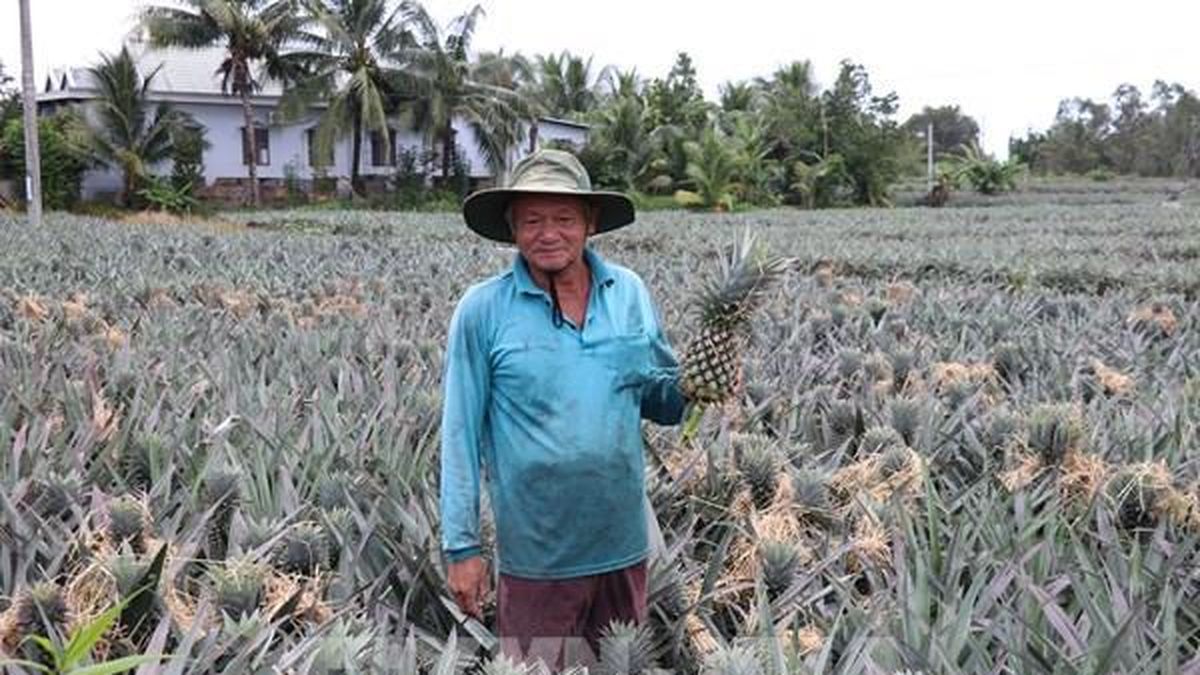
Pineapple yields illustrate the impact of varietal change. The industry moved from Queen varieties yielding about 50 tonnes per hectare to Cayenne at 70 tonnes and now MD2 at 100 tonnes. One hectare of MD2 pineapple can generate revenue of VND900 million to VND1 billion, while passion fruit produces at least about VND500 million per hectare, according to Đinh Cao Khuê. The MD2 variety can serve both fresh consumption and industrial processing, improving the economics of investment in factories and contracted growing areas.
Banana exporters are also being urged to prioritize commercial yields, quality and higher-value markets rather than acreage alone. Phạm Quốc Liêm, vice chairman of the association and chief executive of U&I Agriculture JSC, or Unifarm, said company calculations indicate that about 24,000 hectares of export-compliant farms would be needed to lift banana exports to $1 billion, alongside improvements in yields and prices. Standardizing 30% of Vietnam’s existing banana area could raise exports above $2 billion.
Companies are beginning to assemble larger raw-material zones. Westfood Hậu Giang has developed more than 300 hectares of MD2 pineapple on acid sulphate and grey soils in Cần Thơ, An Giang and Đồng Tháp. Trần Bá Sơn, the company’s raw-material area director, said Westfood aims to expand the area to about 1,000 hectares by 2030 to supply long-term export orders. Doveco also plans to start construction of a large processing plant in Nghệ An with capacity of 30 tonnes of product per hour, equivalent to about 60,000 tonnes annually. The facility is intended to purchase pineapples from Nghệ An to Quảng Trị.
Processing and post-harvest capacity become critical
Industry representatives say each promising crop needs at least one integrated model led by a major company connecting cooperatives and farmers with certified raw-material areas. Preferential credit tied to supply contracts could support those links. For MD2 pineapple, where imported planting material remains difficult to obtain, tissue-culture propagation is being proposed to secure domestic seedling supply and enable expansion.
Processing growth will also depend on sorting, packing, storage and traceability facilities that comply with GMP, HACCP and ISO 22000. Phạm Quốc Liêm warned that infrastructure mismatched with processing lines or farm scale could raise costs and limit exporters’ ability to fulfil orders. Industry participants are therefore seeking rules that permit appropriately sized post-harvest facilities on agricultural land while meeting environmental and land-use requirements. They also want irrigation investment to cover fruit-growing regions, not mainly rice production, particularly in areas exposed to climate-related water instability.