Vietnam exporters face EUDR deadline as VCCI urges supply-chain data overhaul
The EU Deforestation Regulation applies to large and medium-sized companies from 30 December 2026 and to small and micro enterprises from 30 June 2027, covering more than 80 tariff lines across seven commodity groups. Vietnamese exporters of coffee, rubber and wood are not directly in scope but hold the data EU importers need for due diligence. VCCI told a Hanoi seminar the deadline should be used to rebuild traceability from the plot to the container.
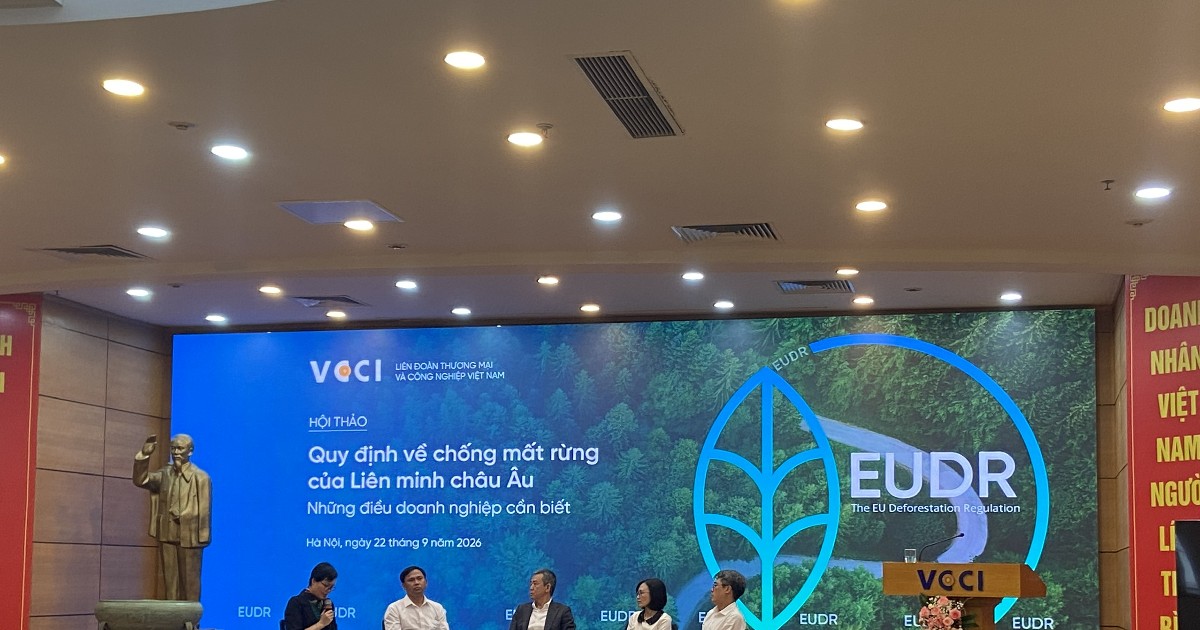
Vietnamese exporters of coffee, rubber and wood have just over three months before the European Union Deforestation Regulation (EUDR) starts to apply, and business groups in Hanoi are arguing that the deadline should be used to rebuild supply-chain data systems rather than to assemble one more set of export papers. VnEconomy reported on a seminar on the regulation hosted by the Vietnam Chamber of Commerce and Industry (VCCI).
EUDR takes effect for large and medium-sized companies on 30 December 2026 and extends to small and micro enterprises on 30 June 2027. It covers more than 80 tariff lines across seven product groups - cattle, cocoa, coffee, palm oil, rubber, soy and wood - and applies to raw materials and unprocessed commodities produced on or after 29 June 2023. The list of covered goods may be expanded in future.
Legal duty in the EU, evidence in Vietnam
Tran Minh Thu of the WTO and Integration Office at VCCI's legal department said the regulation applies directly to operators active on the EU market: EU producers, importers bringing goods into the bloc and exporters shipping goods out of it. It also binds traders that only distribute, including wholesalers and retailers that neither produce nor import.
Vietnamese companies selling into the EU are therefore not legally in scope, but compliance reaches them indirectly. They must ensure goods meet EUDR criteria and supply the information and evidence proving a consignment is unconnected to deforestation and was produced in line with Vietnamese law.
Nguyen Thi Thu Trang, an arbitrator at the Vietnam International Arbitration Centre (VIAC), set out the three obligations falling on the EU importer: collect all information showing the goods are deforestation-free and legal under the law of the country of production; run a risk assessment on that data; and, where risk is significant, apply mitigation measures to reduce it to zero or negligible before filing a due diligence statement. The pivotal role of the Vietnamese supplier sits inside that process, because the EU buyer cannot complete due diligence without the underlying data.
Records must be kept by the EU importer for five years, Trang said. If authorities run a post-check within that window and find the information untrue, the risk and legal exposure fall heavily on the Vietnamese supplier.
Three data sets exporters must assemble
- Basic details of the goods and the supplier: product type, quantity, geolocation coordinates of the growing area and production date.
- Deforestation-free evidence: reports and confirmation from local authorities on the use of agricultural land and production forest land.
- Legality evidence: the legal status of the production area under the rules of the place of production.
Three shifts VCCI is urging
Dau Anh Tuan, VCCI deputy secretary general and head of its legal department, said EUDR is not a standalone rule or a temporary measure but part of the EU's wider green policy system, so companies should build underlying capability rather than react to each regulation as it falls due. Coffee, rubber, wood and wood products are among Vietnam's main export lines, and the EU is both the largest market for them and the market that sets standards other buyers follow.
The first shift is from export-dossier thinking to supply-chain data thinking: continuous traceability from the plot of land to the container. A chain with many intermediate layers can be entirely legal and unconnected to deforestation and still fail to prove it if the information is not reorganised. The second is from individual compliance to sector-level cooperation, since no company, however large, can digitise hundreds of thousands of producing households alone. That puts weight on industry associations, on state land and forest data, and on reasonable cost-sharing between links in the chain. The third is from a passive to a proactive stance: the EU has placed Vietnam in its low-risk country group, which cuts the evidentiary burden and the probability of post-checks, but a country rating does not replace the obligations attached to each consignment.
VCCI also warned against two opposite errors. One camp treats the regulation as distant or plans to divert volumes to other markets if EU sales become difficult. The other over-prepares, spending on requirements that are in fact buyer demands or voluntary certifications rather than mandatory EUDR obligations. Dau Anh Tuan said that each time a market raises its standards and Vietnamese suppliers choose to meet them, the standing of Vietnamese goods rises with it.