Vietnam's Layer Sector Hit by Oversupply as Egg Output Reaches 21.4 Billion and Farmgate Prices Halve
Vietnamese egg production rose from about 19.22 billion eggs in 2023 to roughly 21.4 billion in 2025 and added another 4.8-5% in the first half of 2026, while farmgate prices fell from 2,500-3,000 dong per egg to as low as 1,200-1,500 dong. Industry bodies blame flock expansion by FDI firms, large livestock groups and feed producers, plus the loss of Cambodian demand. Retail prices have not fallen in step, leaving a spread of about 56% over the farm price.
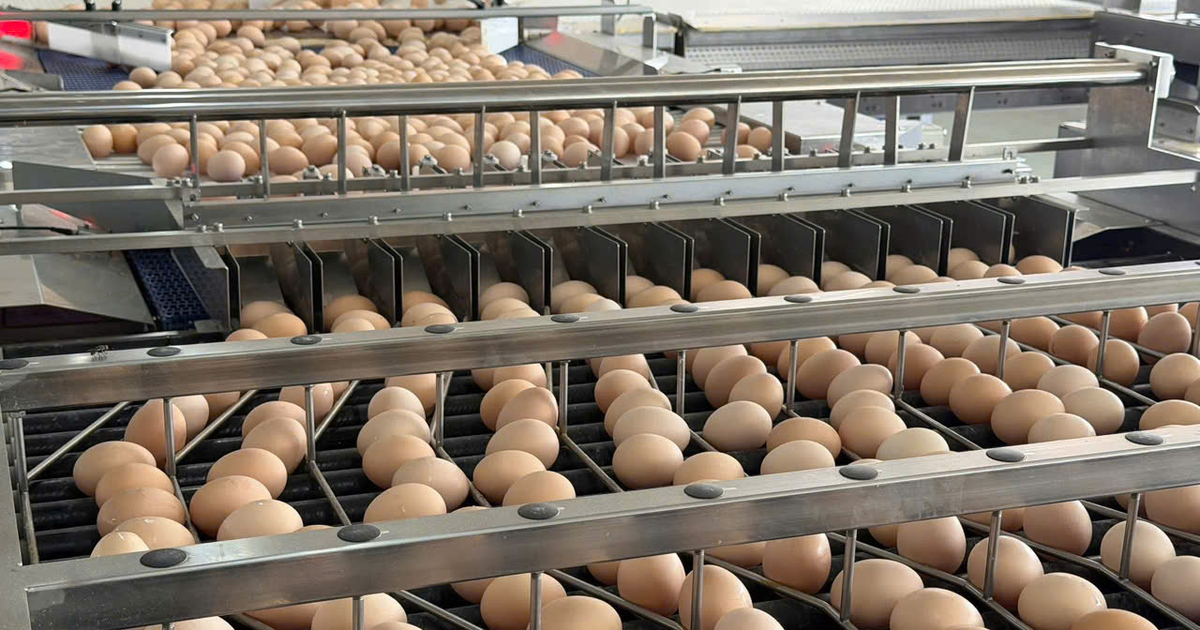
Vietnam's poultry egg market is caught between two opposing forces: output keeps climbing while farmgate prices are under heavy downward pressure. According to Thanh Nien, national egg production reached about 19.22 billion eggs in 2023, rose above 20 billion in 2024 and came in at roughly 21.4 billion in 2025. The increase has not stopped in 2026 — first-half output exceeded 10.8 billion eggs, a further rise of about 4.8-5%.
Supply that cannot be switched off
Livestock companies told Thanh Nien that the biology of laying flocks makes rapid adjustment close to impossible: once hens are in production, farmers cannot cut output quickly, even when the market shows clear signs of surplus. Purchasing power has not grown fast enough to absorb the additional eggs, so supply presses on the market continuously, particularly when consumption dips.
Price moves over the past two years show the scale of that pressure. Farmgate chicken egg prices reached about 2,500-3,000 dong per egg at points in late 2025. Prices began sliding in early 2026 and in May and June touched roughly 1,200-1,500 dong per egg in some areas, nearly half the late-2025 level. Cheap eggs appeared on pavements across the country while farms and companies booked losses every day. "A fall of just 500 dong in the egg price means a company producing 1 million eggs a day loses half a billion dong every single day," a livestock company representative told the newspaper.
The Cambodian demand shock
Truong Chi Thien, General Director of Vinh Thanh Dat Food Company, traced the cycle to a single export outlet. "Egg prices rose in 2025 because the Cambodian market increased purchases from Vietnam. Many people saw prices rising and poured money into expanding flocks. But Cambodia then gradually secured its own supply and restricted imports, leaving the domestic market in surplus. The more output grows, the greater the pressure to sell, because fresh eggs cannot be stored for long," he said.
Producers acknowledge that most Vietnamese eggs still have to be sold domestically and that export capability remains very limited. When supply outruns demand, the farmgate price becomes the first release valve: farmers cut prices to move product even though feed, day-old chicks, electricity, labour, veterinary medicine and the cost of capital do not fall in step.
Prices below cost across poultry
An official of the Vietnam Poultry Association said the most direct cause of the turbulence, especially in the first half of 2026, was the continuous expansion of total flocks and production capacity by FDI companies, large livestock groups and feed manufacturers from late last year onwards. At the low point, white-feather industrial chicken fell to 22,000-24,000 dong per kg and coloured-feather chicken to 45,000-48,000 dong per kg, while farmgate egg prices sank to 1,200-1,300 dong per egg — all below production cost. Conditions improved slightly in August and September 2026, but domestic demand is recovering slowly and output channels remain unstable, with weak offtake from collective kitchens, industrial-zone canteens and schools.
Farmgate falls faster than retail
A second distortion is that farm prices have fallen considerably further than consumer prices. In May 2026, when the market bottomed, southern farmgate chicken eggs commonly traded at about 1,400-1,500 dong per egg while retail prices stayed around 2,200-2,800 dong, a gap of 700-1,400 dong per egg. On 2 October, southern egg prices stood at 1,730 dong per egg, 448 dong below the same period a year earlier, while retail prices remained above 2,700 dong — a spread of about 970 dong, or roughly 56% above the farm price.
Nguyen Thanh Son, Chairman of the Vietnam Poultry Association, said that with surplus supply, low selling prices and persistently high input costs, the poultry sector can no longer grow by adding scale. He called for a shift towards output per bird through genetics, precision nutrition and stronger disease prevention, and for reorganising the entire value chain from breeding stock, feed and farming through slaughter, processing and distribution. Large companies, he said, should build closed linkage chains with offtake contracts while supplying breeding stock, feed and veterinary medicine to household farms, which would improve quality control and traceability. Son also urged fewer layers of intermediaries and more deep processing to lift product value and narrow the farm-to-retail gap, alongside professionalising farmers and expanding export markets.
Some companies additionally asked market-management and livestock authorities to tighten standards for eggs reaching the market, citing expired eggs sold off cheaply to workers and low-income consumers, and export consignments rejected on quality grounds that require closer control to prevent diversion into domestic trade.