Vietnam’s durian crop reaches record 2.08 million tons as oversupply risk grows
Vietnam’s durian production is forecast to reach 2.08 million tons in 2026 after planted area expanded to 200,000 hectares. China remains the dominant export market, while rising supply is already weighing on farm-gate prices.
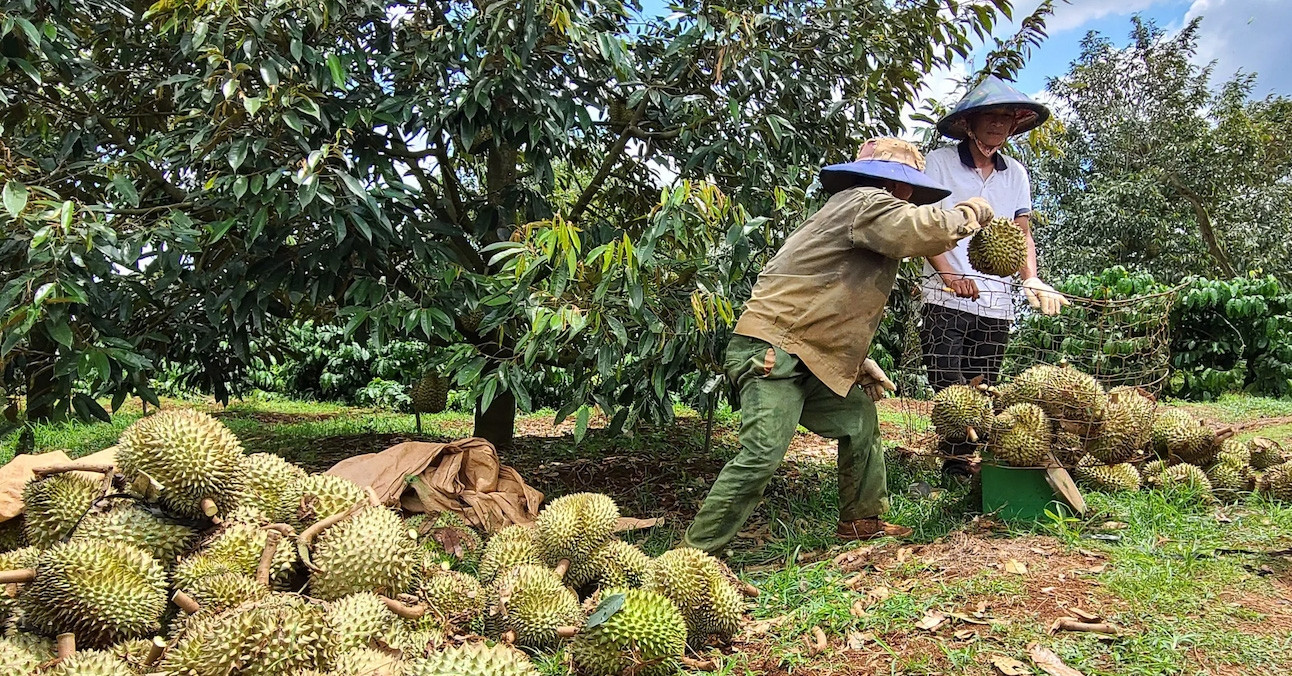
Production triples as planted area expands
Vietnam’s durian production is estimated to reach a record 2.08 million tons in 2026, prompting regulators to warn that rapidly expanding supply could outpace the industry’s processing, marketing and export capacity. According to VietNamNet, the country’s durian area has grown from 85,000 hectares in 2021 to 200,000 hectares in 2026. Output increased from about 674,000 tons to 2.08 million tons over the same period.
The expansion followed the start of official durian exports to China in July 2022. In less than five years, planted area increased 2.4 times and production almost 3.1 times. Only 129,500 hectares are currently bearing fruit. At an average yield of 16 tons per hectare, the Ministry of Agriculture and Environment estimates that production could exceed 3.2 million tons when the entire planted area reaches the fruiting stage.
China drives exports but concentrates risk
Durian export revenue rose from $180 million in 2021 and $421 million in 2022 to $2.24 billion in 2023. It subsequently reached $3.3 billion in 2024 and $3.86 billion in 2025. Durian accounted for 45% of Vietnam’s total fruit and vegetable export revenue in 2025, according to the ministry. In the first six months of 2026, exports were worth nearly $951 million, up 31% year on year. Shipments to China generated $871.8 million, an increase of 36.9%.
Vietnamese durian is sold in 21 countries and territories, but China takes about 90% of export volume. That dependence exposes growers and exporters to changes in Chinese technical rules, trade conditions and border procedures. Vietnamese suppliers also compete in China with Thailand, Malaysia, the Philippines and Cambodia. The ministry said 1,201 growing-area codes had been issued, while additional codes were awaiting Chinese approval. Frozen durian exports grew 45% in the first seven months of 2026 from the corresponding period of 2025, offering an additional outlet for the larger crop.
Harvest pressure reaches farm-gate prices
Vietnam had harvested 768,000 tons by the end of July, with another 1.31 million tons expected during the final five months of 2026. The Central Highlands alone is forecast to produce 850,000 tons, with its main harvest running from August through October. The concentration of supply is already depressing prices in the Central Highlands and Mekong Delta. In July, premium Ri6 durian averaged 44,476 dong per kilogram, down 1,286 dong from June. Monthong averaged 70,762 dong per kilogram, a monthly decline of 8,524 dong. An export company chief executive told VietNamNet that procurement prices for some categories had fallen by 10,000-15,000 dong per kilogram.
The ministry warned that unplanned planting and weak coordination among growers, buyers, packers, processors and distributors increase the risks of technical violations, rejected shipments and lost market access. It advised provinces not to encourage planting outside suitable areas and to prioritize productivity, quality, food safety, traceability and deeper processing. Dak Lak province has launched a 30-day campaign to digitize growing-area and packing-facility data. The ministry is also holding technical negotiations with China’s General Administration of Customs and expects a senior delegation to meet GACC officials in China on August 20-22 to address approvals, testing capacity and customs clearance.