Ukraine's raw milk output falls 13% to 4.1 million tonnes in eight months
Raw milk production in Ukraine declined to 4.1 million tonnes in the first eight months of 2026, down 13% year on year, according to Censor.net. The outlet published the national total alongside a regional breakdown and an assessment of market conditions. The contraction removes roughly 600,000 tonnes of raw material from the national balance and lands directly on processing capacity and export availability.
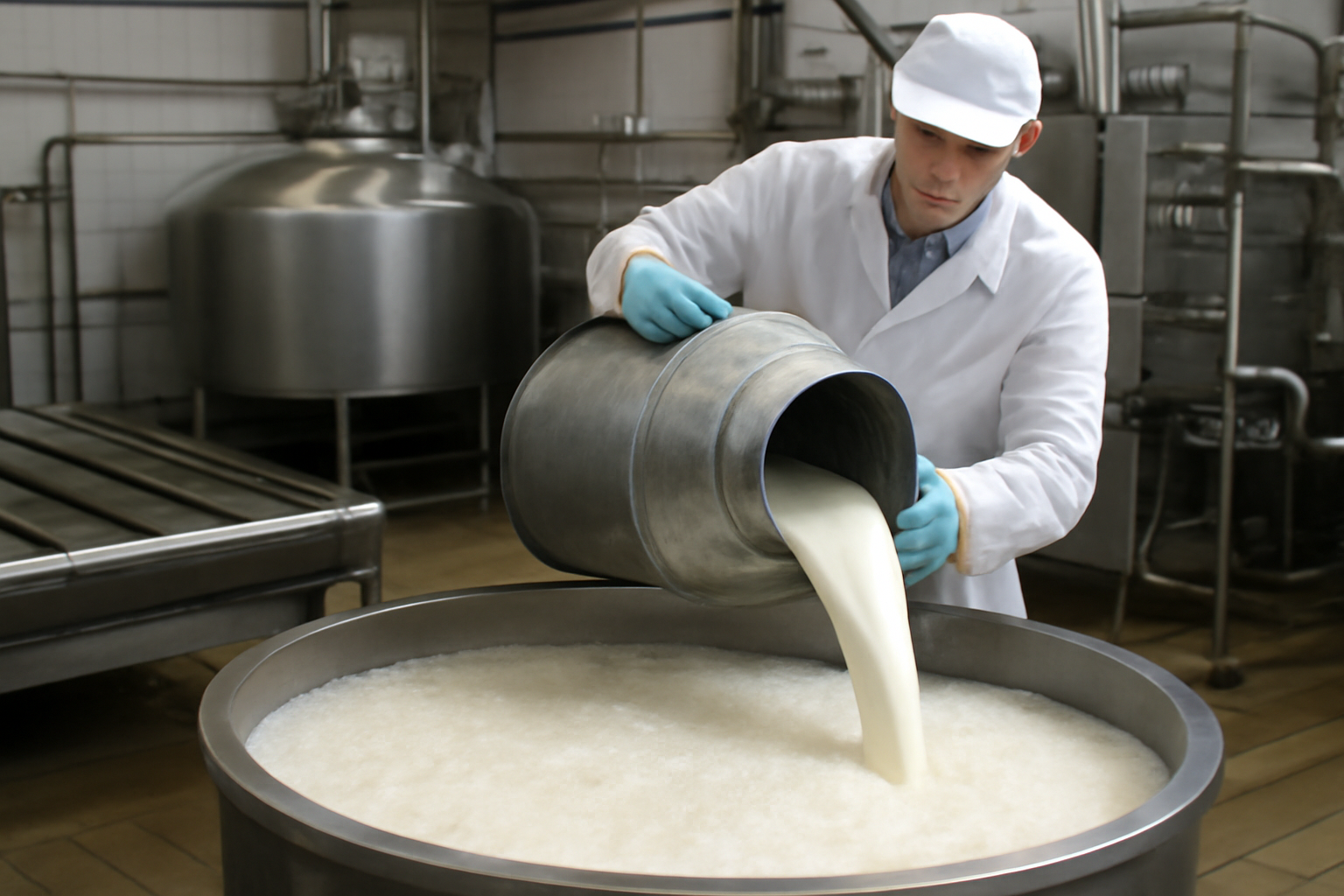
Raw milk production in Ukraine fell to 4.1 million tonnes in the first eight months of 2026, a decline of 13% against the same period a year earlier, according to Censor.net, which published the national figure together with statistics by region and an assessment of market conditions.
Applied to the reported total, a 13% contraction implies output of roughly 4.7 million tonnes in January-August 2025, and the loss of about 600,000 tonnes of raw material from the national balance over a single year. Averaged across the eight-month period, the 2026 volume corresponds to a little over 500,000 tonnes a month.
Why the regional breakdown matters
The regional detail published alongside the national total carries more weight in dairy than in most agricultural categories, because raw milk cannot travel far before quality and logistics costs erode its value. Collection radiuses are measured in hours rather than days, so a shortfall concentrated in particular oblasts is not offset by milk that may be available elsewhere in the country. Plants sited in areas where the herd has contracted face a physical ceiling on what they can buy, regardless of the price they are willing to pay. That is why a national average of minus 13% can understate the pressure on individual processing sites and overstate it on others.
Pressure on processing capacity
A double-digit fall in raw material arrives at fixed processing capacity. Driers, separators and cheese vats are built for a design intake, and running them below that level raises the cost of every tonne of finished product, because energy, labour and depreciation are spread across fewer units. The standard responses are to bid more aggressively for milk, which transfers margin from processors to farms that still have volume, or to shorten product lines and concentrate output on whatever carries the highest netback. The variables to watch through the rest of the season are:
- Capacity utilisation at drying and cheesemaking plants, where fixed costs per tonne are highest and the penalty for underloading is most severe.
- Competition for raw milk between cheese, butter and powder producers on one side and the fresh dairy segment on the other.
- The mix of deliveries processors can secure and the quality grades they are prepared to accept as the raw material base tightens.
What it means for trade
Ukrainian dairy exports are concentrated in butter, cheese and milk powders, and export availability in these positions is a residual: it is what remains once the domestic market has been supplied. A contraction on the scale reported compresses that residual before it compresses domestic consumption. If home demand holds, shipments fall first, and in tighter periods the direction of some flows reverses, with processors importing powder or butter to keep lines loaded and contracts served.
For importers that have used Ukrainian-origin butter and powder as a lower-cost alternative to other suppliers, the eight-month figure is an early signal to re-check contracted volumes for the remainder of the season rather than assume continuity. The full-year outcome will depend on whether the decline steepens in the autumn and winter months, when yields fall seasonally and feed costs weigh most heavily on farm economics. Censor.net did not report a single cause for the contraction in the material published, presenting instead the regional distribution of output and the current state of the market.