Tomato glut crashes prices and halts exports in Karnataka’s Kolar
Tomato arrivals at Karnataka’s Kolar APMC have exceeded 200,000 boxes a day, pushing the price to Rs 200 per 15-kg box. Exports to Bangladesh and Nepal have stopped, intensifying pressure on farmers already facing drought and high input costs.
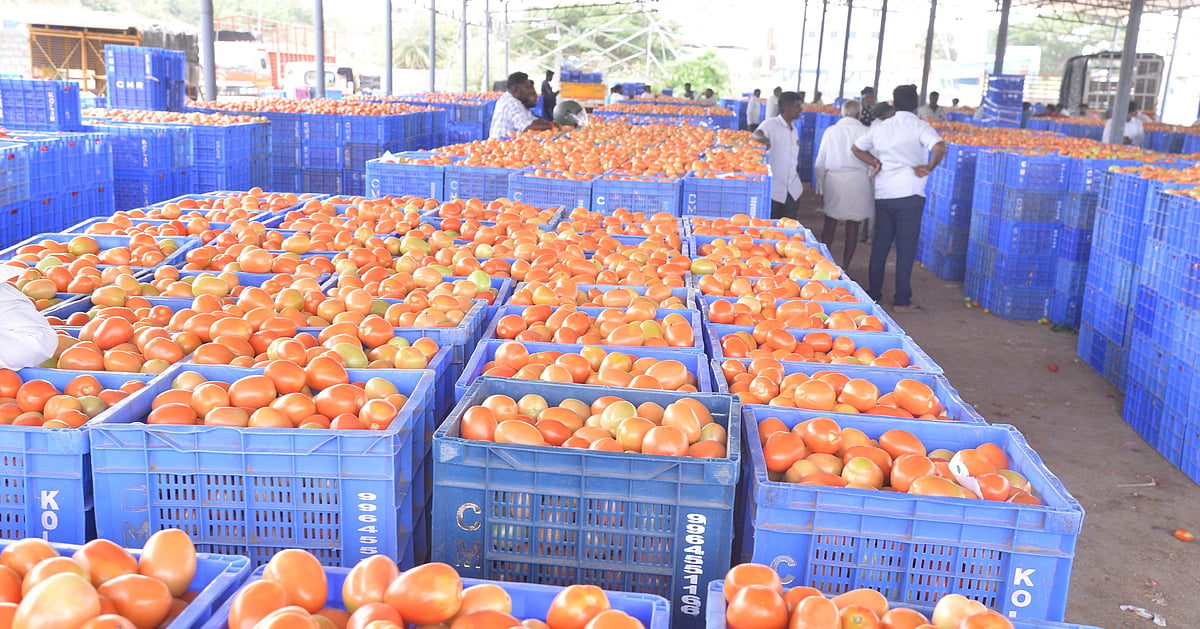
Heavy arrivals overwhelm the Kolar market
A sharp increase in tomato supplies has driven down prices at the Agricultural Produce Market Committee market in Kolar, Karnataka, leaving growers with fewer outlets for their crop. Deccan Herald reported that more than 200,000 boxes are reaching the market each day. With each box holding 15 kilograms, daily arrivals represent more than 3 million kilograms of tomatoes.
The volume has pushed the market price down to Rs 200 for a 15-kg box. That is equivalent to about Rs 13.33 per kilogram at the wholesale box level, before farmers account for harvesting, sorting, packaging and transport. The combination of large arrivals and a low selling price is placing immediate pressure on growers who must move a highly perishable crop quickly.
Exports to Bangladesh and Nepal stop
The price collapse has coincided with a halt in tomato exports to Bangladesh and Nepal, according to Deccan Herald. The loss of these destinations has removed demand from outside the domestic market just as supplies entering Kolar have risen above 200,000 boxes a day. Tomatoes that might otherwise have crossed India’s borders must therefore compete for buyers within a more limited market.
For traders and exporters, the low price at Kolar does not by itself guarantee viable cross-border business. Export movements also depend on available buyers and the ability to handle and deliver a perishable product. With shipments halted, the local market has lost a channel capable of absorbing part of the current supply, increasing the imbalance between daily arrivals and immediate demand.
Farmers face drought and high production costs
The oversupply comes despite drought conditions in Karnataka. Deccan Herald also identified high input costs as a factor worsening farmer distress. Growers are consequently dealing with two pressures at once: difficult production conditions and a market price reduced by concentrated arrivals. A crop can reach the market successfully and still generate a weak return when too much volume is offered within the same period.
The situation is particularly difficult because tomatoes cannot be stored for long while farmers wait for prices to recover. Producers must decide whether the available price covers the additional cost of bringing harvested tomatoes to market. Traders, meanwhile, face quality deterioration if boxes cannot be sold and dispatched promptly.
Market access becomes the immediate issue
The Kolar episode shows how quickly a production surplus can turn into farmer distress when alternative sales channels are unavailable. More than 3 million kilograms arriving daily would require sustained purchasing, rapid distribution or processing capacity to prevent supplies from accumulating. The halt in exports to Bangladesh and Nepal has narrowed those options at the point when they are most needed.
For producers, the key variables are now the pace of arrivals, the availability of domestic buyers and any resumption of export movements. For traders and processors, the price of Rs 200 per 15-kg box offers inexpensive raw material, but only where handling capacity and demand are sufficient. Without additional outlets, low wholesale prices are likely to remain a burden for growers rather than an opportunity they can capture.